
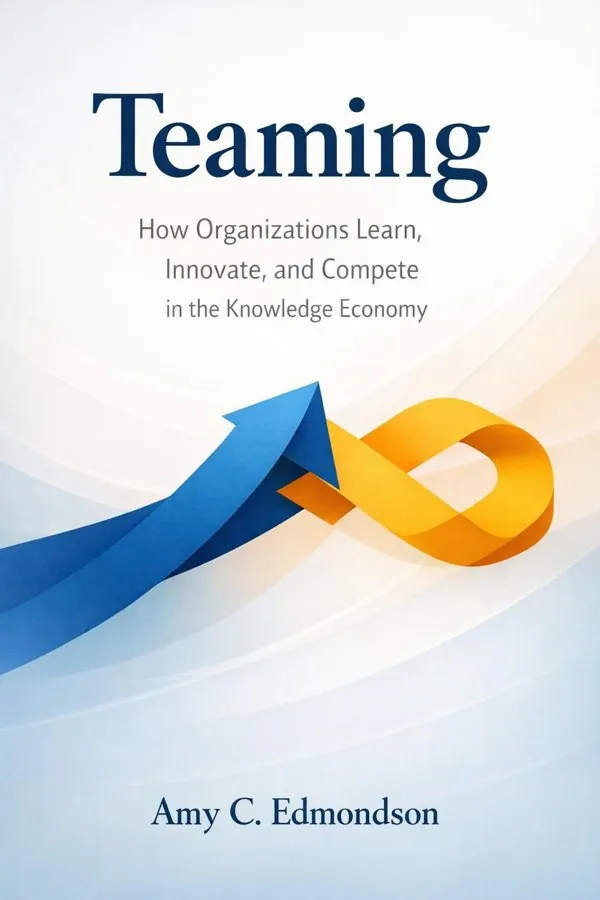
Teaming: How Organizations Learn, Innovate, and Compete in the Knowledge Economy: Summary & Key Insights
 10 min7 chaptersAudio available
What Is Teaming: How Organizations Learn, Innovate, and Compete in the Knowledge Economy About?
Teaming: How Organizations Learn, Innovate, and Compete in the Knowledge Economy by Amy C. Edmondson is a leadership book spanning 7 pages. In 'Teaming', Harvard Business School professor Amy C. Edmondson explores how organizations can thrive in complex, fast-changing environments by fostering collaboration and learning. She introduces the concept of 'teaming'—dynamic teamwork that enables innovation and adaptability across boundaries. Drawing on extensive research and real-world examples, Edmondson shows how leaders can create psychological safety, encourage experimentation, and build learning organizations that continuously improve and innovate.
This FizzRead summary covers all 7 key chapters of Teaming: How Organizations Learn, Innovate, and Compete in the Knowledge Economy in approximately 10 minutes, distilling the most important ideas, arguments, and takeaways from Amy C. Edmondson's work. Also available as an audio summary and Key Quotes Podcast.
Teaming: How Organizations Learn, Innovate, and Compete in the Knowledge Economy
In 'Teaming', Harvard Business School professor Amy C. Edmondson explores how organizations can thrive in complex, fast-changing environments by fostering collaboration and learning. She introduces the concept of 'teaming'—dynamic teamwork that enables innovation and adaptability across boundaries. Drawing on extensive research and real-world examples, Edmondson shows how leaders can create psychological safety, encourage experimentation, and build learning organizations that continuously improve and innovate.
Who Should Read Teaming: How Organizations Learn, Innovate, and Compete in the Knowledge Economy?
This book is perfect for anyone interested in leadership and looking to gain actionable insights in a short read. Whether you're a student, professional, or lifelong learner, the key ideas from Teaming: How Organizations Learn, Innovate, and Compete in the Knowledge Economy by Amy C. Edmondson will help you think differently.
- ✓Readers who enjoy leadership and want practical takeaways
- ✓Professionals looking to apply new ideas to their work and life
- ✓Anyone who wants the core insights of Teaming: How Organizations Learn, Innovate, and Compete in the Knowledge Economy in just 10 minutes
Want the full summary?
Get instant access to this book summary and 100K+ more with Fizz Moment.
Get Free SummaryAvailable on App Store • Free to download
Key Chapters
The traditional picture of teamwork—stable membership, fixed goals, steady routines—simply doesn’t fit today’s reality. In the knowledge economy, problems are too fluid, expertise too distributed, and technology too fast-paced to rely on static collaboration. Teaming answers the need for flexibility. It’s the capacity to collaborate on the fly, combining diverse perspectives to learn and innovate.
Organizations that thrive today realize that most valuable knowledge resides in people, not in manuals or systems. Yet those people are scattered across functions, cultures, and locations. Teaming is how their insights connect and evolve. In contrast to formal teams, teaming is inherently temporary and porous—it allows for coordination without expecting stability. A surgical team may exist for a single operation; a group of engineers may form around one product challenge. What binds them isn’t permanence, but purpose and mutual learning.
In my research, the shift from routine production to knowledge work reveals a deeper tension: efficiency versus learning. Efficiency is about minimizing variation; learning is about exploring variation. Organizations that cling solely to efficiency become rigid. Those that embrace teaming build agility and resilience. In a hospital trying to reduce errors, for example, real learning occurs not in the planning meetings but in the moment when staff members feel comfortable voicing concerns, reflecting on what went wrong, and trying new approaches. That psychological permission to learn collectively is the essence of teaming.
Leaders must help people understand that uncertainty is not a defect—it’s a fact of complex work. The goal is not to eliminate it but to navigate it collectively. Teaming enables organizations to respond to volatility by making learning continuous. Through experimentation, reflection, and open dialogue, each interaction becomes a chance to improve. When learning and working become inseparable, innovation follows naturally.
If there is a single concept that underpins effective teaming, it is psychological safety—the shared belief that you can speak up without fear of humiliation or punishment. Without it, teaming collapses under the weight of silence. People hold back ideas, conceal errors, and avoid asking questions. Learning, which depends on openness and curiosity, cannot occur in such climates.
Psychological safety does not mean comfort. Rather, it fosters productive discomfort—the willingness to challenge, debate, and express doubt without social risk. In the operating rooms I studied, nurses who could question surgeons when they saw potential mistakes saved lives. In manufacturing plants, technicians who alerted supervisors to process flaws prevented costly shutdowns. In high-tech firms, engineers who shared tentative ideas early accelerated breakthroughs. In each case, learning flowed from the freedom to contribute honestly.
Creating psychological safety is primarily the leader’s role. Leaders set the tone by how they respond to failure and inquiry. When leaders acknowledge uncertainty, invite diverse input, and reward transparency, they communicate that voice matters more than rank. One of my favorite examples comes from a team working on complex drug trials: the manager began each meeting by reminding everyone that human error is inevitable—and that the group’s strength lies in catching it together. That framing turned fear into shared vigilance.
Psychological safety also drives inclusion across boundaries. In global teams composed of different cultures and languages, misunderstanding can easily trigger defensiveness. Leaders who model curiosity—asking genuine questions and listening actively—defuse those tensions. They transform diversity from a source of friction into a source of insight. Over time, psychological safety becomes a cultural norm, empowering people to take the risks that learning demands.
+ 5 more chapters — available in the FizzRead app
All Chapters in Teaming: How Organizations Learn, Innovate, and Compete in the Knowledge Economy
About the Author
Amy C. Edmondson is the Novartis Professor of Leadership and Management at Harvard Business School. Her research focuses on leadership, teams, and organizational learning. She is widely recognized for her work on psychological safety and has authored several influential books on teamwork and innovation.
Get This Summary in Your Preferred Format
Read or listen to the Teaming: How Organizations Learn, Innovate, and Compete in the Knowledge Economy summary by Amy C. Edmondson anytime, anywhere. FizzRead offers multiple formats so you can learn on your terms — all free.
Available formats: App · Audio · PDF · EPUB — All included free with FizzRead
Download Teaming: How Organizations Learn, Innovate, and Compete in the Knowledge Economy PDF and EPUB Summary
Key Quotes from Teaming: How Organizations Learn, Innovate, and Compete in the Knowledge Economy
“The traditional picture of teamwork—stable membership, fixed goals, steady routines—simply doesn’t fit today’s reality.”
“If there is a single concept that underpins effective teaming, it is psychological safety—the shared belief that you can speak up without fear of humiliation or punishment.”
Frequently Asked Questions about Teaming: How Organizations Learn, Innovate, and Compete in the Knowledge Economy
Teaming: How Organizations Learn, Innovate, and Compete in the Knowledge Economy by Amy C. Edmondson is a leadership book that explores key ideas across 7 chapters. In 'Teaming', Harvard Business School professor Amy C. Edmondson explores how organizations can thrive in complex, fast-changing environments by fostering collaboration and learning. She introduces the concept of 'teaming'—dynamic teamwork that enables innovation and adaptability across boundaries. Drawing on extensive research and real-world examples, Edmondson shows how leaders can create psychological safety, encourage experimentation, and build learning organizations that continuously improve and innovate.
More by Amy C. Edmondson


You Might Also Like

Extreme Ownership
Jocko Willink
10 min
Dare to Lead
Brene Brown
10 min
Leaders Eat Last
Simon Sinek
10 min
The 21 Irrefutable Laws of Leadership
John Maxwell
10 min
Start With Why
Simon Sinek
10 min
How to Lead When You're Not in Charge
Clay Scroggins
10 minBrowse by Category
Ready to read Teaming: How Organizations Learn, Innovate, and Compete in the Knowledge Economy?
Get the full summary and 100K+ more books with Fizz Moment.