
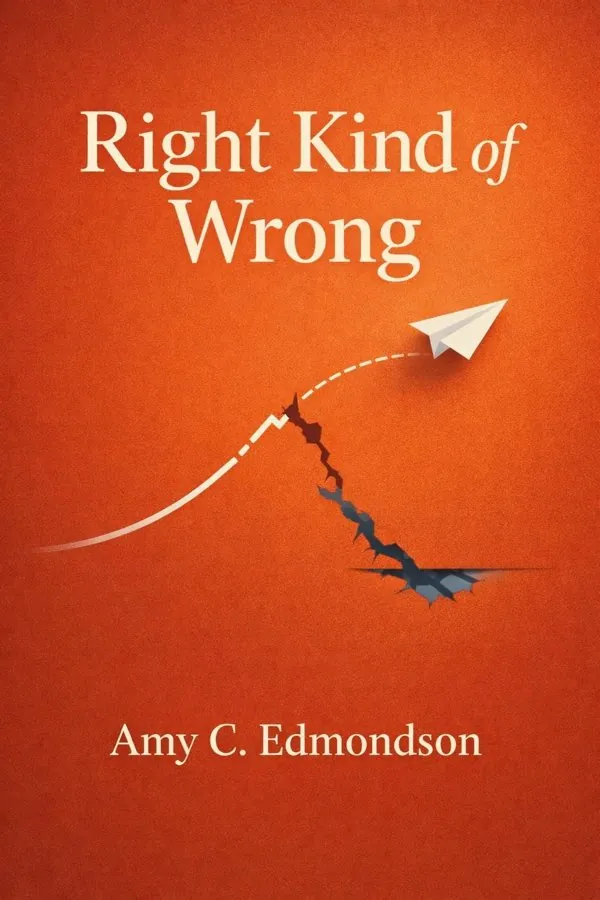
Right Kind of Wrong: The Science of Failing Well: Summary & Key Insights
 10 min8 chaptersAudio available
What Is Right Kind of Wrong: The Science of Failing Well About?
Right Kind of Wrong: The Science of Failing Well by Amy C. Edmondson is a leadership book spanning 8 pages. In 'Right Kind of Wrong: The Science of Failing Well', Harvard Business School professor Amy C. Edmondson explores how individuals and organizations can learn from failure. Drawing on decades of research into psychological safety and organizational learning, Edmondson distinguishes between intelligent, complex, and basic failures, showing how embracing the right kind of failure can foster innovation, resilience, and growth.
This FizzRead summary covers all 8 key chapters of Right Kind of Wrong: The Science of Failing Well in approximately 10 minutes, distilling the most important ideas, arguments, and takeaways from Amy C. Edmondson's work. Also available as an audio summary and Key Quotes Podcast.
Right Kind of Wrong: The Science of Failing Well
In 'Right Kind of Wrong: The Science of Failing Well', Harvard Business School professor Amy C. Edmondson explores how individuals and organizations can learn from failure. Drawing on decades of research into psychological safety and organizational learning, Edmondson distinguishes between intelligent, complex, and basic failures, showing how embracing the right kind of failure can foster innovation, resilience, and growth.
Who Should Read Right Kind of Wrong: The Science of Failing Well?
This book is perfect for anyone interested in leadership and looking to gain actionable insights in a short read. Whether you're a student, professional, or lifelong learner, the key ideas from Right Kind of Wrong: The Science of Failing Well by Amy C. Edmondson will help you think differently.
- ✓Readers who enjoy leadership and want practical takeaways
- ✓Professionals looking to apply new ideas to their work and life
- ✓Anyone who wants the core insights of Right Kind of Wrong: The Science of Failing Well in just 10 minutes
Want the full summary?
Get instant access to this book summary and 100K+ more with Fizz Moment.
Get Free SummaryAvailable on App Store • Free to download
Key Chapters
To learn from failure, we must first develop a precise language for it. All failures are not created equal, and lumping them together distorts our understanding. In *Right Kind of Wrong*, I draw a critical distinction: some failures are avoidable and represent errors of execution; some arise from the unmanageable complexity of a system; and some are necessary steps in the journey of discovery.
Basic failures are the simplest to recognize and often the most easily prevented. They result from inattention, lack of training, or flawed processes. A nurse administering the wrong dosage because of an unreadable label, or a mechanic skipping a safety check due to fatigue — these are tragedies of preventable oversight. Organizations suffer when they fail to institute systems that guard against them. To address basic failures, we must design better processes and cultivate habits of reliable execution.
Complex failures, by contrast, are harder to diagnose. They occur when multiple small problems interact in unpredictable ways. In healthcare, aviation, or finance, such failures reveal how tightly coupled systems can collapse under unforeseen combinations of factors. No one error can be blamed; instead, we must develop systemic insight to understand how interactions, timing, and conditions coalesce. Learning here means mapping cause and effect across systems, not pointing fingers.
Finally, intelligent failures are the most misunderstood — and yet the most valuable. These are the failures that arise from thoughtful experimentation at the edge of current knowledge. When you set out to test a hypothesis under uncertain conditions and discover that it does not hold, you haven’t wasted your effort; you’ve learned something that moves your understanding forward. Intelligent failure is the engine of scientific discovery and innovation. The key is to design experiments that are disciplined, small in scale, and conducted in contexts where learning outweighs risk. Recognizing these distinctions gives us permission to fail well — to use error as a tool for progress rather than as a mark of shame.
The human experience of failure is deeply emotional. Despite our rational understanding that everyone makes mistakes, few of us can separate our errors from our sense of worth. The feelings of fear, embarrassment, or shame that accompany failure are some of the most powerful inhibitors of learning. For individuals and organizations, the cost of these emotions is immeasurable.
In my research, I’ve often seen that when people feel their competence or status is at risk, they hide failures rather than surface them. Teams create elaborate justifications instead of transparent conversations. Leaders punish bad news, and as a result, early warning signals vanish. These reactions are understandable, even humane, but they create cultures of silence — and silence is the enemy of learning.
To overcome this, we must rethink what failure signals. Rather than equating it with personal inadequacy, we need to see it as information. This cognitive reframe demands that we treat ourselves and others with compassion. Learning to replace defensiveness with curiosity is vital. When we can ask, 'What does this teach us?' instead of 'Who is to blame?', we begin to transform our collective mindset.
Emotionally, failing well is about resilience and openness. Cognitive awareness alone isn’t enough; we must also manage our instinctual responses to fear and humiliation. This is why the leader’s role in shaping psychological context is indispensable. Only when people feel safe to be candid can they process failure constructively. It’s here that the concept of psychological safety becomes the bedrock of failing well.
+ 6 more chapters — available in the FizzRead app
All Chapters in Right Kind of Wrong: The Science of Failing Well
About the Author
Amy C. Edmondson is the Novartis Professor of Leadership and Management at Harvard Business School. She is known for her pioneering research on psychological safety, team learning, and organizational behavior. Her work has influenced management practices worldwide and earned her recognition as one of the most influential thinkers in business and leadership.
Get This Summary in Your Preferred Format
Read or listen to the Right Kind of Wrong: The Science of Failing Well summary by Amy C. Edmondson anytime, anywhere. FizzRead offers multiple formats so you can learn on your terms — all free.
Available formats: App · Audio · PDF · EPUB — All included free with FizzRead
Download Right Kind of Wrong: The Science of Failing Well PDF and EPUB Summary
Key Quotes from Right Kind of Wrong: The Science of Failing Well
“To learn from failure, we must first develop a precise language for it.”
“The human experience of failure is deeply emotional.”
Frequently Asked Questions about Right Kind of Wrong: The Science of Failing Well
Right Kind of Wrong: The Science of Failing Well by Amy C. Edmondson is a leadership book that explores key ideas across 8 chapters. In 'Right Kind of Wrong: The Science of Failing Well', Harvard Business School professor Amy C. Edmondson explores how individuals and organizations can learn from failure. Drawing on decades of research into psychological safety and organizational learning, Edmondson distinguishes between intelligent, complex, and basic failures, showing how embracing the right kind of failure can foster innovation, resilience, and growth.
More by Amy C. Edmondson

You Might Also Like

Extreme Ownership
Jocko Willink
10 min
Dare to Lead
Brene Brown
10 min
Leaders Eat Last
Simon Sinek
10 min
The 21 Irrefutable Laws of Leadership
John Maxwell
10 min
Start With Why
Simon Sinek
10 min
How to Lead When You're Not in Charge
Clay Scroggins
10 minBrowse by Category
Ready to read Right Kind of Wrong: The Science of Failing Well?
Get the full summary and 100K+ more books with Fizz Moment.