
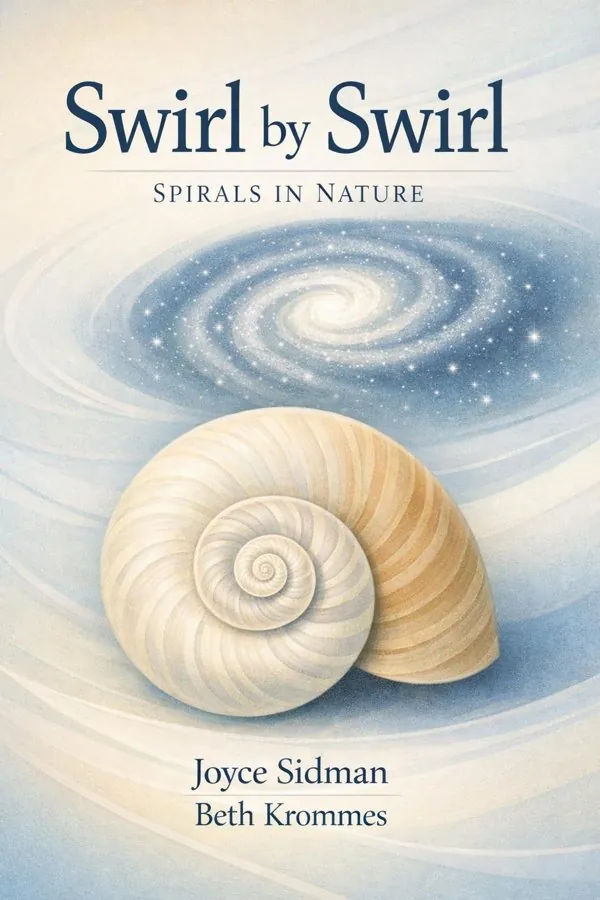
Swirl by Swirl: Spirals in Nature: Summary & Key Insights
 10 min8 chaptersAudio available
Key Takeaways from Swirl by Swirl: Spirals in Nature
A pattern is never just decoration in nature; it is often a solution.
Not everything in nature grows in a straight line; much of life expands by curling and uncurling.
Wonder is often the first step toward knowledge.
A spiral in a shell and a spiral in a storm may seem unrelated, yet Swirl by Swirl reveals that they belong to the same visual family.
Spirals are not only shapes; they are records of motion.
What Is Swirl by Swirl: Spirals in Nature About?
Swirl by Swirl: Spirals in Nature by Joyce Sidman, Beth Krommes is a popular_sci book. Swirl by Swirl: Spirals in Nature is a beautifully crafted exploration of one of the most recurring patterns in the natural world: the spiral. Written by acclaimed poet and children’s author Joyce Sidman and illustrated by Caldecott Medal winner Beth Krommes, the book invites readers to notice how spirals appear in shells, vines, weather systems, animal behavior, and even the unfolding of new life. Though created as a picture book, it offers far more than visual delight. It introduces a foundational scientific idea: nature often builds with patterns, and those patterns reveal both efficiency and beauty. What makes this book matter is its ability to connect observation, science, and wonder. Sidman’s concise, lyrical text turns a simple shape into a gateway for learning about biology, physics, and ecology. Krommes’s intricate scratchboard illustrations deepen that experience by making each spiral feel alive and purposeful. Together, they show that science is not only about facts, but also about attention. This book is especially valuable for young readers, parents, educators, and anyone interested in nature writing because it teaches a powerful habit of mind: look closely, and the world becomes richer, more ordered, and more astonishing.
This FizzRead summary covers all 8 key chapters of Swirl by Swirl: Spirals in Nature in approximately 10 minutes, distilling the most important ideas, arguments, and takeaways from Joyce Sidman, Beth Krommes's work. Also available as an audio summary and Key Quotes Podcast.
Swirl by Swirl: Spirals in Nature
Swirl by Swirl: Spirals in Nature is a beautifully crafted exploration of one of the most recurring patterns in the natural world: the spiral. Written by acclaimed poet and children’s author Joyce Sidman and illustrated by Caldecott Medal winner Beth Krommes, the book invites readers to notice how spirals appear in shells, vines, weather systems, animal behavior, and even the unfolding of new life. Though created as a picture book, it offers far more than visual delight. It introduces a foundational scientific idea: nature often builds with patterns, and those patterns reveal both efficiency and beauty.
What makes this book matter is its ability to connect observation, science, and wonder. Sidman’s concise, lyrical text turns a simple shape into a gateway for learning about biology, physics, and ecology. Krommes’s intricate scratchboard illustrations deepen that experience by making each spiral feel alive and purposeful. Together, they show that science is not only about facts, but also about attention. This book is especially valuable for young readers, parents, educators, and anyone interested in nature writing because it teaches a powerful habit of mind: look closely, and the world becomes richer, more ordered, and more astonishing.
Who Should Read Swirl by Swirl: Spirals in Nature?
This book is perfect for anyone interested in popular_sci and looking to gain actionable insights in a short read. Whether you're a student, professional, or lifelong learner, the key ideas from Swirl by Swirl: Spirals in Nature by Joyce Sidman, Beth Krommes will help you think differently.
- ✓Readers who enjoy popular_sci and want practical takeaways
- ✓Professionals looking to apply new ideas to their work and life
- ✓Anyone who wants the core insights of Swirl by Swirl: Spirals in Nature in just 10 minutes
Want the full summary?
Get instant access to this book summary and 100K+ more with Fizz Moment.
Get Free SummaryAvailable on App Store • Free to download
Key Chapters
A pattern is never just decoration in nature; it is often a solution. One of the central insights of Swirl by Swirl: Spirals in Nature is that the spiral is not a random visual motif scattered across the world, but a recurring form that appears because it helps living things grow, move, protect themselves, or adapt. Sidman presents spirals not as abstract geometry, but as evidence that nature solves problems through repeatable designs.
The book shows spirals in many forms: a snail shell coiling to create a portable home, a fern frond uncurling as it grows, a chameleon tail curling for balance, and a hurricane spinning with enormous atmospheric force. These examples make a crucial scientific idea accessible: similar shapes can appear in very different places because they meet practical needs. A shell expands while keeping its form. A vine twists as it climbs toward sunlight. A whirlpool spins as water follows physical laws. Across scales, the spiral is efficient, flexible, and dynamic.
This idea matters because it trains readers to think beyond surface appearances. Instead of seeing beauty and usefulness as opposites, the book suggests they often come together. In education, this can encourage children to connect art and science rather than separating them. In everyday life, it can deepen outdoor observation. A walk in the garden becomes a search for growth patterns. A trip to the beach becomes a lesson in design.
The broader application is simple but powerful: when you notice a repeated form in nature, ask what job it might be doing. That question turns passive seeing into active learning. Actionable takeaway: choose one outdoor space this week and look for three repeating shapes, then write down what purpose each shape might serve.
Not everything in nature grows in a straight line; much of life expands by curling and uncurling. A memorable idea in Swirl by Swirl is that spirals often represent growth in progress. Rather than instantly appearing fully formed, many natural structures begin tightly coiled and gradually open outward. This makes the spiral a symbol not only of shape, but of becoming.
The book highlights examples such as unfurling fern fronds, curling tendrils, and developing structures that emerge from compact beginnings. Scientifically, this reflects a smart developmental strategy. Coiled forms protect delicate tissues while they are young. They conserve space. They allow expansion without chaos. A fern, for instance, stays tightly wound at first, guarding its tender surfaces until it is strong enough to open. The spiral therefore embodies controlled growth: change that is organized, measured, and adaptive.
This concept is especially useful for young readers because it offers a visible model of development. Growth is not always dramatic or immediate. It can be gradual, layered, and hidden at first. That makes the book emotionally resonant as well as informative. Children can see that becoming takes time. Teachers and parents can use this idea to discuss patience, seasons, life cycles, and even personal learning.
The same principle applies beyond biology. Skills often develop like spirals. We revisit ideas, deepen understanding, and expand outward from a small core. Artists refine techniques over time. Scientists test and retest observations. Readers return to familiar topics and discover new meanings. Progress is not always linear.
Actionable takeaway: observe one growing plant over several days or weeks and sketch how its shape changes. Use that observation to talk about how growth in nature, and in ourselves, often unfolds gradually rather than all at once.
Wonder is often the first step toward knowledge. Swirl by Swirl demonstrates that scientific curiosity does not need to begin with dense explanations or technical language; it can start with amazement. The book’s great achievement is that it uses beauty as an entry point into disciplined observation. Readers are first drawn in by the elegance of spirals, and only then do they begin asking deeper questions about why those spirals exist.
Sidman’s lyrical phrasing encourages attention rather than overload. She does not bury readers in facts. Instead, she guides them to notice a form, compare examples, and infer meaning. Beth Krommes’s illustrations reinforce this method. Her scratchboard art gives each spiral texture, movement, and context, helping readers see the connection between pattern and environment. A shell is not just a shell; it belongs to an organism. A wave is not just a curve; it is energy in motion.
This matters in science education because many people wrongly assume that beauty distracts from rigor. In reality, aesthetic attention can sharpen it. When children are captivated by a pattern, they are more likely to ask questions, remember examples, and make connections across subjects. The book therefore models a highly effective learning approach: begin with observation, build toward explanation, and preserve wonder throughout.
In practical settings, this can transform how adults introduce science. Instead of starting with definitions, start with looking. Instead of giving answers immediately, ask what readers notice. This creates engagement and supports deeper comprehension. It also reminds adults that curiosity itself is a serious intellectual tool.
Actionable takeaway: the next time you teach or learn about a natural topic, begin with a close visual observation. Ask, “What do you notice? What repeats? What seems purposeful?” Let wonder generate the questions before you move to the answers.
A spiral in a shell and a spiral in a storm may seem unrelated, yet Swirl by Swirl reveals that they belong to the same visual family. One of the book’s most powerful lessons is that patterns can connect very different domains of nature. The same basic form appears in living organisms, plant structures, geological phenomena, and weather systems. This encourages readers to think across categories rather than keeping knowledge in separate boxes.
The educational value of this is immense. When a child sees that a coiled snail shell, a swirling wave, and a spinning hurricane all involve similar motion or structure, science becomes a web of relationships. Biology is no longer isolated from physics. Art is no longer isolated from mathematics. Observation becomes a bridge between subjects. The book gently introduces systems thinking by showing that forms repeat across scale and context.
This pattern-based way of thinking is useful far beyond childhood. Designers look to natural forms for inspiration. Engineers study efficient shapes found in living systems. Teachers use recurring patterns to help students organize complex information. Even casual readers can benefit, because noticing recurring structures builds mental habits of comparison, analogy, and synthesis.
The book also invites humility. If the same pattern appears from the tiny to the immense, then the world is more interconnected than we often assume. We begin to understand that nature is not a collection of isolated objects but a network of repeating principles. That realization can make scientific thinking feel coherent and approachable.
Actionable takeaway: pick one natural pattern you notice often, such as spirals, branches, or waves, and find examples of it in at least three different settings. Write down what those examples have in common and what that suggests about how nature works.
Spirals are not only shapes; they are records of motion. In Swirl by Swirl, readers encounter spirals that twist, coil, curl, and spin. This matters because the book quietly teaches that form often reveals process. A spiral can show how something moved, grew, or gathered force over time. In other words, nature leaves clues, and careful observers can read them.
Consider a whirlpool or a hurricane. These are not static objects but patterns created by moving water or air. Their spiral structure reflects energy circulating through space. Similarly, a climbing vine leaves behind a twisting form that records its search for support and sunlight. A shell preserves the history of gradual growth in its widening curve. By presenting these examples side by side, the book helps readers understand that pattern is frozen behavior. What we see now can hint at what happened before.
This is a foundational scientific skill: inference. Scientists often study traces, forms, and effects to understand causes. Geologists read rock layers. Biologists study body structures. Meteorologists analyze storm shapes. Sidman’s book introduces this way of thinking without jargon, making it ideal for developing observational reasoning in young readers.
In everyday life, this perspective can change how we look at the world. A bent branch suggests wind. Ripple marks suggest flowing water. A curled leaf may suggest drought or age. Once we start asking what process created a form, ordinary surroundings become full of evidence and story.
Actionable takeaway: the next time you encounter an interesting natural shape, ask yourself, “What movement or process might have created this?” Write one possible explanation. Practicing this question strengthens scientific reasoning through simple observation.
The world can feel chaotic until you realize that the same ideas repeat at different sizes. A subtle but important lesson in Swirl by Swirl is that spirals are scale-independent in a meaningful way: they appear in the very small, the handheld, the landscape-sized, and the atmospheric. A coiled millipede, a sunflower center, an ocean wave, and a cyclone may differ enormously in size, but each expresses a related structural logic.
This insight helps readers grasp one of science’s most elegant principles: certain patterns are robust. They do not belong to one single creature or setting. They emerge whenever similar constraints or forces are at work. Growth, rotation, packing, flow, and expansion can all produce spiral forms. The book does not present a technical theory of scale, but it cultivates intuitive understanding of it. That is one reason the text remains valuable for adults as well as children.
In learning contexts, scale awareness is essential. Children often struggle to connect the microscopic, the human-sized, and the planetary. By showing the same shape across levels, the book builds cognitive continuity. It says, in effect, “You already know something about this giant storm because you have seen a smaller spiral before.” That reduces intimidation and strengthens conceptual transfer.
This has practical relevance in problem-solving too. Many fields rely on identifying patterns across scale. Architects learn from natural structures. Data analysts look for recurring forms in large systems. Artists repeat motifs with variation. The habit of noticing persistence amid difference is widely useful.
Actionable takeaway: compare one small spiral and one large spiral you can observe or find in images. Note how they differ in material and size, then identify the common structural feature. This simple exercise builds pattern recognition across scale.
The greatest lesson in Swirl by Swirl may be that the natural world teaches those who slow down enough to look. The book is built on a simple discipline: attentive seeing. Rather than delivering a long argument, it invites readers to notice examples, hold them in mind, and discover order through repeated encounters. This makes the reading experience participatory. Readers are not merely told about spirals; they are trained to spot them.
That shift from receiving information to practicing observation is profound. Many books teach facts, but this one teaches a way of noticing. Once learned, that habit extends far beyond the pages. Readers begin searching for patterns in gardens, forests, shorelines, weather, and city parks. A child who learns to notice spirals may later notice symmetry, branching, camouflage, or cycles. Observation becomes self-expanding.
This approach also supports mindfulness. In a distracted culture, paying close attention to a shell, a curled tendril, or a swirling cloud can be grounding. It slows thought and sharpens perception. For educators and parents, the book offers a model for inquiry-based learning: ask students to find examples, compare them, and discuss what function they might serve. For adults, it serves as a reminder that natural literacy begins with looking, not with expertise.
There is also an ethical dimension. People tend to care more deeply about what they have learned to see. Attention fosters appreciation, and appreciation can foster conservation. A child who marvels at the design of a snail shell may become an adult who values habitats and biodiversity.
Actionable takeaway: create a short “pattern walk” routine. Spend ten minutes outdoors looking for one kind of form, such as spirals, and record what you find. Repeating this practice builds observational skill and a stronger relationship with nature.
Facts explain the world, but art helps us feel its significance. Swirl by Swirl is an excellent example of how scientific ideas become more memorable when paired with artistic interpretation. Joyce Sidman’s carefully chosen language and Beth Krommes’s richly textured illustrations do more than decorate information; they deepen understanding by making patterns emotionally vivid and visually coherent.
This matters because many readers, especially young ones, learn best when multiple forms of intelligence are engaged at once. The book teaches scientific content through poetry, image, rhythm, contrast, and design. That combination makes the concept of spirals easier to recall and more enjoyable to explore. A child may first remember the image of a fern curling open or the dramatic sweep of a storm, then later attach scientific explanation to that memory. Art, in this sense, becomes a scaffold for knowledge.
The partnership between author and illustrator also models interdisciplinary thinking. Sidman brings precision and lyricism; Krommes brings visual structure and atmosphere. Together they show that understanding nature is not a narrow technical task. It involves noticing, interpreting, comparing, and responding. That is why the book works equally well in science units, art classrooms, literacy lessons, and family reading.
For adults, this is a useful reminder that communication matters. Scientific ideas reach more people when they are made tangible and beautiful. Educators, writers, and presenters can learn from this approach by pairing information with strong imagery and narrative framing.
Actionable takeaway: when learning or teaching a scientific idea, try representing it in two ways: with factual explanation and with a drawing, poem, or visual collage. Using both modes can strengthen understanding and retention.
All Chapters in Swirl by Swirl: Spirals in Nature
About the Authors
Joyce Sidman is an award-winning American author and poet known for creating children’s books that combine lyrical language with science, ecology, and close observation of the natural world. Her work often helps young readers see nature as both beautiful and deeply interconnected. Beth Krommes is a distinguished illustrator celebrated for her scratchboard technique, which produces intricate, high-contrast images full of texture and atmosphere. She received the Caldecott Medal and is widely admired for illustrations that invite careful looking. In Swirl by Swirl: Spirals in Nature, Sidman and Krommes bring together poetic nonfiction and visual artistry to explore natural patterns in a way that is intellectually engaging and aesthetically rich. Their collaboration makes complex ideas approachable for children while remaining rewarding for adult readers.
Get This Summary in Your Preferred Format
Read or listen to the Swirl by Swirl: Spirals in Nature summary by Joyce Sidman, Beth Krommes anytime, anywhere. FizzRead offers multiple formats so you can learn on your terms — all free.
Available formats: App · Audio · PDF · EPUB — All included free with FizzRead
Download Swirl by Swirl: Spirals in Nature PDF and EPUB Summary
Key Quotes from Swirl by Swirl: Spirals in Nature
“A pattern is never just decoration in nature; it is often a solution.”
“Not everything in nature grows in a straight line; much of life expands by curling and uncurling.”
“Wonder is often the first step toward knowledge.”
“A spiral in a shell and a spiral in a storm may seem unrelated, yet Swirl by Swirl reveals that they belong to the same visual family.”
“Spirals are not only shapes; they are records of motion.”
Frequently Asked Questions about Swirl by Swirl: Spirals in Nature
Swirl by Swirl: Spirals in Nature by Joyce Sidman, Beth Krommes is a popular_sci book that explores key ideas across 8 chapters. Swirl by Swirl: Spirals in Nature is a beautifully crafted exploration of one of the most recurring patterns in the natural world: the spiral. Written by acclaimed poet and children’s author Joyce Sidman and illustrated by Caldecott Medal winner Beth Krommes, the book invites readers to notice how spirals appear in shells, vines, weather systems, animal behavior, and even the unfolding of new life. Though created as a picture book, it offers far more than visual delight. It introduces a foundational scientific idea: nature often builds with patterns, and those patterns reveal both efficiency and beauty. What makes this book matter is its ability to connect observation, science, and wonder. Sidman’s concise, lyrical text turns a simple shape into a gateway for learning about biology, physics, and ecology. Krommes’s intricate scratchboard illustrations deepen that experience by making each spiral feel alive and purposeful. Together, they show that science is not only about facts, but also about attention. This book is especially valuable for young readers, parents, educators, and anyone interested in nature writing because it teaches a powerful habit of mind: look closely, and the world becomes richer, more ordered, and more astonishing.
You Might Also Like
Structures: Or Why Things Don"t Fall Down
J.E. Gordon
10 min
The Road to Wigan Pier
George Orwell
10 min
Bonk: The Curious Coupling of Science and Sex
Mary Roach
10 min
First Bite: How We Learn to Eat
Bee Wilson
10 min
In Pursuit Of The Unknown: 17 Equations That Changed The World
Ian Stewart
10 min
Napoleon's Buttons: 17 Molecules That Changed History
Penny Le Couteur and Jay Burreson
10 minBrowse by Category
Ready to read Swirl by Swirl: Spirals in Nature?
Get the full summary and 100K+ more books with Fizz Moment.