
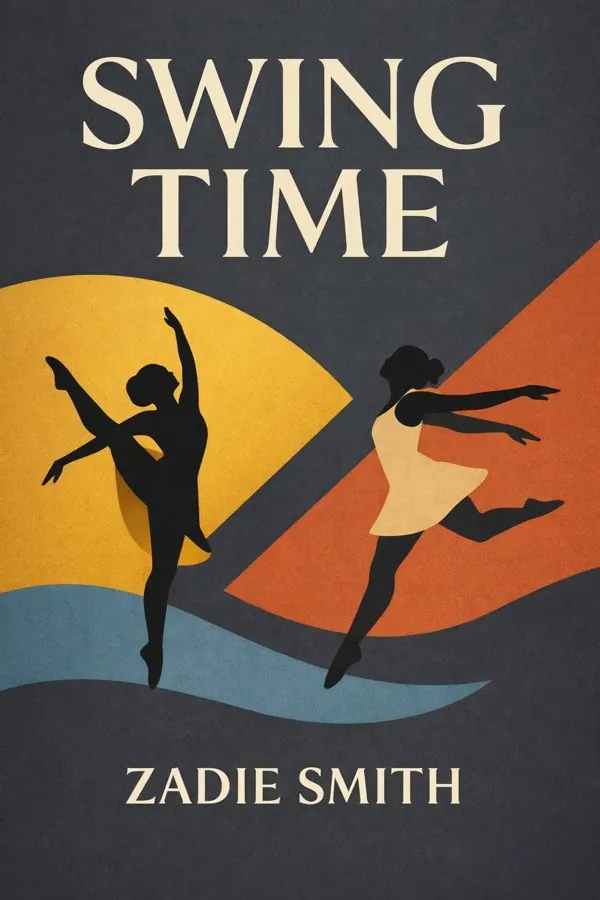
Swing Time: Summary & Key Insights
by Zadie Smith
 10 min9 chaptersAudio available
Key Takeaways from Swing Time
Childhood friendships often feel destined, as if two people simply hear the same music at the same moment.
Art promises freedom, but it also exposes hierarchy.
Growing up often means discovering that shared beginnings do not guarantee shared futures.
We like to think we invent ourselves, yet much of who we become is first rehearsed in the shadow of our parents.
To be seen is never a neutral experience.
What Is Swing Time About?
Swing Time by Zadie Smith is a bestsellers book spanning 4 pages. What if two children begin in near-perfect step, only to discover that talent, luck, class, race, and desire pull them into entirely different lives? In Swing Time, Zadie Smith uses the intimate story of two brown girls growing up in northwest London to examine far larger questions: who gets to belong, who gets to move freely through the world, and what it means to build an identity from fragments of family, culture, ambition, and memory. One girl, Tracey, has natural dancing talent and restless charisma. The unnamed narrator, her friend and sometime rival, lacks Tracey’s gifts but develops a searching mind attuned to music, history, and the hidden structures shaping people’s lives. Their paths diverge from childhood dance classes to celebrity culture and a philanthropic venture in West Africa, revealing the uneasy overlap between personal freedom and social constraint. Smith, one of the most perceptive contemporary novelists writing about race, class, and multicultural life, brings extraordinary intelligence and emotional precision to this story. Swing Time matters because it turns friendship into a lens for understanding modern identity itself: improvised, unstable, and always in motion.
This FizzRead summary covers all 9 key chapters of Swing Time in approximately 10 minutes, distilling the most important ideas, arguments, and takeaways from Zadie Smith's work. Also available as an audio summary and Key Quotes Podcast.
Swing Time
What if two children begin in near-perfect step, only to discover that talent, luck, class, race, and desire pull them into entirely different lives? In Swing Time, Zadie Smith uses the intimate story of two brown girls growing up in northwest London to examine far larger questions: who gets to belong, who gets to move freely through the world, and what it means to build an identity from fragments of family, culture, ambition, and memory. One girl, Tracey, has natural dancing talent and restless charisma. The unnamed narrator, her friend and sometime rival, lacks Tracey’s gifts but develops a searching mind attuned to music, history, and the hidden structures shaping people’s lives. Their paths diverge from childhood dance classes to celebrity culture and a philanthropic venture in West Africa, revealing the uneasy overlap between personal freedom and social constraint. Smith, one of the most perceptive contemporary novelists writing about race, class, and multicultural life, brings extraordinary intelligence and emotional precision to this story. Swing Time matters because it turns friendship into a lens for understanding modern identity itself: improvised, unstable, and always in motion.
Who Should Read Swing Time?
This book is perfect for anyone interested in bestsellers and looking to gain actionable insights in a short read. Whether you're a student, professional, or lifelong learner, the key ideas from Swing Time by Zadie Smith will help you think differently.
- ✓Readers who enjoy bestsellers and want practical takeaways
- ✓Professionals looking to apply new ideas to their work and life
- ✓Anyone who wants the core insights of Swing Time in just 10 minutes
Want the full summary?
Get instant access to this book summary and 100K+ more with Fizz Moment.
Get Free SummaryAvailable on App Store • Free to download
Key Chapters
Childhood friendships often feel destined, as if two people simply hear the same music at the same moment. In Swing Time, the bond between Tracey and the unnamed narrator begins in exactly that spirit. They are two brown girls in a working-class area of northwest London, drawn together by dance, by television musicals, and by the intoxicating fantasy that movement can lift them beyond the limits of their surroundings. Yet from the start, Smith shows that similarity is never simple. The girls share race and neighborhood, but not family structure, temperament, or opportunity. Tracey comes from instability and instinct; the narrator from a home shaped by intellectual ambition and her mother’s political seriousness. One girl feels rhythm in her body. The other studies it, thinking about what performance means and why certain bodies are celebrated while others are judged.
This beginning matters because it reveals how identity forms relationally. We often understand ourselves first through comparison: who is prettier, freer, more talented, more loved, more likely to escape. Childhood becomes the first stage where admiration, envy, loyalty, and self-doubt all dance together. Smith captures how innocent play already contains the seeds of adult conflict.
In everyday life, this idea helps explain why our earliest friendships can remain emotionally powerful long after they fade. They often shaped the standards by which we measure ourselves. Reflecting on those formative relationships can uncover hidden beliefs about success, belonging, and self-worth.
Actionable takeaway: Think about one early friendship that influenced your sense of identity, and ask what assumptions about yourself you are still carrying from that first shared rhythm.
Art promises freedom, but it also exposes hierarchy. Dance in Swing Time is never just a hobby or decorative background detail; it is the novel’s central metaphor for aspiration, embodiment, and social sorting. For Tracey, dance is raw possibility. She possesses natural ability, absorbing rhythm intuitively and commanding attention through physical grace. For the narrator, dance is more complicated. She loves it, studies it, and thinks deeply about its cultural meanings, but she lacks Tracey’s effortless talent. That imbalance becomes one of the novel’s first painful truths: wanting something intensely does not guarantee access to it.
Smith uses this contrast to challenge the comforting myth that merit alone determines outcomes. Talent matters, yes, but so do discipline, support, body type, beauty standards, family chaos, race-coded expectations, and luck. Even in a children’s dance class, the world is already assigning value. Who looks right? Who can afford lessons? Who gets encouraged? Who learns to turn embarrassment into bravado? Dance becomes a miniature version of society itself.
This idea extends beyond the arts. In school, work, or creative pursuits, people rarely begin from equal footing. Some move naturally in systems that confuse ease with worth. Others must compensate with thoughtfulness, persistence, or reinvention. The lesson is not cynicism but clarity. Understanding structure allows us to judge ourselves and others more honestly.
Actionable takeaway: The next time you compare your progress to someone else’s, separate effort from circumstance and talent from opportunity. That distinction can replace shame with sharper self-knowledge.
Growing up often means discovering that shared beginnings do not guarantee shared futures. As Tracey and the narrator move into adolescence, their friendship starts to fracture under pressure from sexuality, family instability, social reputation, and diverging ambitions. What once felt mutual becomes uneven. Tracey’s charisma intensifies, but so does her volatility. The narrator becomes more inward, observant, and intellectually alert, yet also more uncertain of her place. Their bond survives through memory and attachment, but no longer through equal movement.
Smith portrays adolescence as the period when personality hardens into strategy. Children improvise; teenagers calculate. Each girl begins adapting to the roles available to her. Tracey leans into performance, defiance, and seduction. The narrator leans toward analysis, self-containment, and escape through education and work. Neither path is pure liberation. Both involve losses. To become someone, they must relinquish the fantasy of remaining everything to each other.
This insight speaks to many real relationships. We often mourn friendship breakdown as if someone failed morally, but sometimes the rupture comes from developmental divergence. The conditions that made closeness possible at twelve may not survive at seventeen. Values shift. Shame appears. Social class becomes more visible. Desire enters the room. Silence starts replacing innocence.
Understanding this can help us read our own past with compassion. Not every lost friendship was betrayal; some were collisions between different versions of survival. Recognizing that does not erase hurt, but it can soften the need to assign simple blame.
Actionable takeaway: Revisit one friendship that drifted apart and ask not only what happened, but what each person may have been trying to protect, become, or escape at the time.
We like to think we invent ourselves, yet much of who we become is first rehearsed in the shadow of our parents. In Swing Time, motherhood is not a side theme but a powerful force shaping identity, shame, ambition, and belonging. The narrator’s mother is politically engaged, intellectually driven, and determined to rise beyond the confines placed on her as a Black woman in Britain. Tracey’s mother, by contrast, is unstable, erratic, and linked to a world of improvisation and unmet promises. These two maternal presences create different emotional climates, and the girls absorb them in ways they do not fully understand until much later.
Smith resists easy judgment. A mother can be admirable and still emotionally unavailable. Another can be deeply flawed and still offer forms of warmth or recognition. The daughters inherit not only values but tensions: attitudes toward race, class mobility, men, respectability, and the body. The narrator spends much of her life negotiating with her mother’s seriousness and expectations, while also resisting being defined by them.
This idea has broad application. Many adult choices that feel personal are partly inherited scripts. How we speak in public, what kind of work we respect, whether we trust intimacy, and how we think about achievement often begin as family choreography. Becoming an adult may involve identifying which movements are ours and which were learned under pressure.
Smith suggests that maturity requires neither worshipping nor rejecting our origins wholesale. It requires interpretation. We must understand the stories our parents told through action, silence, aspiration, and fear.
Actionable takeaway: Write down three beliefs you carry about success, love, or respectability, then ask which came from your family and whether they still fit the life you want.
To be seen is never a neutral experience. Throughout Swing Time, Smith examines how race shapes visibility: who is watched, who is exoticized, who is disciplined, and who gets mistaken for representative rather than individual. The narrator becomes deeply aware that Blackness, mixed heritage, and female embodiment are constantly interpreted by others. Dance and popular culture intensify this dynamic. Black music and Black bodies are celebrated, imitated, and consumed, yet the people attached to them remain constrained by stereotype and social inequality.
One of the novel’s most incisive achievements is showing how representation can flatter while still distorting. A person may be admired for rhythm, style, authenticity, or resilience, yet reduced in the process. The narrator is acutely aware of this contradiction. She sees how histories of appropriation shape contemporary taste, and how class and geography complicate any simple idea of racial solidarity. Not all brown girls occupy the same world. Not all cultural recognition is respect.
This remains highly relevant. In workplaces, media, and social life, people from marginalized groups are often made visible in symbolic ways while still denied complexity. They may be praised for diversity, flavor, or perspective, but not necessarily given power, privacy, or interiority. Smith urges readers to notice the difference between inclusion and true understanding.
A useful practical application is to examine how we consume culture. Are we engaging with people and traditions as full histories, or only taking what feels stylish or emotionally gratifying? Ethical attention means asking harder questions about context and power.
Actionable takeaway: The next time you admire a cultural form, pause to learn about the communities, labor, and historical struggles behind it before turning appreciation into certainty.
Modern life often encourages people to mistake access for identity. As an adult, the narrator enters the orbit of Aimee, a globally famous pop star whose wealth, mobility, and influence seem to promise a different scale of existence. Working as Aimee’s assistant gives the narrator status by association: she moves through airports, hotels, elite spaces, and carefully managed humanitarian projects. Yet this glamorous role also reveals a hollowing effect. The closer she gets to borrowed power, the more she risks losing her own moral and emotional center.
Smith is especially sharp about the seductions of service to charisma. Aimee is not simply a villain; she represents a whole system in which image, intention, and self-branding merge. Around such figures, ordinary ethical judgments become blurred. People excuse bad behavior because the machine of fame appears larger than any individual discomfort. The narrator learns that proximity to celebrity can feel like transcendence while functioning as a kind of dependency.
This idea extends beyond pop stardom. Many people define themselves through institutions, bosses, influencers, or prestigious networks. The glow of affiliation can mask passivity. We may begin speaking in another person’s priorities, defending values we never chose, or mistaking logistical usefulness for purpose.
Smith invites readers to ask where dignity comes from. Is it enough to be adjacent to power, or must meaning arise from one’s own commitments? Recognizing this distinction is especially important in careers built around gatekeepers and glamorous hierarchies.
Actionable takeaway: If your role depends on serving someone powerful, list which of your values are genuinely yours and which have quietly shifted to accommodate their world.
Good intentions can still reproduce inequality. When the novel moves to West Africa through Aimee’s philanthropic project, Swing Time expands from an intimate story of friendship into a wider critique of global power. The narrator observes development work, cultural exchange, and celebrity-led charity from a position both complicit and uneasy. On the surface, the project appears generous: resources, visibility, and opportunity are being directed toward a village school. But Smith carefully exposes the asymmetry beneath the language of helping. Who defines the community’s needs? Who receives credit? Who gets to leave when difficulties arise?
The narrator’s experiences in Africa force her to confront fantasies she has inherited about authenticity, roots, escape, and freedom. Distance from London does not produce clarity. Instead, it reveals how mobility itself is unequally distributed. Some people cross borders as self-improving travelers or saviors; others remain fixed in systems shaped by colonial history, global capital, and external narratives.
This idea is practical far beyond the novel. In an era of international nonprofits, corporate social impact, and social-media activism, many people participate in forms of help that flatter the helper more than they empower the recipient. Smith’s insight is that ethical action requires humility, listening, and attention to local agency. Charity without self-interrogation can become performance.
Readers can apply this lesson by questioning any project that centers the benefactor’s identity too strongly. Who is making decisions? Who is speaking? What would accountability look like if image were removed from the equation?
Actionable takeaway: Before supporting or joining a cause, investigate whether the people most affected actually shape its goals, leadership, and measures of success.
We do not simply remember our lives; we compose them. Swing Time is narrated retrospectively, and that structure matters deeply. The unnamed narrator tells her story through fragments, returns, omissions, and reinterpretations, reminding us that memory is both revelation and defense. She is not offering a neat chronology because identity itself is not neat. Certain scenes insist on being retold. Others remain shadowed until later understanding makes them legible. In this way, Smith shows that adulthood often involves editing the story of who we have been.
This is especially important in relation to Tracey. The narrator cannot fully account for her friend without also accounting for envy, guilt, class anxiety, and the ways she used Tracey as a mirror. Memory becomes a moral act. To remember honestly is to resist self-exoneration. Yet complete honesty may be impossible; every story has a point of view, and every point of view has blind spots.
This insight applies to ordinary life whenever we explain a breakup, a family conflict, or a career turning point. We instinctively organize events to protect coherence and self-respect. That does not make memory false, but it does make it partial. Growth begins when we notice the edits.
One practical way to use this idea is in reflection or journaling. If you tell a story in which you appear only as victim, rescuer, or rational observer, there may be missing complexity. Revisiting the same event from another angle can expose hidden motivations and unresolved grief.
Actionable takeaway: Rewrite one important memory from your life twice—first from your own perspective, then imagining how another person involved might tell it.
The past does not disappear; it waits for a moment when we are forced to hear its rhythm again. In the later movement of Swing Time, the narrator circles back toward Tracey, toward family history, and toward the choices she has made while trying to outrun earlier versions of herself. Return in this novel is not sentimental reunion. It is confrontation. The narrator must face what success has and has not given her, what loyalty she abandoned, and how much of her identity has been built through avoidance.
Smith’s great strength here is her refusal of tidy closure. There is no final dance number in which every conflict resolves into harmony. Instead, there is sharper perception. The narrator begins to understand that self-knowledge is rarely triumphant. Often it arrives as embarrassment, humility, or grief. Yet this is still a form of freedom. To see one’s compromises clearly is better than living inside flattering illusion.
This has practical force because many people postpone emotional reckoning, imagining that distance, achievement, or reinvention will erase unresolved wounds. But old dynamics frequently resurface in work, intimacy, and even in the stories we tell about our own maturity. Return becomes necessary when avoidance starts costing too much.
The novel suggests that we do not need perfect redemption to move forward. What we need is the courage to stop romanticizing ourselves. Honest recognition can be more transformative than dramatic reinvention.
Actionable takeaway: Identify one unresolved relationship or personal contradiction you keep postponing, and take a concrete step toward facing it—through a conversation, a letter, or a candid private reflection.
All Chapters in Swing Time
About the Author
Zadie Smith is a British novelist, essayist, and short-story writer celebrated for her intelligent, stylish, and socially perceptive fiction. Born in London in 1975, she rose to international prominence with her debut novel, White Teeth, which became a major literary success and established her as a defining voice in contemporary literature. Her work frequently explores race, class, identity, migration, family, and the contradictions of multicultural life in Britain and beyond. Known for combining wit, psychological insight, and cultural criticism, Smith has written acclaimed novels including On Beauty, NW, and Swing Time, as well as several influential essay collections. In addition to her literary career, she has taught creative writing at New York University. Smith is widely admired for turning complex social questions into vivid, deeply human stories.
Get This Summary in Your Preferred Format
Read or listen to the Swing Time summary by Zadie Smith anytime, anywhere. FizzRead offers multiple formats so you can learn on your terms — all free.
Available formats: App · Audio · PDF · EPUB — All included free with FizzRead
Download Swing Time PDF and EPUB Summary
Key Quotes from Swing Time
“Childhood friendships often feel destined, as if two people simply hear the same music at the same moment.”
“Art promises freedom, but it also exposes hierarchy.”
“Growing up often means discovering that shared beginnings do not guarantee shared futures.”
“We like to think we invent ourselves, yet much of who we become is first rehearsed in the shadow of our parents.”
“To be seen is never a neutral experience.”
Frequently Asked Questions about Swing Time
Swing Time by Zadie Smith is a bestsellers book that explores key ideas across 9 chapters. What if two children begin in near-perfect step, only to discover that talent, luck, class, race, and desire pull them into entirely different lives? In Swing Time, Zadie Smith uses the intimate story of two brown girls growing up in northwest London to examine far larger questions: who gets to belong, who gets to move freely through the world, and what it means to build an identity from fragments of family, culture, ambition, and memory. One girl, Tracey, has natural dancing talent and restless charisma. The unnamed narrator, her friend and sometime rival, lacks Tracey’s gifts but develops a searching mind attuned to music, history, and the hidden structures shaping people’s lives. Their paths diverge from childhood dance classes to celebrity culture and a philanthropic venture in West Africa, revealing the uneasy overlap between personal freedom and social constraint. Smith, one of the most perceptive contemporary novelists writing about race, class, and multicultural life, brings extraordinary intelligence and emotional precision to this story. Swing Time matters because it turns friendship into a lens for understanding modern identity itself: improvised, unstable, and always in motion.
More by Zadie Smith




You Might Also Like

The Godfather
Mario Puzo
10 min
The Handmaid's Tale
Margaret Atwood
10 min
The Hunger Games
Suzanne Collins
10 min
The Nightingale
Kristin Hannah
10 min
The Seven Husbands of Evelyn Hugo
Taylor Jenkins Reid
10 min
Backwater Justice
Fern Michaels
10 minBrowse by Category
Ready to read Swing Time?
Get the full summary and 100K+ more books with Fizz Moment.