
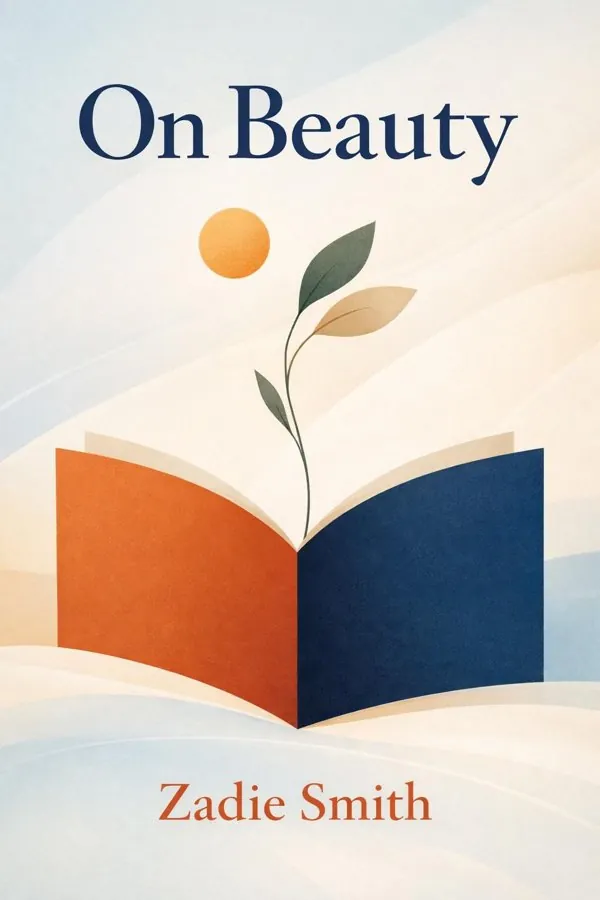
On Beauty: Summary & Key Insights
by Zadie Smith
 10 min8 chaptersAudio available
Key Takeaways from On Beauty
Intellectual confidence can sometimes conceal emotional bankruptcy.
Our fiercest opponents often reflect more of us than we want to admit.
Beauty in human life often appears less in appearance than in the quality of attention we give one another.
The next generation does not simply absorb what parents say; it absorbs what parents live.
Crisis strips away performance.
What Is On Beauty About?
On Beauty by Zadie Smith is a bestsellers book spanning 5 pages. What happens when brilliant ideas fail to make people good? Zadie Smith’s On Beauty is a richly layered novel about two families, the liberal Belseys and the conservative Kippses, whose lives become entangled in a New England college town. Through marriages, affairs, academic rivalries, generational conflict, and cross-cultural misunderstandings, Smith explores race, class, beauty, politics, faith, and the uneasy gap between what people believe and how they actually live. The novel is witty, emotionally sharp, and deeply humane, exposing hypocrisy without denying the possibility of grace. What makes On Beauty matter is its refusal to flatten anyone into a slogan. Smith shows that intellectual sophistication does not protect people from vanity, betrayal, insecurity, or longing. At the same time, she insists that art, family, and honest attention still have the power to transform us. Inspired in part by E.M. Forster’s Howards End, the novel brings classic questions about connection and morality into a modern multicultural world. Smith, one of the most acclaimed contemporary novelists in English, writes with rare intelligence and vitality, making On Beauty both a social comedy and a serious meditation on what it means to see others clearly.
This FizzRead summary covers all 8 key chapters of On Beauty in approximately 10 minutes, distilling the most important ideas, arguments, and takeaways from Zadie Smith's work. Also available as an audio summary and Key Quotes Podcast.
On Beauty
What happens when brilliant ideas fail to make people good? Zadie Smith’s On Beauty is a richly layered novel about two families, the liberal Belseys and the conservative Kippses, whose lives become entangled in a New England college town. Through marriages, affairs, academic rivalries, generational conflict, and cross-cultural misunderstandings, Smith explores race, class, beauty, politics, faith, and the uneasy gap between what people believe and how they actually live. The novel is witty, emotionally sharp, and deeply humane, exposing hypocrisy without denying the possibility of grace.
What makes On Beauty matter is its refusal to flatten anyone into a slogan. Smith shows that intellectual sophistication does not protect people from vanity, betrayal, insecurity, or longing. At the same time, she insists that art, family, and honest attention still have the power to transform us. Inspired in part by E.M. Forster’s Howards End, the novel brings classic questions about connection and morality into a modern multicultural world. Smith, one of the most acclaimed contemporary novelists in English, writes with rare intelligence and vitality, making On Beauty both a social comedy and a serious meditation on what it means to see others clearly.
Who Should Read On Beauty?
This book is perfect for anyone interested in bestsellers and looking to gain actionable insights in a short read. Whether you're a student, professional, or lifelong learner, the key ideas from On Beauty by Zadie Smith will help you think differently.
- ✓Readers who enjoy bestsellers and want practical takeaways
- ✓Professionals looking to apply new ideas to their work and life
- ✓Anyone who wants the core insights of On Beauty in just 10 minutes
Want the full summary?
Get instant access to this book summary and 100K+ more with Fizz Moment.
Get Free SummaryAvailable on App Store • Free to download
Key Chapters
Our fiercest opponents often reflect more of us than we want to admit. Monty Kipps, Howard’s academic rival, appears to be his complete opposite: politically conservative, religiously grounded, rhetorically assured, and publicly disciplined. A Caribbean-born scholar with strong views on family, responsibility, and culture, Monty embodies everything Howard rejects. Their rivalry is intellectual, ideological, and deeply personal, fueled by published attacks and institutional competition. Yet On Beauty gradually reveals that the Belseys and the Kippses are not simple opposites. They are mirrors.
Both families are shaped by ambition, pride, disappointment, and the desire to control how they are seen. Both fathers are flawed. Both households wrestle with generational tension. Both public identities conceal private vulnerabilities. By setting these families against each other, Smith undermines the comfort of tribal thinking. It is easy to believe our side possesses complexity while the other side is ruled by bad faith. Smith refuses that simplification. She shows that ideology may shape people’s language, but not erase shared human weakness.
This idea applies far beyond the novel. In workplaces, politics, or online culture, people often define themselves through opposition. Progressives caricature conservatives; conservatives caricature progressives. Secular people dismiss believers; believers dismiss secular people. Yet individuals across these divides may struggle with the same needs: respect, certainty, relevance, belonging, forgiveness. Recognizing that commonality does not require agreement. It requires maturity.
The Kipps family’s presence in the novel also complicates assumptions about race and authority. Monty’s Blackness does not align with expected political positions, and this challenges characters who want identity to predict ideology. Smith thereby exposes how quickly even supposedly enlightened people stereotype others when their views feel inconvenient.
Actionable takeaway: The next time you dismiss an opponent as fundamentally different from you, identify one fear or desire you may actually share.
Beauty in human life often appears less in appearance than in the quality of attention we give one another. One of the novel’s deepest currents is the question of moral beauty: what makes a person admirable, trustworthy, or genuinely good. Smith explores this through friendship, marriage, infidelity, loyalty, and disappointment. Relationships in On Beauty are rarely stable. They are tested by desire, neglect, resentment, and the constant temptation to prioritize self-justification over honesty.
Howard and Kiki’s marriage sits at the emotional center of the novel. Kiki is not merely the wounded spouse of an unfaithful academic. She is one of Smith’s moral anchors: perceptive, warm, strong, and painfully aware of how easily affection can be taken for granted. Her friendships, especially with women outside her immediate family, open a space in the novel where care is possible without sentimentality. Betrayal hurts in On Beauty not only because promises are broken, but because people fail to recognize the reality of one another’s inner lives.
Smith suggests that moral beauty emerges in acts of receptivity. It appears when someone listens without trying to win, apologizes without evasion, or sees another person beyond utility. In everyday life, this matters enormously. A friend who remembers your vulnerability and handles it gently is practicing moral beauty. A colleague who gives credit fairly instead of competing for attention does the same. A partner who admits harm without rushing to defend intention creates the conditions for trust.
The novel does not romanticize goodness. People are inconsistent, and care is often mixed with vanity or need. But Smith still insists that character is visible in ordinary encounters. Beauty is not just what dazzles; it is what dignifies.
Actionable takeaway: Practice one concrete act of moral beauty this week by offering someone careful attention without making the moment about yourself.
The next generation does not simply absorb what parents say; it absorbs what parents live. The Belsey children and the younger members of the Kipps family carry much of the novel’s energy because they reveal how ideas about race, class, aspiration, and belonging are transmitted, resisted, and revised. Jerome, Zora, and Levi Belsey are strikingly different from one another, and each dramatizes a separate response to family influence.
Jerome, earnest and spiritually searching, is drawn toward forms of order and sincerity that his parents’ intellectual world cannot satisfy. Zora is fiercely ambitious, hyper-articulate, and invested in achievement, but her confidence often masks insecurity and a desperate need for validation. Levi, restless and politically charged, seeks authenticity in Black urban culture, often in ways that expose his own naïveté and privilege. None of these children is reducible to a type. Smith uses them to show how identity is negotiated under pressure from family narratives, social expectations, and personal hunger.
This is one of the novel’s most practically relevant insights. Parents often assume children will inherit principles through direct instruction. But children are more likely to learn from contradiction: how adults handle conflict, who gets listened to, what kind of bodies are praised, what ambitions are rewarded, and what hypocrisies are tolerated. Institutions work similarly. Schools may claim to value inclusion while rewarding conformity. Families may praise honesty while punishing vulnerability.
The younger characters also show that identity formation is improvisational. Young adults test personas, ideologies, friendships, and communities to discover where they fit. That process can look messy or misguided, but it is often how maturity begins.
Actionable takeaway: If you mentor, parent, or teach others, look beyond what you say and assess the values your habits, reactions, and loyalties actually model.
Crisis strips away performance. As On Beauty moves toward confrontation, long-maintained facades begin to fail. Marital betrayals surface, academic poses lose their authority, children rebel against parental scripts, and public identities become harder to sustain. What gives these climactic moments force is not simply scandal. It is exposure. People are forced to see themselves without the protective narration they have built around their lives.
Howard’s downfall is especially revealing because he has spent so much time occupying the role of critic rather than the position of the criticized. Once his personal failures become undeniable, he can no longer hide behind intellect or irony. Kiki, too, reaches a point where endurance no longer looks like strength if it requires self-erasure. Other characters experience related moments of reckoning as the gap between image and truth becomes impossible to ignore.
Smith treats collapse as painful but necessary. Many people only confront reality when a system of self-deception stops functioning. This happens in ordinary life all the time. A professional setback reveals how much self-worth depended on status. A friendship rupture reveals buried selfishness. A family argument reveals years of unspoken resentment. Such moments are destabilizing, but they can also interrupt denial.
Importantly, the novel does not suggest that revelation automatically leads to redemption. Some people double down; others change only slightly. But once illusions break, new forms of honesty become possible. Catharsis in Smith’s world is rarely neat. It is not dramatic purification so much as an uneasy chance to begin again with fewer lies.
Actionable takeaway: When a personal failure or conflict exposes something uncomfortable about you, resist the urge to immediately defend yourself; ask first what truth the collapse may be revealing.
People may argue endlessly about what art means, but powerful art still has the ability to arrest us before explanation catches up. One of the novel’s most memorable tensions lies in its treatment of aesthetics. Howard has built a career on skepticism toward traditional notions of beauty, greatness, and artistic transcendence. He is suspicious of reverence and alert to the politics embedded in cultural taste. Smith takes those critiques seriously. Yet she also suggests that theory alone cannot account for the lived experience of encountering art.
The novel repeatedly returns to the possibility that beauty can break through cynicism. This does not mean beauty is pure, universal, or politically innocent. Rather, it means that moments of aesthetic attention can be deeply humanizing. A painting, a piece of music, or a face seen with fresh tenderness can interrupt self-absorption. Smith asks whether beauty is something we construct, discover, resist, or need. Her answer is intentionally unresolved, but emotionally clear: art matters because it can enlarge perception.
This insight has practical value in a culture that often treats art as either status currency or ideological battleground. We may ask whether a book is problematic, a film overrated, or a museum elitist. Those are valid questions. But Smith reminds us not to lose the primary event: the experience of being moved. In daily life, engaging with art can sharpen attention, deepen empathy, and create a vocabulary for feelings that ordinary conversation cannot hold.
You do not need formal expertise to practice this. Visit a gallery and stay with one painting for ten minutes. Read a poem aloud twice. Notice what changes in your body, memory, or mood before deciding what it means.
Actionable takeaway: Make space for one unhurried encounter with art this week and let yourself respond before you analyze.
Identity becomes especially fragile when people try to perform it for approval. On Beauty is intensely alert to the social complexity of race and class, especially within educated, multicultural environments where people speak fluently about difference but often remain trapped by status anxieties and stereotypes. Smith does not present identity as fixed or simple. Instead, she shows how race, class, nationality, and education interact in ways that make belonging both urgent and unstable.
Levi Belsey’s search for Black authenticity is one of the clearest examples. As the son of a white British father and a Black American mother, raised in relative privilege, he feels alienated from the elite academic world around him and drawn toward a more rooted, street-level Black culture. His longing is emotionally real, but his performance often reveals romanticism and appropriation. He wants a version of identity that feels earned and unambiguous. Smith sympathizes with the hunger behind that desire while exposing the illusions within it.
Other characters also struggle with how they are read. Kiki navigates racism, body politics, and invisibility within spaces that claim sophistication. The Kipps family complicates expectations around Black political identity. Zora experiences how education can sharpen social intelligence while intensifying self-consciousness. Across the novel, identity is shown not as essence but as negotiation under unequal conditions.
In contemporary life, this remains highly relevant. Many people feel pressure to signal authenticity, cultural awareness, or political correctness. But identity performed for recognition can become brittle. A healthier alternative is to pursue honesty over performance: learn your history, acknowledge your position, and remain open to correction without turning identity into theater.
Actionable takeaway: Reflect on one part of your identity you feel pressure to perform, and ask how you might relate to it more honestly and less defensively.
Long relationships are not sustained by romance alone but by repeated choices about mercy, truth, and respect. On Beauty offers one of the more unsentimental portraits of marriage in contemporary fiction. Howard and Kiki’s relationship is loving, exhausted, wounded, and full of history. Smith resists the fantasy that a strong marriage is one without betrayal or disappointment. Instead, she portrays marriage as a living structure constantly shaped by memory, resentment, tenderness, routine, and unequal sacrifice.
Desire in the novel is disruptive not merely because it threatens fidelity, but because it exposes unmet needs and self-deceptions. Howard’s betrayals are selfish, but they also reveal a man chasing validation he cannot generate from integrity. Kiki’s pain is intensified by the long accumulation of being taken for granted. Their marriage raises difficult questions: What can be repaired? What cannot? Is forgiveness a virtue, a burden, or both? Can love survive when admiration is broken?
These questions matter outside fiction because many long-term bonds face quieter versions of the same strain. Partners drift into roles instead of intimacy. They stop seeing each other as changing people. Small failures to notice, appreciate, or confess eventually become larger wounds. Smith shows that everyday forgiveness is not passive tolerance. It requires boundaries, truthfulness, and a willingness to confront what has actually happened.
For readers, the novel offers a practical reminder that relationships decay in the absence of attention. Grand declarations matter less than sustained habits: listening fully, apologizing specifically, sharing burdens fairly, and refusing contempt. Not every relationship should be saved, but every serious relationship demands honesty about what it costs and what it needs.
Actionable takeaway: Strengthen one important relationship by naming a neglected truth kindly and directly instead of waiting for resentment to do the speaking.
All Chapters in On Beauty
About the Author
Zadie Smith is a British novelist, essayist, and short-story writer celebrated for her sharp intelligence, comic range, and nuanced portrayals of contemporary life. Born in London in 1975, she rose to prominence with her debut novel White Teeth, which became an international success and announced her as a major literary voice. Her fiction often explores race, class, identity, family, migration, and the tensions between public ideas and private experience. In addition to novels such as The Autograph Man, NW, Swing Time, and The Fraud, Smith has written acclaimed essays on literature, politics, and culture. She is especially admired for combining intellectual depth with emotional vitality and social observation. On Beauty remains one of her most widely read works, praised for its wit, complexity, and humane insight.
Get This Summary in Your Preferred Format
Read or listen to the On Beauty summary by Zadie Smith anytime, anywhere. FizzRead offers multiple formats so you can learn on your terms — all free.
Available formats: App · Audio · PDF · EPUB — All included free with FizzRead
Download On Beauty PDF and EPUB Summary
Key Quotes from On Beauty
“Intellectual confidence can sometimes conceal emotional bankruptcy.”
“Our fiercest opponents often reflect more of us than we want to admit.”
“Beauty in human life often appears less in appearance than in the quality of attention we give one another.”
“The next generation does not simply absorb what parents say; it absorbs what parents live.”
“As On Beauty moves toward confrontation, long-maintained facades begin to fail.”
Frequently Asked Questions about On Beauty
On Beauty by Zadie Smith is a bestsellers book that explores key ideas across 8 chapters. What happens when brilliant ideas fail to make people good? Zadie Smith’s On Beauty is a richly layered novel about two families, the liberal Belseys and the conservative Kippses, whose lives become entangled in a New England college town. Through marriages, affairs, academic rivalries, generational conflict, and cross-cultural misunderstandings, Smith explores race, class, beauty, politics, faith, and the uneasy gap between what people believe and how they actually live. The novel is witty, emotionally sharp, and deeply humane, exposing hypocrisy without denying the possibility of grace. What makes On Beauty matter is its refusal to flatten anyone into a slogan. Smith shows that intellectual sophistication does not protect people from vanity, betrayal, insecurity, or longing. At the same time, she insists that art, family, and honest attention still have the power to transform us. Inspired in part by E.M. Forster’s Howards End, the novel brings classic questions about connection and morality into a modern multicultural world. Smith, one of the most acclaimed contemporary novelists in English, writes with rare intelligence and vitality, making On Beauty both a social comedy and a serious meditation on what it means to see others clearly.
More by Zadie Smith

You Might Also Like
The Godfather
Mario Puzo
10 min
The Handmaid's Tale
Margaret Atwood
10 min
The Hunger Games
Suzanne Collins
10 min
The Nightingale
Kristin Hannah
10 min
The Seven Husbands of Evelyn Hugo
Taylor Jenkins Reid
10 min
Backwater Justice
Fern Michaels
10 minBrowse by Category
Ready to read On Beauty?
Get the full summary and 100K+ more books with Fizz Moment.