
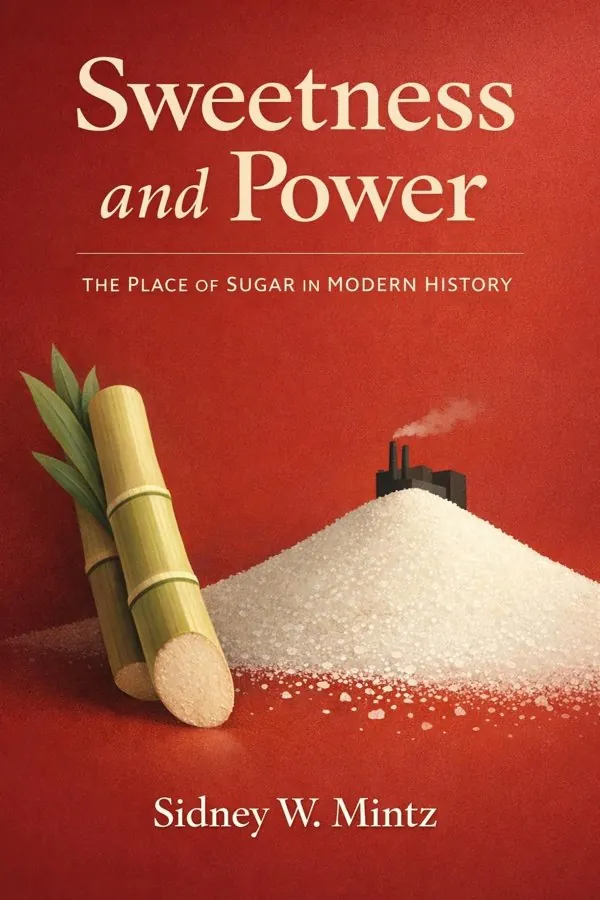
Sweetness and Power: The Place of Sugar in Modern History: Summary & Key Insights
 10 min9 chaptersAudio available
Key Takeaways from Sweetness and Power: The Place of Sugar in Modern History
A substance now taken for granted once carried the prestige of gold.
One of Mintz’s central arguments is that Europe’s growing appetite for sugar did not simply reflect expanding trade; it actively drove colonial expansion.
Modern industry did not begin only in European factories; it was rehearsed on plantations.
Few everyday pleasures have rested on such systematic brutality.
What people eat is also a record of who they are allowed to be.
What Is Sweetness and Power: The Place of Sugar in Modern History About?
Sweetness and Power: The Place of Sugar in Modern History by Sidney W. Mintz is a sociology book spanning 9 pages. Sweetness and Power is one of the most influential works ever written about food, capitalism, and social change. In this groundbreaking book, anthropologist Sidney W. Mintz shows that sugar is far more than a simple ingredient. Its rise from rare luxury to everyday necessity reveals how modern history was built through conquest, forced labor, industrialization, and changing habits of consumption. By tracing sugar from its cultivation in tropical colonies to its place in European tea cups and working-class diets, Mintz uncovers the hidden connections between taste and power. What makes the book so important is its method: it takes an ordinary commodity and uses it to explain global systems. Mintz demonstrates how the desire for sweetness helped fuel plantation slavery, empire, and the growth of industrial capitalism, while also reshaping family life, class identity, and everyday eating. His authority comes from deep anthropological research, historical analysis, and firsthand knowledge of Caribbean societies. The result is a rich, accessible study that changes how readers think about food. After this book, sugar no longer looks trivial; it becomes a key to understanding the modern world.
This FizzRead summary covers all 9 key chapters of Sweetness and Power: The Place of Sugar in Modern History in approximately 10 minutes, distilling the most important ideas, arguments, and takeaways from Sidney W. Mintz's work. Also available as an audio summary and Key Quotes Podcast.
Sweetness and Power: The Place of Sugar in Modern History
Sweetness and Power is one of the most influential works ever written about food, capitalism, and social change. In this groundbreaking book, anthropologist Sidney W. Mintz shows that sugar is far more than a simple ingredient. Its rise from rare luxury to everyday necessity reveals how modern history was built through conquest, forced labor, industrialization, and changing habits of consumption. By tracing sugar from its cultivation in tropical colonies to its place in European tea cups and working-class diets, Mintz uncovers the hidden connections between taste and power.
What makes the book so important is its method: it takes an ordinary commodity and uses it to explain global systems. Mintz demonstrates how the desire for sweetness helped fuel plantation slavery, empire, and the growth of industrial capitalism, while also reshaping family life, class identity, and everyday eating. His authority comes from deep anthropological research, historical analysis, and firsthand knowledge of Caribbean societies. The result is a rich, accessible study that changes how readers think about food. After this book, sugar no longer looks trivial; it becomes a key to understanding the modern world.
Who Should Read Sweetness and Power: The Place of Sugar in Modern History?
This book is perfect for anyone interested in sociology and looking to gain actionable insights in a short read. Whether you're a student, professional, or lifelong learner, the key ideas from Sweetness and Power: The Place of Sugar in Modern History by Sidney W. Mintz will help you think differently.
- ✓Readers who enjoy sociology and want practical takeaways
- ✓Professionals looking to apply new ideas to their work and life
- ✓Anyone who wants the core insights of Sweetness and Power: The Place of Sugar in Modern History in just 10 minutes
Want the full summary?
Get instant access to this book summary and 100K+ more with Fizz Moment.
Get Free SummaryAvailable on App Store • Free to download
Key Chapters
A substance now taken for granted once carried the prestige of gold. Mintz begins by reminding us that sugar did not enter European life as an ordinary food. It was first cultivated in Asia and later spread through the Mediterranean world, where it remained scarce, expensive, and closely tied to elite consumption. In early periods, sugar was not primarily a daily sweetener. It appeared as medicine, spice, decoration, and a symbol of refinement. To consume it was to display status.
This origin matters because it shows that foods do not become “normal” on their own. Their meaning changes with economics, politics, and culture. Sugar’s early association with luxury helped create the conditions for its later expansion. Once elites had established sweetness as desirable, merchants and rulers had incentives to increase supply. Demand was not merely natural appetite; it was historically cultivated taste.
We can see similar dynamics today in products that begin as elite markers and later become mass goods: coffee, chocolate, bottled water, smartphones, even air travel. What starts as privilege can become habit once production scales up and markets expand. Mintz uses sugar to show that desire is social before it is personal.
The deeper lesson is that ordinary consumption often has an extraordinary past. A spoonful of sugar in tea carries traces of migration, trade, cultivation, and social aspiration. To understand how something becomes common, we must ask who first valued it, who made it available, and what systems were built to normalize it.
Actionable takeaway: The next time you encounter an everyday product, ask how it moved from rarity to routine. That question can reveal the hidden history behind modern consumption.
Taste can reshape empires. One of Mintz’s central arguments is that Europe’s growing appetite for sugar did not simply reflect expanding trade; it actively drove colonial expansion. As sugar became more desirable, European powers sought lands with climates suitable for sugarcane and systems capable of producing it cheaply. The Caribbean and parts of the Americas became central because they could be reorganized around export agriculture for European markets.
Sugar was uniquely suited to empire because it was profitable, transportable, and increasingly in demand. It linked distant territories to metropolitan wealth. Colonies were not peripheral sideshows in this story; they were the productive heart of a new global economic order. Land, labor, shipping, finance, and state power were coordinated around a commodity that consumers in Europe came to crave.
Mintz helps readers see that colonialism was not only about military domination or political prestige. It was also about reorganizing entire regions to satisfy metropolitan habits. In practical terms, this meant clearing land, concentrating ownership, building ports, securing naval routes, and imposing economic dependency on colonized places. The sweetening of European diets depended on bitter forms of extraction elsewhere.
This pattern remains recognizable. Modern consumers often enjoy inexpensive goods whose low prices depend on distant labor, weak regulation, and unequal trade relationships. Sugar’s history offers a framework for thinking about coffee, palm oil, fast fashion, and electronics. Convenience and affordability are rarely innocent.
Mintz’s insight is powerful because it connects intimate desire with world-scale transformation. The preference for sweetness was not private at all. It became part of a geopolitical machine.
Actionable takeaway: When evaluating any cheap, widely available commodity, look beyond the shelf price and ask what political and global structures make that affordability possible.
Modern industry did not begin only in European factories; it was rehearsed on plantations. Mintz presents the plantation system as more than a site of agriculture. It was an intensely organized productive regime that combined land concentration, labor discipline, export orientation, and managerial control. In that sense, plantations were early laboratories of modern capitalism.
Sugar cultivation and processing required coordination, timing, and hierarchy. Cane had to be cut quickly, transported rapidly, milled immediately, and processed under strict supervision. This created a highly regimented system where workers had little autonomy and production was driven by efficiency and profit. The plantation was therefore not merely rural or premodern. It anticipated industrial forms of labor organization that would later be associated with factories.
This challenges a comforting historical narrative in which modernity emerges gradually through progress and innovation alone. Mintz shows that some of the organizational techniques of modern capitalism were forged under coercive colonial conditions. The plantation linked accounting, scheduling, surveillance, and standardized output long before these became familiar features of industrial work.
The plantation model also reminds us that supply chains are social systems. Every refined product begins with arrangements of labor and power. Today’s logistics warehouses, food-processing plants, and gig-economy platforms may look different, but they still rely on discipline, measurement, and asymmetries of control. Mintz does not claim these are identical to plantations, but he urges us to notice structural continuities between past and present forms of production.
By focusing on how sugar was made, not just how it was consumed, he restores labor to the center of economic history. Sweetness was manufactured through organization as much as through nature.
Actionable takeaway: When thinking about a product, examine the labor system behind it. Understanding how something is produced often changes how you judge its true social cost.
Few everyday pleasures have rested on such systematic brutality. Mintz makes clear that sugar’s rise as a mass commodity cannot be separated from the Atlantic slave trade and the exploitation of enslaved Africans in the Caribbean and the Americas. Sugar plantations demanded immense labor under harsh, often lethal conditions. Enslaved people were forced to grow, cut, and process cane so European consumers could enjoy sweetness at lower and lower prices.
This is not a side note to the story of sugar. It is the story. The profitability of sugar depended on the violent reduction of human beings to labor power. The plantation economy extracted value through racial domination, legal dehumanization, and physical coercion. The result was a product whose apparent innocence concealed a vast machinery of suffering.
Mintz’s contribution is to connect consumption to slavery without allowing consumers or historians to keep them mentally separate. The sugar in tea, desserts, jams, and preserves was historically linked to enslaved labor. This means modern consumer culture did not emerge despite slavery; in important ways, it emerged through slavery.
The broader application is moral as well as historical. We often prefer to treat exploitation as distant from our daily routines, but Mintz insists that ordinary habits can be tied to extraordinary injustice. Today, debates about ethical sourcing, fair trade, labor transparency, and modern slavery echo this same concern. The question is not whether consumers are personally guilty for historical systems; it is whether they are willing to understand the systems behind comfort and convenience.
Sugar teaches that demand is never abstract. Someone pays for cheap abundance.
Actionable takeaway: Cultivate the habit of asking who labors for what you consume. Ethical awareness begins when comfort is connected to its human cost.
What people eat is also a record of who they are allowed to be. Mintz shows that sugar’s movement through European society followed class lines. It began among elites as a luxury and marker of refinement, but over time it spread downward into broader consumption. This transition did not erase class differences; it transformed them. Foods that once signaled status became popular, while elites developed new distinctions. Sugar’s journey reveals how class is expressed not only through income and occupation but through taste, ritual, and daily diet.
In upper-class settings, sugar could symbolize sophistication, hospitality, and ceremonial excess. In lower-income households, it later became practical fuel, cheap pleasure, and a way to make otherwise plain foods more satisfying. The same commodity could therefore mean elegance in one setting and necessity in another. Mintz’s sociological insight is that consumption is never just nutritional. It is embedded in status systems, work routines, and cultural aspiration.
This remains true today. Organic produce, artisanal coffee, premium chocolate, energy drinks, meal replacements, and fast food all carry class meanings as well as caloric functions. People do not just buy products; they buy identities, convenience, belonging, and signals of competence or care. Food choices are shaped by affordability, time pressure, education, and social expectation.
Mintz helps readers resist simplistic judgments about diet. If sugar became important to the working class, that was not because people suddenly became irrational. It was because social conditions made sweet, dense, low-cost foods deeply useful. Consumption patterns make sense when viewed through lived realities.
The key lesson is that taste is structured. To study what people consume is to study hierarchy itself.
Actionable takeaway: Before judging any food habit, ask what social and economic conditions make that habit practical, meaningful, or desirable for different groups.
A luxury became a staple when work itself changed. Mintz argues that industrialization transformed sugar from an occasional indulgence into an everyday necessity for large parts of the population. As people moved into wage labor and urban life became more disciplined by the clock, diets shifted toward foods that were cheap, portable, energizing, and easy to prepare. Sugar fit this new world perfectly.
It could be added quickly to tea, bread, porridge, and preserved foods. It provided calories without long preparation. It also complemented emerging industrial schedules, where workers had less time for elaborate meals and increasing need for fast, reliable energy. Sugar’s rise was therefore not simply a triumph of taste. It was tied to new labor regimes and the reorganization of daily life.
Mintz’s analysis is especially powerful because it connects diet to time. Industrial capitalism did not only change what people produced; it changed how they ate, when they ate, and what counted as a practical meal. Sweetened tea, for example, became more than a beverage. It was warmth, stimulation, calories, and routine compressed into a cheap form.
This argument helps explain modern processed food cultures as well. Products succeed not just because they are tasty but because they fit constrained schedules and economic pressures. Convenience often reflects structural necessity rather than free choice. When food systems reward speed, portability, and low cost, highly processed and sugar-rich products thrive.
Mintz thus turns nutrition into social history. To ask why sugar spread is also to ask what kind of work society expected from ordinary people.
Actionable takeaway: Examine your own eating habits through the lens of time pressure. Often what looks like preference is actually adaptation to the rhythms of work and daily obligation.
Sometimes a food becomes popular not because it is luxurious, but because it helps people endure. Mintz shows that sugar became deeply embedded in working-class life because it offered an affordable source of calories, comfort, and quick energy. Combined with tea, bread, or cheap preserves, sugar could stretch a meal, brighten a harsh routine, and meet the demands of long hours and limited income.
This matters because it complicates elite narratives about “good” and “bad” food. For workers facing exhausting schedules, modest wages, and little leisure, sugary foods were not simply indulgent. They were practical. They could be stored, shared, and consumed with minimal preparation. They also carried emotional value. Sweetness provided pleasure in lives often shaped by discipline and scarcity.
Mintz therefore treats diet as a social adaptation. Food choices emerge from working conditions, household labor, gender roles, and access to resources. In many homes, women responsible for feeding families had to balance cost, time, and satisfaction. Sugar helped solve these problems, even as it drew people further into commercial food systems.
The modern parallel is obvious. Many households still rely on inexpensive, highly processed, sugar-rich foods because those options fit budgets and schedules better than idealized nutritional advice. Public health discussions often fail when they ignore this structural reality. People do not eat in laboratories; they eat in economies.
Mintz does not romanticize sugar, but he does insist on understanding why it mattered. If a food becomes central to daily survival, moral criticism alone will miss the point.
Actionable takeaway: When thinking about diet and health, focus not only on individual willpower but on the economic and time constraints that shape real-world food choices.
People do not merely consume sugar; they interpret it. Mintz explores how sweetness acquired powerful symbolic meanings across societies. Sugar came to signify celebration, reward, affection, hospitality, childhood, abundance, and even moral comfort. It was woven into holidays, rituals, gift-giving, desserts, and emotional life. In this way, a commodity shaped not only bodies and markets but imagination.
This cultural dimension is crucial because it explains why sugar’s importance cannot be reduced to calories. Sweetness feels special. It marks birthdays, religious festivals, courtship, mourning, and domestic care. A sweet dish can communicate love, generosity, or memory. Once sugar entered these symbolic systems, it became harder to separate from identity and tradition.
Mintz’s anthropological strength lies in showing that material and symbolic histories are intertwined. A commodity may arrive through trade and labor exploitation, but it stays because people make meaning with it. This is why sugar’s social power endured even when its novelty disappeared. It became emotionally and culturally embedded.
We can apply this insight to many modern products. Coffee is not just caffeine; it represents adulthood, productivity, and sociability. Wine is not just alcohol; it signals taste and ceremony. Smartphones are not just tools; they express connection and status. Cultural meanings often sustain consumption more effectively than utility alone.
Understanding sugar’s symbolism also helps explain resistance to dietary change. Asking people to reduce sugar may feel, at some level, like asking them to surrender comfort, family ritual, or celebration.
Actionable takeaway: When trying to understand or change a habit, identify not just its function but its meaning. Cultural attachments are often stronger than rational arguments.
Sometimes the smallest objects reveal the largest systems. Mintz’s boldest achievement is methodological: he shows that one humble commodity can illuminate the making of the modern world. By following sugar across regions, classes, and centuries, he links consumption in Europe to slavery in the Caribbean, labor discipline to dietary change, and personal taste to imperial power. Sugar becomes a lens through which capitalism, colonialism, and globalization come into focus.
This approach changed how scholars think about history. Rather than treating economics, politics, and culture as separate spheres, Mintz demonstrates their entanglement. Food is not trivial. Everyday life is not marginal. The routine act of stirring sugar into tea can connect households to plantations, states, markets, and ideologies. In that sense, modernity is not only built in parliaments and factories; it is also built in kitchens and shops.
The practical value of this insight extends beyond sugar. We can study oil to understand geopolitics, cotton to understand industrialization, coffee to understand colonial trade, or data to understand digital capitalism. Commodity histories reveal how abstract systems become ordinary habits. They make large structures visible through concrete objects.
Mintz’s broader lesson is intellectual as much as historical: pay attention to the everyday. Often the most familiar things are the least examined and the most revealing. What people eat, wear, and use each day can expose inequalities and dependencies that grand narratives overlook.
Sugar matters, then, not because it is unique, but because its story is exceptionally clear. It teaches us how the world is woven together.
Actionable takeaway: Choose one everyday item in your life and trace its global story. This simple exercise can deepen your understanding of how personal habits connect to historical and economic systems.
All Chapters in Sweetness and Power: The Place of Sugar in Modern History
About the Author
Sidney W. Mintz (1922–2015) was an American anthropologist whose work transformed the study of food, labor, and Caribbean society. Trained at Columbia University, he became one of the most important scholars to connect anthropology with history and political economy. Much of his research focused on the Caribbean, where he examined plantation life, peasant communities, and the long legacy of colonialism. Mintz taught for many years at Johns Hopkins University and helped establish food as a serious subject of academic inquiry rather than a minor cultural curiosity. His landmark book Sweetness and Power made him especially influential, showing how sugar could illuminate capitalism, slavery, and everyday life. He remains a foundational figure in anthropology and food studies.
Get This Summary in Your Preferred Format
Read or listen to the Sweetness and Power: The Place of Sugar in Modern History summary by Sidney W. Mintz anytime, anywhere. FizzRead offers multiple formats so you can learn on your terms — all free.
Available formats: App · Audio · PDF · EPUB — All included free with FizzRead
Download Sweetness and Power: The Place of Sugar in Modern History PDF and EPUB Summary
Key Quotes from Sweetness and Power: The Place of Sugar in Modern History
“A substance now taken for granted once carried the prestige of gold.”
“One of Mintz’s central arguments is that Europe’s growing appetite for sugar did not simply reflect expanding trade; it actively drove colonial expansion.”
“Modern industry did not begin only in European factories; it was rehearsed on plantations.”
“Few everyday pleasures have rested on such systematic brutality.”
“What people eat is also a record of who they are allowed to be.”
Frequently Asked Questions about Sweetness and Power: The Place of Sugar in Modern History
Sweetness and Power: The Place of Sugar in Modern History by Sidney W. Mintz is a sociology book that explores key ideas across 9 chapters. Sweetness and Power is one of the most influential works ever written about food, capitalism, and social change. In this groundbreaking book, anthropologist Sidney W. Mintz shows that sugar is far more than a simple ingredient. Its rise from rare luxury to everyday necessity reveals how modern history was built through conquest, forced labor, industrialization, and changing habits of consumption. By tracing sugar from its cultivation in tropical colonies to its place in European tea cups and working-class diets, Mintz uncovers the hidden connections between taste and power. What makes the book so important is its method: it takes an ordinary commodity and uses it to explain global systems. Mintz demonstrates how the desire for sweetness helped fuel plantation slavery, empire, and the growth of industrial capitalism, while also reshaping family life, class identity, and everyday eating. His authority comes from deep anthropological research, historical analysis, and firsthand knowledge of Caribbean societies. The result is a rich, accessible study that changes how readers think about food. After this book, sugar no longer looks trivial; it becomes a key to understanding the modern world.
You Might Also Like

Between the World and Me
Ta-Nehisi Coates
10 min
Half the Sky
Nicholas D. Kristof, Sheryl WuDunn
10 min
Men Explain Things To Me
Rebecca Solnit
10 min
Rational Ritual
Michael Suk-Young Chwe
10 min
The New Jim Crow
Michelle Alexander
10 min
Beyond Culture
Edward T. Hall
10 minBrowse by Category
Ready to read Sweetness and Power: The Place of Sugar in Modern History?
Get the full summary and 100K+ more books with Fizz Moment.