
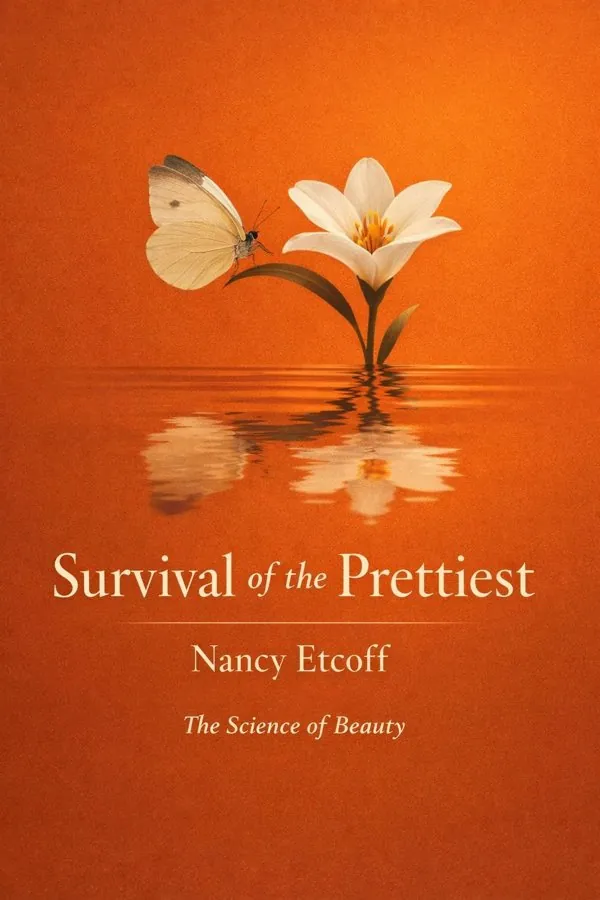
Survival of the Prettiest: The Science of Beauty: Summary & Key Insights
by Nancy Etcoff
 10 min9 chaptersAudio available
Key Takeaways from Survival of the Prettiest: The Science of Beauty
Beauty feels personal, but many of our preferences were shaped long before modern culture existed.
If beauty were purely cultural, we would expect preferences to vary wildly from one group to another.
A face can function like a biological résumé.
Bodies are judged not only aesthetically but biologically.
Beauty is not just seen; it is felt because the brain rewards it.
What Is Survival of the Prettiest: The Science of Beauty About?
Survival of the Prettiest: The Science of Beauty by Nancy Etcoff is a popular_sci book spanning 12 pages. Why does beauty matter so much, even when we insist it should not? In Survival of the Prettiest, psychologist Nancy Etcoff tackles that uncomfortable question with unusual clarity and intellectual courage. Rather than treating beauty as a shallow social fixation or a purely cultural invention, she argues that our responses to attractiveness are rooted in biology, shaped by evolution, and reinforced by the brain’s deepest reward systems. Beauty, in her account, is not trivial at all: it influences love, status, self-image, economic opportunity, and the way we judge one another before a single word is spoken. Etcoff draws on evolutionary theory, neuroscience, anthropology, developmental psychology, and social research to show how beauty standards emerge from a complex interaction between inherited preferences and cultural variation. She examines why symmetry, youthfulness, proportion, and health cues consistently attract us, while also showing how media, fashion, and power amplify those instincts in modern life. As a researcher affiliated with Harvard Medical School and Massachusetts General Hospital, Etcoff brings scientific rigor to a topic often clouded by ideology or sentiment. The result is a provocative, deeply readable exploration of one of humanity’s oldest and most consequential obsessions.
This FizzRead summary covers all 9 key chapters of Survival of the Prettiest: The Science of Beauty in approximately 10 minutes, distilling the most important ideas, arguments, and takeaways from Nancy Etcoff's work. Also available as an audio summary and Key Quotes Podcast.
Survival of the Prettiest: The Science of Beauty
Why does beauty matter so much, even when we insist it should not? In Survival of the Prettiest, psychologist Nancy Etcoff tackles that uncomfortable question with unusual clarity and intellectual courage. Rather than treating beauty as a shallow social fixation or a purely cultural invention, she argues that our responses to attractiveness are rooted in biology, shaped by evolution, and reinforced by the brain’s deepest reward systems. Beauty, in her account, is not trivial at all: it influences love, status, self-image, economic opportunity, and the way we judge one another before a single word is spoken.
Etcoff draws on evolutionary theory, neuroscience, anthropology, developmental psychology, and social research to show how beauty standards emerge from a complex interaction between inherited preferences and cultural variation. She examines why symmetry, youthfulness, proportion, and health cues consistently attract us, while also showing how media, fashion, and power amplify those instincts in modern life. As a researcher affiliated with Harvard Medical School and Massachusetts General Hospital, Etcoff brings scientific rigor to a topic often clouded by ideology or sentiment. The result is a provocative, deeply readable exploration of one of humanity’s oldest and most consequential obsessions.
Who Should Read Survival of the Prettiest: The Science of Beauty?
This book is perfect for anyone interested in popular_sci and looking to gain actionable insights in a short read. Whether you're a student, professional, or lifelong learner, the key ideas from Survival of the Prettiest: The Science of Beauty by Nancy Etcoff will help you think differently.
- ✓Readers who enjoy popular_sci and want practical takeaways
- ✓Professionals looking to apply new ideas to their work and life
- ✓Anyone who wants the core insights of Survival of the Prettiest: The Science of Beauty in just 10 minutes
Want the full summary?
Get instant access to this book summary and 100K+ more with Fizz Moment.
Get Free SummaryAvailable on App Store • Free to download
Key Chapters
Beauty feels personal, but many of our preferences were shaped long before modern culture existed. Etcoff’s central claim is that beauty is not merely a social script we learn from magazines, films, or peers. It is tied to evolutionary pressures that made certain traits more attractive because they signaled health, fertility, vigor, or good genes. Charles Darwin’s theory of sexual selection is crucial here: some traits survive not because they help an organism avoid predators or find food, but because they help it attract mates. In humans, attractiveness became one of the silent languages through which reproductive value and physical condition were assessed.
This does not mean beauty is destiny or that every preference is fixed. Etcoff is careful to show that biology creates tendencies, not rigid commandments. But those tendencies are powerful. People across times and places have repeatedly favored signs of youth, clear skin, bodily balance, and energetic movement. These traits often correlate, however imperfectly, with developmental stability and reproductive potential.
A practical way to understand this idea is to notice how quickly first impressions form. Before we know a person’s values, intelligence, or kindness, our minds rapidly register visible cues. Employers, voters, romantic partners, and even teachers can be influenced by those signals without realizing it. Recognizing that attraction has deep evolutionary roots helps us separate moral judgment from biological reaction.
Actionable takeaway: Treat your first impressions as natural but not final. Pause when beauty strongly influences your judgment, and deliberately look for deeper indicators of character, competence, and compatibility.
If beauty were purely cultural, we would expect preferences to vary wildly from one group to another. Yet one of Etcoff’s most striking observations is that human beings show remarkable agreement about what counts as attractive. Infants stare longer at faces adults consider beautiful. People from different societies often converge in their ratings of facial appeal. Even when local customs differ, broad preferences for clear skin, symmetry, youthful features, and expressive vitality appear again and again.
This universality matters because it challenges the comforting idea that beauty is entirely arbitrary. Culture certainly shapes style, ornamentation, and the meaning attached to appearance, but it does not create all preferences from nothing. Instead, culture often decorates a deeper biological template. A society may prize pale skin, a tan, thinness, softness, muscularity, or particular hairstyles at different moments in history, yet underneath those fashions remain persistent cues linked to health and reproductive fitness.
This idea has practical applications in parenting, education, and media literacy. When children begin responding to attractive faces early in life, it suggests that appearance-based bias cannot be eliminated simply by preaching equality. We must actively teach fairness because our perceptual system does not naturally ignore beauty. In workplaces and schools, awareness of this bias can lead to better hiring practices, more objective evaluation systems, and more thoughtful discussions about body image.
Actionable takeaway: Accept that some standards of attractiveness have biological roots, but use that insight to design fairer environments. Build habits and systems that reduce appearance bias instead of pretending it does not exist.
A face can function like a biological résumé. Etcoff explores how facial attractiveness often depends on traits that subtly communicate developmental health and genetic stability. Symmetry is one of the best-known examples. Perfect symmetry is rare in living organisms, but relative symmetry suggests that a body developed under fewer environmental and genetic stresses. Likewise, averageness, or the blending of many facial features into a balanced whole, often appears attractive because it may reflect normal development and the absence of extreme irregularities.
Proportion also matters. Certain distances between the eyes, nose, lips, and jaw are repeatedly perceived as pleasing. Youthful skin texture, bright eyes, facial expressiveness, and sexual dimorphism also influence attractiveness. Feminine faces in women and masculine structure in men can signal hormonal patterns associated with fertility or maturity. None of these cues guarantees health or compatibility, but the brain treats them as useful heuristics.
In everyday life, this explains why lighting, grooming, sleep, stress, and emotional state can dramatically affect how a face is perceived. Someone who is well-rested, emotionally animated, and physically healthy often appears more attractive than someone with technically similar features but visible fatigue or strain. It also helps explain the success of cosmetics, skincare, photography filters, and portrait techniques: many enhance cues our brains already favor.
The deeper lesson is not to obsess over ideal proportions. It is to understand that attractiveness often grows from signals of vitality rather than perfection. People can increase perceived attractiveness through health, posture, emotional warmth, and self-care.
Actionable takeaway: Focus less on chasing flawlessness and more on strengthening visible signs of health and aliveness, such as sleep, skincare, stress reduction, and expressive presence.
Bodies are judged not only aesthetically but biologically. Etcoff discusses how body shape functions as a set of signals, especially in the context of sexual selection. Features such as waist-to-hip ratio in women and shoulder-to-waist ratio in men tend to be widely noticed because they can indicate fertility, hormonal balance, strength, and physical maturity. Across cultures, people often respond to bodily proportions that suggest reproductive health and energetic capacity, even when local ideals of weight or ornament differ.
This does not mean there is one universally perfect body. Historical and cultural conditions alter what is emphasized. In times of scarcity, fuller bodies may suggest wealth and resilience. In affluent societies, slimness may become associated with discipline, youth, or status. Yet Etcoff argues that beneath these shifts remain recurring biological cues. Humans are not simply inventing preferences out of fashion; they are interpreting bodies through ancient perceptual systems tuned to survival and mating.
This helps explain the intensity of modern body anxiety. Advertising, fitness culture, and celebrity imagery magnify traits that our brains already find meaningful. The result is often a painful mismatch between evolved instincts and industrialized beauty markets. People compare themselves not just to peers but to curated, manipulated images optimized to trigger attention.
A healthier application of Etcoff’s argument is to distinguish functional attractiveness from commercial idealization. A body that signals health, movement, strength, and confidence often has more real-world social power than one chasing a narrow visual standard. Understanding the evolutionary logic behind body preferences can help us resist being ruled by distorted extremes.
Actionable takeaway: Reframe body goals around health, strength, mobility, and vitality rather than media-driven perfection. Aim to project well-being, not conformity to impossible ideals.
Beauty is not just seen; it is felt because the brain rewards it. One of Etcoff’s most compelling contributions is her explanation of how beauty operates at the neurological level. Attractive faces and forms capture attention quickly, activate pleasure-related pathways, and are processed with unusual efficiency. In other words, beauty is not merely an opinion we state after reflection. It is a perceptual event tied to emotion, memory, desire, and reward.
This helps explain why attractive people often seem more charismatic, trustworthy, or competent before they have earned those impressions. The brain links positive feeling to the beautiful object or person, and that emotional spillover shapes judgment. This is part of what psychologists call the halo effect: when one positive trait, such as attractiveness, leads us to assume other virtues. Beauty can literally make social reality easier, because it influences how others feel in one’s presence.
Modern life exploits this bias constantly. Marketers use beautiful faces to sell products. Social media platforms reward visually appealing content. Political campaigns benefit from photogenic candidates. Even user interface design relies on the fact that people judge beautiful things as easier to use and more trustworthy. Beauty affects decision-making far beyond romance.
Yet understanding the brain’s response to beauty also gives us leverage. If our judgments are shaped by automatic reward systems, then fairness requires deliberate correction. Managers can blind parts of hiring processes. Teachers can use rubrics. Individuals can ask whether their enthusiasm is based on substance or surface appeal.
Actionable takeaway: When you feel strongly drawn to a person, product, or message, ask what role visual appeal is playing. Separate emotional attraction from evidence before making important decisions.
Biology sets the stage, but culture writes many of the lines. One of the book’s most balanced insights is that beauty cannot be reduced to either nature or nurture alone. Etcoff argues that humans come equipped with evolved preferences, but these preferences are modified, intensified, and sometimes exaggerated by social context. Fashion, religion, class, technology, and media all influence which traits become prestigious, erotic, or respectable at a given moment.
This explains why some standards vary dramatically across time and place. A fuller body may symbolize abundance in one era and lack of discipline in another. Tanned skin may shift from a marker of outdoor labor to a symbol of leisure. Cosmetics, hairstyles, tattoos, and clothing codes create culturally legible forms of beauty that extend beyond biology. Culture can even distort natural preferences into harmful extremes, rewarding thinness, youthfulness, or artificial enhancement far beyond what health would justify.
Etcoff’s framework is especially useful today, when algorithmic media intensifies imitation and comparison. Online images circulate beauty norms globally, collapsing local diversity into a narrow visual marketplace. At the same time, subcultures continue to create alternative ideals, proving that cultural expression still matters. The key is to recognize that social trends gain power partly because they latch onto preexisting human sensitivities.
For readers, this means two things at once: you are not imagining beauty pressure, and you are not powerless before it. Understanding where biology ends and cultural exaggeration begins allows more freedom. You can participate in beauty practices without treating them as sacred truths.
Actionable takeaway: Audit your beauty standards. Ask which preferences reflect health and personal expression, and which come from repetitive media exposure, status anxiety, or cultural conformity.
The mirror is never just a mirror; it reflects status, belonging, and self-worth. In later themes of the book, Etcoff shows how beauty becomes deeply entangled with economics, politics, love, and the psychology of self-image. Because attractiveness influences hiring, mating, popularity, and prestige, people invest heavily in managing appearance. Cosmetics, dieting, fitness, surgery, fashion, and digital self-presentation become tools for social mobility and self-control. Beauty is no longer only perceived; it is produced, edited, purchased, and performed.
This creates a paradox. On one hand, beauty work can be empowering. It allows people to highlight strengths, signal identity, and navigate social realities with greater confidence. On the other hand, it can become coercive, draining time, money, and mental energy in pursuit of unstable standards. The same society that tells people beauty should not matter often punishes them when they ignore it.
Etcoff also links beauty to love and reproduction without reducing intimacy to appearance alone. Beauty may open the door, but attachment, loyalty, humor, and shared values determine whether a relationship deepens. Likewise, self-image is shaped not just by how one looks, but by how one believes others are reading that appearance. Modern beauty culture thus affects both public opportunity and private emotional life.
This idea is especially relevant in the age of filters, cosmetic procedures, and personal branding. The manipulation of beauty has become normalized, yet the psychological costs remain real. The challenge is to engage appearance strategically without becoming enslaved to it.
Actionable takeaway: Use beauty as a tool, not an identity. Invest in appearance where it genuinely supports confidence and opportunity, but anchor self-worth in competence, connection, and character.
All Chapters in Survival of the Prettiest: The Science of Beauty
About the Author
Nancy Etcoff is an American psychologist, researcher, and author best known for exploring the science of beauty, emotion, and human flourishing. She has been affiliated with Harvard Medical School and Massachusetts General Hospital, where her work has focused on how people perceive attractiveness, happiness, and well-being. Trained in psychology and deeply influenced by evolutionary theory, Etcoff has built a reputation for bringing scientific depth to topics often treated as merely fashionable or controversial. In Survival of the Prettiest, she combines insights from neuroscience, anthropology, developmental psychology, and social research to examine why beauty has such enduring power in human life. Her writing is notable for being both intellectually rigorous and highly accessible, making complex scientific ideas engaging for general readers.
Get This Summary in Your Preferred Format
Read or listen to the Survival of the Prettiest: The Science of Beauty summary by Nancy Etcoff anytime, anywhere. FizzRead offers multiple formats so you can learn on your terms — all free.
Available formats: App · Audio · PDF · EPUB — All included free with FizzRead
Download Survival of the Prettiest: The Science of Beauty PDF and EPUB Summary
Key Quotes from Survival of the Prettiest: The Science of Beauty
“Beauty feels personal, but many of our preferences were shaped long before modern culture existed.”
“If beauty were purely cultural, we would expect preferences to vary wildly from one group to another.”
“A face can function like a biological résumé.”
“Bodies are judged not only aesthetically but biologically.”
“Beauty is not just seen; it is felt because the brain rewards it.”
Frequently Asked Questions about Survival of the Prettiest: The Science of Beauty
Survival of the Prettiest: The Science of Beauty by Nancy Etcoff is a popular_sci book that explores key ideas across 9 chapters. Why does beauty matter so much, even when we insist it should not? In Survival of the Prettiest, psychologist Nancy Etcoff tackles that uncomfortable question with unusual clarity and intellectual courage. Rather than treating beauty as a shallow social fixation or a purely cultural invention, she argues that our responses to attractiveness are rooted in biology, shaped by evolution, and reinforced by the brain’s deepest reward systems. Beauty, in her account, is not trivial at all: it influences love, status, self-image, economic opportunity, and the way we judge one another before a single word is spoken. Etcoff draws on evolutionary theory, neuroscience, anthropology, developmental psychology, and social research to show how beauty standards emerge from a complex interaction between inherited preferences and cultural variation. She examines why symmetry, youthfulness, proportion, and health cues consistently attract us, while also showing how media, fashion, and power amplify those instincts in modern life. As a researcher affiliated with Harvard Medical School and Massachusetts General Hospital, Etcoff brings scientific rigor to a topic often clouded by ideology or sentiment. The result is a provocative, deeply readable exploration of one of humanity’s oldest and most consequential obsessions.
You Might Also Like

Structures: Or Why Things Don"t Fall Down
J.E. Gordon
10 min
The Road to Wigan Pier
George Orwell
10 min
Bonk: The Curious Coupling of Science and Sex
Mary Roach
10 min
First Bite: How We Learn to Eat
Bee Wilson
10 min
In Pursuit Of The Unknown: 17 Equations That Changed The World
Ian Stewart
10 min
Napoleon's Buttons: 17 Molecules That Changed History
Penny Le Couteur and Jay Burreson
10 minBrowse by Category
Ready to read Survival of the Prettiest: The Science of Beauty?
Get the full summary and 100K+ more books with Fizz Moment.