
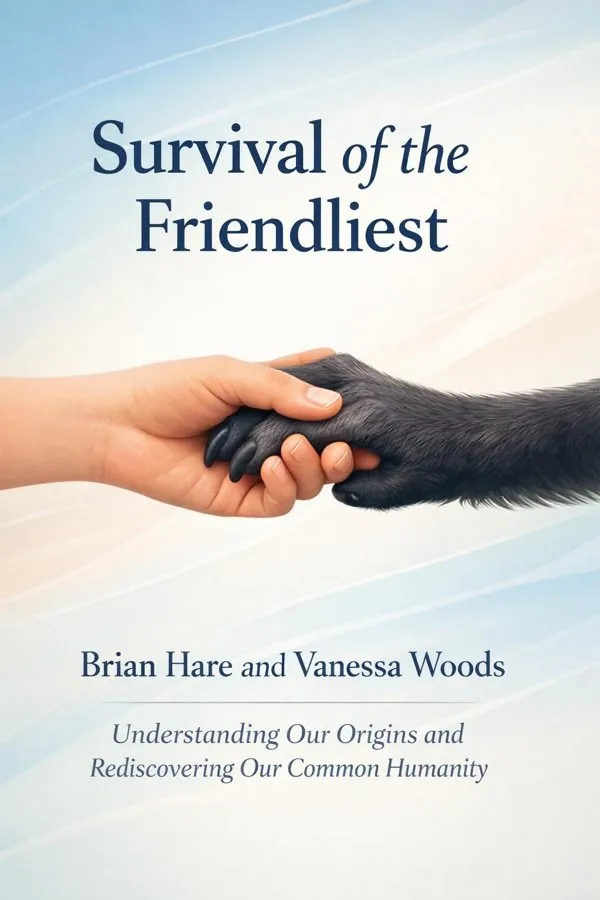
Survival of the Friendliest: Understanding Our Origins and Rediscovering Our Common Humanity: Summary & Key Insights
 10 min5 chaptersAudio available
What Is Survival of the Friendliest: Understanding Our Origins and Rediscovering Our Common Humanity About?
Survival of the Friendliest: Understanding Our Origins and Rediscovering Our Common Humanity by Brian Hare and Vanessa Woods is a popular_sci book spanning 5 pages. In this groundbreaking work, evolutionary anthropologist Brian Hare and science writer Vanessa Woods argue that friendliness—our ability to cooperate and connect—is the key to human success. Drawing on research in anthropology, psychology, and genetics, they show how natural selection favored social intelligence and empathy over aggression, shaping both our species and our societies. The book explores how understanding this evolutionary advantage can help us build a more compassionate and cooperative world.
This FizzRead summary covers all 5 key chapters of Survival of the Friendliest: Understanding Our Origins and Rediscovering Our Common Humanity in approximately 10 minutes, distilling the most important ideas, arguments, and takeaways from Brian Hare and Vanessa Woods's work. Also available as an audio summary and Key Quotes Podcast.
Survival of the Friendliest: Understanding Our Origins and Rediscovering Our Common Humanity
In this groundbreaking work, evolutionary anthropologist Brian Hare and science writer Vanessa Woods argue that friendliness—our ability to cooperate and connect—is the key to human success. Drawing on research in anthropology, psychology, and genetics, they show how natural selection favored social intelligence and empathy over aggression, shaping both our species and our societies. The book explores how understanding this evolutionary advantage can help us build a more compassionate and cooperative world.
Who Should Read Survival of the Friendliest: Understanding Our Origins and Rediscovering Our Common Humanity?
This book is perfect for anyone interested in popular_sci and looking to gain actionable insights in a short read. Whether you're a student, professional, or lifelong learner, the key ideas from Survival of the Friendliest: Understanding Our Origins and Rediscovering Our Common Humanity by Brian Hare and Vanessa Woods will help you think differently.
- ✓Readers who enjoy popular_sci and want practical takeaways
- ✓Professionals looking to apply new ideas to their work and life
- ✓Anyone who wants the core insights of Survival of the Friendliest: Understanding Our Origins and Rediscovering Our Common Humanity in just 10 minutes
Want the full summary?
Get instant access to this book summary and 100K+ more with Fizz Moment.
Get Free SummaryAvailable on App Store • Free to download
Key Chapters
Picture two cousins of ours, equally close genetic relatives, yet strikingly different in their societies. Chimpanzees live by dominance and hierarchy—males compete violently for power, and alliances often crumble in brutal contests. Bonobos, however, offer a glimpse of what evolution can achieve when friendliness becomes the guiding force. Their world is gentler, led by female alliances, sustained by play, sex, and tolerance. Conflicts rarely end in bloodshed; they end with reconciliation.
When we study bonobos, we don’t just observe a different temperament—we see what humans might have become if peaceful cooperation had dominated over aggression. Both species diverged from a common ancestor, but environmental pressure shaped them differently. In regions where resources were scarce, chimpanzees evolved toward aggression and territoriality. Bonobos, living in abundance south of the Congo River, didn’t face the same pressure—they could afford generosity. Over generations, natural selection favored individuals who were less hostile and more inclined to share and bond.
Humans resemble bonobos more than chimps in psychological terms. We depend on social ties and reciprocal relationships for survival. Our evolutionary success didn’t arise from the ability to kill, but from the ability to understand others’ intentions, to build networks of trust that far exceed the limits of kinship. This didn’t make us weaker—it made us capable of creating societies where cooperation could scale to millions. The cognitive shift toward social sensitivity became the oxygen of our cultural development.
In this comparison lies the key evolutionary insight: aggression might offer short-term victory, but friendliness secures long-term success. Species that learn to cooperate, to share information, and to synchronize goals, create resilience. From sharing food around ancient campfires to developing global economies today, friendliness remains our invisible force of progress. Once we see evolution through this lens, survival no longer appears as the victory of the fittest, but of the friendliest.
One of the most fascinating ideas that emerged from our research is that humans, over thousands of generations, have undergone a process similar to what we call domestication—but we did it to ourselves. When animals are domesticated—from wolves becoming dogs to wild cats becoming house pets—certain traits change predictably: smaller faces, reduced aggression, heightened playfulness, and increased sociability. Now imagine this process happening within our species, driven not by human breeders but by evolution itself. We selected, unconsciously, for friendliness.
But how does self-domestication work? It begins with social selection—our ancestors favored individuals who could maintain alliances and cooperate. The hostile and impulsive were ostracized, while those capable of empathy gained partners and allies. Over time, this preference produced genetic shifts. Our brains became wired for emotional communication; hormones like oxytocin encouraged bonding; and physical changes—less pronounced brow ridges, rounder faces—mirrored those seen in domesticated animals.
This transformation rewired our survival strategy. Instead of succeeding through intimidation, humans thrived by building coalitions. The drive to connect overpowered the drive to dominate. And fascinatingly, this shift parallels the evolution seen in bonobos. Both species share signs of self-domestication—proof that friendliness can reshape biology itself.
Understanding self-domestication changes how we see human nature. It means our capacity for kindness is not a cultural accident—it’s a biological trait, deeply selected across millennia. The human story becomes not a tale of conquest, but of connection. When we recognize this truth, we grasp that cooperation is not merely good behavior—it’s the essence of our species.
+ 3 more chapters — available in the FizzRead app
All Chapters in Survival of the Friendliest: Understanding Our Origins and Rediscovering Our Common Humanity
About the Authors
Brian Hare is a professor of evolutionary anthropology at Duke University and a leading researcher on animal cognition and human evolution. Vanessa Woods is a science writer and research scientist at Duke University, known for her work on primate behavior and human-animal relationships. Together, they have coauthored several acclaimed books on the science of cooperation and empathy.
Get This Summary in Your Preferred Format
Read or listen to the Survival of the Friendliest: Understanding Our Origins and Rediscovering Our Common Humanity summary by Brian Hare and Vanessa Woods anytime, anywhere. FizzRead offers multiple formats so you can learn on your terms — all free.
Available formats: App · Audio · PDF · EPUB — All included free with FizzRead
Download Survival of the Friendliest: Understanding Our Origins and Rediscovering Our Common Humanity PDF and EPUB Summary
Key Quotes from Survival of the Friendliest: Understanding Our Origins and Rediscovering Our Common Humanity
“Picture two cousins of ours, equally close genetic relatives, yet strikingly different in their societies.”
Frequently Asked Questions about Survival of the Friendliest: Understanding Our Origins and Rediscovering Our Common Humanity
Survival of the Friendliest: Understanding Our Origins and Rediscovering Our Common Humanity by Brian Hare and Vanessa Woods is a popular_sci book that explores key ideas across 5 chapters. In this groundbreaking work, evolutionary anthropologist Brian Hare and science writer Vanessa Woods argue that friendliness—our ability to cooperate and connect—is the key to human success. Drawing on research in anthropology, psychology, and genetics, they show how natural selection favored social intelligence and empathy over aggression, shaping both our species and our societies. The book explores how understanding this evolutionary advantage can help us build a more compassionate and cooperative world.
More by Brian Hare and Vanessa Woods

You Might Also Like

Structures: Or Why Things Don"t Fall Down
J.E. Gordon
10 min
The Road to Wigan Pier
George Orwell
10 min
Bonk: The Curious Coupling of Science and Sex
Mary Roach
10 min
First Bite: How We Learn to Eat
Bee Wilson
10 min
In Pursuit Of The Unknown: 17 Equations That Changed The World
Ian Stewart
10 min
Napoleon's Buttons: 17 Molecules That Changed History
Penny Le Couteur and Jay Burreson
10 minBrowse by Category
Ready to read Survival of the Friendliest: Understanding Our Origins and Rediscovering Our Common Humanity?
Get the full summary and 100K+ more books with Fizz Moment.