
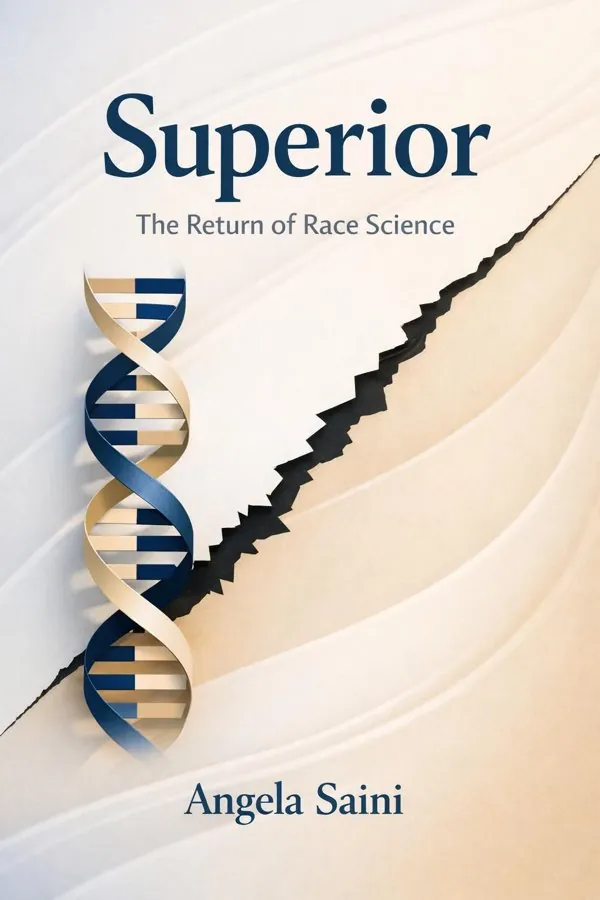
Superior: The Return of Race Science: Summary & Key Insights
by Angela Saini
 10 min9 chaptersAudio available
Key Takeaways from Superior: The Return of Race Science
Modern science likes to imagine itself as a force of liberation, but some of its earliest ambitions were tied to ranking human beings.
Scientific racism did not grow in isolation; it expanded alongside empire.
The collapse of overt eugenics after the Second World War created the illusion that biology-based hierarchy had been defeated.
Discredited ideas rarely vanish all at once; they adapt.
If race were a clear biological reality, modern genetics should have confirmed it neatly.
What Is Superior: The Return of Race Science About?
Superior: The Return of Race Science by Angela Saini is a popular_sci book spanning 10 pages. In Superior: The Return of Race Science, Angela Saini investigates one of the most unsettling developments in contemporary public life: the reappearance of old racial myths in the language of modern science. The book examines how ideas once used to justify slavery, colonialism, segregation, and eugenics have not vanished. Instead, they have been repackaged through genetics, intelligence research, online extremism, and selective uses of data. Saini traces the long history of race science, showing how supposedly objective inquiry has often been shaped by power, ideology, and social prejudice. What makes this book especially urgent is its refusal to treat racism in science as a relic of the past. Saini demonstrates that debates about biology, ancestry, medicine, and human difference still carry serious political consequences today. Drawing on deep historical research and interviews with scientists, historians, and scholars around the world, she offers a clear-eyed account of how scientific institutions can both challenge and reproduce inequality. As a respected science journalist, Saini brings rigor, accessibility, and moral clarity to a topic that affects education, health, politics, and our understanding of what it means to be human.
This FizzRead summary covers all 9 key chapters of Superior: The Return of Race Science in approximately 10 minutes, distilling the most important ideas, arguments, and takeaways from Angela Saini's work. Also available as an audio summary and Key Quotes Podcast.
Superior: The Return of Race Science
In Superior: The Return of Race Science, Angela Saini investigates one of the most unsettling developments in contemporary public life: the reappearance of old racial myths in the language of modern science. The book examines how ideas once used to justify slavery, colonialism, segregation, and eugenics have not vanished. Instead, they have been repackaged through genetics, intelligence research, online extremism, and selective uses of data. Saini traces the long history of race science, showing how supposedly objective inquiry has often been shaped by power, ideology, and social prejudice.
What makes this book especially urgent is its refusal to treat racism in science as a relic of the past. Saini demonstrates that debates about biology, ancestry, medicine, and human difference still carry serious political consequences today. Drawing on deep historical research and interviews with scientists, historians, and scholars around the world, she offers a clear-eyed account of how scientific institutions can both challenge and reproduce inequality. As a respected science journalist, Saini brings rigor, accessibility, and moral clarity to a topic that affects education, health, politics, and our understanding of what it means to be human.
Who Should Read Superior: The Return of Race Science?
This book is perfect for anyone interested in popular_sci and looking to gain actionable insights in a short read. Whether you're a student, professional, or lifelong learner, the key ideas from Superior: The Return of Race Science by Angela Saini will help you think differently.
- ✓Readers who enjoy popular_sci and want practical takeaways
- ✓Professionals looking to apply new ideas to their work and life
- ✓Anyone who wants the core insights of Superior: The Return of Race Science in just 10 minutes
Want the full summary?
Get instant access to this book summary and 100K+ more with Fizz Moment.
Get Free SummaryAvailable on App Store • Free to download
Key Chapters
Modern science likes to imagine itself as a force of liberation, but some of its earliest ambitions were tied to ranking human beings. Saini shows that the Enlightenment, though celebrated for reason and universalism, also produced influential systems for classifying people into racial categories. Naturalists and philosophers sought to organize the world, and in doing so they often treated Europeans as the standard against which all others were measured. These classifications were never neutral descriptions. They carried assumptions about beauty, intelligence, morality, and civilization.
What made these early theories so powerful was their scientific appearance. Once race was presented as a natural fact rather than a political construction, inequality could be framed as inevitable. Thinkers such as Carl Linnaeus and Johann Friedrich Blumenbach did not merely describe variation; they helped create enduring hierarchies that later institutions would treat as objective truth. These ideas shaped education, law, religion, and policy, influencing how societies understood who was fit to rule and who was destined to be ruled.
The practical lesson is that categories created in science can outlive the evidence that first supported them. Today, we still inherit terms, assumptions, and research habits formed in those earlier eras. Whether in school curricula, census data, or medical forms, classifications can affect access to resources and social recognition.
Actionable takeaway: whenever a scientific claim about human groups sounds natural or self-evident, ask who created the category, what purpose it served, and whose interests it still protects.
Scientific racism did not grow in isolation; it expanded alongside empire. Saini argues that colonialism gave race science its field sites, its specimens, and its political purpose. As European powers conquered territories across Africa, Asia, and the Americas, they needed moral and intellectual justifications for domination. Science helped provide them. Colonized peoples were measured, photographed, cataloged, and compared, often stripped of dignity in the process. The language of research became a tool of control.
Colonial officials and scholars frequently claimed that conquered populations were biologically less advanced, more primitive, or less capable of self-government. These claims were not side effects of empire; they were central to its functioning. They rationalized land theft, forced labor, educational exclusion, and cultural destruction. Museums, universities, and medical institutions often benefited directly from colonial extraction, collecting human remains and data under the banner of knowledge.
This history matters because its structure persists. Research agendas are still influenced by global inequalities in funding, prestige, and whose voices count as authoritative. A modern example is when Western institutions study marginalized communities without meaningfully involving them in the design, interpretation, or ownership of the work. Another is when ancestry or health data from underrepresented populations are extracted for scientific value but not translated into benefits for those communities.
Actionable takeaway: support forms of research that include local expertise, informed consent, community partnership, and shared accountability rather than treating vulnerable populations as raw material for discovery.
The collapse of overt eugenics after the Second World War created the illusion that biology-based hierarchy had been defeated. Saini reveals a harder truth: many of the assumptions behind eugenics survived, even when the language changed. Eugenics rested on the belief that social problems such as poverty, criminality, disability, or low intelligence were rooted in inherited defects. Once this idea takes hold, inequality can be blamed on biology rather than injustice.
In the twentieth century, eugenics shaped sterilization laws, immigration restrictions, marriage controls, and public health policy in multiple countries, not just Nazi Germany. Its supporters included respected scientists, reformers, and institutions that saw themselves as modern and progressive. That is what makes this history so disturbing. Harmful ideas do not always arrive wearing the face of extremism; they often come wrapped in expertise, efficiency, and concern for social improvement.
Saini also shows how echoes of eugenic thinking remain visible today in debates over intelligence, reproductive technologies, and social welfare. For example, when commentators imply that some populations are trapped by inherited inferiority rather than structural barriers, they are recycling an old logic. Likewise, selective enthusiasm for genetic enhancement can slide into judgments about which lives are more valuable.
The practical application is vigilance. Scientific advances in genomics and reproductive medicine can be beneficial, but they require ethical frameworks that resist ranking human worth.
Actionable takeaway: when proposals claim to improve society by identifying better or worse kinds of people, pause and examine whether they are reviving eugenic assumptions under new terminology.
Discredited ideas rarely vanish all at once; they adapt. After the horrors of Nazism made explicit racial hierarchy morally toxic, many scientists and institutions publicly distanced themselves from race science. Yet Saini shows that the retreat was often superficial. Instead of openly talking about racial superiority, researchers shifted to coded discussions of population differences, culture, heredity, and intelligence. The questions changed form, but not always substance.
This postwar period is important because it reveals how prejudice survives through respectable language. Organizations issued statements affirming human equality, and anthropology increasingly challenged biological race. At the same time, some scholars continued searching for innate explanations of group inequality. Debates over IQ became a key site of this struggle. Claims about inherited differences in intelligence repeatedly resurfaced, often presented as brave truth-telling against political correctness, despite deep methodological and ethical problems.
The modern application is easy to see in public debate. Arguments that appear to focus only on data can still carry hidden assumptions about fixed group essence. A chart, a ranking, or a statistical average may be used to imply that social disparities are natural rather than historically produced. This is especially persuasive in media environments that reward controversy over nuance.
Saini’s point is not that all research into human variation is suspect. It is that context, framing, and interpretation matter enormously. Numbers do not explain themselves.
Actionable takeaway: when reading claims about group differences, look beyond the headline and ask what social factors, historical conditions, and measurement limits might have been excluded from the analysis.
If race were a clear biological reality, modern genetics should have confirmed it neatly. Instead, Saini shows that genetic research has made the concept far more complicated. Human populations do show patterns of ancestry and geographic variation, but these patterns do not map cleanly onto the rigid racial categories used in everyday life. Most genetic variation exists within populations rather than between them, and the boundaries between groups are porous, overlapping, and historically fluid.
This distinction matters. Ancestry, lineage, and population history can be scientifically meaningful; race, as commonly understood, often collapses that complexity into broad social labels such as Black, White, or Asian. Those labels may be politically real and socially consequential, but they are poor proxies for precise biological difference. Saini argues that when scientists or the public confuse ancestry with race, they risk reviving simplistic thinking that genetics itself does not support.
A practical example appears in medicine. Using race as a shortcut for diagnosis can obscure more relevant variables such as socioeconomic conditions, environmental exposure, family history, stress, or specific genetic markers. In consumer DNA testing, people may also overinterpret ancestry percentages as evidence of essential identity, when in fact such results are probabilistic and dependent on reference databases.
Saini does not deny biological diversity. She asks us to understand it more accurately and more ethically. Human variation is real, but it does not justify hierarchy.
Actionable takeaway: prefer precise terms like ancestry, population history, or specific risk factors over broad racial labels when discussing biology, health, or heredity.
One of the most provocative ideas in Superior is that bias in science does not always look like open bigotry. Often, it appears in the choice of research questions, the design of studies, the interpretation of findings, and the assumptions built into institutions. Saini shows that scientists can sincerely believe they are pursuing objective truth while still reproducing social prejudice. Objectivity is not a personal virtue alone; it requires systems that actively check for blind spots.
For instance, if researchers begin with the assumption that a marginalized group is biologically different in a meaningful way, they may design studies that search for confirmation rather than context. If datasets exclude certain populations, results can be misleading. If peer reviewers, journal editors, and funding bodies share similar backgrounds, unconventional critiques may struggle to gain attention. These are structural problems, not simply individual failings.
The consequences are practical and serious. In medicine, racial assumptions can lead to undertreatment of pain, distorted risk assessments, or diagnostic shortcuts. In social science, poorly framed studies can reinforce stereotypes that later influence policy and media narratives. In technology, algorithms trained on biased data can produce discriminatory outcomes while appearing neutral.
Saini’s broader argument is that science becomes stronger, not weaker, when it welcomes scrutiny from diverse perspectives. Inclusion is not a political add-on; it improves knowledge quality.
Actionable takeaway: evaluate scientific claims not only by whether they use data, but also by who asked the question, how the data were collected, what alternatives were considered, and who might be harmed by oversimplified conclusions.
It is tempting to treat race science as a Western historical oddity, but Saini broadens the frame. She shows that ideas about human hierarchy travel across borders and take different forms in different societies. National histories, caste systems, ethnic conflicts, immigration politics, and colonial legacies all shape how biological difference gets imagined and weaponized. The details vary, but the underlying pattern is familiar: social inequality seeks validation in nature.
This global perspective is one of the book’s major strengths. By looking beyond the United States and Britain, Saini reveals that there is no single story of race. In some places, religion and ethnicity intertwine with pseudoscientific ideas. In others, nationalist projects draw on selective history, archaeology, or genetics to claim purity, indigeneity, or superiority. Even when the term race is avoided, analogous hierarchies can emerge through language about blood, lineage, civilization, or origin.
A practical implication is that readers should resist assuming that scientific racism belongs only to the past or to a few extremists. It can appear in immigration policy, education systems, policing, reproductive politics, or conflict rhetoric around the world. Online spaces amplify this by allowing fringe theories to circulate globally and attach themselves to local grievances.
Saini’s comparative approach helps readers see race science as part of a broader human tendency to naturalize power. Once that tendency is recognized, it becomes easier to challenge it.
Actionable takeaway: pay attention to how claims about ancestry, purity, or innate group difference operate in your own national context, even if they are not explicitly labeled as race science.
Bad ideas survive not only because they are persuasive, but because institutions and media ecosystems can keep them circulating. Saini explains that race science re-enters public life through think tanks, academic controversies, publishing platforms, political movements, and digital networks that reward sensational claims. A flawed study, a provocative speaker, or a misleading headline can travel much faster than careful correction.
This is especially dangerous when institutions grant legitimacy without sufficient scrutiny. Universities may platform controversial work in the name of open debate while neglecting the unequal burden placed on those targeted by it. Journalists may frame long-discredited claims as balanced controversy. Social media algorithms may promote inflammatory racial content because outrage drives engagement. In each case, the issue is not censorship versus freedom, but whether systems built for attention and prestige can distinguish inquiry from ideological laundering.
Saini also highlights the role of politics. Biological explanations for inequality are attractive to movements that want to oppose social reform. If disparities in wealth, health, education, or incarceration can be blamed on innate differences, then governments and elites are relieved of responsibility. This makes race science politically useful, even when scientifically weak.
The practical response is media literacy and institutional accountability. Readers, educators, editors, and researchers must learn to ask not just whether a claim is controversial, but whether it is credible, responsibly framed, and historically informed.
Actionable takeaway: before sharing headlines about racial differences, check the underlying source, expert consensus, study limitations, and whether the coverage treats fringe claims as stronger than the evidence warrants.
Superior is not an argument against science; it is an argument for a more honest and humane science. Saini ends on the idea that the solution to biased knowledge is not abandoning research into human diversity, but improving the ethical and institutional conditions under which that research happens. Science can correct itself, but only when it acknowledges how often social power shapes what counts as a question, whose evidence matters, and who benefits from discovery.
A better science would be historically aware, methodologically careful, and more representative of the societies it studies. That means expanding participation in research, especially among groups long excluded from scientific authority. It means questioning inherited categories rather than treating them as timeless facts. It means designing medical and genetic research with precision and fairness, avoiding crude racial shortcuts. And it means building safeguards so that findings cannot be easily distorted into narratives of superiority.
This has concrete applications in education, journalism, healthcare, and policy. Teachers can present science history alongside its ethical failures. Doctors can move away from race-based assumptions toward individualized care. Editors can contextualize controversial studies rather than amplifying them for clicks. Research institutions can create stronger review processes for work involving sensitive human variation.
Saini’s deeper contribution is moral as well as intellectual. She reminds readers that curiosity without humility can become dangerous, while evidence joined with empathy can enlarge our understanding of one another.
Actionable takeaway: support scientific practices that are transparent, diverse, historically informed, and accountable, because better methods are the best defense against the return of old prejudices.
All Chapters in Superior: The Return of Race Science
About the Author
Angela Saini is a British science journalist, broadcaster, and author whose work explores how science is shaped by culture, politics, and inequality. She has written for leading publications including Nature, New Scientist, and The Guardian, and is widely recognized for making complex scientific debates accessible to general readers. Saini’s books often examine the hidden biases embedded in supposedly objective fields of knowledge. Her acclaimed title Inferior challenged sexist assumptions in scientific research, while Superior investigates the enduring legacy of race science and its modern resurgence. Known for her careful reporting, historical depth, and critical perspective, Saini has become an important public voice on the ethics of science, the politics of knowledge, and the need for more inclusive and accountable research.
Get This Summary in Your Preferred Format
Read or listen to the Superior: The Return of Race Science summary by Angela Saini anytime, anywhere. FizzRead offers multiple formats so you can learn on your terms — all free.
Available formats: App · Audio · PDF · EPUB — All included free with FizzRead
Download Superior: The Return of Race Science PDF and EPUB Summary
Key Quotes from Superior: The Return of Race Science
“Modern science likes to imagine itself as a force of liberation, but some of its earliest ambitions were tied to ranking human beings.”
“Scientific racism did not grow in isolation; it expanded alongside empire.”
“The collapse of overt eugenics after the Second World War created the illusion that biology-based hierarchy had been defeated.”
“Discredited ideas rarely vanish all at once; they adapt.”
“If race were a clear biological reality, modern genetics should have confirmed it neatly.”
Frequently Asked Questions about Superior: The Return of Race Science
Superior: The Return of Race Science by Angela Saini is a popular_sci book that explores key ideas across 9 chapters. In Superior: The Return of Race Science, Angela Saini investigates one of the most unsettling developments in contemporary public life: the reappearance of old racial myths in the language of modern science. The book examines how ideas once used to justify slavery, colonialism, segregation, and eugenics have not vanished. Instead, they have been repackaged through genetics, intelligence research, online extremism, and selective uses of data. Saini traces the long history of race science, showing how supposedly objective inquiry has often been shaped by power, ideology, and social prejudice. What makes this book especially urgent is its refusal to treat racism in science as a relic of the past. Saini demonstrates that debates about biology, ancestry, medicine, and human difference still carry serious political consequences today. Drawing on deep historical research and interviews with scientists, historians, and scholars around the world, she offers a clear-eyed account of how scientific institutions can both challenge and reproduce inequality. As a respected science journalist, Saini brings rigor, accessibility, and moral clarity to a topic that affects education, health, politics, and our understanding of what it means to be human.
You Might Also Like

Structures: Or Why Things Don"t Fall Down
J.E. Gordon
10 min
The Road to Wigan Pier
George Orwell
10 min
Bonk: The Curious Coupling of Science and Sex
Mary Roach
10 min
First Bite: How We Learn to Eat
Bee Wilson
10 min
In Pursuit Of The Unknown: 17 Equations That Changed The World
Ian Stewart
10 min
Napoleon's Buttons: 17 Molecules That Changed History
Penny Le Couteur and Jay Burreson
10 minBrowse by Category
Ready to read Superior: The Return of Race Science?
Get the full summary and 100K+ more books with Fizz Moment.