
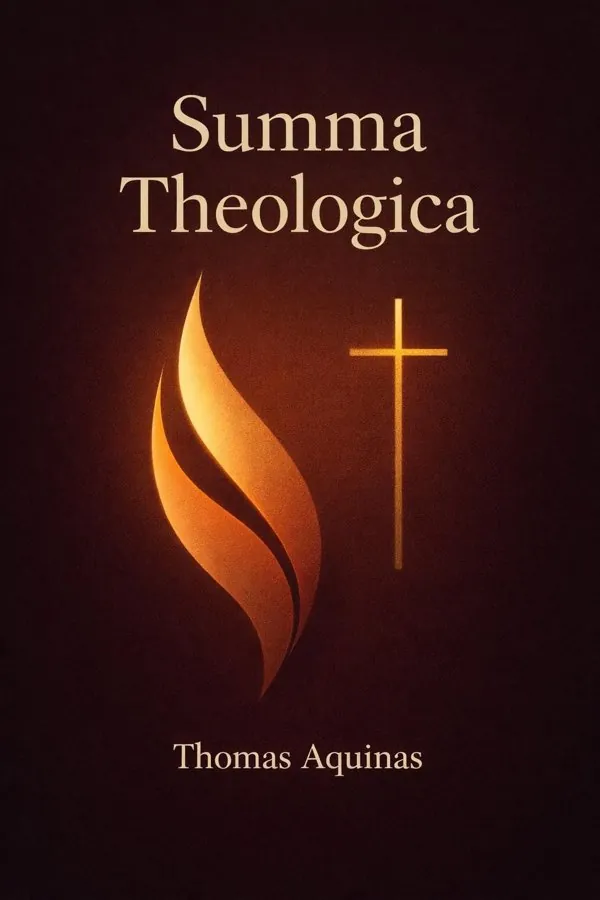
Summa Theologica: Summary & Key Insights
 10 min3 chaptersAudio available
What Is Summa Theologica About?
Summa Theologica by Thomas Aquinas is a western_phil book spanning 3 pages. The *Summa Theologica* is the masterpiece of Saint Thomas Aquinas, written between 1265 and 1274. It is a monumental synthesis of Christian theology that seeks to systematically explain the Catholic faith through philosophical reason. Divided into three main parts, it addresses the existence of God, human nature, morality, and the sacraments, integrating Aristotelian philosophy with Christian doctrine.
This FizzRead summary covers all 3 key chapters of Summa Theologica in approximately 10 minutes, distilling the most important ideas, arguments, and takeaways from Thomas Aquinas's work. Also available as an audio summary and Key Quotes Podcast.
Summa Theologica
The *Summa Theologica* is the masterpiece of Saint Thomas Aquinas, written between 1265 and 1274. It is a monumental synthesis of Christian theology that seeks to systematically explain the Catholic faith through philosophical reason. Divided into three main parts, it addresses the existence of God, human nature, morality, and the sacraments, integrating Aristotelian philosophy with Christian doctrine.
Who Should Read Summa Theologica?
This book is perfect for anyone interested in western_phil and looking to gain actionable insights in a short read. Whether you're a student, professional, or lifelong learner, the key ideas from Summa Theologica by Thomas Aquinas will help you think differently.
- ✓Readers who enjoy western_phil and want practical takeaways
- ✓Professionals looking to apply new ideas to their work and life
- ✓Anyone who wants the core insights of Summa Theologica in just 10 minutes
Want the full summary?
Get instant access to this book summary and 100K+ more with Fizz Moment.
Get Free SummaryAvailable on App Store • Free to download
Key Chapters
The beginning of theology must be the beginning of all being — God Himself. I asked first whether God exists, not because doubt was legitimate but because reason must trace an intelligible path toward what faith already knows. The Five Ways, or proofs, I presented are not demonstrations for an idle mind but meditative exercises that lead the soul from the movement of the world to the unmoved mover, from contingent beings to the necessary being, from perishable goods to the ultimate good. Each argument, properly grasped, awakens the mind to see that all finite things participate in a being that is pure act, without potentiality, and hence the source of all actuality.
Once God’s existence is acknowledged, we turn to His nature. God is simple — not a composite of parts, for composition implies dependence and limitation. He is perfect because He lacks nothing; good, because His essence is goodness itself; infinite, because He is not confined by any boundary; omnipresent, because in Him all things subsist. In meditating on these truths, one realizes that God’s transcendence does not alienate Him from the world but grounds the very possibility of its intelligibility.
From contemplation of divine essence we turn to creation. Here lies a great mystery: creation is not change, but the entire dependency of being upon the Creator’s will. Out of nothing, God freely willed that there should be something. In that freely given act, the hierarchy of beings arises — from angels, the pure intelligences, to humans, uniting spirit and matter. Each level reflects a particular mode of participating in divine goodness. The diversity of creation is not a mark of disorder but of superabundant wisdom. To love God rightly is also to honor the order He established.
Among created beings, the human being occupies a middle space — body and soul, matter and spirit. The soul, as the form of the body, contains intellect and will: the capacities by which we know truth and pursue good. Through intellect, we participate in the divine light that illumines all understanding; through will, we mirror divine freedom. To understand man is to see an image — imperfect but real — of the divine Trinity.
But the world is not abandoned to chance. Divine providence governs every motion, great and small. All events fall under God’s wisdom and ordaining will, even those involving moral disorder or suffering. Evil, though permitted, is never a positive substance but a privation of good. By allowing it, divine providence draws forth greater goods — much as the defects in creation make the harmony more perfect. To grasp this truth demands faith: the humility to believe that divine order far surpasses human judgment.
Having established the Source of all being, we next turn to the creature endowed with reason and freedom. Human life, in its depths, is a moral journey — a movement from potentiality to fulfillment, from the scattered loves of finite goods to the singular happiness found in God. The ultimate end of man, which I call beatitudo, is not fleeting pleasure but the vision of God. All human acts, to the extent they are ordered to this final end, acquire meaning and worth.
To understand human morality, we must examine acts themselves — what they aim at and how they originate. Every deliberate act proceeds from the will, informed by reason. When reason shows the good, the will moves toward it. Yet our limited understanding and disordered desires often distort this movement. Virtue, therefore, is the perfection of the soul’s powers, aligning reason, will, and emotion with divine order. Sin, conversely, is a turning away from God’s ultimate good toward inferior goods.
Law plays a central role in this order. Above all laws stands the *eternal law*, which is God’s wisdom directing the entire universe. From it flows the *natural law*, written into our very being — the rational creature’s participation in divine reason. Human laws, when just, express and particularize natural law; when unjust, they lose their binding force as law. Finally, divine law, given through revelation, completes what natural reason cannot fully discern, especially regarding our supernatural destiny.
But reason and law alone cannot save us, for the human will, wounded by sin, cannot reach perfect good by its own power. Grace — the gift of divine assistance — elevates nature and restores the soul’s capacity for union with God. Grace does not destroy freedom but perfects it, enabling the soul to act according to a higher principle.
In this ordered life of virtue, I distinguished two kinds. The **theological virtues** — faith, hope, and charity — unite us directly with God. Faith illuminates the intellect; hope sustains the will by confidence in divine help; charity, the greatest, binds us in friendship with God Himself. The **cardinal virtues** — prudence, justice, fortitude, and temperance — govern human conduct, orienting our reason, will, courage, and appetites toward right order. These virtues grow through repeated good actions and are perfected by grace.
Yet the moral landscape cannot be complete without confronting sin, the shadow that distorts our freedom. Sin originates in disordered love: loving the creature over the Creator, the temporal over the eternal. There is the wound of **original sin**, transmitted from our first parents, inclining the soul toward selfishness, and the countless **personal sins** by which each soul reaffirms that turning away. The consequences are grave — alienation from God, darkness of mind, weakness of will — yet divine mercy provides the path of return. Through repentance, confession, and grace, the human heart can be restored to its proper order and resume its ascent toward God.
+ 1 more chapters — available in the FizzRead app
All Chapters in Summa Theologica
About the Author
Saint Thomas Aquinas (1225–1274) was an Italian Dominican theologian and philosopher, considered one of the most influential thinkers of medieval scholasticism. His work combines Christian faith with philosophical reason, especially that of Aristotle, and has had a lasting influence on theology, philosophy, and Catholic education.
Get This Summary in Your Preferred Format
Read or listen to the Summa Theologica summary by Thomas Aquinas anytime, anywhere. FizzRead offers multiple formats so you can learn on your terms — all free.
Available formats: App · Audio · PDF · EPUB — All included free with FizzRead
Download Summa Theologica PDF and EPUB Summary
Key Quotes from Summa Theologica
“The beginning of theology must be the beginning of all being — God Himself.”
“Having established the Source of all being, we next turn to the creature endowed with reason and freedom.”
Frequently Asked Questions about Summa Theologica
Summa Theologica by Thomas Aquinas is a western_phil book that explores key ideas across 3 chapters. The *Summa Theologica* is the masterpiece of Saint Thomas Aquinas, written between 1265 and 1274. It is a monumental synthesis of Christian theology that seeks to systematically explain the Catholic faith through philosophical reason. Divided into three main parts, it addresses the existence of God, human nature, morality, and the sacraments, integrating Aristotelian philosophy with Christian doctrine.
You Might Also Like
A Little History of Philosophy
Nigel Warburton
10 min
Areopagitica
John Milton
10 min
How To Think Like A Philosopher: Essential Principles For Clear Thinking
Peter Cave
10 min
Language, Truth and Logic
A. J. Ayer
10 min
The Age of Reason
Thomas Paine
10 min
The Essays
Michel De Montaigne
10 minBrowse by Category
Ready to read Summa Theologica?
Get the full summary and 100K+ more books with Fizz Moment.