
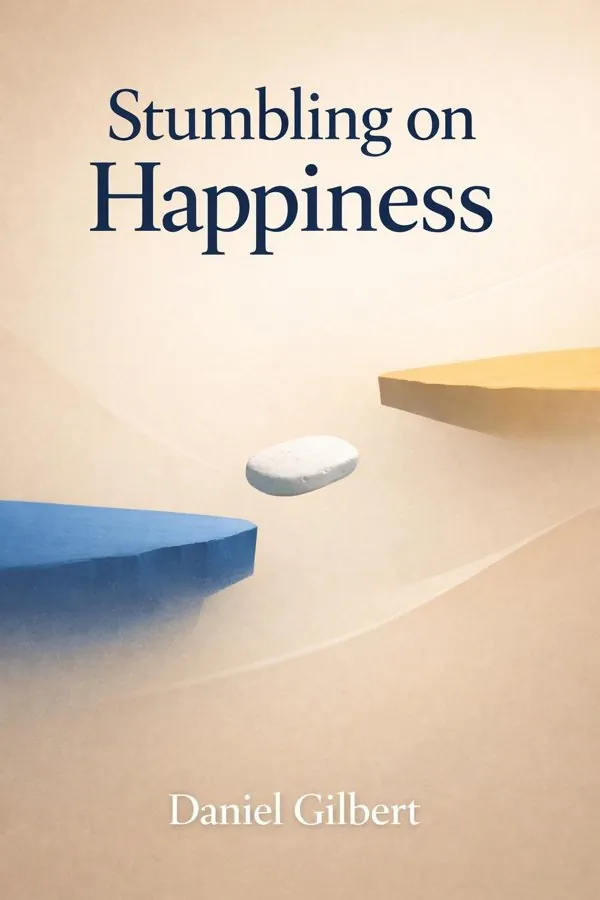
Stumbling on Happiness: Summary & Key Insights
 10 min9 chaptersAudio available
Key Takeaways from Stumbling on Happiness
One of the strangest truths about the human mind is that we spend enormous amounts of time in places that do not exist yet.
We trust memory because it feels like evidence.
What you experience is not reality in raw form but your brain’s best construction of it.
Happiness rarely arrives as a standalone feeling.
People routinely believe that future events will affect them for longer and more intensely than they actually do.
What Is Stumbling on Happiness About?
Stumbling on Happiness by Daniel Gilbert is a psychology book spanning 8 pages. Why do we work so hard to build a future we often end up misjudging? In Stumbling on Happiness, Harvard psychologist Daniel Gilbert explores one of the most fascinating flaws in human thinking: our inability to accurately predict what will make us happy. We imagine future promotions, relationships, purchases, failures, and disappointments with great confidence, yet those predictions are often wrong in surprisingly consistent ways. Gilbert shows that the mind is not a clear window onto reality but a meaning-making machine shaped by memory errors, perceptual distortions, and emotional blind spots. What makes this book so powerful is its mix of scientific rigor and wit. Drawing on research in psychology, neuroscience, and behavioral economics, Gilbert explains why we overestimate the lasting impact of future events, misunderstand our own preferences, and fail to appreciate how adaptable we really are. His central insight is both humbling and useful: if we want to make better decisions, we must first understand how unreliable our mental simulations can be. Stumbling on Happiness matters because it changes how we think about ambition, regret, choice, and well-being—and offers a smarter way to navigate life.
This FizzRead summary covers all 9 key chapters of Stumbling on Happiness in approximately 10 minutes, distilling the most important ideas, arguments, and takeaways from Daniel Gilbert's work. Also available as an audio summary and Key Quotes Podcast.
Stumbling on Happiness
Why do we work so hard to build a future we often end up misjudging? In Stumbling on Happiness, Harvard psychologist Daniel Gilbert explores one of the most fascinating flaws in human thinking: our inability to accurately predict what will make us happy. We imagine future promotions, relationships, purchases, failures, and disappointments with great confidence, yet those predictions are often wrong in surprisingly consistent ways. Gilbert shows that the mind is not a clear window onto reality but a meaning-making machine shaped by memory errors, perceptual distortions, and emotional blind spots.
What makes this book so powerful is its mix of scientific rigor and wit. Drawing on research in psychology, neuroscience, and behavioral economics, Gilbert explains why we overestimate the lasting impact of future events, misunderstand our own preferences, and fail to appreciate how adaptable we really are. His central insight is both humbling and useful: if we want to make better decisions, we must first understand how unreliable our mental simulations can be. Stumbling on Happiness matters because it changes how we think about ambition, regret, choice, and well-being—and offers a smarter way to navigate life.
Who Should Read Stumbling on Happiness?
This book is perfect for anyone interested in psychology and looking to gain actionable insights in a short read. Whether you're a student, professional, or lifelong learner, the key ideas from Stumbling on Happiness by Daniel Gilbert will help you think differently.
- ✓Readers who enjoy psychology and want practical takeaways
- ✓Professionals looking to apply new ideas to their work and life
- ✓Anyone who wants the core insights of Stumbling on Happiness in just 10 minutes
Want the full summary?
Get instant access to this book summary and 100K+ more with Fizz Moment.
Get Free SummaryAvailable on App Store • Free to download
Key Chapters
One of the strangest truths about the human mind is that we spend enormous amounts of time in places that do not exist yet. We rehearse conversations, imagine career changes, picture vacations, and simulate heartbreaks long before anything happens. This capacity is one of our greatest strengths, because it allows planning, anticipation, and creativity. But Daniel Gilbert argues that it is also a major source of error: the future we imagine is not the future we will experience.
The brain builds the future by recombining pieces of the past. It takes memories, expectations, fears, and desires and edits them into a plausible scene. That process feels accurate because the image is vivid and personal. But vividness is not the same as truth. We leave out inconvenient details, exaggerate emotional intensity, and assume our future self will react exactly as our current self expects. In other words, we do not so much preview the future as author it.
Consider someone imagining a new job. They picture the prestige, higher salary, and pride of telling friends about the promotion. What they often fail to imagine are the meetings, commutes, new pressures, office politics, and how quickly the novelty will fade. The fantasy highlights the exceptional moments and ignores the ordinary texture of daily life.
This matters because much of modern life is built on future-oriented decision-making. We choose partners, careers, cities, and purchases based on how we think they will make us feel. If our simulations are flawed, our choices will be too.
Actionable takeaway: Before making a major decision, assume your imagination is incomplete. Ask what ordinary details, hidden costs, and emotional adjustments you may be leaving out.
We trust memory because it feels like evidence. But Gilbert reminds us that memory is less like a video archive and more like a biased editor cutting together a story. We do not retrieve the past exactly as it happened; we reconstruct it from fragments, beliefs, and emotional meaning. As a result, the past we rely on to predict future happiness is often distorted from the start.
This has serious consequences. When we imagine how happy a beach vacation, a new apartment, or a breakup will make us, we usually consult memory for guidance. But if memory exaggerates the best moments, minimizes boredom, or reshapes painful experiences into meaningful lessons, then the advice it gives us is suspect. We may chase experiences because we remember them as more satisfying than they really were, or avoid risks because we remember prior discomfort as more devastating than it actually felt.
A common example is nostalgia. People remember college as a magical period of freedom and friendship, but forget the stress, loneliness, uncertainty, and financial pressure that were part of it. Likewise, they may recall a difficult job as intolerable, while omitting the competence, camaraderie, or growth it offered. Memory simplifies complexity and creates a cleaner narrative than lived experience ever was.
This tendency also helps explain why people repeat patterns. If your mind edits a past relationship to emphasize chemistry and connection while softening conflict, you may misjudge what a similar relationship will feel like in the future.
Actionable takeaway: Treat your memories as interpretations, not recordings. When predicting future happiness, write down what actually happened in past experiences—not just what your memory now prefers to highlight.
What you experience is not reality in raw form but your brain’s best construction of it. That insight sits at the heart of Gilbert’s argument. Just as the mind fills visual gaps and creates coherent scenes from limited information, it also fills psychological gaps when judging situations, people, and future outcomes. We feel as though we are perceiving the world directly, but much of what we ‘see’ is inferred.
This matters for happiness because our judgments depend on context, framing, and hidden assumptions. A glass of wine tastes better when we believe it is expensive. A medical treatment seems more promising when described in terms of survival rather than mortality. A social interaction appears insulting or respectful depending on the story we tell ourselves about another person’s intentions. In each case, our emotional response is shaped not just by the event but by the interpretation layered onto it.
Perception’s constructive nature also affects self-knowledge. We think we know what situations are objectively pleasant or painful, when in fact our reactions are heavily influenced by comparison, expectation, and attention. A delayed flight may feel unbearable if you expected convenience, yet tolerable if you expected chaos. The event is the same; the experienced reality is not.
Gilbert’s broader point is that the mind is constantly making invisible corrections and assumptions. Because these processes happen automatically, we rarely notice them. We mistake our interpretation for the world itself.
Actionable takeaway: When a situation feels obviously wonderful or awful, pause and ask: What part of this reaction comes from the facts, and what part comes from my framing, assumptions, or expectations?
Happiness rarely arrives as a standalone feeling. More often, it is produced through comparison. We judge our salary against a colleague’s, our vacation against someone else’s photos, our home against the one we almost bought, and our current life against the life we imagined. Gilbert shows that much of what we call satisfaction or disappointment comes from relative evaluation rather than absolute experience.
This explains why people can feel miserable after a success or content despite modest circumstances. A raise feels great until you learn someone else got more. A smaller apartment feels charming until you tour a larger one. A good meal seems average after a spectacular one. The human mind does not assess things in isolation; it places them beside alternatives, memories, expectations, and social benchmarks.
Comparison is not always harmful. It helps us make distinctions and choices. But it becomes a trap when we assume that improving our position in a comparison game will produce lasting happiness. Often it produces only temporary relief before the mind recalibrates and finds a new standard. This is one reason status competitions can feel endless.
In everyday life, comparison can distort major decisions. Someone might choose a higher-paying job with worse hours because it looks better next to peers’ careers, even if the lived experience would be less satisfying. Another might undervalue a stable relationship because it lacks the drama of an imagined alternative.
Actionable takeaway: When evaluating a decision, separate the actual experience from the comparison surrounding it. Ask yourself: If no one else knew about this choice, would it still feel meaningful and satisfying to me?
People routinely believe that future events will affect them for longer and more intensely than they actually do. Gilbert calls attention to one of the mind’s most important blind spots: we underestimate our psychological immune system, the collection of mental processes that help us recover from setbacks, reinterpret adversity, and regain emotional balance.
When imagining failure, rejection, illness, or embarrassment, we focus on the immediate sting and assume it will define our future. But in real life, people adapt. They rationalize, find meaning, shift priorities, discover new pleasures, and revise expectations. None of this means pain is fake or that tragedy is easy. It means the human mind is built to heal more than it expects.
This insight is powerful because fear of lasting unhappiness drives many choices. People stay in unfulfilling jobs because they dread the regret of leaving. They avoid difficult conversations because they imagine enduring shame. They cling to bad relationships because a breakup feels emotionally unsurvivable. Yet much of that dread comes from a failure to appreciate how resilient they will be once circumstances change.
Gilbert also notes that we misjudge positive change in the same way. We assume winning, succeeding, or acquiring something desirable will transform life permanently, when in fact adaptation softens gains as well as losses. The emotional system seeks equilibrium.
Actionable takeaway: When forecasting how a future event will affect you, widen the timeline. Imagine not just the first emotional reaction, but how you will likely think, cope, and adjust three months later.
We usually think more options mean more freedom and therefore more happiness. Gilbert complicates that assumption by showing how choice can intensify regret, self-blame, and dissatisfaction. The more alternatives we consider, the easier it becomes to imagine the better life we might have had. Instead of enjoying what we chose, we mentally revisit what we rejected.
This is especially true when decisions are reversible. If you can return the item, change the plan, leave the role, or keep searching for something better, your mind may never fully commit to the present experience. You continue evaluating rather than inhabiting. Ironically, the freedom to undo a choice can reduce satisfaction with the choice itself.
Think about buying a couch, choosing a university, or selecting a restaurant from a huge menu. After deciding, many people keep scanning for evidence that they chose correctly. If the outcome is merely good rather than perfect, the unchosen alternatives become sources of irritation. In relationships and careers, this can be even more destabilizing. Constant awareness of other options makes gratitude harder and second-guessing easier.
Gilbert’s point is not that choice is bad, but that our minds are not great at handling abundant possibilities. We often imagine that maximizing will make us happy, when in reality it may simply exhaust us and sharpen regret.
Actionable takeaway: For many decisions, choose carefully, then close the mental door. Limit post-decision comparison and give yourself permission to invest fully in the path you selected.
One of Gilbert’s most surprising claims is that when we want to know how an experience will feel, we are often better off asking other people who have already had that experience than relying on our own imagination. This sounds counterintuitive because personal futures seem unique. We assume no one else can tell us how we will feel about marriage, divorce, moving cities, becoming a parent, or changing careers. But the evidence suggests otherwise.
Humans share more emotional commonality than we like to admit. While circumstances vary, the broad patterns of adaptation, disappointment, pleasure, and meaning are often remarkably consistent. Yet we distrust others’ reports because they seem too generic, and we overvalue the detailed simulations generated by our own minds because they feel personal and precise.
Imagine deciding whether to take a demanding job in a new city. You might construct an elaborate mental movie about exciting restaurants, personal reinvention, and professional prestige. Meanwhile, people already living that reality can tell you something simpler but more useful: the work is stimulating, the commute is draining, and the novelty fades faster than expected. Their report may lack your fantasy’s richness, but it is grounded in actual experience.
Gilbert argues that “surrogation,” using other people’s experiences as a guide, is one of the most reliable ways to improve affective forecasting. We resist it because we want to believe our happiness is highly individual. Often it is less unique than we think.
Actionable takeaway: Before a major life decision, find people who are living the outcome you are considering. Ask how they actually feel day to day, not just what they hoped it would be like.
A powerful source of unhappiness is the gap between what we expect to feel and what we actually feel. Gilbert shows that expectations do not merely predict experience; they shape it. They guide attention, influence interpretation, and determine whether we classify an outcome as satisfying, disappointing, unfair, or thrilling.
If you expect a wedding, a promotion, or a dream trip to be life-changing, ordinary imperfections can feel disproportionately deflating. The event may still be good, but because it failed to deliver the imagined emotional transformation, it registers as a letdown. On the other hand, when expectations are modest, the same experience can feel surprisingly rewarding.
This confusion is especially common in consumer culture, where products and milestones are marketed not as useful additions to life but as gateways to a new self. We do not just buy a car; we buy confidence. We do not just plan a move; we imagine renewal. We do not just seek a relationship; we seek permanent emotional arrival. When the lived experience turns out to be more ordinary, we may blame the choice rather than the inflated expectation.
Gilbert’s insight encourages a more realistic emotional economy. Happiness often comes not from securing extraordinary outcomes but from engaging more honestly with ordinary life. Expectations that are too dramatic can rob us of the ability to enjoy what is actually present.
Actionable takeaway: Before pursuing a major goal, define success in concrete terms. Focus on what the experience is likely to be day by day, rather than on the identity or emotional transformation you hope it will deliver.
Perhaps the deepest lesson of Stumbling on Happiness is that wise living begins with admitting how little we know about our future feelings. We are confident forecasters of our own emotional lives, yet repeatedly mistaken. We overestimate intensity, duration, uniqueness, and certainty. Gilbert’s work is not a cynical attack on happiness; it is a call for humility about the machinery we use to pursue it.
This humility has practical value. It makes us less dogmatic about life plans, less terrified of setbacks, and less seduced by fantasies. It helps us see that many decisions do not require perfect prediction. We can move forward while recognizing uncertainty. We can design lives that are flexible, informed, and open to revision rather than built on exaggerated emotional certainties.
Humility also makes us kinder to ourselves and others. If people often mispredict what will make them happy, then some poor choices are not signs of stupidity or weakness but of being human. We all operate with a forecasting system that feels authoritative while being systematically flawed.
The result is a more grounded approach to well-being. Instead of asking, “What single future outcome will finally make me happy?” we ask better questions: “What do people in this situation actually experience? How adaptable am I likely to be? What comparisons are distorting my judgment? What kind of life is sustainable, not just exciting to imagine?”
Actionable takeaway: Replace certainty with curiosity. The next time you make a major decision, treat your happiness prediction as a hypothesis to test—not a fact to obey.
All Chapters in Stumbling on Happiness
About the Author
Daniel Gilbert is a Harvard psychologist, bestselling author, and leading researcher in the science of happiness and human judgment. He is best known for his work on affective forecasting—the study of how people predict their future emotions—and for showing how often those predictions go wrong. As a professor of psychology at Harvard University, Gilbert has published widely on topics such as imagination, decision-making, belief, and subjective well-being. He became widely known to general readers through Stumbling on Happiness, which translated complex psychological research into witty, accessible prose. Gilbert is also a popular speaker whose work has appeared in major media outlets and academic journals. His writing stands out for combining scientific depth with humor, clarity, and practical relevance to everyday life.
Get This Summary in Your Preferred Format
Read or listen to the Stumbling on Happiness summary by Daniel Gilbert anytime, anywhere. FizzRead offers multiple formats so you can learn on your terms — all free.
Available formats: App · Audio · PDF · EPUB — All included free with FizzRead
Download Stumbling on Happiness PDF and EPUB Summary
Key Quotes from Stumbling on Happiness
“One of the strangest truths about the human mind is that we spend enormous amounts of time in places that do not exist yet.”
“We trust memory because it feels like evidence.”
“What you experience is not reality in raw form but your brain’s best construction of it.”
“Happiness rarely arrives as a standalone feeling.”
“People routinely believe that future events will affect them for longer and more intensely than they actually do.”
Frequently Asked Questions about Stumbling on Happiness
Stumbling on Happiness by Daniel Gilbert is a psychology book that explores key ideas across 9 chapters. Why do we work so hard to build a future we often end up misjudging? In Stumbling on Happiness, Harvard psychologist Daniel Gilbert explores one of the most fascinating flaws in human thinking: our inability to accurately predict what will make us happy. We imagine future promotions, relationships, purchases, failures, and disappointments with great confidence, yet those predictions are often wrong in surprisingly consistent ways. Gilbert shows that the mind is not a clear window onto reality but a meaning-making machine shaped by memory errors, perceptual distortions, and emotional blind spots. What makes this book so powerful is its mix of scientific rigor and wit. Drawing on research in psychology, neuroscience, and behavioral economics, Gilbert explains why we overestimate the lasting impact of future events, misunderstand our own preferences, and fail to appreciate how adaptable we really are. His central insight is both humbling and useful: if we want to make better decisions, we must first understand how unreliable our mental simulations can be. Stumbling on Happiness matters because it changes how we think about ambition, regret, choice, and well-being—and offers a smarter way to navigate life.
You Might Also Like
The Body Keeps the Score
Bessel van der Kolk
10 min
Surrounded by Idiots
Thomas Erikson
10 min
Emotional Intelligence
Daniel Goleman
10 min
Attached
Amir Levine
10 min
Why Does He Do That
Lundy Bancroft
10 min
Women Who Run with the Wolves
Clarissa Pinkola Estés
10 minBrowse by Category
Ready to read Stumbling on Happiness?
Get the full summary and 100K+ more books with Fizz Moment.