
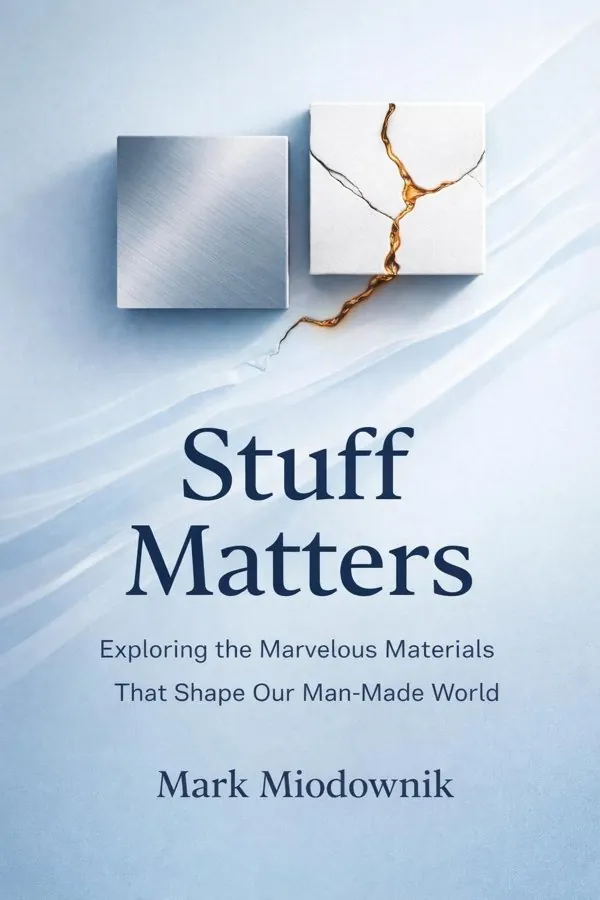
Stuff Matters: Exploring the Marvelous Materials That Shape Our Man-Made World: Summary & Key Insights
 10 min10 chaptersAudio available
What Is Stuff Matters: Exploring the Marvelous Materials That Shape Our Man-Made World About?
Stuff Matters: Exploring the Marvelous Materials That Shape Our Man-Made World by Mark Miodownik is a popular_sci book spanning 10 pages. This book explores the fascinating world of materials science, revealing how everyday substances—from steel and paper to chocolate and porcelain—shape our lives and civilization. Miodownik combines scientific insight with engaging storytelling to show the hidden beauty and complexity of the materials that make up our world.
This FizzRead summary covers all 10 key chapters of Stuff Matters: Exploring the Marvelous Materials That Shape Our Man-Made World in approximately 10 minutes, distilling the most important ideas, arguments, and takeaways from Mark Miodownik's work. Also available as an audio summary and Key Quotes Podcast.
Stuff Matters: Exploring the Marvelous Materials That Shape Our Man-Made World
This book explores the fascinating world of materials science, revealing how everyday substances—from steel and paper to chocolate and porcelain—shape our lives and civilization. Miodownik combines scientific insight with engaging storytelling to show the hidden beauty and complexity of the materials that make up our world.
Who Should Read Stuff Matters: Exploring the Marvelous Materials That Shape Our Man-Made World?
This book is perfect for anyone interested in popular_sci and looking to gain actionable insights in a short read. Whether you're a student, professional, or lifelong learner, the key ideas from Stuff Matters: Exploring the Marvelous Materials That Shape Our Man-Made World by Mark Miodownik will help you think differently.
- ✓Readers who enjoy popular_sci and want practical takeaways
- ✓Professionals looking to apply new ideas to their work and life
- ✓Anyone who wants the core insights of Stuff Matters: Exploring the Marvelous Materials That Shape Our Man-Made World in just 10 minutes
Want the full summary?
Get instant access to this book summary and 100K+ more with Fizz Moment.
Get Free SummaryAvailable on App Store • Free to download
Key Chapters
Steel, to me, is elegance and danger condensed into one material. When I was younger, the knife that cut me was steel, but so too are the bridges that hold cities together and the scalpels that heal. This duality captures the essence of human civilization—how we harness the elements for good and ill through our mastery of materials.
Steel’s story is one of transformation: iron, a dull and pliant metal, reborn through controlled impurity. The addition of carbon grants it strength and resilience far beyond its natural form. In this transformation lies the very blueprint of human progress—our ability to take what nature gives and improve upon it.
When we built with stone, we created monuments. When we forged steel, we created movement. Skyscrapers, railways, and ships—all exist because we learned how to align the atomic structure of a material to our will. But steel’s beauty is not only functional. There’s a visual poetry in its sheen, a sense of permanence in its weight. From the cold precision of a surgical instrument to the soaring arcs of modern architecture, steel reflects our confidence and our ambition.
Though modern technology now explores lighter and smarter materials, steel remains central to our lives. It endures because it captures something fundamental: the idea that strength can emerge from the right balance of elements, that perfection is built from imperfection.
If steel gave us strength, paper gave us thought. The story of paper is the story of our collective mind made visible. We use it to write, draw, design, and dream. It’s the simplest of materials: a mat of interwoven cellulose fibers born from trees. Yet it revolutionized human communication, turning fleeting ideas into tangible memory.
Before paper, knowledge was heavy—stored in clay, wood, or animal skin. Then came a light, flexible, and democratic surface that could fold into letters or stack into libraries. Its texture invites touch; its smell invokes nostalgia. The faint crackle of a turning page becomes a sensory symbol of learning itself.
What often surprises people is that paper is a marvel of micro-engineering. Its strength arises from hydrogen bonds invisible to the naked eye, holding fibers together in delicate yet durable harmony. Even the torn edge of a sheet reveals this structure—a feathery reminder that within every piece of paper lies both fragility and fortitude.
In a world increasingly digital, I still believe paper has spiritual significance. To write by hand is to slow down thought, to let ink bleed into fiber until meaning becomes substance. Paper is our oldest interface between the physical and the intellectual world, and perhaps it remains our most human one.
+ 8 more chapters — available in the FizzRead app
All Chapters in Stuff Matters: Exploring the Marvelous Materials That Shape Our Man-Made World
About the Author
Mark Miodownik is a British materials scientist, engineer, and broadcaster. He is a professor of materials and society at University College London and is known for his work in promoting public understanding of science through books and television.
Get This Summary in Your Preferred Format
Read or listen to the Stuff Matters: Exploring the Marvelous Materials That Shape Our Man-Made World summary by Mark Miodownik anytime, anywhere. FizzRead offers multiple formats so you can learn on your terms — all free.
Available formats: App · Audio · PDF · EPUB — All included free with FizzRead
Download Stuff Matters: Exploring the Marvelous Materials That Shape Our Man-Made World PDF and EPUB Summary
Key Quotes from Stuff Matters: Exploring the Marvelous Materials That Shape Our Man-Made World
“Steel, to me, is elegance and danger condensed into one material.”
“If steel gave us strength, paper gave us thought.”
Frequently Asked Questions about Stuff Matters: Exploring the Marvelous Materials That Shape Our Man-Made World
Stuff Matters: Exploring the Marvelous Materials That Shape Our Man-Made World by Mark Miodownik is a popular_sci book that explores key ideas across 10 chapters. This book explores the fascinating world of materials science, revealing how everyday substances—from steel and paper to chocolate and porcelain—shape our lives and civilization. Miodownik combines scientific insight with engaging storytelling to show the hidden beauty and complexity of the materials that make up our world.
You Might Also Like

Structures: Or Why Things Don"t Fall Down
J.E. Gordon
10 min
The Road to Wigan Pier
George Orwell
10 min
Bonk: The Curious Coupling of Science and Sex
Mary Roach
10 min
First Bite: How We Learn to Eat
Bee Wilson
10 min
In Pursuit Of The Unknown: 17 Equations That Changed The World
Ian Stewart
10 min
Napoleon's Buttons: 17 Molecules That Changed History
Penny Le Couteur and Jay Burreson
10 minBrowse by Category
Ready to read Stuff Matters: Exploring the Marvelous Materials That Shape Our Man-Made World?
Get the full summary and 100K+ more books with Fizz Moment.