
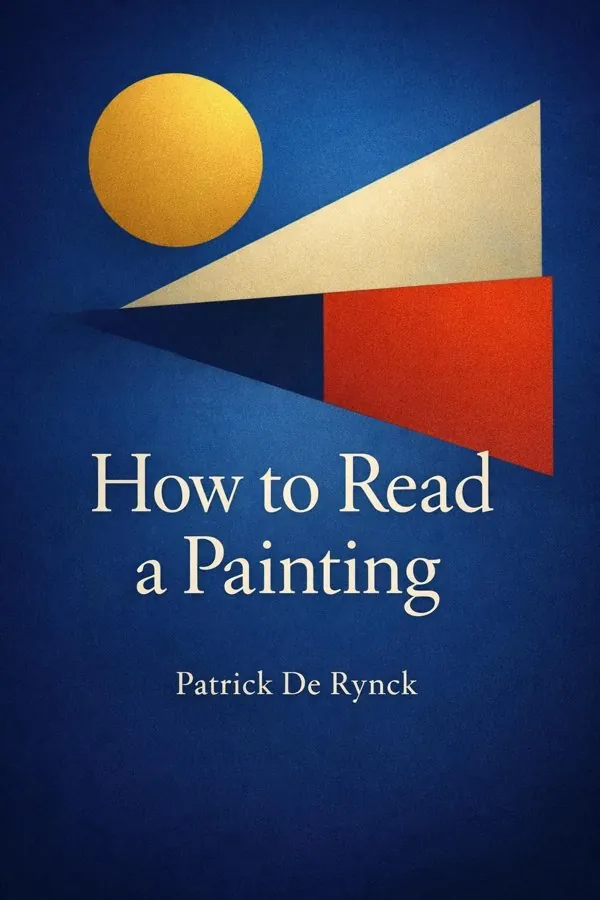
How to Read a Painting: From Giotto to Jackson Pollock: Summary & Key Insights
 10 min10 chaptersAudio available
What Is How to Read a Painting: From Giotto to Jackson Pollock About?
How to Read a Painting: From Giotto to Jackson Pollock by Patrick De Rynck is a art_history book spanning 10 pages. This book offers an accessible guide to understanding paintings from the Middle Ages to modern times. Patrick De Rynck explains how composition, color, symbolism, and context contribute to the meaning of a work of art. It combines art historical insight with practical guidance to help readers learn the visual language of painting.
This FizzRead summary covers all 10 key chapters of How to Read a Painting: From Giotto to Jackson Pollock in approximately 10 minutes, distilling the most important ideas, arguments, and takeaways from Patrick De Rynck's work. Also available as an audio summary and Key Quotes Podcast.
How to Read a Painting: From Giotto to Jackson Pollock
This book offers an accessible guide to understanding paintings from the Middle Ages to modern times. Patrick De Rynck explains how composition, color, symbolism, and context contribute to the meaning of a work of art. It combines art historical insight with practical guidance to help readers learn the visual language of painting.
Who Should Read How to Read a Painting: From Giotto to Jackson Pollock?
This book is perfect for anyone interested in art_history and looking to gain actionable insights in a short read. Whether you're a student, professional, or lifelong learner, the key ideas from How to Read a Painting: From Giotto to Jackson Pollock by Patrick De Rynck will help you think differently.
- ✓Readers who enjoy art_history and want practical takeaways
- ✓Professionals looking to apply new ideas to their work and life
- ✓Anyone who wants the core insights of How to Read a Painting: From Giotto to Jackson Pollock in just 10 minutes
Want the full summary?
Get instant access to this book summary and 100K+ more with Fizz Moment.
Get Free SummaryAvailable on App Store • Free to download
Key Chapters
To read a painting, we must first become aware of its structure, its internal architecture. Artists construct space deliberately, guiding your eye through invisible geometry. In early Western art, composition was both symbolic and functional—its structure carried meaning long before naturalism took hold. Medieval masters placed Christ at the center not merely because He was the subject, but because spatial hierarchy expressed divine order. Every element had a meaning born of position.
Composition became the silent mathematics of faith. Yet beneath that symbolism lay experimentation with how figures could inhabit space. Painters gradually learned that balance could evoke harmony and that diagonal lines could create movement. The transition from flat decorative surface to illusionistic depth was, in fact, the birth of perspective—a revolution in seeing.
Perspective offered a means to place the viewer within the painting. It began as a spiritual metaphor, reflecting the individual’s personal relationship to the divine, but soon evolved into a scientific system. The geometry of vision taught painters that space could be rational and ordered, that images could replicate reality faithfully. When you analyze an early painting, pay attention to this dance between flatness and depth, between symbol and sensation. Composition is both the painter’s logic and emotion; perspective transforms that logic into a believable world.
Thus, to read any painting, start by tracing its internal map. Lines, edges, and focal points guide your interpretation. Spacing is never accidental. Whether it is Giotto’s careful staging in the Scrovegni Chapel or Duccio’s elegant grouping of figures, organization teaches how meaning and visual structure fuse. Once you become aware of this foundational layer, subsequent innovations will reveal themselves as extensions and challenges to it.
Giotto di Bondone stands at the turning point between imagination and observation. Before him, figures floated within golden skies—timeless icons disconnected from physical life. Giotto dared to incarnate divinity within human flesh. His figures occupy real space, cast shadows, weigh upon the ground, express emotion with gesture and face. This was no small revolution: he replaced the language of strict symbolism with the grammar of human experience.
In his frescoes at Padua, the divine story unfolds like theater. Architecture frames action, gestures link figures, and light sets emotional tone. Giotto transformed the wall into a stage upon which heaven and earth could meet. This realism was not about copying nature, but about making faith tangible. He offered the viewer empathy as a path to understanding—Mary grieving like a mother, Christ suffering like a man. The viewer could now participate emotionally.
Giotto’s innovation established the foundation of a pictorial tradition that sought truth through observation. His spatial constructions, such as converging lines and continuous architecture, invited narrative coherence—each scene part of a larger story told through visual connection. Reading Giotto teaches us how vision becomes narrative: every gesture is a word, every directional gaze a sentence.
He taught generations to look beyond the gold background, to discover humanity behind symbolism. His legacy was not just improved technique but the conception of painting as a mirror for the soul’s drama. In learning to read his art, we witness the birth of Western realism—the moment when art began to speak our emotional language rather than an abstract code.
+ 8 more chapters — available in the FizzRead app
All Chapters in How to Read a Painting: From Giotto to Jackson Pollock
About the Author
Patrick De Rynck is a Belgian author and art historian specializing in classical and modern art. He has written several books on art interpretation and cultural history and frequently collaborates with museums and publishers in Flanders and the Netherlands.
Get This Summary in Your Preferred Format
Read or listen to the How to Read a Painting: From Giotto to Jackson Pollock summary by Patrick De Rynck anytime, anywhere. FizzRead offers multiple formats so you can learn on your terms — all free.
Available formats: App · Audio · PDF · EPUB — All included free with FizzRead
Download How to Read a Painting: From Giotto to Jackson Pollock PDF and EPUB Summary
Key Quotes from How to Read a Painting: From Giotto to Jackson Pollock
“To read a painting, we must first become aware of its structure, its internal architecture.”
“Giotto di Bondone stands at the turning point between imagination and observation.”
Frequently Asked Questions about How to Read a Painting: From Giotto to Jackson Pollock
How to Read a Painting: From Giotto to Jackson Pollock by Patrick De Rynck is a art_history book that explores key ideas across 10 chapters. This book offers an accessible guide to understanding paintings from the Middle Ages to modern times. Patrick De Rynck explains how composition, color, symbolism, and context contribute to the meaning of a work of art. It combines art historical insight with practical guidance to help readers learn the visual language of painting.
You Might Also Like
Studies In Impressionism
John Rewald
10 min
Art Since 1900: Modernism, Antimodernism, Postmodernism
Hal Foster, Rosalind E. Krauss, Yve-Alain Bois, Benjamin H. D. Buchloh
10 min
Art Since 1940: Strategies of Being
Jonathan Fineberg
10 min
Color and Meaning: Art, Science, and Symbolism
John Gage
10 min
Color: Travels Through the Paintbox
Victoria Finlay
10 min
Curatorial Activism: Towards an Ethics of Curating
Maura Reilly
10 minBrowse by Category
Ready to read How to Read a Painting: From Giotto to Jackson Pollock?
Get the full summary and 100K+ more books with Fizz Moment.