
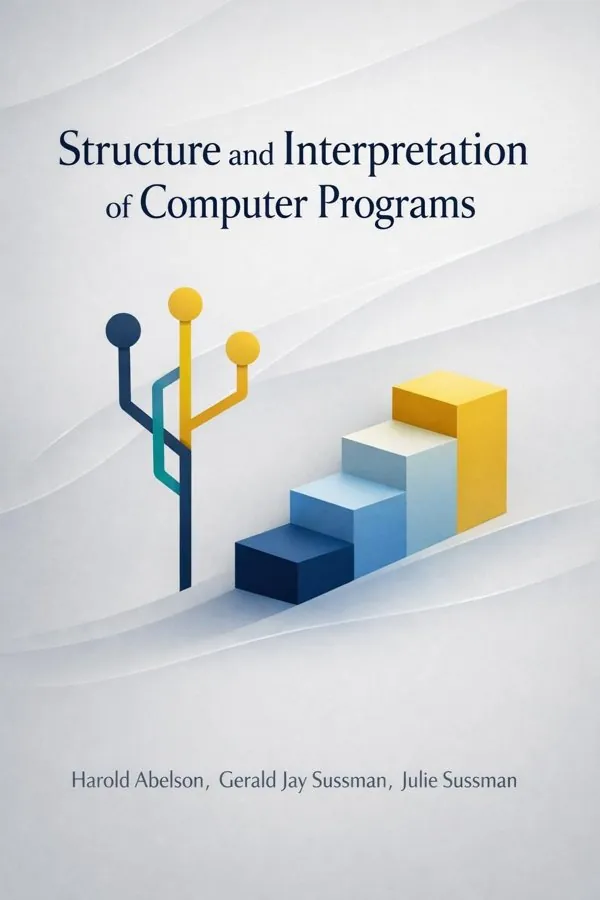
Structure and Interpretation of Computer Programs: Summary & Key Insights
by Harold Abelson, Gerald Jay Sussman, Julie Sussman
 10 min10 chaptersAudio available
What Is Structure and Interpretation of Computer Programs About?
Structure and Interpretation of Computer Programs by Harold Abelson, Gerald Jay Sussman, Julie Sussman is a programming book spanning 10 pages. Structure and Interpretation of Computer Programs (SICP) is a foundational textbook in computer science that introduces the principles of programming languages, abstraction, recursion, modularity, and metalinguistic abstraction. Using the Scheme programming language, it teaches how to think about computation and how to design programs that are both elegant and efficient. The book emphasizes the importance of understanding the underlying processes of computation rather than focusing solely on syntax or specific programming paradigms.
This FizzRead summary covers all 10 key chapters of Structure and Interpretation of Computer Programs in approximately 10 minutes, distilling the most important ideas, arguments, and takeaways from Harold Abelson, Gerald Jay Sussman, Julie Sussman's work. Also available as an audio summary and Key Quotes Podcast.
Structure and Interpretation of Computer Programs
Structure and Interpretation of Computer Programs (SICP) is a foundational textbook in computer science that introduces the principles of programming languages, abstraction, recursion, modularity, and metalinguistic abstraction. Using the Scheme programming language, it teaches how to think about computation and how to design programs that are both elegant and efficient. The book emphasizes the importance of understanding the underlying processes of computation rather than focusing solely on syntax or specific programming paradigms.
Who Should Read Structure and Interpretation of Computer Programs?
This book is perfect for anyone interested in programming and looking to gain actionable insights in a short read. Whether you're a student, professional, or lifelong learner, the key ideas from Structure and Interpretation of Computer Programs by Harold Abelson, Gerald Jay Sussman, Julie Sussman will help you think differently.
- ✓Readers who enjoy programming and want practical takeaways
- ✓Professionals looking to apply new ideas to their work and life
- ✓Anyone who wants the core insights of Structure and Interpretation of Computer Programs in just 10 minutes
Want the full summary?
Get instant access to this book summary and 100K+ more with Fizz Moment.
Get Free SummaryAvailable on App Store • Free to download
Key Chapters
Every meaningful program begins with a simple idea: compose small building blocks into larger ones through abstraction. In Scheme, this takes form through procedures. A procedure is more than just a way to organize code—it is a mental model of a process. We start with primitive expressions—numbers, basic operations, and function applications. When we define a procedure, we capture a method of computation so that it becomes reusable, manipulable, and intellectually portable.
Procedural abstraction is the foundation of software construction. By defining a procedure, we give a name to a process, freeing ourselves from its internal details. This freedom allows us to build complexity in layers. Consider how we describe a mathematical operation like factorial: the recursive structure mirrors mathematical induction. The elegance lies not in the mechanics of recursion, but in the way it mirrors reasoning itself—reducing a complex problem into smaller instances until the solution becomes trivial.
Soon you learn to compose procedures: one procedure calling another, layers of logic intertwining. The act of composing these abstractions builds mental clarity. The creator of such systems is not merely coding but constructing a hierarchy of ideas. In this sense, programming becomes a means to organize knowledge. Scheme helps you do this cleanly because of its uniform evaluation rules. Through writing recursive definitions and combining them with conditional logic, you train yourself to think in patterns that promote generalization. At this stage, programming ceases to be mechanical—it becomes a language of thought.
Having defined procedures, we next explore what they actually *do* when executed. A procedure generates a computational process—a dynamic unfolding in time of steps that consume resources and yield results. Understanding this distinction between procedure and process is crucial.
Take the simple example of computing a factorial. Two distinctive processes arise depending on how we define our method: one recursive, one iterative. Though both produce the same result, their internal mechanisms differ profoundly. The recursive version grows and contracts—a cascade of deferred operations that finally collapse into a result. The iterative version, by contrast, maintains constant space, evolving through the accumulation of state variables. These patterns reveal that *how* a process uses time and space is as significant as *what* it computes.
This exploration teaches a fundamental discipline: to reason about efficiency is to reason about process structure. A recursive definition might appear elegant, but elegance alone is not efficiency. As we analyze growth and resource usage, we learn to predict how our programs behave, not just what they compute. This kind of reasoning extends naturally to all computation—from simple arithmetic to symbolic transformation. When you begin to perceive programs as processes, you transcend syntax and start seeing dynamics. You learn to design computational systems that balance expressiveness and performance—a harmony between human understanding and machine execution.
+ 8 more chapters — available in the FizzRead app
All Chapters in Structure and Interpretation of Computer Programs
About the Authors
Harold Abelson and Gerald Jay Sussman are professors at the Massachusetts Institute of Technology (MIT) and pioneers in computer science education. Julie Sussman is a software engineer and technical writer who contributed to the book’s editing and pedagogical clarity. Together, they have influenced generations of programmers through their work on SICP and their contributions to the MIT curriculum.
Get This Summary in Your Preferred Format
Read or listen to the Structure and Interpretation of Computer Programs summary by Harold Abelson, Gerald Jay Sussman, Julie Sussman anytime, anywhere. FizzRead offers multiple formats so you can learn on your terms — all free.
Available formats: App · Audio · PDF · EPUB — All included free with FizzRead
Download Structure and Interpretation of Computer Programs PDF and EPUB Summary
Key Quotes from Structure and Interpretation of Computer Programs
“Every meaningful program begins with a simple idea: compose small building blocks into larger ones through abstraction.”
“Having defined procedures, we next explore what they actually *do* when executed.”
Frequently Asked Questions about Structure and Interpretation of Computer Programs
Structure and Interpretation of Computer Programs by Harold Abelson, Gerald Jay Sussman, Julie Sussman is a programming book that explores key ideas across 10 chapters. Structure and Interpretation of Computer Programs (SICP) is a foundational textbook in computer science that introduces the principles of programming languages, abstraction, recursion, modularity, and metalinguistic abstraction. Using the Scheme programming language, it teaches how to think about computation and how to design programs that are both elegant and efficient. The book emphasizes the importance of understanding the underlying processes of computation rather than focusing solely on syntax or specific programming paradigms.
You Might Also Like
ANSI Common Lisp
Paul Graham
10 min
Automate the Boring Stuff with Python: Practical Programming for Total Beginners
Al Sweigart
10 min
Black Hat Python: Python Programming for Hackers and Pentesters
Justin Seitz
10 min
Building Microservices: Designing Fine-Grained Systems
Sam Newman
10 min
C++ Primer
Stanley B. Lippman, Josée Lajoie, Barbara E. Moo
10 min
Clean Code: A Handbook of Agile Software Craftsmanship
Robert C. Martin
10 minBrowse by Category
Ready to read Structure and Interpretation of Computer Programs?
Get the full summary and 100K+ more books with Fizz Moment.