
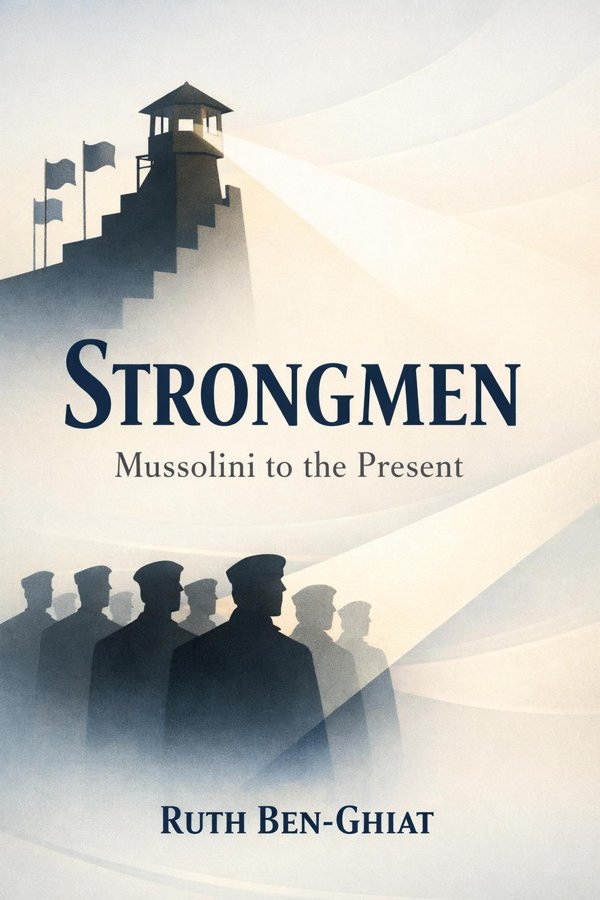
Strongmen: Mussolini to the Present: Summary & Key Insights
 10 min9 chaptersAudio available
What Is Strongmen: Mussolini to the Present About?
Strongmen: Mussolini to the Present by Ruth Ben-Ghiat is a politics book spanning 9 pages. A study of authoritarian leaders from Mussolini to the present day, examining how strongmen rise to power, maintain control, and shape societies through propaganda, violence, and charisma. The book explores the patterns of authoritarian rule and the ways democracies can resist such figures.
This FizzRead summary covers all 9 key chapters of Strongmen: Mussolini to the Present in approximately 10 minutes, distilling the most important ideas, arguments, and takeaways from Ruth Ben-Ghiat's work. Also available as an audio summary and Key Quotes Podcast.
Strongmen: Mussolini to the Present
A study of authoritarian leaders from Mussolini to the present day, examining how strongmen rise to power, maintain control, and shape societies through propaganda, violence, and charisma. The book explores the patterns of authoritarian rule and the ways democracies can resist such figures.
Who Should Read Strongmen: Mussolini to the Present?
This book is perfect for anyone interested in politics and looking to gain actionable insights in a short read. Whether you're a student, professional, or lifelong learner, the key ideas from Strongmen: Mussolini to the Present by Ruth Ben-Ghiat will help you think differently.
- ✓Readers who enjoy politics and want practical takeaways
- ✓Professionals looking to apply new ideas to their work and life
- ✓Anyone who wants the core insights of Strongmen: Mussolini to the Present in just 10 minutes
Want the full summary?
Get instant access to this book summary and 100K+ more with Fizz Moment.
Get Free SummaryAvailable on App Store • Free to download
Key Chapters
When Mussolini seized power in Italy in 1922, he inaugurated the modern template for authoritarian rule. His approach combined mass mobilization, media spectacle, and personal mythmaking into an invention that would echo throughout the twentieth century. Mussolini presented himself as Il Duce — the leader who embodied the will of the nation. His speeches, broadcast by radio and immortalized in visuals of him shirtless at work or astride horses, constructed a masculine image meant to reassure Italians that virility equaled stability.
Mussolini didn’t merely consolidate politics; he reshaped identity. Through rituals, uniforms, and a controlled press, he made fascism a lived experience. Citizens were encouraged to see themselves as participants in a grand civilizational revival. The theater of fascism blurred boundaries between truth and fiction, presenting obedience as belonging. Violence was never peripheral; it served as proof of resolve. By crushing opposition, Mussolini legitimized brutality as national pride. This logic — that the leader’s violence cleanses and protects — became central to every strongman who followed.
He also pioneered what I call 'authoritarian masculinity': the conflation of virility with political power. His presence was ubiquitous, his image curated. Mussolini understood that political domination required emotional engagement. Italians were not merely governed; they were seduced. In his Italy, institutions bent toward his persona, creating the 'leader state' — a system where loyalty mattered more than law.
The Fascist model would be copied, mutated, and exported. It showed that control doesn’t rely solely on coercion; it thrives through myth. Mussolini taught the world how spectacle could substitute for substance, and how propaganda could make dictatorship appear destiny.
Adolf Hitler followed Mussolini’s script closely but took it to its totalitarian extreme. In Nazi Germany, Mussolini’s aesthetic of power was fused with racial ideology and mass terror. Hitler admired Mussolini’s ability to fuse leader and state, yet he perfected the psychology of devotion. Through orchestrated rallies, symbolic architecture, and cinematic propaganda, he transformed spectatorship into submission. What Mussolini initiated as performative politics, Hitler evolved into total absorption — the leader as both redeemer and avenger.
In Spain, Francisco Franco adopted the trappings of authoritarianism but tailored them to conservative Catholicism rather than revolutionary fervor. Where Hitler and Mussolini promised rebirth, Franco offered restoration. His control stemmed from fear rather than charisma, bureaucracy rather than mobilization. Yet all three understood the same truth: authoritarian power depends on narrative control. Whether through myths of racial purity, national revival, or divine sanction, each figure cast himself as the singular agent of destiny.
These variations remind us that authoritarianism is never a monolith. It mutates within local histories, taking on religious, military, or populist hues, but its essence remains rooted in domination. The twentieth century became a laboratory of imitation, each strongman absorbing lessons from the other — the manipulation of media, the crafting of enemy images, the centralization of personality cults. By the end of World War II, the strongman had become an international archetype, recognizable across cultures.
+ 7 more chapters — available in the FizzRead app
All Chapters in Strongmen: Mussolini to the Present
About the Author
Ruth Ben-Ghiat is a historian and professor of history and Italian studies at New York University. She specializes in authoritarianism, propaganda, and the politics of images, and is a frequent commentator on threats to democracy and the legacy of fascism.
Get This Summary in Your Preferred Format
Read or listen to the Strongmen: Mussolini to the Present summary by Ruth Ben-Ghiat anytime, anywhere. FizzRead offers multiple formats so you can learn on your terms — all free.
Available formats: App · Audio · PDF · EPUB — All included free with FizzRead
Download Strongmen: Mussolini to the Present PDF and EPUB Summary
Key Quotes from Strongmen: Mussolini to the Present
“When Mussolini seized power in Italy in 1922, he inaugurated the modern template for authoritarian rule.”
“Adolf Hitler followed Mussolini’s script closely but took it to its totalitarian extreme.”
Frequently Asked Questions about Strongmen: Mussolini to the Present
Strongmen: Mussolini to the Present by Ruth Ben-Ghiat is a politics book that explores key ideas across 9 chapters. A study of authoritarian leaders from Mussolini to the present day, examining how strongmen rise to power, maintain control, and shape societies through propaganda, violence, and charisma. The book explores the patterns of authoritarian rule and the ways democracies can resist such figures.
You Might Also Like
Antifa: The Anti-Fascist Handbook
Mark Bray
10 min
Attack from Within: How Disinformation Is Sabotaging America
Barbara McQuade
10 min
Coercion, Capital, and European States, AD 990–1992
Charles Tilly
10 min
Digital Democracy: Concepts, Methodologies, Tools, and Applications
Various Authors
10 min
Fascism
Stanley G. Payne
10 min
Fire And Fury: Inside The Trump White House
Michael Wolff
10 minBrowse by Category
Ready to read Strongmen: Mussolini to the Present?
Get the full summary and 100K+ more books with Fizz Moment.