
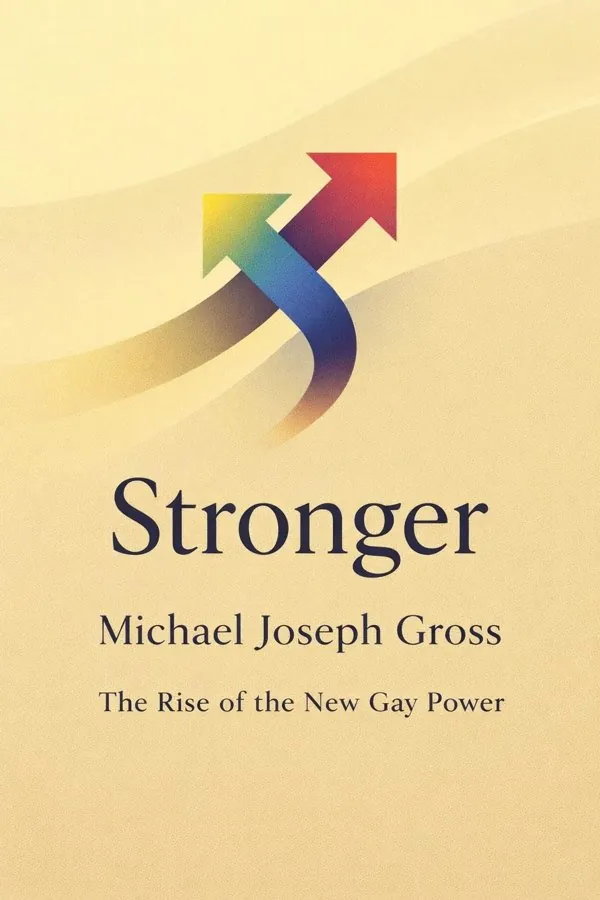
Stronger: The Rise of the New Gay Power: Summary & Key Insights
 10 min9 chaptersAudio available
What Is Stronger: The Rise of the New Gay Power About?
Stronger: The Rise of the New Gay Power by Michael Joseph Gross is a sociology book spanning 9 pages. Stronger: The Rise of the New Gay Power is a nonfiction work by journalist Michael Joseph Gross that explores the growing political, cultural, and social influence of the LGBTQ+ community in the United States. Through interviews, reportage, and analysis, Gross examines how gay Americans have transformed from a marginalized group into a powerful force shaping national discourse, politics, and identity in the early 21st century.
This FizzRead summary covers all 9 key chapters of Stronger: The Rise of the New Gay Power in approximately 10 minutes, distilling the most important ideas, arguments, and takeaways from Michael Joseph Gross's work. Also available as an audio summary and Key Quotes Podcast.
Stronger: The Rise of the New Gay Power
Stronger: The Rise of the New Gay Power is a nonfiction work by journalist Michael Joseph Gross that explores the growing political, cultural, and social influence of the LGBTQ+ community in the United States. Through interviews, reportage, and analysis, Gross examines how gay Americans have transformed from a marginalized group into a powerful force shaping national discourse, politics, and identity in the early 21st century.
Who Should Read Stronger: The Rise of the New Gay Power?
This book is perfect for anyone interested in sociology and looking to gain actionable insights in a short read. Whether you're a student, professional, or lifelong learner, the key ideas from Stronger: The Rise of the New Gay Power by Michael Joseph Gross will help you think differently.
- ✓Readers who enjoy sociology and want practical takeaways
- ✓Professionals looking to apply new ideas to their work and life
- ✓Anyone who wants the core insights of Stronger: The Rise of the New Gay Power in just 10 minutes
Want the full summary?
Get instant access to this book summary and 100K+ more with Fizz Moment.
Get Free SummaryAvailable on App Store • Free to download
Key Chapters
Every revolution begins with resistance, and for gay America, that resistance first erupted in the form of riots — notably at Stonewall in 1969. But what seems like a single spark was preceded by years of quiet endurance and coded lives. I retrace these roots, connecting the defiance of Stonewall to the earliest homophile organizations like the Mattachine Society and the Daughters of Bilitis, whose polite petitions already contained the seeds of insurgency. This historical ground matters because it reveals how community forms long before visibility. When the AIDS crisis struck in the 1980s, that underground network gave rise to a disciplined political force. Grief turned into agency. Groups like ACT UP and GMHC redefined activism, blending anger with strategy and confronting both state neglect and societal prejudice head-on.
In the 1990s, as therapy replaced pathology and popular culture began to flirt with inclusion, the movement matured. The first openly gay elected officials appeared, pride parades became civic rituals rather than spectacles of dissent, and what had once been seen as deviance started to look like another expression of citizenship. This trajectory — from invisibility to confrontation to engagement — defines the foundation of the new power I describe throughout *Stronger*. Without those decades of marginalization and mourning, there would have been no unified identity to transform into influence.
One of the most striking shifts I document is how the gay rights movement evolved from the street to the suite — from chant to campaign. The early gay liberation ethos distrusted institutions, but by the 1990s many activists realized that legislation, not protest alone, would deliver durable change. They began to speak the language of voters, donors, and lawmakers. Political action committees such as the Human Rights Campaign (HRC) marked a decisive turn: visibility now came with checks attached, and inclusion had a price — strategy, compromise, and patience.
In numerous interviews with political operatives, I saw how this new professionalism didn’t erase passion; it rechanneled it. Gay money and organizing prowess helped reshape the Democratic Party’s platform and, subtly, even some Republicans’ rhetoric. Urban voting blocs influenced national elections, and political candidates began actively courting gay support. Yet with power came friction. Some voices complained that institutional respectability dulled the movement’s original radical edge — that it sought acceptance on existing terms rather than reimagining them. Still, this evolution was inevitable. The new gay power was not outside politics anymore; it helped constitute politics. In that sense, equality ceased being a slogan and became a negotiating stance within democracy itself.
+ 7 more chapters — available in the FizzRead app
All Chapters in Stronger: The Rise of the New Gay Power
About the Author
Michael Joseph Gross is an American journalist and author known for his work in publications such as Vanity Fair, The New York Times, and The Atlantic. His writing often focuses on culture, politics, and technology, with a particular interest in the intersection of identity and power.
Get This Summary in Your Preferred Format
Read or listen to the Stronger: The Rise of the New Gay Power summary by Michael Joseph Gross anytime, anywhere. FizzRead offers multiple formats so you can learn on your terms — all free.
Available formats: App · Audio · PDF · EPUB — All included free with FizzRead
Download Stronger: The Rise of the New Gay Power PDF and EPUB Summary
Key Quotes from Stronger: The Rise of the New Gay Power
“Every revolution begins with resistance, and for gay America, that resistance first erupted in the form of riots — notably at Stonewall in 1969.”
“One of the most striking shifts I document is how the gay rights movement evolved from the street to the suite — from chant to campaign.”
Frequently Asked Questions about Stronger: The Rise of the New Gay Power
Stronger: The Rise of the New Gay Power by Michael Joseph Gross is a sociology book that explores key ideas across 9 chapters. Stronger: The Rise of the New Gay Power is a nonfiction work by journalist Michael Joseph Gross that explores the growing political, cultural, and social influence of the LGBTQ+ community in the United States. Through interviews, reportage, and analysis, Gross examines how gay Americans have transformed from a marginalized group into a powerful force shaping national discourse, politics, and identity in the early 21st century.
You Might Also Like
Between the World and Me
Ta-Nehisi Coates
10 min
Half the Sky
Nicholas D. Kristof, Sheryl WuDunn
10 min
Men Explain Things To Me
Rebecca Solnit
10 min
Rational Ritual
Michael Suk-Young Chwe
10 min
The New Jim Crow
Michelle Alexander
10 min
Beyond Culture
Edward T. Hall
10 minBrowse by Category
Ready to read Stronger: The Rise of the New Gay Power?
Get the full summary and 100K+ more books with Fizz Moment.