
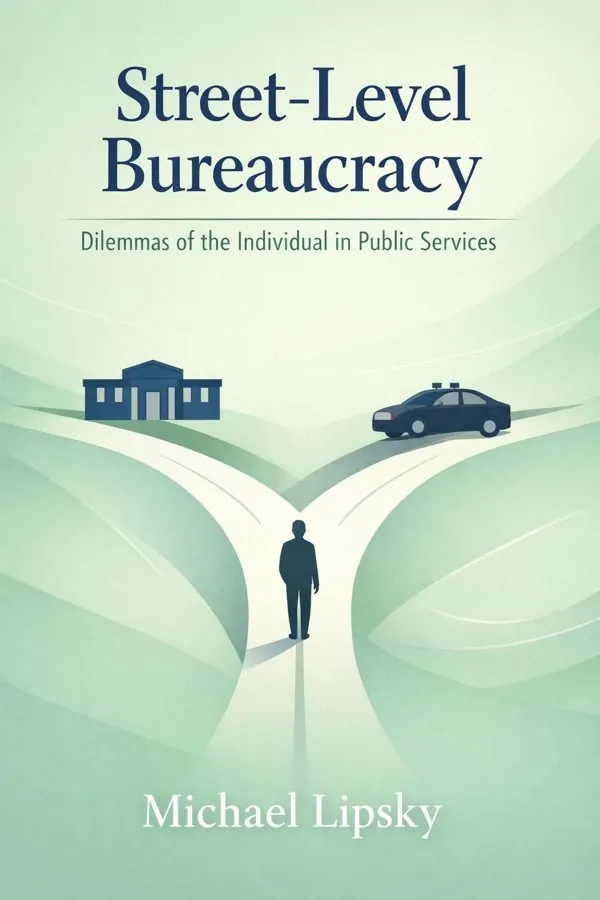
Street-Level Bureaucracy: Dilemmas of the Individual in Public Services: Summary & Key Insights
 10 min9 chaptersAudio available
What Is Street-Level Bureaucracy: Dilemmas of the Individual in Public Services About?
Street-Level Bureaucracy: Dilemmas of the Individual in Public Services by Michael Lipsky is a politics book spanning 9 pages. Street-Level Bureaucracy explores how public service workers—such as teachers, police officers, and social workers—exercise discretion and make policy decisions in their daily interactions with citizens. Michael Lipsky argues that these front-line employees effectively become policymakers through their interpretations and applications of rules, shaping how government policies are experienced by the public.
This FizzRead summary covers all 9 key chapters of Street-Level Bureaucracy: Dilemmas of the Individual in Public Services in approximately 10 minutes, distilling the most important ideas, arguments, and takeaways from Michael Lipsky's work. Also available as an audio summary and Key Quotes Podcast.
Street-Level Bureaucracy: Dilemmas of the Individual in Public Services
Street-Level Bureaucracy explores how public service workers—such as teachers, police officers, and social workers—exercise discretion and make policy decisions in their daily interactions with citizens. Michael Lipsky argues that these front-line employees effectively become policymakers through their interpretations and applications of rules, shaping how government policies are experienced by the public.
Who Should Read Street-Level Bureaucracy: Dilemmas of the Individual in Public Services?
This book is perfect for anyone interested in politics and looking to gain actionable insights in a short read. Whether you're a student, professional, or lifelong learner, the key ideas from Street-Level Bureaucracy: Dilemmas of the Individual in Public Services by Michael Lipsky will help you think differently.
- ✓Readers who enjoy politics and want practical takeaways
- ✓Professionals looking to apply new ideas to their work and life
- ✓Anyone who wants the core insights of Street-Level Bureaucracy: Dilemmas of the Individual in Public Services in just 10 minutes
Want the full summary?
Get instant access to this book summary and 100K+ more with Fizz Moment.
Get Free SummaryAvailable on App Store • Free to download
Key Chapters
Discretion lies at the heart of the work of street-level bureaucrats. Laws and regulations rarely anticipate the full complexity of real-world situations. Thus, public service workers must interpret and apply these rules as they deem appropriate in the circumstances they face. In doing so, they make decisions about people’s lives. A police officer deciding whether to arrest a person, a teacher determining how strictly to apply school policies, or a benefits officer deciding how to interpret eligibility rules — all exercise discretion that goes far beyond mechanical implementation.
I argue that discretion is not the exception but the defining characteristic of street-level work. It arises inevitably from the gap between policy intent and the realities of service delivery. Street-level bureaucrats translate broad directives into specific actions, and this translation is profoundly shaped by their judgments, values, and coping strategies. Discretion, therefore, is both a necessary tool and a source of moral anxiety: workers must make decisions affecting citizens under conditions of ambiguity, limited information, and resource scarcity.
These small, moment-to-moment decisions often determine whether a policy feels humane, arbitrary, or oppressive to the people it touches. Discretion allows workers to adapt rules sensibly to individual cases, but it also risks inconsistency and bias. Understanding this double-edged quality of discretion is essential to understanding how bureaucracy functions in practice.
No street-level bureaucrat operates freely. Their choices are bounded by constraints: insufficient funding, bureaucratic procedures, institutional hierarchies, and the relentless demand to do more with less. The social worker facing a towering caseload, the teacher with too many students and too few materials, the police officer patrolling with minimal support — all must make difficult decisions about where to focus their energies.
Resources shape discretion just as much as rules do. Because time and manpower are limited, workers are forced to prioritize, simplify, and sometimes ration services. Their sense of what is ‘possible’ is not merely personal preference but a rational response to structural scarcity. For instance, a welfare officer cannot devote unlimited time to each client; thus, they develop heuristics — patterns of judgment that enable them to process cases quickly, though often at the cost of nuance.
Organizational design compounds these constraints. Hierarchies emphasize compliance and efficiency but often discourage open reflection about the moral difficulties inherent in the work. Superiors seek predictability, while workers seek discretion to act responsibly. Within this tension lies the fundamental dilemma of democratic administration: how to preserve responsiveness to human need while maintaining consistency and accountability.
+ 7 more chapters — available in the FizzRead app
All Chapters in Street-Level Bureaucracy: Dilemmas of the Individual in Public Services
About the Author
Michael Lipsky is an American political scientist and public policy scholar known for his work on public administration and the role of street-level bureaucrats. He served as a senior fellow at Demos and taught at MIT and Harvard University.
Get This Summary in Your Preferred Format
Read or listen to the Street-Level Bureaucracy: Dilemmas of the Individual in Public Services summary by Michael Lipsky anytime, anywhere. FizzRead offers multiple formats so you can learn on your terms — all free.
Available formats: App · Audio · PDF · EPUB — All included free with FizzRead
Download Street-Level Bureaucracy: Dilemmas of the Individual in Public Services PDF and EPUB Summary
Key Quotes from Street-Level Bureaucracy: Dilemmas of the Individual in Public Services
“Discretion lies at the heart of the work of street-level bureaucrats.”
“No street-level bureaucrat operates freely.”
Frequently Asked Questions about Street-Level Bureaucracy: Dilemmas of the Individual in Public Services
Street-Level Bureaucracy: Dilemmas of the Individual in Public Services by Michael Lipsky is a politics book that explores key ideas across 9 chapters. Street-Level Bureaucracy explores how public service workers—such as teachers, police officers, and social workers—exercise discretion and make policy decisions in their daily interactions with citizens. Michael Lipsky argues that these front-line employees effectively become policymakers through their interpretations and applications of rules, shaping how government policies are experienced by the public.
You Might Also Like

Antifa: The Anti-Fascist Handbook
Mark Bray
10 min
Attack from Within: How Disinformation Is Sabotaging America
Barbara McQuade
10 min
Coercion, Capital, and European States, AD 990–1992
Charles Tilly
10 min
Digital Democracy: Concepts, Methodologies, Tools, and Applications
Various Authors
10 min
Fascism
Stanley G. Payne
10 min
Fire And Fury: Inside The Trump White House
Michael Wolff
10 minBrowse by Category
Ready to read Street-Level Bureaucracy: Dilemmas of the Individual in Public Services?
Get the full summary and 100K+ more books with Fizz Moment.