
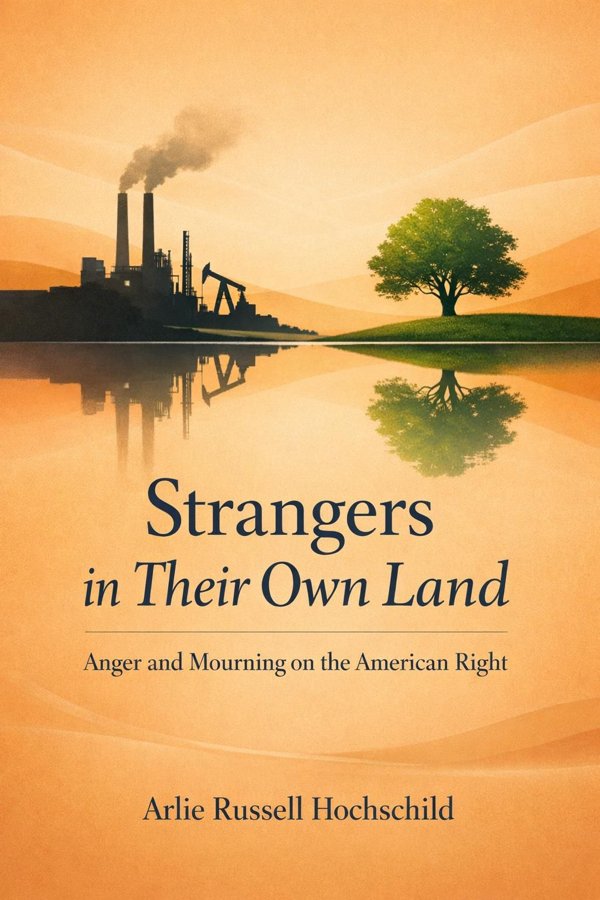
Strangers in Their Own Land: Anger and Mourning on the American Right: Summary & Key Insights
 10 min10 chaptersAudio available
Key Takeaways from Strangers in Their Own Land: Anger and Mourning on the American Right
A society becomes hard to understand when people appear to vote against their own material interests.
Place is never just geography; it is a living emotional world.
Facts persuade less than stories when those stories explain who we are.
Resentment often begins not with hatred, but with the feeling of being bypassed.
Political beliefs are rarely isolated opinions; they are woven into communities of meaning.
What Is Strangers in Their Own Land: Anger and Mourning on the American Right About?
Strangers in Their Own Land: Anger and Mourning on the American Right by Arlie Russell Hochschild is a sociology book spanning 10 pages. Why do many Americans living amid economic insecurity, industrial pollution, and shrinking opportunity reject the very government protections that seem designed to help them? In Strangers in Their Own Land, sociologist Arlie Russell Hochschild tackles that question with unusual patience, empathy, and intellectual honesty. Based on five years of fieldwork in Louisiana, she enters the lives of Tea Party supporters, churchgoers, workers, retirees, and families who often feel dismissed by coastal liberals and abandoned by national institutions. Rather than reducing political disagreement to ignorance or self-interest, Hochschild looks beneath policy preferences to the feelings that animate them: pride, resentment, grief, loyalty, fear, and moral conviction. Her central contribution is the idea of a “deep story,” an emotionally true narrative people carry about who they are, who has wronged them, and what justice should look like. That framework helps explain how identity and emotion can outweigh material evidence. The book matters because it offers a rare model for understanding political polarization without contempt. Hochschild, one of America’s leading sociologists of emotion and culture, shows that if we want to understand the modern right, we must first learn how to cross what she calls the “empathy wall.”
This FizzRead summary covers all 10 key chapters of Strangers in Their Own Land: Anger and Mourning on the American Right in approximately 10 minutes, distilling the most important ideas, arguments, and takeaways from Arlie Russell Hochschild's work. Also available as an audio summary and Key Quotes Podcast.
Strangers in Their Own Land: Anger and Mourning on the American Right
Why do many Americans living amid economic insecurity, industrial pollution, and shrinking opportunity reject the very government protections that seem designed to help them? In Strangers in Their Own Land, sociologist Arlie Russell Hochschild tackles that question with unusual patience, empathy, and intellectual honesty. Based on five years of fieldwork in Louisiana, she enters the lives of Tea Party supporters, churchgoers, workers, retirees, and families who often feel dismissed by coastal liberals and abandoned by national institutions.
Rather than reducing political disagreement to ignorance or self-interest, Hochschild looks beneath policy preferences to the feelings that animate them: pride, resentment, grief, loyalty, fear, and moral conviction. Her central contribution is the idea of a “deep story,” an emotionally true narrative people carry about who they are, who has wronged them, and what justice should look like. That framework helps explain how identity and emotion can outweigh material evidence.
The book matters because it offers a rare model for understanding political polarization without contempt. Hochschild, one of America’s leading sociologists of emotion and culture, shows that if we want to understand the modern right, we must first learn how to cross what she calls the “empathy wall.”
Who Should Read Strangers in Their Own Land: Anger and Mourning on the American Right?
This book is perfect for anyone interested in sociology and looking to gain actionable insights in a short read. Whether you're a student, professional, or lifelong learner, the key ideas from Strangers in Their Own Land: Anger and Mourning on the American Right by Arlie Russell Hochschild will help you think differently.
- ✓Readers who enjoy sociology and want practical takeaways
- ✓Professionals looking to apply new ideas to their work and life
- ✓Anyone who wants the core insights of Strangers in Their Own Land: Anger and Mourning on the American Right in just 10 minutes
Want the full summary?
Get instant access to this book summary and 100K+ more with Fizz Moment.
Get Free SummaryAvailable on App Store • Free to download
Key Chapters
A society becomes hard to understand when people appear to vote against their own material interests. Hochschild begins with what she calls the Great Paradox: why do residents of Louisiana, a state scarred by pollution, weak public services, and economic instability, often oppose environmental regulation, taxation, and federal programs that could improve their lives? Rather than dismissing this as irrational, she treats it as a serious sociological puzzle.
Louisiana offered a vivid case. It ranked poorly on many measures of health, education, and environmental quality, yet many of the people most exposed to toxic air and water distrusted the federal government and supported politicians who promised to reduce its reach. On the surface, this looks contradictory. But Hochschild argues that people do not make political decisions based only on policy outcomes. They also vote according to values, identity, loyalty, and emotional interpretation.
For many of her interviewees, government was not experienced as a protective force. It felt distant, unfair, intrusive, or captured by people unlike them. If a regulator appears to help “undeserving others” while failing to honor your labor and sacrifice, opposition to government can feel morally coherent even when public assistance might help you personally.
This insight applies well beyond Louisiana. In workplaces, families, and organizations, people often resist solutions that threaten their sense of dignity or fairness. If leaders focus only on incentives and ignore moral perception, they will misread behavior.
Actionable takeaway: When someone’s choices seem irrational, ask not only what benefits they might gain, but what identity, dignity, and moral worldview they believe they are defending.
Place is never just geography; it is a living emotional world. Hochschild chose Louisiana not simply because it was politically conservative, but because it concentrated many of the contradictions she wanted to study. It was home to rich natural beauty, strong local culture, evangelical faith, petrochemical industry, and some of the worst environmental damage in the United States. It was also a place where anti-government sentiment ran deep.
Over five years, she visited towns, attended gatherings, sat in kitchens, rode in cars, toured damaged landscapes, and listened carefully to people whose worldview differed sharply from her own Berkeley liberal background. This long immersion matters. Quick reporting can capture slogans, but long fieldwork reveals the texture of trust, pain, humor, contradiction, and daily life. Hochschild’s method lets readers see conservative Louisiana residents not as caricatures, but as full human beings shaped by local history and intimate experience.
She meets people who love hunting, church, family, and hard work; people proud of their endurance and suspicious of outsiders; people harmed by pollution yet reluctant to blame the companies that provide jobs. The setting shows how economic dependence, cultural honor, and political identity become intertwined.
The broader lesson is methodological and personal. If you want to understand a community, you need more than statistics. You need time, proximity, and humility. The same principle applies in management, education, and conflict resolution: data tells you what is happening, but immersion helps explain why it feels acceptable or intolerable.
Actionable takeaway: To understand any divided group, spend sustained time in its environment and let lived context challenge your assumptions before you form conclusions.
Facts persuade less than stories when those stories explain who we are. One of Hochschild’s most influential ideas is the “deep story,” a narrative that feels true emotionally even if it is not a literal statement of events. A deep story strips away facts and arguments and reveals the emotional logic beneath political beliefs.
For many of the conservative Louisianans she met, the deep story goes something like this: you are waiting patiently in line for the American Dream. You have worked hard, obeyed the rules, endured hardship, and kept your dignity. Yet while you wait, others seem to be cutting ahead of you. The federal government appears to help them, celebrate them, and shame you for your complaints. Meanwhile, your own struggles go unseen.
This story captures a feeling of stalled reward, moral injury, and loss of status. It helps explain why policy debates about welfare, immigration, affirmative action, and environmental regulation become charged with emotion. The issue is not only money or law. It is whether one’s sacrifice is respected and whether the social order still feels fair.
Deep stories exist across the political spectrum. Progressives may have their own narrative about power, exclusion, and historical injustice. Recognizing this does not mean all stories are equally accurate in factual terms. It means emotions organize perception long before evidence is assessed.
In daily life, deep stories shape workplace disputes, family conflicts, and public debate. If you address only the visible argument, you miss the emotional script driving it.
Actionable takeaway: When facing a polarizing disagreement, identify the deep story each side is living inside before trying to correct facts or propose solutions.
Resentment often begins not with hatred, but with the feeling of being bypassed. Hochschild’s most memorable image is the line-cutting metaphor embedded in the conservative deep story. Imagine yourself waiting in a long line toward the American Dream: stability, respect, security, and recognition. You have been patient and hardworking. Yet suddenly, others seem to move ahead—racial minorities, immigrants, women, refugees, public-sector workers, even endangered animals—while the government waves them forward.
This metaphor does powerful explanatory work. It reveals how cultural change can be experienced as personal displacement. Even if no one literally jumps a line, social policies designed to address historical exclusion may feel, to some white working- and middle-class conservatives, like favoritism that invalidates their own effort. The result is anger mixed with humiliation. They do not simply think they are losing benefits; they feel they are losing moral standing.
Hochschild does not endorse this perception, but she insists on taking it seriously as a lived emotional reality. That seriousness helps explain why abstract calls for equality can provoke backlash when people already feel invisible. It also clarifies why political rhetoric about “real Americans,” “forgotten people,” and “taking the country back” resonates so strongly.
The metaphor has broad relevance. In organizations, employees can grow resentful when recognition systems seem opaque or when diversity initiatives are poorly explained. If fairness is not communicated carefully, correction can be misread as favoritism.
Actionable takeaway: When implementing change, address perceived fairness openly. People cope better with loss or adjustment when they understand why others are being helped and how their own dignity is being honored.
Political beliefs are rarely isolated opinions; they are woven into communities of meaning. In Louisiana, Hochschild found that church life, family networks, and local moral codes helped shape how people interpreted government, work, sexuality, obligation, and suffering. Religion was not merely a private comfort. It offered a moral map: good people work hard, care for family, help neighbors voluntarily, and distrust distant institutions that claim authority without intimacy.
For many of her interviewees, faith provided both emotional resilience and a language of judgment. It explained hardship as a test of character rather than evidence of structural injustice. It encouraged generosity at the local level while reinforcing skepticism toward state-administered redistribution. If help should come from church, kin, and community, federal welfare can look impersonal, dependency-producing, or morally distorting.
This moral framework also shaped attitudes toward social issues. Questions about abortion, marriage, gender roles, and personal responsibility were not secondary cultural distractions. They were central signs of whether the nation was maintaining a sacred moral order. That helps explain why voters might prioritize symbolic and moral issues over direct economic benefits.
The lesson is that politics competes with other systems of belonging. When analysts ignore religion and local culture, they misread what motivates action. In workplaces and public institutions, the same pattern holds: people support policies that fit their moral world, not just their financial interest.
Actionable takeaway: To engage people across ideological divides, speak not only to outcomes but also to moral values such as duty, care, fairness, responsibility, and respect for community traditions.
Environmental harm is easier to condemn in theory than in a town built around the jobs causing it. One of the book’s sharpest insights is that people living in heavily polluted areas do not necessarily become environmental activists. In Louisiana’s bayou and petrochemical corridor, residents often saw contaminated water, damaged wetlands, illness, and industrial accidents up close. Yet many still defended the companies involved or resisted stronger regulation.
Why? Because those companies were entangled with livelihood, local pride, and survival. Industry brought paychecks, sponsorships, and a sense that the region mattered. Government, by contrast, often appeared late, inconsistent, or selectively attentive. In this setting, pollution was not just an environmental problem; it was part of a wider story of betrayal by elites, corporations, and public institutions alike.
Hochschild shows that residents could express grief about environmental destruction while still opposing environmental politics. They loved the land and water but also feared job loss, outside judgment, and economic abandonment. This creates moral ambivalence: the polluter is also the provider, and the regulator is also the outsider.
The insight generalizes to any community dependent on harmful or declining industries. Coal towns, factory regions, and even modern tech hubs can exhibit the same tension. People resist reforms when they experience them as attacks on identity and survival rather than transitions toward dignity.
Actionable takeaway: Effective reform must pair critique with credible pathways for economic security. People are far more willing to confront damaging systems when they believe they will not be left behind in the process.
Movements endure when they offer belonging, not just positions on legislation. Hochschild explores the Tea Party not as a checklist of policy preferences, but as an emotional and cultural identity. For many participants, it represented patriotism, self-reliance, anti-elitism, and a defense of a threatened way of life. Joining the movement was less about mastering budget details than about affirming who counted as honorable in America.
Tea Party supporters often saw themselves as disciplined citizens carrying burdens that others avoided. They opposed taxes, environmental regulation, and federal expansion not only because they disagreed with those policies, but because such measures symbolized a moral inversion: rule-followers were being punished, and dependents or outsiders were being rewarded. The movement gave people language, rituals, and solidarity through which to express long-accumulated frustration.
This helps explain why purely technocratic rebuttals often failed. If a political movement functions as a home for wounded pride and cultural grief, spreadsheets alone will not weaken its appeal. People are defending esteem as much as interest. That pattern extends beyond the Tea Party. Many populist movements on the left and right thrive because they transform diffuse resentment into a clear moral identity.
For leaders, journalists, and citizens, the implication is simple: do not confuse a movement’s stated policy agenda with its emotional function. To understand its strength, ask what kind of person members believe themselves to be when they join.
Actionable takeaway: When analyzing any political or social movement, identify the identity it offers supporters, not just the policies it promotes. Emotional belonging often matters more than ideological precision.
Polarization survives because each side develops a story about why the other is impossible to understand. Hochschild calls this barrier an “empathy wall,” the obstacle that prevents us from feeling our way into another person’s experience, even when we strongly disagree with their conclusions. The wall is built from stereotypes, class differences, media bubbles, regional suspicion, moral judgment, and the desire to protect one’s own identity.
For liberals, conservatives may appear cruel, anti-science, or manipulated. For conservatives, liberals may appear arrogant, godless, condescending, or detached from ordinary life. Once these images harden, conversation becomes performance rather than inquiry. Each side speaks in ways that reassure its own tribe while confirming the worst assumptions of the other.
Hochschild’s project is not neutrality for its own sake. It is a disciplined effort to understand without surrendering moral convictions. She demonstrates that empathy is not agreement. It is the capacity to grasp how a worldview makes sense from within the life of the person holding it. That distinction is crucial. Without empathy, disagreement turns into mutual contempt. With empathy, criticism can become more accurate and less dehumanizing.
This concept applies to marriages, workplaces, classrooms, and international conflict. The empathy wall appears whenever one group believes another’s motives are beneath understanding. Crossing it requires patience, curiosity, and emotional regulation.
Actionable takeaway: In your next difficult conversation, postpone rebuttal and ask one sincere question aimed at understanding how the other person’s view feels morally and emotionally coherent to them.
Understanding an opponent does not weaken your principles; it sharpens them. One of the most valuable aspects of Hochschild’s book is its demonstration of how to cross ideological divides without romanticizing them. She does not hide her own liberal commitments, nor does she pretend all political claims are equally valid. Instead, she practices a demanding form of listening that seeks truth in emotional experience while remaining open about factual disagreement.
Crossing the empathy wall involves risk. You may be misunderstood by your own side, become emotionally unsettled, or discover uncomfortable truths about your own prejudices. Hochschild shows that genuine listening often reveals not only the fears of others, but also the blind spots of the observer. In her case, she comes to see how easily liberals can communicate contempt, however unintended, and how that contempt deepens conservative defensiveness.
At the same time, the book never suggests that empathy alone solves structural problems. Understanding anger does not erase the harms caused by racism, environmental neglect, or misinformation. But it does create a more realistic basis for political engagement. You cannot build durable coalitions by humiliating the people you hope to persuade.
In practical terms, crossing divides means sharing space, asking better questions, noticing emotional cues, and resisting the temptation to score points. It means separating curiosity from endorsement.
Actionable takeaway: Practice “firm empathy”: seek to understand someone’s fears, loyalties, and losses in detail while still naming clearly where you disagree on facts, policy, or justice.
Many political eruptions are forms of grief that have not found an honest language. The subtitle of Hochschild’s book points to something essential: the American right she studies is animated not only by anger, but by mourning. Beneath outrage lies a sense of loss—loss of status, cultural centrality, trust in institutions, neighborhood stability, environmental beauty, and confidence that hard work will be rewarded.
This mourning is often inchoate. People may not say, “I am grieving a vanished social world.” Instead, they express rage at government, elites, immigrants, media, or social change. Anger is more socially acceptable, more energizing, and more politically mobilizable than sadness. Yet if we miss the grief underneath, we misunderstand the intensity of the reaction.
Hochschild’s reframing helps explain why symbolic issues can matter so much. Flags, religion, language, gender roles, and public recognition become containers for a broader fear that one’s world is slipping away. The result is a politics of restoration: promises to return the country to a moral order that feels familiar and deserved.
This pattern appears whenever groups experience downward mobility or cultural displacement. Organizations facing restructuring often see similar dynamics: resistance is strongest when change threatens identity, not just routine. Addressing anger effectively requires naming the loss beneath it.
Actionable takeaway: When confronting intense resentment, look for the hidden grief. Ask what people believe has been taken from them, and address that loss directly rather than responding only to the surface anger.
All Chapters in Strangers in Their Own Land: Anger and Mourning on the American Right
About the Author
Arlie Russell Hochschild is an American sociologist and professor emerita at the University of California, Berkeley, renowned for her work on emotion, work, gender, and everyday life. She became especially influential through books such as The Managed Heart, which examined emotional labor, and The Second Shift, which explored unpaid domestic work and gender inequality. Across her career, Hochschild has combined academic rigor with vivid reporting, showing how large social forces are lived through intimate feelings and routines. In Strangers in Their Own Land, she extends that approach to politics, using immersive fieldwork to understand the emotional logic of conservative America. Her work is widely respected for its originality, empathy, and ability to bridge sociology and public conversation.
Get This Summary in Your Preferred Format
Read or listen to the Strangers in Their Own Land: Anger and Mourning on the American Right summary by Arlie Russell Hochschild anytime, anywhere. FizzRead offers multiple formats so you can learn on your terms — all free.
Available formats: App · Audio · PDF · EPUB — All included free with FizzRead
Download Strangers in Their Own Land: Anger and Mourning on the American Right PDF and EPUB Summary
Key Quotes from Strangers in Their Own Land: Anger and Mourning on the American Right
“A society becomes hard to understand when people appear to vote against their own material interests.”
“Place is never just geography; it is a living emotional world.”
“Facts persuade less than stories when those stories explain who we are.”
“Resentment often begins not with hatred, but with the feeling of being bypassed.”
“Political beliefs are rarely isolated opinions; they are woven into communities of meaning.”
Frequently Asked Questions about Strangers in Their Own Land: Anger and Mourning on the American Right
Strangers in Their Own Land: Anger and Mourning on the American Right by Arlie Russell Hochschild is a sociology book that explores key ideas across 10 chapters. Why do many Americans living amid economic insecurity, industrial pollution, and shrinking opportunity reject the very government protections that seem designed to help them? In Strangers in Their Own Land, sociologist Arlie Russell Hochschild tackles that question with unusual patience, empathy, and intellectual honesty. Based on five years of fieldwork in Louisiana, she enters the lives of Tea Party supporters, churchgoers, workers, retirees, and families who often feel dismissed by coastal liberals and abandoned by national institutions. Rather than reducing political disagreement to ignorance or self-interest, Hochschild looks beneath policy preferences to the feelings that animate them: pride, resentment, grief, loyalty, fear, and moral conviction. Her central contribution is the idea of a “deep story,” an emotionally true narrative people carry about who they are, who has wronged them, and what justice should look like. That framework helps explain how identity and emotion can outweigh material evidence. The book matters because it offers a rare model for understanding political polarization without contempt. Hochschild, one of America’s leading sociologists of emotion and culture, shows that if we want to understand the modern right, we must first learn how to cross what she calls the “empathy wall.”
More by Arlie Russell Hochschild

You Might Also Like

Between the World and Me
Ta-Nehisi Coates
10 min
Half the Sky
Nicholas D. Kristof, Sheryl WuDunn
10 min
Men Explain Things To Me
Rebecca Solnit
10 min
Rational Ritual
Michael Suk-Young Chwe
10 min
The New Jim Crow
Michelle Alexander
10 min
Beyond Culture
Edward T. Hall
10 minBrowse by Category
Ready to read Strangers in Their Own Land: Anger and Mourning on the American Right?
Get the full summary and 100K+ more books with Fizz Moment.