
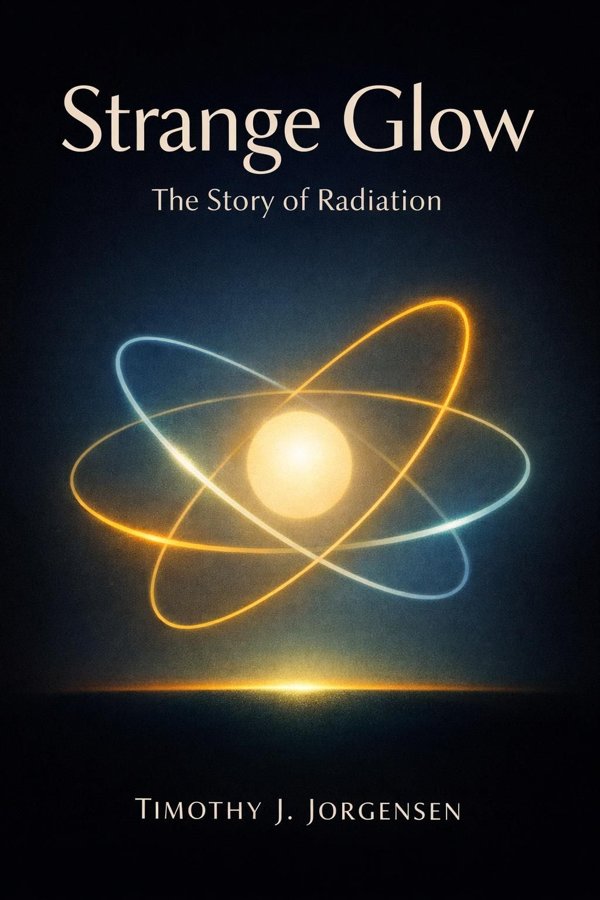
Strange Glow: The Story of Radiation: Summary & Key Insights
 10 min9 chaptersAudio available
Key Takeaways from Strange Glow: The Story of Radiation
Some of the most world-changing discoveries begin with something no one can see.
Fear tends to grow wherever understanding is weak.
A force capable of injuring tissue can also be used to heal.
Radiation’s story is not confined to laboratories or clinics; it runs through factories, power plants, farms, and battlefields.
People often learn about invisible dangers only after systems fail.
What Is Strange Glow: The Story of Radiation About?
Strange Glow: The Story of Radiation by Timothy J. Jorgensen is a popular_sci book spanning 8 pages. Radiation is one of the most misunderstood forces in modern life: invisible, powerful, feared, and yet deeply woven into medicine, energy, industry, and the natural world. In Strange Glow: The Story of Radiation, Timothy J. Jorgensen guides readers through the history and science of radiation with unusual clarity, showing how discoveries that once seemed miraculous also introduced new risks, ethical dilemmas, and public anxieties. The book moves from the first X-rays and early enthusiasm for radioactive substances to nuclear weapons, reactor accidents, cancer treatment, and the radiation exposure all of us experience every day. What makes this book especially valuable is its balance. Jorgensen neither minimizes radiation’s dangers nor sensationalizes them. Instead, he explains dose, risk, and biological effects in practical terms that help readers separate evidence from fear. As a radiation biologist, associate professor of radiation medicine, and director of Georgetown University’s Health Physics and Radiation Protection Graduate Program, he brings scientific authority along with a strong commitment to public education. The result is an accessible, deeply relevant account of how radiation has shaped the modern world—and why understanding it matters for every informed citizen.
This FizzRead summary covers all 9 key chapters of Strange Glow: The Story of Radiation in approximately 10 minutes, distilling the most important ideas, arguments, and takeaways from Timothy J. Jorgensen's work. Also available as an audio summary and Key Quotes Podcast.
Strange Glow: The Story of Radiation
Radiation is one of the most misunderstood forces in modern life: invisible, powerful, feared, and yet deeply woven into medicine, energy, industry, and the natural world. In Strange Glow: The Story of Radiation, Timothy J. Jorgensen guides readers through the history and science of radiation with unusual clarity, showing how discoveries that once seemed miraculous also introduced new risks, ethical dilemmas, and public anxieties. The book moves from the first X-rays and early enthusiasm for radioactive substances to nuclear weapons, reactor accidents, cancer treatment, and the radiation exposure all of us experience every day.
What makes this book especially valuable is its balance. Jorgensen neither minimizes radiation’s dangers nor sensationalizes them. Instead, he explains dose, risk, and biological effects in practical terms that help readers separate evidence from fear. As a radiation biologist, associate professor of radiation medicine, and director of Georgetown University’s Health Physics and Radiation Protection Graduate Program, he brings scientific authority along with a strong commitment to public education. The result is an accessible, deeply relevant account of how radiation has shaped the modern world—and why understanding it matters for every informed citizen.
Who Should Read Strange Glow: The Story of Radiation?
This book is perfect for anyone interested in popular_sci and looking to gain actionable insights in a short read. Whether you're a student, professional, or lifelong learner, the key ideas from Strange Glow: The Story of Radiation by Timothy J. Jorgensen will help you think differently.
- ✓Readers who enjoy popular_sci and want practical takeaways
- ✓Professionals looking to apply new ideas to their work and life
- ✓Anyone who wants the core insights of Strange Glow: The Story of Radiation in just 10 minutes
Want the full summary?
Get instant access to this book summary and 100K+ more with Fizz Moment.
Get Free SummaryAvailable on App Store • Free to download
Key Chapters
Some of the most world-changing discoveries begin with something no one can see. That was the case in the late nineteenth century, when Wilhelm Roentgen discovered X-rays and Henri Becquerel, followed by Marie and Pierre Curie, revealed the phenomenon of radioactivity. Suddenly, scientists realized that matter was not as stable and ordinary as it appeared. Hidden within atoms were forces capable of passing through flesh, exposing photographic plates, and releasing astonishing amounts of energy.
Jorgensen shows how this moment transformed both science and society. X-rays gave doctors the unprecedented ability to look inside the human body without surgery. Broken bones, bullets, and internal abnormalities could now be detected in ways previously impossible. Radioactivity, meanwhile, opened a new frontier in physics and chemistry, reshaping our understanding of atomic structure. But discovery came faster than caution. Early researchers handled radioactive materials with bare hands, carried radium in their pockets, and exposed patients and themselves to radiation without grasping the risks.
The early era of radiation was marked by wonder, ambition, and ignorance in equal measure. Products containing radioactive substances were marketed as health enhancers, while scientists paid for progress with their own injuries and illnesses. Jorgensen uses these stories to show that technological breakthroughs often arrive before society has developed the tools to use them responsibly.
The practical lesson is timeless: when a powerful innovation appears, enthusiasm should be matched by humility. Actionable takeaway: treat every new technology—especially one that seems miraculous—with curiosity, but also with respect for what is still unknown.
Fear tends to grow wherever understanding is weak. One of Jorgensen’s central achievements is to make radiation understandable without oversimplifying it. Radiation, he explains, is energy traveling as waves or particles, often released by unstable atoms trying to become more stable. The major types—alpha particles, beta particles, gamma rays, and X-rays—differ in how deeply they penetrate matter and how much biological damage they can cause.
This matters because the word radiation covers very different phenomena. Alpha particles can be stopped by skin or paper, yet become dangerous if inhaled or ingested. Gamma rays and X-rays penetrate deeply and are therefore useful in medical imaging, but they can also damage living tissue when doses are too high. Jorgensen also distinguishes ionizing radiation from non-ionizing forms such as visible light, radio waves, and microwaves. Much public confusion comes from treating all radiation as if it were equally hazardous.
He then explains the key concept of dose. Risk depends not only on the type of radiation but on the amount, duration, and route of exposure. A dental X-ray, an airline flight, and a nuclear accident are not interchangeable experiences. By grounding the discussion in biology, Jorgensen shows that radiation harms cells primarily by ionizing molecules and damaging DNA. Yet the body also possesses repair mechanisms, which means exposure does not automatically equal disease.
Understanding these distinctions has everyday value. It helps people interpret medical advice, news reports, and safety guidelines more rationally. Actionable takeaway: whenever you hear about radiation, ask three questions first—what type, what dose, and what pathway of exposure?
A force capable of injuring tissue can also be used to heal. That paradox lies at the heart of radiation medicine. Jorgensen traces how radiation moved from an almost magical novelty to a disciplined clinical tool. X-rays revolutionized diagnosis by allowing doctors to see inside the body, while radiation therapy emerged as a way to destroy cancer cells more effectively than many earlier treatments.
The book shows that medicine’s relationship with radiation has always been shaped by trial, error, and improving precision. In the early years, physicians often used radiation too freely, without fully understanding long-term consequences. Skin burns, secondary cancers, and excessive exposures taught hard lessons. Over time, however, medical practice became more sophisticated. Better dosimetry, shielding, imaging technology, and treatment planning made it possible to target tumors while limiting damage to healthy tissues.
Jorgensen is especially good at explaining why radiation remains indispensable despite its risks. In cancer treatment, radiation can shrink tumors, relieve pain, and in many cases cure disease. In diagnosis, imaging tools such as CT scans can reveal life-threatening conditions quickly and accurately. But he also warns against casual overuse. More imaging is not always better, especially when alternative tests can answer the same question.
For readers, the practical value is immediate. Understanding the benefits and risks of medical radiation helps patients ask informed questions: Why is this scan necessary? Is there a lower-dose option? How will the result change treatment? Actionable takeaway: don’t fear medically justified radiation, but do ask your healthcare provider to explain the purpose, expected benefit, and dose-conscious alternatives.
Radiation’s story is not confined to laboratories or clinics; it runs through factories, power plants, farms, and battlefields. Jorgensen broadens the discussion by showing how radioactive materials and radiation technologies became essential to modern industry. Radiation sterilizes medical equipment, preserves food, inspects welds and pipelines, measures material thickness in manufacturing, and helps scientists track environmental and biological processes.
These applications rarely attract public attention because they usually operate quietly and effectively in the background. Yet they illustrate an important point: radiation is not merely a threat to be contained but a tool whose value depends on context, controls, and expertise. Nuclear power is a prime example. It offers a high-output energy source with low direct carbon emissions, but it also requires extraordinary safety systems, waste management, and public trust.
The military uses of radiation expose a darker side. The development of atomic bombs transformed geopolitics and human self-understanding. Radiation became linked not just with science but with mass destruction, secrecy, and existential fear. Jorgensen makes clear that public anxiety about radiation cannot be separated from Hiroshima, Nagasaki, nuclear testing, and the long shadow of the Cold War.
This wider perspective helps readers see why debates about radiation are often emotionally charged. The subject mixes practical benefit, invisible risk, and historical trauma. Actionable takeaway: evaluate radiation-related technologies one use at a time—medical, industrial, energy, or military—rather than treating them as a single moral category.
People often learn about invisible dangers only after systems fail. Nuclear accidents such as Chernobyl and Fukushima became defining events because they turned an abstract technical risk into a public drama of contamination, evacuation, and distrust. Jorgensen examines these disasters not simply as engineering failures but as lessons in how radiation risk is created, measured, and communicated.
Chernobyl represented catastrophic design flaws, poor safety culture, and political secrecy. The release of radioactive material caused immediate harm to workers and firefighters and long-term disruption across large regions. Fukushima, by contrast, emerged from a natural disaster that overwhelmed plant defenses. While the health consequences from radiation exposure were very different from Chernobyl, the social and psychological effects were still immense. Evacuation, stigma, economic losses, and fear often outlasted the highest measured exposures.
Jorgensen’s deeper point is that radiation disasters are never only about dose. They are also about trust, transparency, and preparedness. A population can tolerate risk more rationally when authorities communicate clearly, act quickly, and admit uncertainty. Confusing messages or delayed disclosure, by contrast, magnify fear and often worsen harm.
These chapters matter because they teach readers to think carefully about what counts as damage. Radiation can injure bodies, but poor crisis management can fracture communities. Actionable takeaway: in any technological emergency, pay attention not only to the hazard itself but also to the quality of information, institutional honesty, and whether protective actions are proportionate to the evidence.
One reason radiation feels so frightening is that many people imagine it as something foreign and unnatural. Jorgensen corrects this misconception by showing that radiation is everywhere. We are exposed constantly to natural background radiation from cosmic rays, rocks, soil, radon gas, and even trace radioactive elements within our own bodies. In other words, life on Earth has always unfolded in a radioactive environment.
This does not mean all exposures are harmless, but it does change the frame of the discussion. The relevant question is rarely whether radiation exists; it is how much, from what source, and with what consequence. For many people, one of the largest sources of everyday exposure is radon, a naturally occurring gas that can accumulate indoors and increase lung cancer risk over time. Air travel also raises exposure modestly because of increased cosmic radiation at altitude. Medical procedures can contribute significantly as well, depending on frequency and type.
By placing everyday exposure alongside more dramatic radiation events, Jorgensen helps readers calibrate their intuitions. The body is not encountering radiation for the first time during an airport scan or a chest X-ray. Instead, modern life adds selected exposures to a baseline that already exists.
This perspective empowers practical decision-making. Homeowners can test for radon. Patients can keep records of major imaging procedures. Travelers and workers in higher-exposure settings can learn what levels are considered normal and safe. Actionable takeaway: replace vague anxiety with measurement—understand your main real-world radiation exposures and address the ones you can meaningfully reduce.
Humans are not naturally good at judging invisible risks. Jorgensen argues that much of the confusion surrounding radiation comes from psychology rather than physics. People tend to fear hazards that are unseen, poorly understood, associated with cancer, and linked to catastrophic events. Radiation checks every one of those boxes. As a result, public reactions are often shaped less by statistical risk than by imagery, memory, and trust.
A small dose from a medical scan may provoke outsized anxiety, while more familiar dangers such as smoking, poor diet, or air pollution are treated casually. This mismatch does not arise from stupidity; it reflects how the mind prioritizes certain threats. Radiation also suffers from a communication problem: experts speak in units, probabilities, and dose-response models, while the public wants to know something simpler—am I safe or not?
Jorgensen emphasizes that risk communication must bridge this gap. Good communication is honest about uncertainty, concrete about relative risk, and respectful of emotion without surrendering to sensationalism. Comparisons can help, but only when they are meaningful and not dismissive. Telling people not to worry is rarely effective. Explaining exposure levels, biological effects, and practical protections works better.
This lesson extends beyond radiation. In any contested scientific issue, trust depends on clarity and credibility. Actionable takeaway: when evaluating a radiation claim in the news, look for source quality, dose context, and whether the report distinguishes between detectable exposure and medically significant harm.
Radiation becomes truly understandable when we follow it into the cell. Jorgensen explains that ionizing radiation harms living tissue primarily by knocking electrons out of atoms and molecules, creating chemical changes that can damage DNA. If that damage is severe and unrepaired, cells may die, malfunction, or in some cases become cancerous years later.
But the biological story is more nuanced than simple exposure equals illness. The body is constantly repairing DNA damage from many sources, including normal metabolism. Radiation adds to this burden, and risk rises with dose, but outcomes depend on many factors: tissue type, age at exposure, total accumulated dose, and whether the exposure happened quickly or over time. High doses delivered rapidly can cause acute radiation sickness. Lower doses are more relevant to long-term cancer risk.
Jorgensen uses this biology to explain why radiation protection focuses on limiting unnecessary exposure while recognizing that some exposures are justified by benefit. The distinction between deterministic effects and stochastic effects is crucial. Deterministic effects, like burns or radiation sickness, occur above threshold doses. Stochastic effects, chiefly cancer, become more probable as dose increases, though they are not guaranteed in any individual case.
This framework helps readers resist two equal mistakes: assuming low doses are automatically catastrophic or assuming any exposure below crisis level is irrelevant. Actionable takeaway: think of radiation biologically, not symbolically—ask whether an exposure is high enough to cause immediate injury, or whether the real issue is a small long-term risk balanced against a real-world benefit.
The story of radiation is far from over. Jorgensen ends by looking ahead to a future in which radiation science may become both more precise and more publicly contested. In medicine, innovations such as targeted radiotherapy, advanced imaging, and personalized treatment planning promise better outcomes with fewer side effects. In energy, nuclear technologies may play an important role in low-carbon transitions, especially if newer reactor designs improve safety and waste management.
At the same time, the future will require more than technical progress. Radiation science lives in a social environment shaped by politics, memory, and trust. Even the best technology can fail in public acceptance if communication is poor or institutions are seen as opaque. Likewise, exaggerated fear can block useful applications, while complacency can allow preventable harms.
Jorgensen’s broader contribution is to suggest that maturity—not optimism or pessimism—is the right stance. Radiation should be treated as a powerful natural and technological reality that demands evidence-based governance. That means stronger safety cultures, better public education, transparent regulation, and a willingness to compare risks honestly with alternatives.
For readers, this final perspective is encouraging. Understanding radiation does not make the world less complex, but it does make decisions more intelligent. Actionable takeaway: support policies and institutions that combine scientific expertise with transparency, because the future benefits of radiation will depend as much on trust and governance as on discovery itself.
All Chapters in Strange Glow: The Story of Radiation
About the Author
Timothy J. Jorgensen is a radiation biologist and educator known for making complex scientific topics accessible to general readers. He is an associate professor of radiation medicine at Georgetown University and serves as director of its Health Physics and Radiation Protection Graduate Program. His academic and professional work has focused on radiation biology, public health, cancer risk, and the communication of radiation hazards to non-specialists. That combination of scientific expertise and teaching experience shapes his writing, which is both authoritative and approachable. In Strange Glow, Jorgensen draws on decades of work in radiation science to explain how radiation functions, how it affects human health, and why public understanding of it is often distorted. He is especially valued for bringing historical perspective, scientific rigor, and clarity to a topic surrounded by confusion and fear.
Get This Summary in Your Preferred Format
Read or listen to the Strange Glow: The Story of Radiation summary by Timothy J. Jorgensen anytime, anywhere. FizzRead offers multiple formats so you can learn on your terms — all free.
Available formats: App · Audio · PDF · EPUB — All included free with FizzRead
Download Strange Glow: The Story of Radiation PDF and EPUB Summary
Key Quotes from Strange Glow: The Story of Radiation
“Some of the most world-changing discoveries begin with something no one can see.”
“Fear tends to grow wherever understanding is weak.”
“A force capable of injuring tissue can also be used to heal.”
“Radiation’s story is not confined to laboratories or clinics; it runs through factories, power plants, farms, and battlefields.”
“People often learn about invisible dangers only after systems fail.”
Frequently Asked Questions about Strange Glow: The Story of Radiation
Strange Glow: The Story of Radiation by Timothy J. Jorgensen is a popular_sci book that explores key ideas across 9 chapters. Radiation is one of the most misunderstood forces in modern life: invisible, powerful, feared, and yet deeply woven into medicine, energy, industry, and the natural world. In Strange Glow: The Story of Radiation, Timothy J. Jorgensen guides readers through the history and science of radiation with unusual clarity, showing how discoveries that once seemed miraculous also introduced new risks, ethical dilemmas, and public anxieties. The book moves from the first X-rays and early enthusiasm for radioactive substances to nuclear weapons, reactor accidents, cancer treatment, and the radiation exposure all of us experience every day. What makes this book especially valuable is its balance. Jorgensen neither minimizes radiation’s dangers nor sensationalizes them. Instead, he explains dose, risk, and biological effects in practical terms that help readers separate evidence from fear. As a radiation biologist, associate professor of radiation medicine, and director of Georgetown University’s Health Physics and Radiation Protection Graduate Program, he brings scientific authority along with a strong commitment to public education. The result is an accessible, deeply relevant account of how radiation has shaped the modern world—and why understanding it matters for every informed citizen.
You Might Also Like
Structures: Or Why Things Don"t Fall Down
J.E. Gordon
10 min
The Road to Wigan Pier
George Orwell
10 min
Bonk: The Curious Coupling of Science and Sex
Mary Roach
10 min
First Bite: How We Learn to Eat
Bee Wilson
10 min
In Pursuit Of The Unknown: 17 Equations That Changed The World
Ian Stewart
10 min
Napoleon's Buttons: 17 Molecules That Changed History
Penny Le Couteur and Jay Burreson
10 minBrowse by Category
Ready to read Strange Glow: The Story of Radiation?
Get the full summary and 100K+ more books with Fizz Moment.