
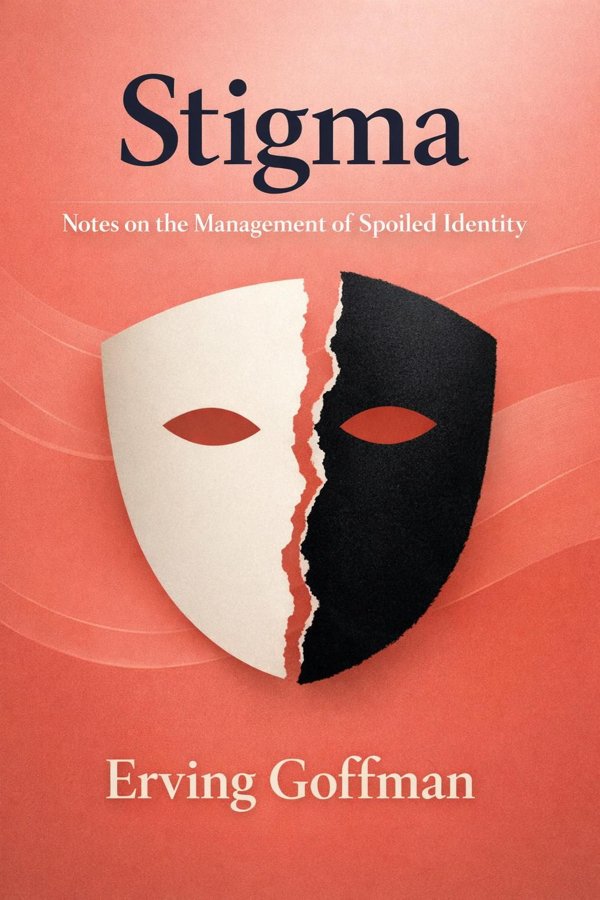
Stigma: Notes on the Management of Spoiled Identity: Summary & Key Insights
 10 min10 chaptersAudio available
What Is Stigma: Notes on the Management of Spoiled Identity About?
Stigma: Notes on the Management of Spoiled Identity by Erving Goffman is a sociology book spanning 10 pages. Stigma: Notes on the Management of Spoiled Identity es un estudio sociológico clásico que examina cómo las personas cuya identidad se considera 'estropeada' por la sociedad manejan su presentación personal y las interacciones sociales. Goffman analiza los mecanismos de etiquetado, exclusión y adaptación que surgen cuando los individuos son percibidos como desviados de las normas sociales.
This FizzRead summary covers all 10 key chapters of Stigma: Notes on the Management of Spoiled Identity in approximately 10 minutes, distilling the most important ideas, arguments, and takeaways from Erving Goffman's work. Also available as an audio summary and Key Quotes Podcast.
Stigma: Notes on the Management of Spoiled Identity
Stigma: Notes on the Management of Spoiled Identity es un estudio sociológico clásico que examina cómo las personas cuya identidad se considera 'estropeada' por la sociedad manejan su presentación personal y las interacciones sociales. Goffman analiza los mecanismos de etiquetado, exclusión y adaptación que surgen cuando los individuos son percibidos como desviados de las normas sociales.
Who Should Read Stigma: Notes on the Management of Spoiled Identity?
This book is perfect for anyone interested in sociology and looking to gain actionable insights in a short read. Whether you're a student, professional, or lifelong learner, the key ideas from Stigma: Notes on the Management of Spoiled Identity by Erving Goffman will help you think differently.
- ✓Readers who enjoy sociology and want practical takeaways
- ✓Professionals looking to apply new ideas to their work and life
- ✓Anyone who wants the core insights of Stigma: Notes on the Management of Spoiled Identity in just 10 minutes
Want the full summary?
Get instant access to this book summary and 100K+ more with Fizz Moment.
Get Free SummaryAvailable on App Store • Free to download
Key Chapters
When people think of stigma, they often imagine visible signs—scars, disabilities, deformities. Yet stigma extends far beyond the physical. I distinguish three broad types that encompass the social ways identities can be spoiled. The first, physical stigma, arises from bodily differences—blindness, paralysis, or disfigurement—that disrupt the ideal of physical completeness society values. The second, blemishes of individual character, includes behaviors and associations that signal moral weakness, criminality, or mental disorder. The third, tribal stigmas, are inherited marks that bind entire groups—the color of skin, religion, or nationality—rendering difference a collective rather than individual fault.
These categories are sociological rather than moral; they show how society attaches meaning to difference. The person bearing such marks becomes, in effect, a symbol of deviation from what is accepted. What offends the social order is not the attribute itself but the interpretation attached to it. Thus, even before any act of discrimination, stigma functions as a kind of filter that distorts the person’s identity, separating appearance from presumed essence. The stigmatized live under a systematic suspicion—the fear that every encounter may confirm what others already suspect.
What fascinates me most is the elasticity of stigma. What counts as a 'taint' in one culture may be neutral, even honorable, in another. The categories of disgrace change, but the process remains: society shapes itself by defining who belongs and who is to be managed. Stigma, therefore, is not a property of an individual but a relationship between attribute and audience.
+ 8 more chapters — available in the FizzRead app
All Chapters in Stigma: Notes on the Management of Spoiled Identity
About the Author
Erving Goffman (1922–1982) fue un sociólogo canadiense-estadounidense, reconocido por sus estudios sobre la interacción social, la presentación del yo y las instituciones totales. Su obra influyó profundamente en la sociología contemporánea y en el análisis de la vida cotidiana.
Get This Summary in Your Preferred Format
Read or listen to the Stigma: Notes on the Management of Spoiled Identity summary by Erving Goffman anytime, anywhere. FizzRead offers multiple formats so you can learn on your terms — all free.
Available formats: App · Audio · PDF · EPUB — All included free with FizzRead
Download Stigma: Notes on the Management of Spoiled Identity PDF and EPUB Summary
Key Quotes from Stigma: Notes on the Management of Spoiled Identity
“When people think of stigma, they often imagine visible signs—scars, disabilities, deformities.”
“Each of us carries two versions of identity: one held in our own consciousness, and one distributed among those who meet us.”
Frequently Asked Questions about Stigma: Notes on the Management of Spoiled Identity
Stigma: Notes on the Management of Spoiled Identity by Erving Goffman is a sociology book that explores key ideas across 10 chapters. Stigma: Notes on the Management of Spoiled Identity es un estudio sociológico clásico que examina cómo las personas cuya identidad se considera 'estropeada' por la sociedad manejan su presentación personal y las interacciones sociales. Goffman analiza los mecanismos de etiquetado, exclusión y adaptación que surgen cuando los individuos son percibidos como desviados de las normas sociales.
More by Erving Goffman


You Might Also Like

Between the World and Me
Ta-Nehisi Coates
10 min
Half the Sky
Nicholas D. Kristof, Sheryl WuDunn
10 min
Men Explain Things To Me
Rebecca Solnit
10 min
Rational Ritual
Michael Suk-Young Chwe
10 min
The New Jim Crow
Michelle Alexander
10 min
Beyond Culture
Edward T. Hall
10 minBrowse by Category
Ready to read Stigma: Notes on the Management of Spoiled Identity?
Get the full summary and 100K+ more books with Fizz Moment.