
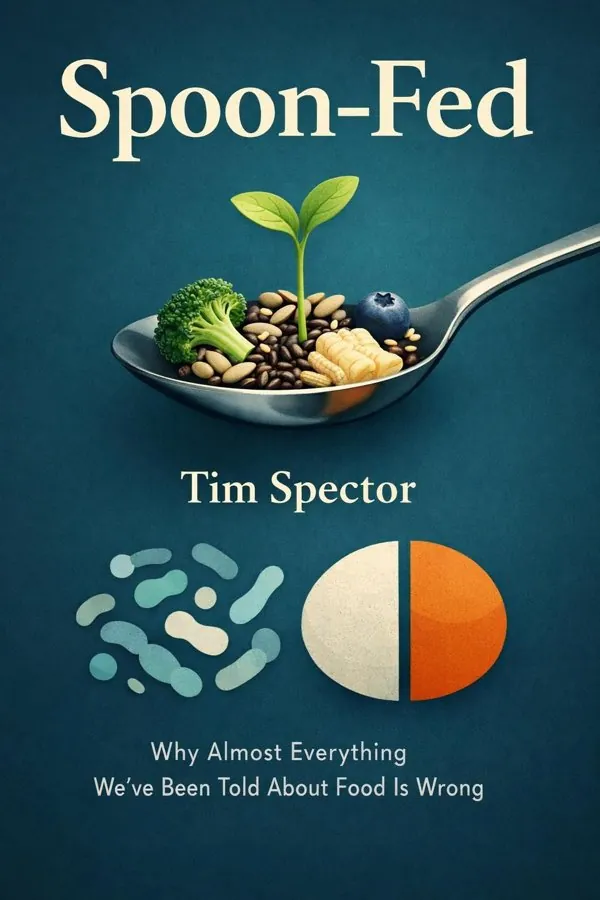
Spoon-Fed: Why Almost Everything We've Been Told About Food Is Wrong: Summary & Key Insights
by Tim Spector
 10 min9 chaptersAudio available
What Is Spoon-Fed: Why Almost Everything We've Been Told About Food Is Wrong About?
Spoon-Fed: Why Almost Everything We've Been Told About Food Is Wrong by Tim Spector is a health_med book spanning 9 pages. In 'Spoon-Fed', genetic epidemiologist Tim Spector challenges widespread myths about nutrition and diet. Drawing on cutting-edge research from the fields of microbiome science and nutritional epidemiology, Spector argues that much of what we believe about healthy eating—such as calorie counting, low-fat diets, and superfoods—is misleading or oversimplified. He advocates for a more personalized and evidence-based approach to food, emphasizing the importance of gut health and dietary diversity.
This FizzRead summary covers all 9 key chapters of Spoon-Fed: Why Almost Everything We've Been Told About Food Is Wrong in approximately 10 minutes, distilling the most important ideas, arguments, and takeaways from Tim Spector's work. Also available as an audio summary and Key Quotes Podcast.
Spoon-Fed: Why Almost Everything We've Been Told About Food Is Wrong
In 'Spoon-Fed', genetic epidemiologist Tim Spector challenges widespread myths about nutrition and diet. Drawing on cutting-edge research from the fields of microbiome science and nutritional epidemiology, Spector argues that much of what we believe about healthy eating—such as calorie counting, low-fat diets, and superfoods—is misleading or oversimplified. He advocates for a more personalized and evidence-based approach to food, emphasizing the importance of gut health and dietary diversity.
Who Should Read Spoon-Fed: Why Almost Everything We've Been Told About Food Is Wrong?
This book is perfect for anyone interested in health_med and looking to gain actionable insights in a short read. Whether you're a student, professional, or lifelong learner, the key ideas from Spoon-Fed: Why Almost Everything We've Been Told About Food Is Wrong by Tim Spector will help you think differently.
- ✓Readers who enjoy health_med and want practical takeaways
- ✓Professionals looking to apply new ideas to their work and life
- ✓Anyone who wants the core insights of Spoon-Fed: Why Almost Everything We've Been Told About Food Is Wrong in just 10 minutes
Want the full summary?
Get instant access to this book summary and 100K+ more with Fizz Moment.
Get Free SummaryAvailable on App Store • Free to download
Key Chapters
For much of the twentieth century, we’ve been told that the key to maintaining a healthy weight is simple arithmetic: eat fewer calories than you burn. Yet, as an epidemiologist who has studied thousands of individuals, I can assure you this view is dangerously reductive. Calories are a measure of energy, not nutrition. Moreover, not all calories are absorbed or metabolized in the same way.
When you eat a 200-calorie portion of almonds, the amount of energy your body actually extracts depends on how well your gut microbes break down their fibrous structure. A 200-calorie soda, by contrast, floods the bloodstream with glucose within minutes, sparking insulin spikes and fat storage. In real life, these “equal” calories have entirely different metabolic consequences.
The obsession with calorie counting arose from a scientific desire for quantification, but it ignored biological complexity. We now know that people differ vastly in how efficiently their bodies process various foods. I’ve seen repeated experiments where one person’s blood sugar soared after eating bread, while another’s barely changed. The old calorie model simply can’t account for this variability.
Moreover, calorie labels on food packaging are often inaccurate because they assume a universal absorption rate. They also ignore the vital influence of your gut microbiome, which decides how much energy your body extracts from food in the first place. Gut microbes can even protect you from gaining weight, or conversely, predispose you to obesity.
When you stop thinking of your body as an impersonal calorie-burning machine, you can reconnect with how it actually works—as a living ecosystem of cells and microbes cooperating to transform nutrients into health or disease. The secret is not to count calories but to choose foods that nourish these interactions: fibrous plants, diverse ingredients, and minimally processed meals that feed your microbes as much as they feed you.
For years, fat was public enemy number one. Government guidelines, influenced by flawed early studies, warned that dietary fat—especially saturated fat—led directly to heart disease. Supermarkets filled with low-fat yogurts, margarine spreads, and “heart-healthy” snacks. But the consequences of that advice were profound and damaging.
When you remove fat from food, you remove much of its flavor and satiety. To compensate, food manufacturers added sugar and refined starch. The result was a surge in obesity and metabolic diseases. Modern research, including large cohort and randomized studies, has now shown that the link between saturated fat and heart disease is not as clear-cut as once claimed. What matters most is the overall dietary pattern—the context of the fats, the quality of the foods they come from, and what replaces them.
Not all fats are created equal. The fats found in olive oil, nuts, oily fish, and even moderate amounts in dairy can be beneficial. Our brains, hormones, and cell membranes depend on fats; depriving the body of them can disrupt multiple systems. What really harms us are industrial trans fats and the ultra-processed oils used in fried or packaged foods—compounds far removed from anything our ancestors ate.
It’s time to stop fearing fat and start respecting its role as a driver of flavor, satisfaction, and metabolic balance. The vilification of fat distracted us from the real culprit: ultra-processing and refined carbohydrates. Healthy eating is not about stripping away essential nutrients; it’s about restoring the rich diversity of whole foods our evolution prepared us for.
+ 7 more chapters — available in the FizzRead app
All Chapters in Spoon-Fed: Why Almost Everything We've Been Told About Food Is Wrong
About the Author
Tim Spector is a British epidemiologist and professor of genetic epidemiology at King's College London. He is known for his pioneering research on twins and the human microbiome, as well as for founding the ZOE Health Study. His work focuses on how genetics, diet, and lifestyle interact to influence health and disease.
Get This Summary in Your Preferred Format
Read or listen to the Spoon-Fed: Why Almost Everything We've Been Told About Food Is Wrong summary by Tim Spector anytime, anywhere. FizzRead offers multiple formats so you can learn on your terms — all free.
Available formats: App · Audio · PDF · EPUB — All included free with FizzRead
Download Spoon-Fed: Why Almost Everything We've Been Told About Food Is Wrong PDF and EPUB Summary
Key Quotes from Spoon-Fed: Why Almost Everything We've Been Told About Food Is Wrong
“For much of the twentieth century, we’ve been told that the key to maintaining a healthy weight is simple arithmetic: eat fewer calories than you burn.”
“For years, fat was public enemy number one.”
Frequently Asked Questions about Spoon-Fed: Why Almost Everything We've Been Told About Food Is Wrong
Spoon-Fed: Why Almost Everything We've Been Told About Food Is Wrong by Tim Spector is a health_med book that explores key ideas across 9 chapters. In 'Spoon-Fed', genetic epidemiologist Tim Spector challenges widespread myths about nutrition and diet. Drawing on cutting-edge research from the fields of microbiome science and nutritional epidemiology, Spector argues that much of what we believe about healthy eating—such as calorie counting, low-fat diets, and superfoods—is misleading or oversimplified. He advocates for a more personalized and evidence-based approach to food, emphasizing the importance of gut health and dietary diversity.
You Might Also Like

On Immunity
Eula Biss
10 min
The Three-Body Problem
Liu Cixin
10 min
Community Health Volunteer Toolkit: Training and Practical Activities
World Health Organization
10 min
Healing Back Pain: The Mind-Body Connection
John E. Sarno
10 min
Health Literacy for All: Practical Guides to Communicate Health Information (Compilations)
World Health Organization
10 min
The Complete Guide to Sports Supplements: An Evidence-Based Review
Anita Bean
10 minBrowse by Category
Ready to read Spoon-Fed: Why Almost Everything We've Been Told About Food Is Wrong?
Get the full summary and 100K+ more books with Fizz Moment.