
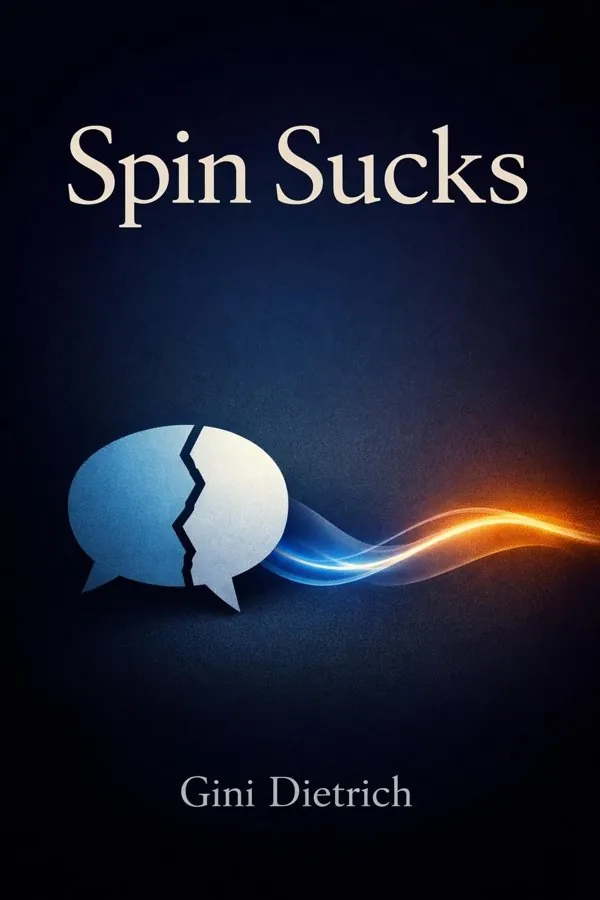
Spin Sucks: Communication and Reputation Management in the Digital Age: Summary & Key Insights
 10 min9 chaptersAudio available
Key Takeaways from Spin Sucks: Communication and Reputation Management in the Digital Age
The biggest shift in communication is not technological but psychological: organizations no longer own the conversation.
A strategy built on message control becomes fragile the moment people can fact-check you in seconds.
People forgive mistakes more easily than deception.
If trust is the goal, useful content is one of the best ways to earn it.
Strong communication strategies do not rely on one channel; they combine channels in a deliberate system.
What Is Spin Sucks: Communication and Reputation Management in the Digital Age About?
Spin Sucks: Communication and Reputation Management in the Digital Age by Gini Dietrich is a communication book spanning 9 pages. In a world where a single tweet can damage a brand and a well-told story can build a movement, Spin Sucks argues that communication can no longer rely on polish, deflection, or control. Gini Dietrich shows how public relations, marketing, and reputation management have been permanently reshaped by the internet, where audiences talk back, employees publish their own perspectives, and trust is earned in public view. The book is both a critique of old-school “spin” and a practical guide to modern, ethical communication. Dietrich’s central claim is simple but powerful: credibility is now the most valuable asset an organization can have, and credibility grows from honesty, transparency, and consistent behavior. Rather than manipulating perception, communicators must learn to create useful content, engage openly with stakeholders, measure what matters, and respond to crises with speed and integrity. As the founder of Arment Dietrich and the influential Spin Sucks platform, Dietrich writes from deep professional experience in PR and digital strategy. Her perspective matters because it bridges theory and practice, offering a realistic model for how organizations can build reputations that actually withstand scrutiny in the digital age.
This FizzRead summary covers all 9 key chapters of Spin Sucks: Communication and Reputation Management in the Digital Age in approximately 10 minutes, distilling the most important ideas, arguments, and takeaways from Gini Dietrich's work. Also available as an audio summary and Key Quotes Podcast.
Spin Sucks: Communication and Reputation Management in the Digital Age
In a world where a single tweet can damage a brand and a well-told story can build a movement, Spin Sucks argues that communication can no longer rely on polish, deflection, or control. Gini Dietrich shows how public relations, marketing, and reputation management have been permanently reshaped by the internet, where audiences talk back, employees publish their own perspectives, and trust is earned in public view. The book is both a critique of old-school “spin” and a practical guide to modern, ethical communication.
Dietrich’s central claim is simple but powerful: credibility is now the most valuable asset an organization can have, and credibility grows from honesty, transparency, and consistent behavior. Rather than manipulating perception, communicators must learn to create useful content, engage openly with stakeholders, measure what matters, and respond to crises with speed and integrity. As the founder of Arment Dietrich and the influential Spin Sucks platform, Dietrich writes from deep professional experience in PR and digital strategy. Her perspective matters because it bridges theory and practice, offering a realistic model for how organizations can build reputations that actually withstand scrutiny in the digital age.
Who Should Read Spin Sucks: Communication and Reputation Management in the Digital Age?
This book is perfect for anyone interested in communication and looking to gain actionable insights in a short read. Whether you're a student, professional, or lifelong learner, the key ideas from Spin Sucks: Communication and Reputation Management in the Digital Age by Gini Dietrich will help you think differently.
- ✓Readers who enjoy communication and want practical takeaways
- ✓Professionals looking to apply new ideas to their work and life
- ✓Anyone who wants the core insights of Spin Sucks: Communication and Reputation Management in the Digital Age in just 10 minutes
Want the full summary?
Get instant access to this book summary and 100K+ more with Fizz Moment.
Get Free SummaryAvailable on App Store • Free to download
Key Chapters
The biggest shift in communication is not technological but psychological: organizations no longer own the conversation. Not long ago, companies could shape public understanding through press releases, media interviews, and carefully managed campaigns. Communication flowed in one direction, and the public had limited channels to respond. In the digital age, that model is gone. Customers post reviews, employees share experiences online, journalists publish instantly, and communities organize around issues in real time. Reputation is now built through participation, not proclamation.
Dietrich explains that this new reality forces communicators to stop thinking like gatekeepers and start thinking like facilitators. A message is no longer finished when it is sent; it evolves as people react, remix, challenge, and spread it. This means every statement, product launch, customer interaction, and internal policy can become part of a larger public narrative. Silence, inconsistency, or defensiveness can be as damaging as a direct mistake.
A practical example is how consumers now evaluate brands before buying. They look beyond advertising to search results, employee commentary, customer complaints, and social media conversations. A glossy campaign may attract attention, but one unresolved service issue can undermine credibility if it gains traction online. Smart organizations adapt by listening continuously, responding quickly, and aligning what they say with what they do.
The lesson is clear: communication is no longer about controlling a message from the top. It is about building relationships in an environment where everyone has a voice. Actionable takeaway: treat every communication effort as the beginning of a conversation, and build systems for listening, responding, and learning in public.
A strategy built on message control becomes fragile the moment people can fact-check you in seconds. Dietrich argues that traditional PR rose to prominence by mastering access: access to journalists, access to media outlets, and access to public attention. That gave communicators influence because they could help determine what stories were told and how they were framed. But digital platforms weakened that advantage. Today, organizations can publish directly, critics can publish just as easily, and the audience can compare competing versions of the truth in real time.
This does not mean PR is dead. It means the old version of PR—based on selective storytelling, delayed responses, and manufactured polish—is no longer reliable. If a company tries to bury bad news, someone will likely expose it. If leaders overstate a claim, screenshots and receipts may surface. If a brand hides behind vague statements, the lack of specificity itself becomes a story. Traditional tactics fail because they assume information scarcity in an age of information abundance.
Dietrich encourages communicators to redefine their role. Instead of serving as image managers who smooth over problems, they should become trust builders who help organizations communicate honestly and strategically. Media relations still matter, but they must be integrated with owned channels, community engagement, internal communication, and crisis preparedness.
Imagine a company facing criticism over workplace culture. In the past, it might issue a tightly worded statement and hope the cycle passes. Today, former employees can speak publicly, reporters can investigate, and customers can amplify the issue. The stronger response is to acknowledge concerns, explain actions being taken, and maintain ongoing dialogue.
Actionable takeaway: stop asking how to control the story and start asking how to contribute truthfully, consistently, and credibly to it.
People forgive mistakes more easily than deception. That insight sits at the heart of Dietrich’s argument for transparency. In the digital age, trust does not come from sounding perfect; it comes from being believable. Audiences are increasingly skeptical of corporate language that feels sanitized, evasive, or overly promotional. They want to know what happened, what an organization actually thinks, and what it plans to do next. Transparency meets that need by replacing image protection with open communication.
Dietrich is careful not to confuse transparency with oversharing. Organizations do not need to reveal every internal detail or legal complexity. Instead, they should communicate in ways that are timely, honest, and understandable. If a product has been delayed, explain why. If a mistake was made, admit it clearly. If a policy is changing, tell people what that means in practical terms. Transparency is not a slogan; it is a habit of clarity.
This principle applies across everyday situations. A nonprofit can publish both successes and setbacks in its annual report. A startup can explain changes in pricing before customer frustration builds. A corporate leader can address layoffs with direct language, acknowledging the human impact rather than hiding behind jargon. In each case, transparency reduces speculation and shows respect for the audience.
The long-term value of transparency is reputational resilience. When people believe you generally tell the truth, they are more likely to give you the benefit of the doubt when problems arise. Without that foundation, every misstep looks like part of a larger pattern.
Actionable takeaway: in your next important communication, replace vague protective language with clear explanations of what happened, why it matters, and what comes next.
If trust is the goal, useful content is one of the best ways to earn it. Dietrich argues that modern PR cannot depend only on pitching stories to the media. Organizations must become publishers in their own right, creating articles, videos, newsletters, podcasts, reports, and social posts that educate, clarify, and engage. Content is not an add-on to communication strategy; it is the engine that helps audiences understand who you are, what you know, and why they should believe you.
What matters most is not volume but relevance. Effective content answers real questions, addresses real concerns, and reflects audience needs rather than internal talking points. A healthcare company might publish plain-language explainers on treatment options. A software firm might create tutorials that help users solve everyday problems. A CEO might share thoughtful commentary on industry changes rather than generic leadership quotes. Over time, this builds authority and familiarity.
Dietrich’s point is especially important because content does two jobs at once. First, it supports discoverability: when people search for information, your expertise can meet them where they are. Second, it shapes reputation: people infer your values from the quality, tone, and consistency of what you publish. Helpful content signals confidence and competence. Empty content signals self-absorption.
For communicators, this requires editorial discipline. You need a clear point of view, a publishing rhythm, and standards for quality. Content should also align with broader business goals, whether that means customer retention, thought leadership, recruitment, or issue management.
Actionable takeaway: audit your current content and ask one simple question—does it genuinely help the audience? If not, shift from promotional output to practical, trust-building information.
Strong communication strategies do not rely on one channel; they combine channels in a deliberate system. One of Dietrich’s most influential contributions is the PESO Model, which integrates Paid, Earned, Shared, and Owned media. Rather than treating advertising, media coverage, social media, and owned content as separate silos, the model shows how they can reinforce one another. The result is a more resilient and measurable communication ecosystem.
Owned media includes your website, blog, newsletter, and other channels you control. Shared media covers social platforms and community engagement. Earned media refers to coverage, mentions, reviews, and third-party attention. Paid media includes sponsored distribution, ads, promoted content, and amplification. Dietrich’s insight is that each type has strengths and weaknesses. Owned media gives control but limited built-in reach. Earned media provides credibility but cannot be fully controlled. Shared media creates interaction but can become noisy. Paid media scales exposure but lacks organic trust on its own.
A practical campaign might begin with owned content, such as a research report published on the company site. That report is then promoted through social channels, pitched to journalists and influencers, and amplified through paid distribution to reach targeted audiences. Each element supports the others. The story travels farther, and the organization gains not just visibility but evidence of impact across multiple touchpoints.
The PESO model also helps teams collaborate. Marketing, PR, content, and digital specialists can work from one integrated plan rather than duplicating effort. This reduces waste and improves consistency.
Actionable takeaway: map your next campaign across all four PESO categories and identify how each channel can extend the reach, credibility, and usefulness of the others.
In the digital age, a crisis often begins before leadership even realizes one exists. Dietrich emphasizes that online communication has compressed the timeline of reputation risk. Complaints can go viral in hours, internal memos can leak instantly, and customer outrage can snowball before a formal response is drafted. The old instinct—to wait, gather every detail, and release a carefully polished statement—can worsen the damage if it creates the impression of indifference or concealment.
Modern crisis management requires preparation, speed, and credibility. Preparation means more than having a binder of protocols. It means knowing who monitors online conversation, who makes decisions, who approves statements, and how teams coordinate across legal, communications, operations, and leadership. Speed means acknowledging issues early, even if all the facts are not yet available. Credibility means avoiding defensive language, accepting responsibility where appropriate, and communicating what concrete steps are being taken.
Dietrich also makes an important distinction: many crises are not communications failures at all. They are operational or ethical failures exposed through communication channels. A weak statement cannot fix a broken culture, unsafe product, or dishonest policy. In those cases, communication must support actual reform rather than mask the underlying problem.
Consider a restaurant chain accused of discriminatory treatment. A fast but generic statement may calm no one. A stronger response would acknowledge the complaint, describe the investigation process, communicate immediate actions, and follow up publicly with policy changes and staff training. The follow-through matters as much as the first response.
Actionable takeaway: build a crisis plan now, but center it on real accountability—early acknowledgement, clear ownership, and visible corrective action—not just message drafting.
What cannot be measured is often undervalued, and Dietrich insists that communicators must stop hiding behind vague claims of awareness or buzz. For too long, PR was judged by outputs such as clips, impressions, or the sheer number of mentions. Those metrics may indicate activity, but they do not prove meaningful impact. In an era of tighter budgets and higher accountability, communication needs stronger evidence.
Dietrich argues for measurement tied to business outcomes. That means asking not only whether people saw a message, but whether it changed anything. Did website traffic increase from a media placement? Did lead quality improve after a thought leadership campaign? Did customer sentiment recover after a crisis response? Did employee engagement rise after a transparency initiative? The right metrics depend on the goal, but the principle is constant: communication should be connected to behavior, trust, and performance.
This shift also helps communicators earn strategic influence inside organizations. When PR professionals can explain how a campaign contributed to recruitment, sales enablement, stakeholder support, or risk reduction, they move from tactical execution to leadership relevance. Measurement turns communication from a cost center into a source of strategic insight.
A practical application could involve tracking a content campaign across the PESO framework. Owned media metrics might include time on page and email sign-ups. Shared media could show engagement quality. Earned media might drive referral traffic or backlinks. Paid media can be evaluated by conversion rates. Together, these data points reveal what is working and where to improve.
Actionable takeaway: before launching any communication effort, define one business objective, three meaningful metrics, and a reporting method that shows results beyond vanity numbers.
Ethics in communication are often treated as a moral luxury, but Dietrich presents them as a practical necessity. In a connected world, manipulative tactics are not only wrong; they are dangerous. Misleading headlines, hidden sponsorships, selective omissions, and misleading statements may create short-term gains, but they corrode trust over time. Once audiences believe a brand bends the truth, every future message is filtered through suspicion.
Dietrich’s rejection of spin is not naive idealism. It is rooted in the reality that trust compounds, and so does distrust. Ethical communication means telling the truth, disclosing interests, respecting audiences, and refusing to manipulate through confusion or fear. It also means advising leaders honestly, even when the easier route is to protect egos or preserve appearances.
This is especially relevant in areas such as influencer partnerships, crisis messaging, and corporate social responsibility. If a company promotes a social cause while failing to address internal misconduct, audiences will spot the contradiction. If sponsored content is disguised as organic endorsement, backlash can be swift. If a business apologizes publicly but blames others privately, the inconsistency eventually surfaces.
An ethical approach does not guarantee universal praise. Sometimes transparency reveals uncomfortable realities. But it creates a reputation for seriousness and integrity, which is far more durable than reputation by illusion. Ethical communicators help organizations face truth early, before the truth arrives as scandal.
Actionable takeaway: establish a clear ethical standard for communication decisions—if a tactic would damage trust once fully visible, do not use it, no matter how effective it seems in the short term.
Communication strategy fails when company culture contradicts it. Dietrich argues that reputation management cannot be outsourced to the PR team alone because trust is created by the behavior of the whole organization. A business cannot claim transparency while leaders hide information internally. It cannot promote customer care while frontline staff lack support. It cannot publish values externally that employees experience as fiction. In the digital age, culture leaks.
This is why Dietrich emphasizes openness as an organizational practice, not merely a messaging style. Leaders need to communicate candidly with employees, encourage feedback, and make it safe to raise concerns early. Internal communication is not secondary to external reputation; it is one of its foundations. Employees who feel informed and respected become credible ambassadors. Employees who feel ignored or misled often become sources of reputational risk.
A culture of openness also improves decision-making. If teams can surface mistakes without fear, issues are more likely to be fixed before they escalate. If leadership explains the rationale behind changes, employees can carry those messages consistently to customers and partners. If transparency is normal internally, it becomes easier to practice externally.
For example, a company facing public criticism over product quality will struggle to respond effectively if internal teams are already confused, defensive, or in the dark. By contrast, an open culture allows rapid alignment: what happened, what is being done, and how everyone should address stakeholder questions.
Actionable takeaway: strengthen reputation from the inside by creating regular, honest communication loops with employees and by rewarding those who surface problems early rather than punishing them for speaking up.
All Chapters in Spin Sucks: Communication and Reputation Management in the Digital Age
About the Author
Gini Dietrich is an American communications strategist, author, and entrepreneur best known for her work in modern public relations and reputation management. She founded Arment Dietrich, a communications agency, and created Spin Sucks, a leading platform dedicated to ethical PR, marketing, and digital communication. Dietrich has built a strong reputation for challenging manipulative industry practices and advocating a more transparent, measurable, and integrated approach to communication. She is also widely associated with the PESO model, a framework that combines paid, earned, shared, and owned media into a unified strategy. Through her writing, speaking, and consulting, Dietrich has helped organizations rethink how they build trust in an era of constant online scrutiny, making her an influential voice in the evolution of public relations.
Get This Summary in Your Preferred Format
Read or listen to the Spin Sucks: Communication and Reputation Management in the Digital Age summary by Gini Dietrich anytime, anywhere. FizzRead offers multiple formats so you can learn on your terms — all free.
Available formats: App · Audio · PDF · EPUB — All included free with FizzRead
Download Spin Sucks: Communication and Reputation Management in the Digital Age PDF and EPUB Summary
Key Quotes from Spin Sucks: Communication and Reputation Management in the Digital Age
“The biggest shift in communication is not technological but psychological: organizations no longer own the conversation.”
“A strategy built on message control becomes fragile the moment people can fact-check you in seconds.”
“People forgive mistakes more easily than deception.”
“If trust is the goal, useful content is one of the best ways to earn it.”
“Strong communication strategies do not rely on one channel; they combine channels in a deliberate system.”
Frequently Asked Questions about Spin Sucks: Communication and Reputation Management in the Digital Age
Spin Sucks: Communication and Reputation Management in the Digital Age by Gini Dietrich is a communication book that explores key ideas across 9 chapters. In a world where a single tweet can damage a brand and a well-told story can build a movement, Spin Sucks argues that communication can no longer rely on polish, deflection, or control. Gini Dietrich shows how public relations, marketing, and reputation management have been permanently reshaped by the internet, where audiences talk back, employees publish their own perspectives, and trust is earned in public view. The book is both a critique of old-school “spin” and a practical guide to modern, ethical communication. Dietrich’s central claim is simple but powerful: credibility is now the most valuable asset an organization can have, and credibility grows from honesty, transparency, and consistent behavior. Rather than manipulating perception, communicators must learn to create useful content, engage openly with stakeholders, measure what matters, and respond to crises with speed and integrity. As the founder of Arment Dietrich and the influential Spin Sucks platform, Dietrich writes from deep professional experience in PR and digital strategy. Her perspective matters because it bridges theory and practice, offering a realistic model for how organizations can build reputations that actually withstand scrutiny in the digital age.
You Might Also Like

Magic Words: The Science and Secrets Behind Seven Words That Motivate, Engage, and Influence
Tim David
10 min
Talking Across The Divide: How to Communicate with People You Disagree with and Maybe Even Change the World
Justin Lee
10 min
The Exceptional Presenter: A Proven Formula to Open Up! and Own the Room
Timothy J. Koegel
10 min
4 Essential Keys to Effective Communication in Love, Life, Work--Anywhere!: Including the 12-Day Communication Challenge!
Bento C. Leal III
10 min
Active Listening Techniques: 30 Practical Tools to Hone Your Communication Skills
Nisha Gupta
10 min
Bargaining for Advantage: Negotiation Strategies for Reasonable People
G. Richard Shell
10 minBrowse by Category
Ready to read Spin Sucks: Communication and Reputation Management in the Digital Age?
Get the full summary and 100K+ more books with Fizz Moment.