
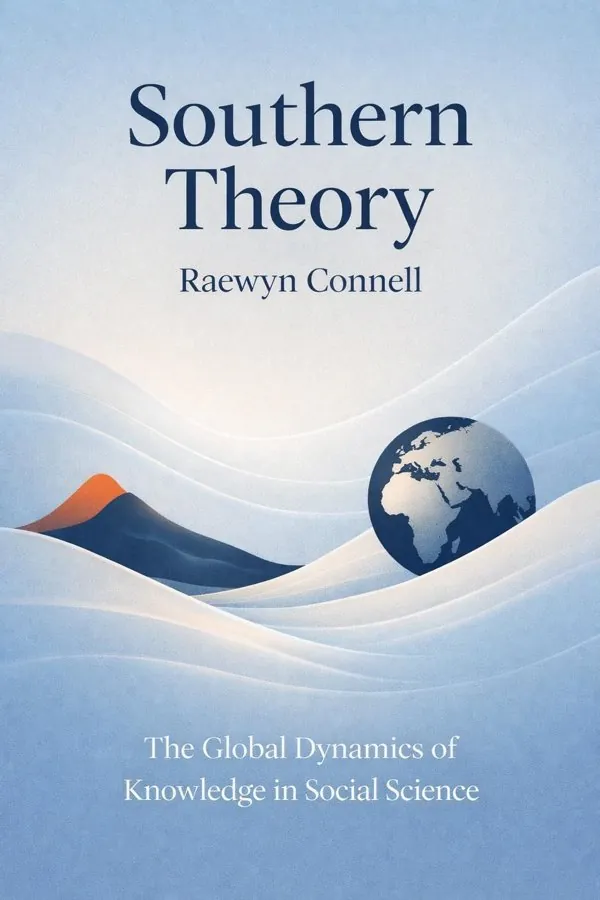
Southern Theory: The Global Dynamics of Knowledge in Social Science: Summary & Key Insights
 10 min8 chaptersAudio available
What Is Southern Theory: The Global Dynamics of Knowledge in Social Science About?
Southern Theory: The Global Dynamics of Knowledge in Social Science by Raewyn Connell is a sociology book spanning 8 pages. Southern Theory is a foundational work by Australian sociologist Raewyn Connell that rethinks social science from the perspective of the Global South. The book examines how knowledge, power, and democracy are shaped in a world dominated by Northern intellectual traditions, and argues for a more inclusive 'world social science' that incorporates the experiences and theories of the South. Connell analyzes the global dynamics of knowledge production and provides examples of social thought originating in Africa, Asia, and Latin America.
This FizzRead summary covers all 8 key chapters of Southern Theory: The Global Dynamics of Knowledge in Social Science in approximately 10 minutes, distilling the most important ideas, arguments, and takeaways from Raewyn Connell's work. Also available as an audio summary and Key Quotes Podcast.
Southern Theory: The Global Dynamics of Knowledge in Social Science
Southern Theory is a foundational work by Australian sociologist Raewyn Connell that rethinks social science from the perspective of the Global South. The book examines how knowledge, power, and democracy are shaped in a world dominated by Northern intellectual traditions, and argues for a more inclusive 'world social science' that incorporates the experiences and theories of the South. Connell analyzes the global dynamics of knowledge production and provides examples of social thought originating in Africa, Asia, and Latin America.
Who Should Read Southern Theory: The Global Dynamics of Knowledge in Social Science?
This book is perfect for anyone interested in sociology and looking to gain actionable insights in a short read. Whether you're a student, professional, or lifelong learner, the key ideas from Southern Theory: The Global Dynamics of Knowledge in Social Science by Raewyn Connell will help you think differently.
- ✓Readers who enjoy sociology and want practical takeaways
- ✓Professionals looking to apply new ideas to their work and life
- ✓Anyone who wants the core insights of Southern Theory: The Global Dynamics of Knowledge in Social Science in just 10 minutes
Want the full summary?
Get instant access to this book summary and 100K+ more with Fizz Moment.
Get Free SummaryAvailable on App Store • Free to download
Key Chapters
Social science emerged in the shadow of empire. The nineteenth century was a time of intense European expansion, and the new disciplines—anthropology, sociology, political economy—grew alongside colonial administration. The very categories through which these sciences perceived the world—'civilization,' 'development,' 'tradition'—were infused with imperial assumptions. Colonized peoples were studied, classified, and spoken for, but rarely allowed to speak back. Knowledge served domination.
In *Southern Theory*, I trace the ways colonial and imperial power created an enduring global hierarchy of knowledge. Institutions like universities, museums, and learned societies were concentrated in the metropole. Resources flowed from the periphery to the center—raw materials, labor, and also information. The South furnished field sites, case studies, and data, but not theory. European thinkers described their societies as the pinnacle of progress and saw others as backward or transitional. This framework became embedded in global academia. When independence movements later demanded a place in modernity, development theory and modernization ideology reasserted Northern leadership in subtler, technocratic forms.
What was missing was an appreciation of Southern experiences as themselves theoretical. Colonized and postcolonial societies wrestled with rapid cultural transformation, political oppression, and creative resistance—contexts rich in insight about social change. Yet Northern theory often ignored these realities or absorbed them into universals derived from its own history. In recovering these Southern perspectives, I wanted to show that global intellectual life has always been plural, but only recently have we begun to hear all its voices.
The intellectual heritage of sociology is dominated by figures like Weber, Durkheim, and Marx; later by Parsons, Bourdieu, and Habermas. Their ideas have shaped generations of scholars worldwide, and their frameworks remain the default lens through which societies are explained. But the universality of these perspectives is deceptive. Each was born from particular historical and social conditions—industrial Europe, capitalist class formation, bureaucratic state-building—and these conditions shaped their assumptions about what constitutes 'the social.'
In examining the Northern tradition, I emphasize how its theories often universalize local experience. For example, the image of modernity as rational, bureaucratic, and secular reflects Western pathways, not the world’s diversity. Theories of development reproduce colonial hierarchies—treating the South as a lagging follower destined to repeat the North’s evolutionary trajectory. Even critical traditions like Marxism sometimes reduced imperial relations to economic abstraction, neglecting the cultural violence of colonialism. The result was an academic global order in which Northern experience functioned as the model, and everyone else’s reality was interpreted as deviation.
This is why Southern Theory insists on provincializing the North. To understand global society, we must recognize that Northern thought is neither neutral nor complete—it is situated. The North’s history of domination has saturated its intellectual categories. Once we see that clearly, we can begin to imagine social theory as something else: as a conversation across societies rather than a monologue from the metropole.
+ 6 more chapters — available in the FizzRead app
All Chapters in Southern Theory: The Global Dynamics of Knowledge in Social Science
About the Author
Raewyn Connell is an Australian sociologist known for her contributions to social theory, gender studies, and the sociology of education. She has been a professor at the University of Sydney and is the author of influential works such as 'Masculinities' and 'Gender and Power'. Her research focuses on global knowledge justice and the creation of a more equitable social science.
Get This Summary in Your Preferred Format
Read or listen to the Southern Theory: The Global Dynamics of Knowledge in Social Science summary by Raewyn Connell anytime, anywhere. FizzRead offers multiple formats so you can learn on your terms — all free.
Available formats: App · Audio · PDF · EPUB — All included free with FizzRead
Download Southern Theory: The Global Dynamics of Knowledge in Social Science PDF and EPUB Summary
Key Quotes from Southern Theory: The Global Dynamics of Knowledge in Social Science
“Social science emerged in the shadow of empire.”
“The intellectual heritage of sociology is dominated by figures like Weber, Durkheim, and Marx; later by Parsons, Bourdieu, and Habermas.”
Frequently Asked Questions about Southern Theory: The Global Dynamics of Knowledge in Social Science
Southern Theory: The Global Dynamics of Knowledge in Social Science by Raewyn Connell is a sociology book that explores key ideas across 8 chapters. Southern Theory is a foundational work by Australian sociologist Raewyn Connell that rethinks social science from the perspective of the Global South. The book examines how knowledge, power, and democracy are shaped in a world dominated by Northern intellectual traditions, and argues for a more inclusive 'world social science' that incorporates the experiences and theories of the South. Connell analyzes the global dynamics of knowledge production and provides examples of social thought originating in Africa, Asia, and Latin America.
You Might Also Like

Between the World and Me
Ta-Nehisi Coates
10 min
Half the Sky
Nicholas D. Kristof, Sheryl WuDunn
10 min
Men Explain Things To Me
Rebecca Solnit
10 min
Rational Ritual
Michael Suk-Young Chwe
10 min
The New Jim Crow
Michelle Alexander
10 min
Beyond Culture
Edward T. Hall
10 minBrowse by Category
Ready to read Southern Theory: The Global Dynamics of Knowledge in Social Science?
Get the full summary and 100K+ more books with Fizz Moment.