
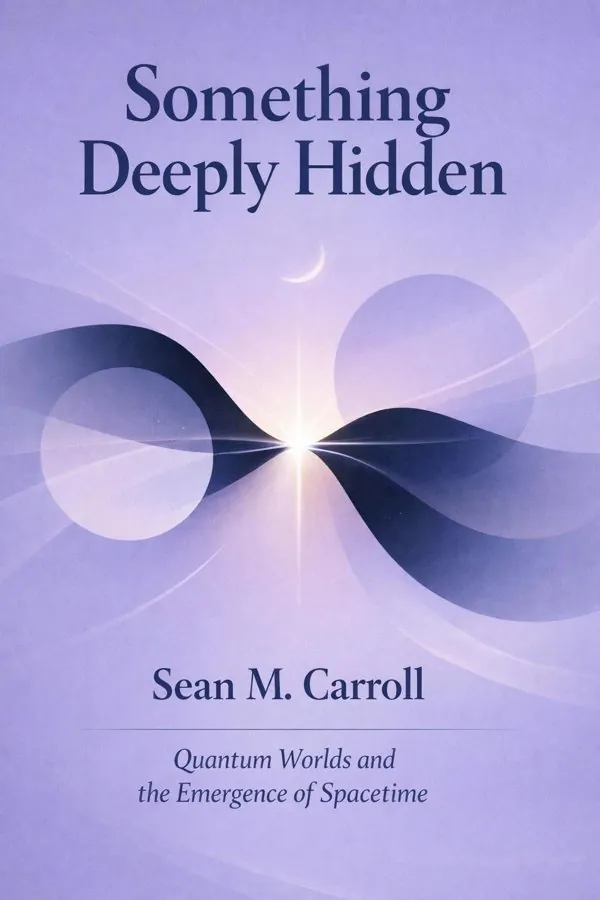
Something Deeply Hidden: Quantum Worlds and the Emergence of Spacetime: Summary & Key Insights
 10 min9 chaptersAudio available
Key Takeaways from Something Deeply Hidden: Quantum Worlds and the Emergence of Spacetime
The road to quantum mechanics begins with a humbling lesson: reality has repeatedly turned out to be less intuitive than it first appears.
The central mystery of quantum mechanics is not that particles are weird; it is that the theory seems to describe two different kinds of evolution.
Sometimes the boldest idea is simply refusing to add extra assumptions.
Our first reaction to Many-Worlds is often disbelief, but Carroll shows that many objections target caricatures rather than the actual proposal.
Carroll highlights decoherence as the key mechanism that explains why branches of the wave function become effectively independent.
What Is Something Deeply Hidden: Quantum Worlds and the Emergence of Spacetime About?
Something Deeply Hidden: Quantum Worlds and the Emergence of Spacetime by Sean M. Carroll is a popular_sci book spanning 9 pages. What if the strangest features of quantum mechanics are not signs that physics has failed, but clues that reality is far richer than common sense allows? In Something Deeply Hidden, theoretical physicist Sean M. Carroll tackles one of science’s most enduring puzzles: how a mathematical theory of possibilities gives rise to the definite world we experience. Rather than treating quantum weirdness as a technical inconvenience, Carroll argues that it forces us to rethink the basic nature of existence. At the center of the book is Carroll’s defense of the Many-Worlds interpretation, the idea that the wave function never collapses and that every quantum possibility is realized in branching worlds. He presents this view not as science fiction, but as a serious attempt to take quantum mechanics literally and consistently. Along the way, he explains decoherence, probability, identity, and the possibility that spacetime itself may emerge from deeper quantum structures. Carroll’s authority comes from his work as a leading theoretical physicist in cosmology and quantum foundations, as well as his exceptional talent for making difficult ideas intelligible. This book matters because it invites readers to confront a profound question: what kind of universe do our best theories actually describe?
This FizzRead summary covers all 9 key chapters of Something Deeply Hidden: Quantum Worlds and the Emergence of Spacetime in approximately 10 minutes, distilling the most important ideas, arguments, and takeaways from Sean M. Carroll's work. Also available as an audio summary and Key Quotes Podcast.
Something Deeply Hidden: Quantum Worlds and the Emergence of Spacetime
What if the strangest features of quantum mechanics are not signs that physics has failed, but clues that reality is far richer than common sense allows? In Something Deeply Hidden, theoretical physicist Sean M. Carroll tackles one of science’s most enduring puzzles: how a mathematical theory of possibilities gives rise to the definite world we experience. Rather than treating quantum weirdness as a technical inconvenience, Carroll argues that it forces us to rethink the basic nature of existence.
At the center of the book is Carroll’s defense of the Many-Worlds interpretation, the idea that the wave function never collapses and that every quantum possibility is realized in branching worlds. He presents this view not as science fiction, but as a serious attempt to take quantum mechanics literally and consistently. Along the way, he explains decoherence, probability, identity, and the possibility that spacetime itself may emerge from deeper quantum structures.
Carroll’s authority comes from his work as a leading theoretical physicist in cosmology and quantum foundations, as well as his exceptional talent for making difficult ideas intelligible. This book matters because it invites readers to confront a profound question: what kind of universe do our best theories actually describe?
Who Should Read Something Deeply Hidden: Quantum Worlds and the Emergence of Spacetime?
This book is perfect for anyone interested in popular_sci and looking to gain actionable insights in a short read. Whether you're a student, professional, or lifelong learner, the key ideas from Something Deeply Hidden: Quantum Worlds and the Emergence of Spacetime by Sean M. Carroll will help you think differently.
- ✓Readers who enjoy popular_sci and want practical takeaways
- ✓Professionals looking to apply new ideas to their work and life
- ✓Anyone who wants the core insights of Something Deeply Hidden: Quantum Worlds and the Emergence of Spacetime in just 10 minutes
Want the full summary?
Get instant access to this book summary and 100K+ more with Fizz Moment.
Get Free SummaryAvailable on App Store • Free to download
Key Chapters
The road to quantum mechanics begins with a humbling lesson: reality has repeatedly turned out to be less intuitive than it first appears. Classical physics gave us a powerful picture of the world as a clockwork machine, governed by precise laws of motion and cause and effect. From Newton’s mechanics to Maxwell’s electromagnetism, scientists learned to describe nature with extraordinary accuracy. But as researchers probed atoms, light, and heat, classical ideas began to crack. Tiny particles did not behave like miniature billiard balls, and light did not fit neatly into a purely wave-like or particle-like category.
Carroll uses this history to show that quantum mechanics did not emerge from philosophical speculation. It was forced upon physicists by experiments. Electrons produced interference patterns, atoms emitted discrete spectra, and matter behaved in ways no classical theory could explain. The result was a revolutionary framework centered on the wave function and the Schrödinger equation. These tools predict outcomes with astonishing precision, yet they challenge our ordinary assumptions about certainty, locality, and observation.
A practical way to appreciate this shift is to compare older and newer technologies. Classical physics can explain why a thrown baseball follows an arc. Quantum physics explains semiconductors, lasers, MRI scanners, and the electronic devices we use every day. The strange theory is not optional; modern life depends on it.
Carroll’s broader point is that confusion about quantum mechanics is not a sign that the theory is weak. It is a sign that reality is deeper than our inherited intuitions. If nature does not conform to common sense, then common sense must evolve.
Actionable takeaway: When confronting a baffling scientific idea, start by asking what experiments forced scientists to adopt it. Evidence, not intuition, is the best guide to reality.
The central mystery of quantum mechanics is not that particles are weird; it is that the theory seems to describe two different kinds of evolution. On the one hand, the Schrödinger equation says the wave function evolves smoothly and deterministically. On the other hand, when a measurement occurs, textbooks often say the wave function suddenly collapses into a single outcome. Carroll argues that this split is not a minor technical detail. It is the deepest conceptual problem in the foundations of quantum theory.
Imagine an electron in a superposition of two positions. According to the mathematics, both possibilities are part of the wave function. But when we look, we see only one result. Why? What exactly counts as a measurement? Does a human observer cause collapse? Does a detector? A cat? A planet? If collapse is a real physical process, where is the equation describing it? Carroll insists that a serious physical theory should not depend on vague terms like “observation” without telling us what those words mean in the language of physics.
This is why the measurement problem matters beyond the lab. It reveals a conflict between the formalism of quantum theory and the story we tell ourselves about how the world becomes definite. In daily life, we assume objects possess clear properties whether or not anyone is looking. Quantum mechanics challenges that assumption unless we interpret it carefully.
A useful analogy is software with contradictory instructions. If one part of the program says “always continue smoothly” and another says “sometimes jump unpredictably,” you would want to know when and why the jump occurs. Physics deserves the same clarity.
Actionable takeaway: Whenever you hear that quantum mechanics is merely about “what we observe,” ask what physical process turns possibilities into outcomes. That question is the gateway to understanding the whole debate.
Sometimes the boldest idea is simply refusing to add extra assumptions. Carroll presents the Many-Worlds interpretation as the most straightforward way to understand quantum mechanics: the wave function is real, it always evolves according to the Schrödinger equation, and it never collapses. If the mathematics says multiple outcomes exist in superposition, then all of them are physically realized in different branches of the quantum state.
In this view, measurement does not magically select a single result. Instead, the observer becomes entangled with the system. One branch contains a version of you seeing outcome A; another contains a version seeing outcome B. Each observer experiences a definite world, even though the total wave function contains many such worlds. Carroll emphasizes that this is not a gratuitous multiplication of realities invented for drama. It is what naturally follows if we trust the formalism rather than patching it with an unexplained collapse rule.
Many people resist Many-Worlds because it sounds extravagant. But Carroll turns the objection around. Is it really more reasonable to posit a mysterious collapse mechanism that appears nowhere in the fundamental equations? In science, simplicity is not always about the fewest imagined entities; it is often about the fewest ad hoc rules.
A practical example helps. In quantum computing, systems exploit superposition and interference in ways that are difficult to conceptualize using collapse-centered intuition. Many-Worlds offers a coherent picture of how quantum amplitudes evolve without requiring exceptions to the dynamics.
Carroll does not claim the interpretation is emotionally comfortable. He claims it is intellectually honest. If we want a theory that is precise, universal, and physically consistent, Many-Worlds deserves serious consideration.
Actionable takeaway: Judge scientific interpretations by how clearly and consistently they explain the equations, not by whether they feel familiar or philosophically comfortable.
Our first reaction to Many-Worlds is often disbelief, but Carroll shows that many objections target caricatures rather than the actual proposal. Critics say the interpretation is absurd because it creates endless copies of ourselves, violates common sense, or sounds untestable. Carroll responds that quantum theory itself already violates common sense; interpretation is about making sense of the formalism we know works. The real question is not whether Many-Worlds feels strange, but whether it provides a cleaner account of what the theory implies.
One common misconception is that worlds are constantly “splitting” like scenes in a fantasy novel. Carroll clarifies that branching is a way of describing how parts of the wave function evolve into effectively noninteracting sectors due to decoherence. Another objection is that if all outcomes occur, probability becomes meaningless. Carroll argues this concern is serious, but solvable, and not unique to Many-Worlds. Others claim that because we cannot travel between branches, the theory is metaphysical. Yet plenty of accepted scientific claims concern entities or domains we cannot directly access, as long as they arise from well-supported theory.
This debate has practical relevance beyond quantum foundations. In many areas of life, people reject ideas because the implications feel too weird, not because the reasoning fails. Scientific progress often requires learning to separate emotional resistance from logical criticism.
Carroll’s treatment encourages intellectual discipline. Instead of dismissing an interpretation with rhetorical jokes, he asks readers to examine whether alternative views are genuinely more precise. Many fashionable objections, he suggests, merely hide the fact that collapse-based approaches often leave the hardest questions unanswered.
Actionable takeaway: When evaluating a controversial idea, identify the strongest version of the argument before criticizing it. Clear thinking begins with refusing to attack straw men.
One of the most important insights in modern quantum theory is that the everyday world looks classical not because quantum mechanics stops applying, but because environmental interactions hide quantum superpositions from us. Carroll highlights decoherence as the key mechanism that explains why branches of the wave function become effectively independent. When a quantum system interacts with its surroundings, delicate phase relationships spread into the environment. Interference between different outcomes becomes practically impossible to detect.
This matters because it solves part of the mystery that once made Many-Worlds seem hopelessly abstract. We do not see cats that are visibly both alive and dead because macroscopic systems constantly interact with air molecules, photons, thermal vibrations, and countless other environmental factors. These interactions rapidly decohere the system, producing robust, classical-looking branches. The world of tables, planets, and people emerges from the quantum substrate without requiring a mysterious collapse.
A practical analogy is a drop of ink dispersing in water. In principle, the information still exists in the full system, but for ordinary purposes it becomes inaccessible. Similarly, coherence is not destroyed in some magical sense; it becomes spread out in ways that prevent branches from influencing each other.
Decoherence also has real technological importance. Engineers working on quantum computers must fight decoherence constantly, because maintaining coherent superpositions is essential for quantum computation. In this context, a philosophical idea becomes an engineering challenge.
Carroll is careful to note that decoherence does not by itself solve every interpretive problem. It does not choose a unique outcome. But it explains why branching worlds appear autonomous and why observers within them experience definite realities.
Actionable takeaway: To understand why quantum weirdness rarely appears in everyday life, focus on interactions with the environment. The loss of observable coherence is the bridge from quantum possibility to classical experience.
If every possible outcome happens, what could probability possibly mean? This is one of the hardest questions Many-Worlds must answer, and Carroll treats it seriously rather than brushing it aside. In ordinary life, probability measures uncertainty about what will happen. In a branching universe, however, all outcomes occur somewhere in the wave function. The puzzle becomes uncertainty about which future version of yourself you will become associated with after branching.
Carroll draws on decision theory and the structure of the Born rule, which assigns probabilities according to the squared amplitudes of quantum branches. The claim is not that branches are counted equally, as if reality were determined by a simple tally of worlds. Instead, amplitudes carry weight. Rational agents, when making bets in a quantum universe, should care about future branches in proportion to those weights. That is how familiar probabilistic predictions emerge from a deterministic underlying theory.
This discussion reaches into questions of personal identity. If the future contains multiple descendants of you, what does it mean to anticipate one experience rather than another? Carroll suggests that our ordinary concept of a single continuous self may need refinement. We already live with a kind of uncertainty about the future; quantum mechanics makes that structure more explicit.
A practical application lies in how science uses probability generally. Weather forecasts, medical risks, and financial models do not remove uncertainty; they guide action under uncertainty. Quantum probability plays a similar role, even if the metaphysical backdrop is different.
The deeper lesson is that probability does not require literal randomness at the fundamental level. It can emerge from rational expectations in a structured multiverse.
Actionable takeaway: When thinking about probability, distinguish between randomness in the laws and uncertainty from your perspective. That distinction clarifies many debates, both in science and everyday decision-making.
One of Carroll’s most exciting claims is that quantum mechanics may not just describe objects in space and time; it may help explain where space and time come from in the first place. Modern physics increasingly suggests that spacetime is not fundamental but emergent, arising from deeper quantum relationships. This idea sounds radical, yet it follows naturally from efforts to reconcile quantum theory with gravity and from discoveries in black hole physics, holography, and quantum information.
The core insight is that geometry may be encoded in patterns of entanglement. Instead of imagining space as a preexisting stage on which particles move, physicists are exploring whether spatial connections emerge from the informational structure of the quantum state. In this view, two regions may be “close” not because they sit side by side in a fundamental arena, but because they are strongly entangled. Classical spacetime could then be a large-scale approximation, much as temperature emerges from molecular motion.
This shift matters because it reorients some of our oldest intuitions. We tend to think of matter as located in space. Carroll invites us to consider the possibility that what we call space is itself a secondary phenomenon derived from something more abstract and more quantum.
A practical analogy is a digital image. When you look at a photograph, you perceive smooth shapes and continuous depth. But underneath lies a grid of pixels and data. The visible picture is real, yet it is not fundamental. Likewise, spacetime may be a robust emergent description of a deeper quantum substrate.
Carroll does not pretend the details are settled. But he argues that taking quantum mechanics seriously may illuminate the origin of the arena in which all physical events occur.
Actionable takeaway: Be open to the idea that familiar features of reality, including space and time, might be emergent. Scientific understanding often advances by showing that what seems basic is actually built from something deeper.
The universe is not only quantum at small scales; it may be quantum all the way up. Carroll connects the interpretation of quantum mechanics to cosmology and quantum gravity, arguing that foundational questions become unavoidable when we consider the universe as a whole. In a laboratory, one might try to separate observer from observed. In cosmology, that distinction breaks down. There is no external observer standing outside the universe to collapse its wave function.
This is one reason Carroll thinks Everettian quantum mechanics is especially powerful. It offers a framework in which the entire cosmos can be described by a universal wave function evolving according to the same laws everywhere. That perspective becomes relevant in inflationary cosmology, black hole physics, and attempts to understand the earliest moments after the Big Bang. If quantum mechanics is truly universal, then its interpretation must work not just for electrons in experiments but for galaxies, horizons, and the fabric of reality itself.
The practical significance of this idea is philosophical as much as scientific. It reminds us that local intuitions formed from everyday experience may fail completely at cosmic scales. We cannot assume that concepts like observation, measurement, and classical definiteness have the same meaning when discussing the whole universe.
Carroll’s cosmological background gives this section special force. He shows that quantum foundations are not an isolated niche; they are tied to the biggest questions in physics. What is the universe made of? How did it begin? Why does spacetime have the form it does? These questions may depend on whether we understand quantum theory correctly.
Actionable takeaway: When a theory is claimed to be fundamental, ask whether it can describe the entire universe consistently. A truly basic framework should not need special exceptions at the largest scale.
Science does not eliminate philosophy; it often makes good philosophy unavoidable. Carroll argues that quantum mechanics exposes hidden assumptions about reality, causation, identity, and explanation. Many people claim they want a purely pragmatic approach: just use the equations and stop asking what they mean. But Carroll insists that interpretation matters because physics is not only about predicting observations. It is about describing the world.
This leads to questions that are both scientific and philosophical. What counts as real: the wave function, measurement outcomes, or both? Is the self a single entity persisting through time, or a pattern that can branch? Are probabilities objective features of the universe or tools for rational agents? What does it mean for one level of reality, such as spacetime, to emerge from another? These are not distractions from physics. They are part of what it means to understand a theory deeply.
A practical benefit of Carroll’s approach is that it models intellectual courage. Rather than hiding behind vague language, he follows the implications of the theory wherever they lead, even when they challenge deeply rooted intuitions. This habit applies outside physics too. In ethics, politics, or personal life, confusion often persists because people avoid clarifying their assumptions.
Carroll also shows that philosophical rigor improves science. Clear concepts help distinguish genuine problems from verbal confusion. The history of quantum mechanics is full of cases where muddled language created false mysteries or concealed real ones.
The book’s final impact is not merely to persuade readers of Many-Worlds. It is to train them to ask better questions about explanation, reality, and evidence.
Actionable takeaway: Treat philosophical questions as tools for clarification, not as optional decoration. Whenever a theory works mathematically but feels conceptually blurry, examine the assumptions hidden in your language.
All Chapters in Something Deeply Hidden: Quantum Worlds and the Emergence of Spacetime
About the Author
Sean M. Carroll is an American theoretical physicist and research professor known for his work in cosmology, gravitation, quantum field theory, and the foundations of physics. He has held positions at institutions including the California Institute of Technology and Johns Hopkins University, and he has become one of the most prominent public communicators of modern physics. Carroll’s research interests range from dark energy and the early universe to the interpretation of quantum mechanics and the nature of time. In addition to his academic work, he is the author of several acclaimed popular science books and the host of a widely followed podcast featuring conversations on science, philosophy, and culture. He is especially respected for translating difficult ideas into clear, engaging prose without sacrificing intellectual depth.
Get This Summary in Your Preferred Format
Read or listen to the Something Deeply Hidden: Quantum Worlds and the Emergence of Spacetime summary by Sean M. Carroll anytime, anywhere. FizzRead offers multiple formats so you can learn on your terms — all free.
Available formats: App · Audio · PDF · EPUB — All included free with FizzRead
Download Something Deeply Hidden: Quantum Worlds and the Emergence of Spacetime PDF and EPUB Summary
Key Quotes from Something Deeply Hidden: Quantum Worlds and the Emergence of Spacetime
“The road to quantum mechanics begins with a humbling lesson: reality has repeatedly turned out to be less intuitive than it first appears.”
“The central mystery of quantum mechanics is not that particles are weird; it is that the theory seems to describe two different kinds of evolution.”
“Sometimes the boldest idea is simply refusing to add extra assumptions.”
“Our first reaction to Many-Worlds is often disbelief, but Carroll shows that many objections target caricatures rather than the actual proposal.”
“Carroll highlights decoherence as the key mechanism that explains why branches of the wave function become effectively independent.”
Frequently Asked Questions about Something Deeply Hidden: Quantum Worlds and the Emergence of Spacetime
Something Deeply Hidden: Quantum Worlds and the Emergence of Spacetime by Sean M. Carroll is a popular_sci book that explores key ideas across 9 chapters. What if the strangest features of quantum mechanics are not signs that physics has failed, but clues that reality is far richer than common sense allows? In Something Deeply Hidden, theoretical physicist Sean M. Carroll tackles one of science’s most enduring puzzles: how a mathematical theory of possibilities gives rise to the definite world we experience. Rather than treating quantum weirdness as a technical inconvenience, Carroll argues that it forces us to rethink the basic nature of existence. At the center of the book is Carroll’s defense of the Many-Worlds interpretation, the idea that the wave function never collapses and that every quantum possibility is realized in branching worlds. He presents this view not as science fiction, but as a serious attempt to take quantum mechanics literally and consistently. Along the way, he explains decoherence, probability, identity, and the possibility that spacetime itself may emerge from deeper quantum structures. Carroll’s authority comes from his work as a leading theoretical physicist in cosmology and quantum foundations, as well as his exceptional talent for making difficult ideas intelligible. This book matters because it invites readers to confront a profound question: what kind of universe do our best theories actually describe?
You Might Also Like

Structures: Or Why Things Don"t Fall Down
J.E. Gordon
10 min
The Road to Wigan Pier
George Orwell
10 min
Bonk: The Curious Coupling of Science and Sex
Mary Roach
10 min
First Bite: How We Learn to Eat
Bee Wilson
10 min
In Pursuit Of The Unknown: 17 Equations That Changed The World
Ian Stewart
10 min
Napoleon's Buttons: 17 Molecules That Changed History
Penny Le Couteur and Jay Burreson
10 minBrowse by Category
Ready to read Something Deeply Hidden: Quantum Worlds and the Emergence of Spacetime?
Get the full summary and 100K+ more books with Fizz Moment.