
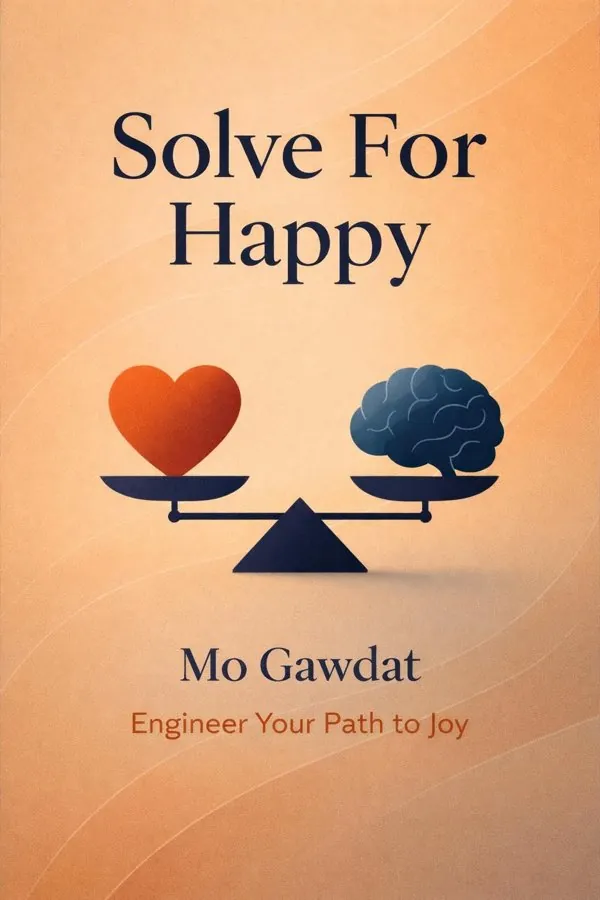
Solve For Happy: Engineer Your Path to Joy: Summary & Key Insights
by Mo Gawdat
 10 min10 chaptersAudio available
What Is Solve For Happy: Engineer Your Path to Joy About?
Solve For Happy: Engineer Your Path to Joy by Mo Gawdat is a positive_psych book spanning 10 pages. Solve for Happy es un libro escrito por Mo Gawdat, ex Director de Negocios de Google [X], que aplica su formación como ingeniero para analizar la felicidad desde una perspectiva lógica y científica. El autor propone una ecuación para la felicidad basada en la comprensión de cómo el cerebro procesa la alegría y la tristeza, y ofrece herramientas prácticas para reducir el sufrimiento y alcanzar una vida más plena.
This FizzRead summary covers all 10 key chapters of Solve For Happy: Engineer Your Path to Joy in approximately 10 minutes, distilling the most important ideas, arguments, and takeaways from Mo Gawdat's work. Also available as an audio summary and Key Quotes Podcast.
Solve For Happy: Engineer Your Path to Joy
Solve for Happy es un libro escrito por Mo Gawdat, ex Director de Negocios de Google [X], que aplica su formación como ingeniero para analizar la felicidad desde una perspectiva lógica y científica. El autor propone una ecuación para la felicidad basada en la comprensión de cómo el cerebro procesa la alegría y la tristeza, y ofrece herramientas prácticas para reducir el sufrimiento y alcanzar una vida más plena.
Who Should Read Solve For Happy: Engineer Your Path to Joy?
This book is perfect for anyone interested in positive_psych and looking to gain actionable insights in a short read. Whether you're a student, professional, or lifelong learner, the key ideas from Solve For Happy: Engineer Your Path to Joy by Mo Gawdat will help you think differently.
- ✓Readers who enjoy positive_psych and want practical takeaways
- ✓Professionals looking to apply new ideas to their work and life
- ✓Anyone who wants the core insights of Solve For Happy: Engineer Your Path to Joy in just 10 minutes
Want the full summary?
Get instant access to this book summary and 100K+ more with Fizz Moment.
Get Free SummaryAvailable on App Store • Free to download
Key Chapters
The central insight of my book begins with a simple formula: Happiness ≥ Your perception of the events of your life − Your expectations of how life should behave. This equation became my compass, born out of logic yet deeply personal. Our emotional states, I realized, depend less on what happens and more on how we interpret what happens compared with what we expect.
Think about it like an engineering system. Inputs—events—flow into our mental model. Our brain processes them, evaluates them against expected outcomes, and produces outputs—our emotions. If perception equals or exceeds expectation, we feel content. When perception falls short, suffering arises. This gap is where unhappiness hides.
Once you grasp this equation, happiness becomes less mysterious. You begin to ask: am I perceiving accurately? Are my expectations realistic? Much of our suffering stems from distorted inputs or inflated demands on reality. When you adjust either side of the equation—by seeing things clearly or by softening expectations—the result stabilizes.
This approach liberates us from the tyranny of circumstance. Instead of trying to control life’s random variables, we start tuning the internal system. Happiness becomes less dependent on outcomes and more on alignment. It is not passive acceptance; it is intelligent calibration. Once you realize the equation’s truth, every disappointment can become an opportunity to correct your perception or your expectation. That’s how you begin engineering happiness instead of waiting for it.
Our brains, magnificent as they are, were not designed for happiness; they were built for survival. Throughout evolution, accuracy was less important than vigilance. The mind’s wiring leans toward fear, prediction, and control—adaptive for a prehistoric world, but disastrous for a peaceful modern life.
In the book, I explain how this design creates illusions. The brain generates stories to fill gaps in information, projects past fears onto the future, and invents control mechanisms to preserve safety. These processes distort reality. You might recall moments when you gave in to worry, assuming threats where none existed. That’s your brain’s survival software running outdated code.
Understanding these illusions is the first step to neutralizing them. Through awareness, we recognize that the brain’s alarms do not necessarily reflect truth. Illusions are not lies; they’re simplifications. They helped our ancestors, but today they distort our joy.
When you start to see thoughts and emotions as artifacts of this evolutionary machinery, you stop identifying with them. You stop confusing the system with the self. The brain creates illusions, but you can observe them without surrendering to them. This is the path to clarity—seeing things as they truly are, not as the mind’s reflexes dictate.
+ 8 more chapters — available in the FizzRead app
All Chapters in Solve For Happy: Engineer Your Path to Joy
About the Author
Mo Gawdat es un empresario egipcio y ex Director de Negocios de Google [X]. Con una carrera destacada en tecnología y una pasión por la ingeniería, Gawdat ha dedicado su vida a investigar la felicidad y compartir sus hallazgos a través de conferencias y libros. Su enfoque combina la lógica, la ciencia y la empatía humana.
Get This Summary in Your Preferred Format
Read or listen to the Solve For Happy: Engineer Your Path to Joy summary by Mo Gawdat anytime, anywhere. FizzRead offers multiple formats so you can learn on your terms — all free.
Available formats: App · Audio · PDF · EPUB — All included free with FizzRead
Download Solve For Happy: Engineer Your Path to Joy PDF and EPUB Summary
Key Quotes from Solve For Happy: Engineer Your Path to Joy
“The central insight of my book begins with a simple formula: Happiness ≥ Your perception of the events of your life − Your expectations of how life should behave.”
“Our brains, magnificent as they are, were not designed for happiness; they were built for survival.”
Frequently Asked Questions about Solve For Happy: Engineer Your Path to Joy
Solve For Happy: Engineer Your Path to Joy by Mo Gawdat is a positive_psych book that explores key ideas across 10 chapters. Solve for Happy es un libro escrito por Mo Gawdat, ex Director de Negocios de Google [X], que aplica su formación como ingeniero para analizar la felicidad desde una perspectiva lógica y científica. El autor propone una ecuación para la felicidad basada en la comprensión de cómo el cerebro procesa la alegría y la tristeza, y ofrece herramientas prácticas para reducir el sufrimiento y alcanzar una vida más plena.
More by Mo Gawdat
You Might Also Like
Don't Sweat the Small Stuff... and It's All Small Stuff
Richard Carlson
10 min
Option B
Sheryl Sandberg & Adam Grant
10 min
Hallelujah Anyway: Rediscovering Mercy
Anne Lamott
10 min
I Can Do It: How to Use Affirmations to Change Your Life
Louise Hay
10 min
The Coffee Bean: A Simple Lesson to Create Positive Change
Jon Gordon, Damon West
10 min
The Happiness Hypothesis: Finding Modern Truth in Ancient Wisdom
Jonathan Haidt
10 minBrowse by Category
Ready to read Solve For Happy: Engineer Your Path to Joy?
Get the full summary and 100K+ more books with Fizz Moment.