
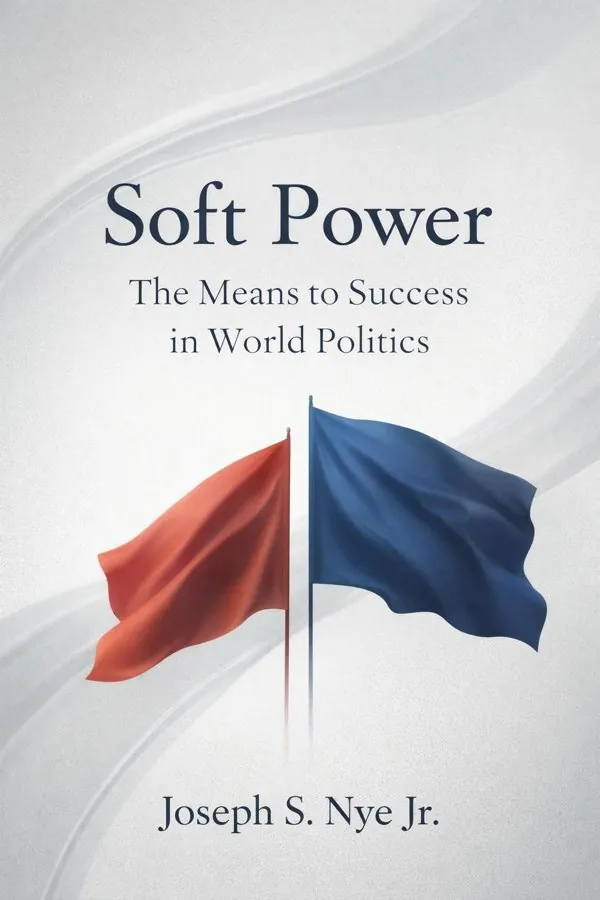
Soft Power: The Means to Success in World Politics: Summary & Key Insights
 10 min4 chaptersAudio available
What Is Soft Power: The Means to Success in World Politics About?
Soft Power: The Means to Success in World Politics by Joseph S. Nye Jr. is a politics book spanning 4 pages. In this influential work, political scientist Joseph S. Nye Jr. introduces the concept of 'soft power'—the ability of a country to shape the preferences of others through appeal and attraction rather than coercion or payment. Nye explores how culture, political values, and foreign policies can serve as sources of soft power, and how nations can effectively wield it to achieve global influence in the modern era.
This FizzRead summary covers all 4 key chapters of Soft Power: The Means to Success in World Politics in approximately 10 minutes, distilling the most important ideas, arguments, and takeaways from Joseph S. Nye Jr.'s work. Also available as an audio summary and Key Quotes Podcast.
Soft Power: The Means to Success in World Politics
In this influential work, political scientist Joseph S. Nye Jr. introduces the concept of 'soft power'—the ability of a country to shape the preferences of others through appeal and attraction rather than coercion or payment. Nye explores how culture, political values, and foreign policies can serve as sources of soft power, and how nations can effectively wield it to achieve global influence in the modern era.
Who Should Read Soft Power: The Means to Success in World Politics?
This book is perfect for anyone interested in politics and looking to gain actionable insights in a short read. Whether you're a student, professional, or lifelong learner, the key ideas from Soft Power: The Means to Success in World Politics by Joseph S. Nye Jr. will help you think differently.
- ✓Readers who enjoy politics and want practical takeaways
- ✓Professionals looking to apply new ideas to their work and life
- ✓Anyone who wants the core insights of Soft Power: The Means to Success in World Politics in just 10 minutes
Want the full summary?
Get instant access to this book summary and 100K+ more with Fizz Moment.
Get Free SummaryAvailable on App Store • Free to download
Key Chapters
When I first began writing about power, my focus was on how states used tangible resources—military strength, economic capability, and technology—to compel others to act in certain ways. This was what I termed hard power: the use of coercion, threats, or payments to achieve one’s goals. Throughout history, nations have relied on these instruments, shaping alliances and wars by balancing or accumulating material might. Yet I noticed cracks in this paradigm. Victory on the battlefield rarely translated into lasting influence; economic domination often bred resentment, not respect.
To understand soft power, we must first recognize what limits hard power. Military force can destroy, but it cannot compel love or admiration. Money can buy loyalty, but it does not buy belief. As societies grew more interconnected—through trade, technology, and the spread of information—the ability to control others through fear or reward weakened. Influence needed to operate across minds, not just borders.
Soft power emerged as a response to this changing reality. It describes the ability of a country to shape the preferences of others through appeal and attraction. The resources of soft power lie not in armies or economies, but in culture, political values, and foreign policies that are perceived as legitimate or moral. When your culture inspires and your values resonate, others may want what you want. That is the essence of attraction as power.
I often use the United States as an example: American music, films, universities, and ideals of freedom have drawn people across continents not because they were forced, but because they saw something worth emulating. This attraction creates an environment of cooperation rather than confrontation. It gives a nation influence without firing a shot.
Understanding this shift—from commanding to persuading—is vital for any nation hoping to maintain relevance in the twenty-first century. Globalization multiplies voices and fragments control. In this environment, credibility and trust become scarce yet immensely valuable commodities. Soft power is the currency of that new world order.
Culture is often the most visible vessel of soft power. What people watch, read, and experience shapes their perceptions of other societies. When cultural products carry resonance—when they embody openness, creativity, and aspiration—they attract hearts and minds more effectively than any government proclamation.
Throughout this book, I explore how nations project influence through their cultural symbols. Hollywood, music, media, fashion, and technology are all fields where identity and appeal converge. They communicate a way of life. For the United States, the idea of possibility—the sense that anyone can innovate, speak freely, or define themselves—has been the source of enduring attraction. It is not the power of propaganda but of authentic dreams.
Political values constitute another dimension of soft power. When a country’s domestic institutions reflect fairness, transparency, and respect for rights, these become global assets. They give credibility to the nation's voice on international matters. During the Cold War, for instance, U.S. democracy and civil liberties contrasted sharply with authoritarian alternatives. Even when imperfect, these values projected an image of legitimacy and hope.
Yet it is crucial to stress that values must be practiced, not merely proclaimed. Hypocrisy erodes soft power faster than any military defeat. When the conduct of a nation contradicts its principles—when liberty is preached but denied, or justice promised but corrupted—its appeal fades. Soft power rests on trust; it requires authenticity.
Foreign policy is the third pillar. Policies that acknowledge global interdependence and show respect for other nations’ interests amplify a country’s attractiveness. A generous aid program, a commitment to environmental protection, or the courage to admit mistakes—these create moral authority that cannot be commanded.
In each case—culture, values, and policies—soft power depends on credibility. Attraction without integrity is manipulation, and it does not endure. My call to policymakers is simple: nurture your sources of attraction by being true to the ideals that inspire it. Only then can power be both persuasive and principled.
+ 2 more chapters — available in the FizzRead app
All Chapters in Soft Power: The Means to Success in World Politics
About the Author
Joseph S. Nye Jr. is an American political scientist and former Dean of the Harvard Kennedy School. He is best known for his theories on power in international relations, including the concepts of 'soft power' and 'smart power'. Nye has served in various U.S. government positions and remains a leading voice in global policy and diplomacy.
Get This Summary in Your Preferred Format
Read or listen to the Soft Power: The Means to Success in World Politics summary by Joseph S. Nye Jr. anytime, anywhere. FizzRead offers multiple formats so you can learn on your terms — all free.
Available formats: App · Audio · PDF · EPUB — All included free with FizzRead
Download Soft Power: The Means to Success in World Politics PDF and EPUB Summary
Key Quotes from Soft Power: The Means to Success in World Politics
“When I first began writing about power, my focus was on how states used tangible resources—military strength, economic capability, and technology—to compel others to act in certain ways.”
“Culture is often the most visible vessel of soft power.”
Frequently Asked Questions about Soft Power: The Means to Success in World Politics
Soft Power: The Means to Success in World Politics by Joseph S. Nye Jr. is a politics book that explores key ideas across 4 chapters. In this influential work, political scientist Joseph S. Nye Jr. introduces the concept of 'soft power'—the ability of a country to shape the preferences of others through appeal and attraction rather than coercion or payment. Nye explores how culture, political values, and foreign policies can serve as sources of soft power, and how nations can effectively wield it to achieve global influence in the modern era.
You Might Also Like

Antifa: The Anti-Fascist Handbook
Mark Bray
10 min
Attack from Within: How Disinformation Is Sabotaging America
Barbara McQuade
10 min
Coercion, Capital, and European States, AD 990–1992
Charles Tilly
10 min
Digital Democracy: Concepts, Methodologies, Tools, and Applications
Various Authors
10 min
Fascism
Stanley G. Payne
10 min
Fire And Fury: Inside The Trump White House
Michael Wolff
10 minBrowse by Category
Ready to read Soft Power: The Means to Success in World Politics?
Get the full summary and 100K+ more books with Fizz Moment.