
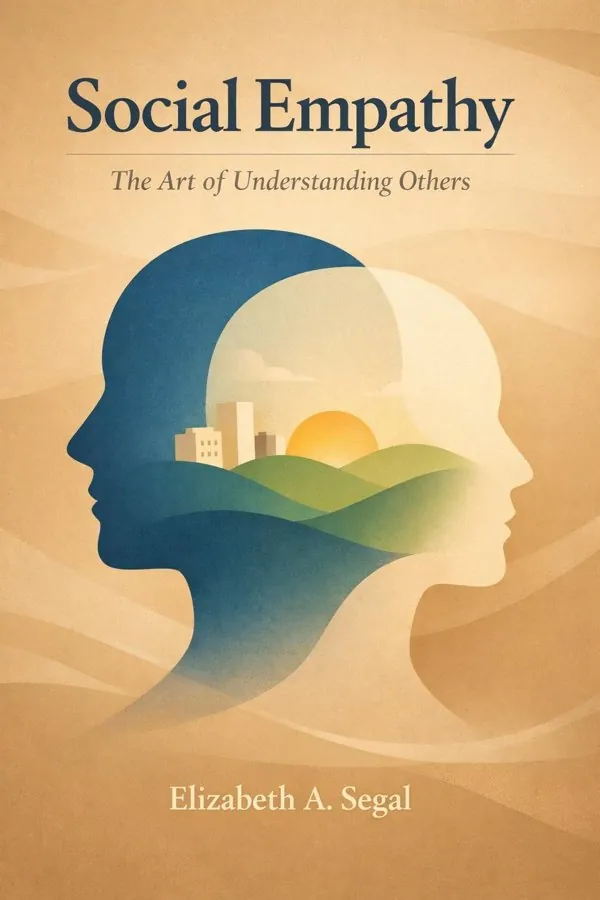
Social Empathy: The Art of Understanding Others: Summary & Key Insights
 10 min5 chaptersAudio available
What Is Social Empathy: The Art of Understanding Others About?
Social Empathy: The Art of Understanding Others by Elizabeth A. Segal is a sociology book spanning 5 pages. Social Empathy explores how understanding others’ life experiences can lead to more compassionate individuals and a more just society. Drawing from social work, psychology, and neuroscience, Elizabeth A. Segal presents a framework for developing empathy at both personal and societal levels, emphasizing its role in reducing inequality and promoting social justice.
This FizzRead summary covers all 5 key chapters of Social Empathy: The Art of Understanding Others in approximately 10 minutes, distilling the most important ideas, arguments, and takeaways from Elizabeth A. Segal's work. Also available as an audio summary and Key Quotes Podcast.
Social Empathy: The Art of Understanding Others
Social Empathy explores how understanding others’ life experiences can lead to more compassionate individuals and a more just society. Drawing from social work, psychology, and neuroscience, Elizabeth A. Segal presents a framework for developing empathy at both personal and societal levels, emphasizing its role in reducing inequality and promoting social justice.
Who Should Read Social Empathy: The Art of Understanding Others?
This book is perfect for anyone interested in sociology and looking to gain actionable insights in a short read. Whether you're a student, professional, or lifelong learner, the key ideas from Social Empathy: The Art of Understanding Others by Elizabeth A. Segal will help you think differently.
- ✓Readers who enjoy sociology and want practical takeaways
- ✓Professionals looking to apply new ideas to their work and life
- ✓Anyone who wants the core insights of Social Empathy: The Art of Understanding Others in just 10 minutes
Want the full summary?
Get instant access to this book summary and 100K+ more with Fizz Moment.
Get Free SummaryAvailable on App Store • Free to download
Key Chapters
The origins of empathy trace through philosophy, psychology, and the helping professions. In the early twentieth century, empathy entered English through the German *Einfühlung*, meaning 'feeling into.' Psychologists such as Edward Titchener and later Carl Rogers refined it to describe a central skill for understanding another’s inner world. In social work, empathy has long been both a method and a moral orientation—what allows practitioners to recognize clients’ dignity and social context.
But history has treated empathy unequally. Individual empathy, the kind that helps us connect one-on-one, has received lavish attention in psychological research. Social empathy—the insight that systems, structures, and cultures shape personal realities—remained largely neglected. I sought to fill that gap. Rooted in social work and built upon cognitive and affective sciences, my framework defines empathy as multilevel: personal, relational, and societal.
Theoretically, empathy functions as both cognition and emotion. Cognitive empathy describes our ability to take another’s perspective intellectually, while affective empathy captures the emotional attunement that allows us to feel with others. Social empathy integrates these with contextual understanding—the capacity to link personal experience with social conditions. To grasp why a person faces housing insecurity, for instance, one must see beyond their individual choices into economic systems, wage inequality, and policy design. That is the moral vision I call social empathy: the fusion of psychological insight with social awareness.
This approach situates empathy as a bridge between micro and macro realities. Social empathy demands that we ask how differences in power, privilege, and history shape behavior. Without that broader lens, empathy risks degenerating into sentimentality—tears without responsibility. By rooting empathy in social structures, we transform it from a feeling into an analysis, from private emotion into collective knowledge.
Advances in neuroscience have deepened our grasp of how empathy works. Functional imaging studies reveal that when we observe another’s emotions or pain, the same regions of our brain—such as the anterior insula and anterior cingulate cortex—activate as if we were experiencing the event ourselves. This mirroring mechanism, supported by mirror neurons, forms the biological scaffolding of empathic connection. Yet biology is only the beginning.
Empathy is shaped by learning, culture, and socialization. Psychological research shows that children begin rudimentary perspective-taking early but require nurturing environments to develop it fully. Trauma, deprivation, or cultural norms that discourage emotional expression can blunt empathic growth. Social biases—implicit and explicit—alter neurological responses; experiments show diminished empathic activation when subjects view pain inflicted on racial out-group members. These findings confirm what many social workers witness daily: empathy thrives in supportive, inclusive contexts and withers under exclusion.
Understanding these biological and psychological bases helps us cultivate empathy more deliberately. It allows educators, parents, and policymakers to see empathy not as an innate trait bestowed upon the few but as a learnable, expandable capacity. Neuroscience gives us the map; social context provides the terrain. The crucial insight is that our brains are social organs, designed for connection but sculpted by environment. Every institution—from schools to governments—therefore has the power to nurture or stifle empathy’s potential.
+ 3 more chapters — available in the FizzRead app
All Chapters in Social Empathy: The Art of Understanding Others
About the Author
Elizabeth A. Segal is a professor of social work at Arizona State University. Her research focuses on social empathy, social justice, and the intersection of social policy and human behavior. She has authored numerous works on empathy and its implications for public policy and social welfare.
Get This Summary in Your Preferred Format
Read or listen to the Social Empathy: The Art of Understanding Others summary by Elizabeth A. Segal anytime, anywhere. FizzRead offers multiple formats so you can learn on your terms — all free.
Available formats: App · Audio · PDF · EPUB — All included free with FizzRead
Download Social Empathy: The Art of Understanding Others PDF and EPUB Summary
Key Quotes from Social Empathy: The Art of Understanding Others
“The origins of empathy trace through philosophy, psychology, and the helping professions.”
“Advances in neuroscience have deepened our grasp of how empathy works.”
Frequently Asked Questions about Social Empathy: The Art of Understanding Others
Social Empathy: The Art of Understanding Others by Elizabeth A. Segal is a sociology book that explores key ideas across 5 chapters. Social Empathy explores how understanding others’ life experiences can lead to more compassionate individuals and a more just society. Drawing from social work, psychology, and neuroscience, Elizabeth A. Segal presents a framework for developing empathy at both personal and societal levels, emphasizing its role in reducing inequality and promoting social justice.
You Might Also Like

Between the World and Me
Ta-Nehisi Coates
10 min
Half the Sky
Nicholas D. Kristof, Sheryl WuDunn
10 min
Men Explain Things To Me
Rebecca Solnit
10 min
Rational Ritual
Michael Suk-Young Chwe
10 min
The New Jim Crow
Michelle Alexander
10 min
Beyond Culture
Edward T. Hall
10 minBrowse by Category
Ready to read Social Empathy: The Art of Understanding Others?
Get the full summary and 100K+ more books with Fizz Moment.