
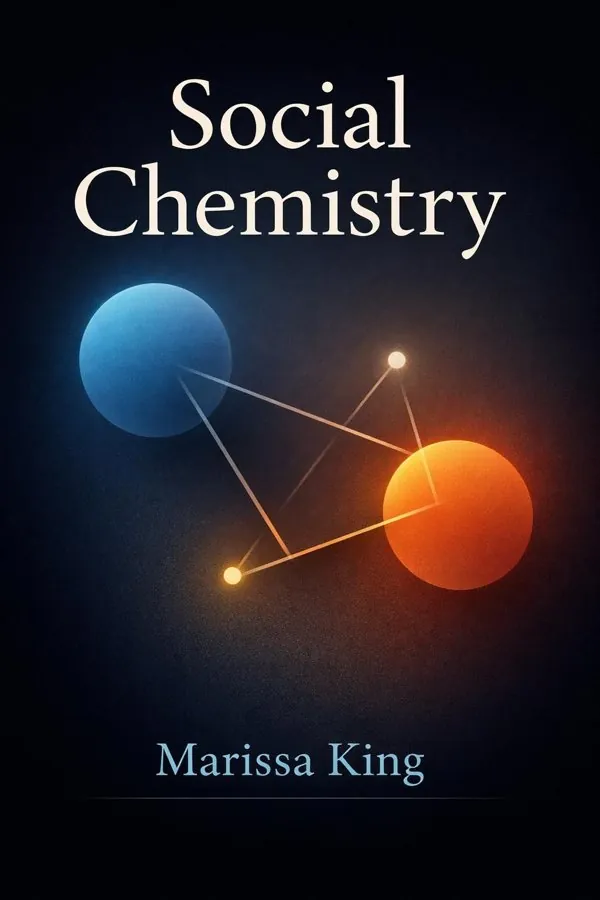
Social Chemistry: Decoding the Patterns of Human Connection: Summary & Key Insights
by Marissa King
 10 min13 chaptersAudio available
What Is Social Chemistry: Decoding the Patterns of Human Connection About?
Social Chemistry: Decoding the Patterns of Human Connection by Marissa King is a sociology book spanning 13 pages. Social Chemistry explores how the structure and quality of our social networks shape our personal and professional lives. Drawing on decades of research in sociology and organizational behavior, Marissa King identifies three primary network types—expansionists, brokers, and conveners—and explains how understanding and cultivating these patterns can enhance collaboration, creativity, and well-being.
This FizzRead summary covers all 13 key chapters of Social Chemistry: Decoding the Patterns of Human Connection in approximately 10 minutes, distilling the most important ideas, arguments, and takeaways from Marissa King's work. Also available as an audio summary and Key Quotes Podcast.
Social Chemistry: Decoding the Patterns of Human Connection
Social Chemistry explores how the structure and quality of our social networks shape our personal and professional lives. Drawing on decades of research in sociology and organizational behavior, Marissa King identifies three primary network types—expansionists, brokers, and conveners—and explains how understanding and cultivating these patterns can enhance collaboration, creativity, and well-being.
Who Should Read Social Chemistry: Decoding the Patterns of Human Connection?
This book is perfect for anyone interested in sociology and looking to gain actionable insights in a short read. Whether you're a student, professional, or lifelong learner, the key ideas from Social Chemistry: Decoding the Patterns of Human Connection by Marissa King will help you think differently.
- ✓Readers who enjoy sociology and want practical takeaways
- ✓Professionals looking to apply new ideas to their work and life
- ✓Anyone who wants the core insights of Social Chemistry: Decoding the Patterns of Human Connection in just 10 minutes
Want the full summary?
Get instant access to this book summary and 100K+ more with Fizz Moment.
Get Free SummaryAvailable on App Store • Free to download
Key Chapters
Human beings are wired for connection. Long before organizations and industries existed, our ability to form and sustain social bonds determined survival. In modern life, this same instinct translates into networks that govern information flow, collaboration, and trust. The science of these connections reveals that our social structures are not random. They follow predictable patterns that influence how we think and behave.
Sociologists like Mark Granovetter demonstrated that weak ties—those casual acquaintances, distant colleagues, or people we meet infrequently—are surprisingly powerful conduits for information and opportunity. Psychologists, meanwhile, have shown how social belonging enhances not only happiness but also cognitive performance and resilience under stress. By mapping decades of research from both fields, I’ve tried to show that relationships have a measurable architecture, one that determines much of our social and professional fate.
In my own studies and those of my colleagues, we have observed that the diversity of one’s network correlates strongly with innovation and adaptability, while the density of close ties predicts trust, cohesion, and emotional support. Knowing this, understanding our networks is not a vanity project—it’s a diagnostic tool for understanding our own behavior, our sources of strength, and our blind spots.
To change your social chemistry, you must first see it. Network mapping is a method to visualize how your connections cluster, overlap, or remain disconnected. The exercise begins by listing people you regularly interact with—colleagues, friends, mentors, family. Then, identifying who knows whom among them reveals the underlying structure of your network.
Most people discover they have a dominant pattern. Some have wide, dispersed circles that bring in varied perspectives but few deep ties. Others see dense clusters reflecting tightly bonded communities. The insight here is not to judge but to illuminate. Patterns reflect priorities, environments, and stages of life. For example, someone early in their career might benefit from bridging across departments or industries, while someone leading a team may thrive by deepening trust within a close group.
When we visualize networks, we reveal the topography of our social life—the peaks of influence, the valleys of isolation, and the corridors through which innovation or empathy flows. This awareness is where transformation begins.
+ 11 more chapters — available in the FizzRead app
All Chapters in Social Chemistry: Decoding the Patterns of Human Connection
About the Author
Marissa King is a professor of organizational behavior at the Yale School of Management. Her research focuses on social networks, team dynamics, and the spread of behaviors within organizations. She has published extensively in leading academic journals and is recognized for her work on how social structures influence performance and innovation.
Get This Summary in Your Preferred Format
Read or listen to the Social Chemistry: Decoding the Patterns of Human Connection summary by Marissa King anytime, anywhere. FizzRead offers multiple formats so you can learn on your terms — all free.
Available formats: App · Audio · PDF · EPUB — All included free with FizzRead
Download Social Chemistry: Decoding the Patterns of Human Connection PDF and EPUB Summary
Key Quotes from Social Chemistry: Decoding the Patterns of Human Connection
“Long before organizations and industries existed, our ability to form and sustain social bonds determined survival.”
“To change your social chemistry, you must first see it.”
Frequently Asked Questions about Social Chemistry: Decoding the Patterns of Human Connection
Social Chemistry: Decoding the Patterns of Human Connection by Marissa King is a sociology book that explores key ideas across 13 chapters. Social Chemistry explores how the structure and quality of our social networks shape our personal and professional lives. Drawing on decades of research in sociology and organizational behavior, Marissa King identifies three primary network types—expansionists, brokers, and conveners—and explains how understanding and cultivating these patterns can enhance collaboration, creativity, and well-being.
You Might Also Like

Between the World and Me
Ta-Nehisi Coates
10 min
Half the Sky
Nicholas D. Kristof, Sheryl WuDunn
10 min
Men Explain Things To Me
Rebecca Solnit
10 min
Rational Ritual
Michael Suk-Young Chwe
10 min
The New Jim Crow
Michelle Alexander
10 min
Beyond Culture
Edward T. Hall
10 minBrowse by Category
Ready to read Social Chemistry: Decoding the Patterns of Human Connection?
Get the full summary and 100K+ more books with Fizz Moment.