
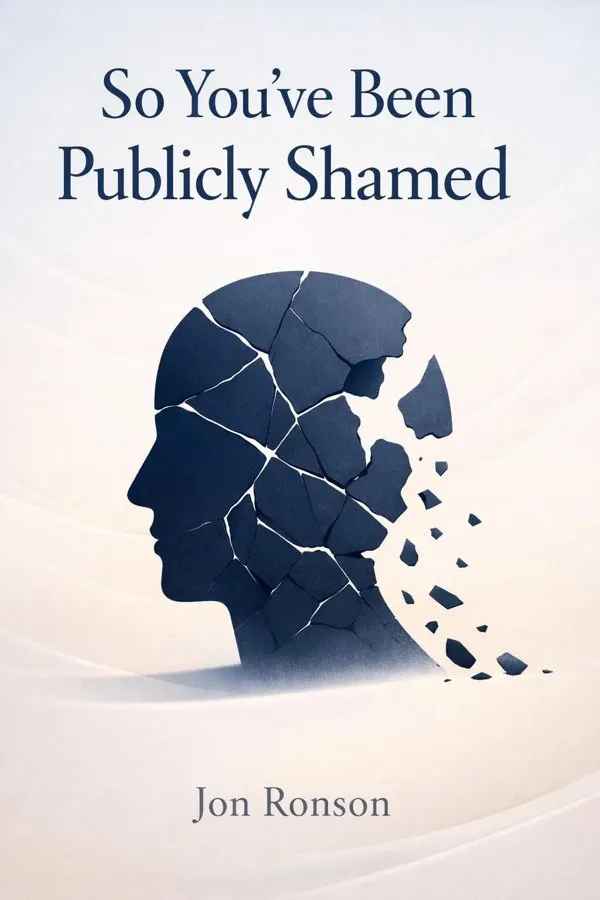
So You've Been Publicly Shamed: Summary & Key Insights
by Jon Ronson
 10 min8 chaptersAudio available
What Is So You've Been Publicly Shamed About?
So You've Been Publicly Shamed by Jon Ronson is a sociology book spanning 8 pages. In this book, Jon Ronson explores the phenomenon of public shaming in the age of social media. Through interviews and case studies, he examines how online outrage can destroy reputations and lives, and questions whether this modern form of justice has gone too far. The book blends investigative journalism with psychological insight, offering a thought-provoking look at the consequences of digital mob behavior.
This FizzRead summary covers all 8 key chapters of So You've Been Publicly Shamed in approximately 10 minutes, distilling the most important ideas, arguments, and takeaways from Jon Ronson's work. Also available as an audio summary and Key Quotes Podcast.
So You've Been Publicly Shamed
In this book, Jon Ronson explores the phenomenon of public shaming in the age of social media. Through interviews and case studies, he examines how online outrage can destroy reputations and lives, and questions whether this modern form of justice has gone too far. The book blends investigative journalism with psychological insight, offering a thought-provoking look at the consequences of digital mob behavior.
Who Should Read So You've Been Publicly Shamed?
This book is perfect for anyone interested in sociology and looking to gain actionable insights in a short read. Whether you're a student, professional, or lifelong learner, the key ideas from So You've Been Publicly Shamed by Jon Ronson will help you think differently.
- ✓Readers who enjoy sociology and want practical takeaways
- ✓Professionals looking to apply new ideas to their work and life
- ✓Anyone who wants the core insights of So You've Been Publicly Shamed in just 10 minutes
Want the full summary?
Get instant access to this book summary and 100K+ more with Fizz Moment.
Get Free SummaryAvailable on App Store • Free to download
Key Chapters
Jonah Lehrer’s story was one of the first that drew me into the depths of our new culture of shaming. Lehrer was a young, admired journalist—a prodigy whose books on creativity made him the darling of the intellectual world. Then he was caught fabricating quotes, including words attributed to Bob Dylan that Dylan never said. The discovery was devastating, but what followed was more devastating still. Online, the reaction was ferocious. Each new revelation brought another wave of scorn, another chorus of disbelief and disgust.
Lehrer’s fall was swift and absolute. His publisher pulled his books from shelves. Twitter was alive with denunciations. When he tried to apologize publicly, standing before an audience with a contrite speech, he was live-tweeted, his every word dissected in real time. What should have been an act of atonement became another performance for the crowd—one that confirmed the futility of his attempt at redemption.
Through Jonah’s experience, I began to understand the anatomy of modern shame: the piling on, the delight in exposure, the sense that justice was being served by each retweet. But when I met him, I saw something beyond the caricature of a liar. He was broken, yes, but also bewildered—caught in a system that offered no way back. His story revealed how quickly we transform a moral error into a permanent identity. The punishment, I realized, was not meant to reform, but to destroy. We had resurrected public execution, not of the body but of the reputation.
If Jonah Lehrer’s collapse was about professional deceit, Justine Sacco’s was about a momentary lapse in judgment. Before boarding a flight to South Africa, she tweeted a clumsy, ironic joke about AIDS—one she assumed would be seen by her tiny following. But while she was airborne, outrage snowballed. By the time her plane landed, she was the world’s villain of the day, her career in ruins, her name synonymous with racism. It was a morality play performed for millions.
I spoke with her months later, after the firestorm had cooled but the damage had calcified. The pain was still vivid. She’d lost her job, her friends had recoiled, and she had become a cautionary meme. Her life was an emblem of how the internet turns complex people into simple symbols. What struck me most was how gleeful the crowd had been. People took comfort in her downfall; they felt they were striking a blow against injustice. But the act of shaming itself seemed to fulfill a darker need—a craving for superiority, perhaps even entertainment.
Through her story, I saw how public shaming operates as a kind of modern theater. The shamed are involuntary actors, forced onto a stage where morality and voyeurism blur. When we join in the chorus, we imagine ourselves defenders of good, yet we often contribute to a cruelty that is anything but virtuous. Justine’s life became the cost of our moral performance.
+ 6 more chapters — available in the FizzRead app
All Chapters in So You've Been Publicly Shamed
About the Author
Jon Ronson is a Welsh journalist, author, and documentary filmmaker known for his investigative and often humorous explorations of human behavior. His works include 'The Psychopath Test' and 'Them: Adventures with Extremists'. He frequently writes about social phenomena, psychology, and the darker sides of modern culture.
Get This Summary in Your Preferred Format
Read or listen to the So You've Been Publicly Shamed summary by Jon Ronson anytime, anywhere. FizzRead offers multiple formats so you can learn on your terms — all free.
Available formats: App · Audio · PDF · EPUB — All included free with FizzRead
Download So You've Been Publicly Shamed PDF and EPUB Summary
Key Quotes from So You've Been Publicly Shamed
“Jonah Lehrer’s story was one of the first that drew me into the depths of our new culture of shaming.”
“If Jonah Lehrer’s collapse was about professional deceit, Justine Sacco’s was about a momentary lapse in judgment.”
Frequently Asked Questions about So You've Been Publicly Shamed
So You've Been Publicly Shamed by Jon Ronson is a sociology book that explores key ideas across 8 chapters. In this book, Jon Ronson explores the phenomenon of public shaming in the age of social media. Through interviews and case studies, he examines how online outrage can destroy reputations and lives, and questions whether this modern form of justice has gone too far. The book blends investigative journalism with psychological insight, offering a thought-provoking look at the consequences of digital mob behavior.
You Might Also Like
Between the World and Me
Ta-Nehisi Coates
10 min
Half the Sky
Nicholas D. Kristof, Sheryl WuDunn
10 min
Men Explain Things To Me
Rebecca Solnit
10 min
Rational Ritual
Michael Suk-Young Chwe
10 min
The New Jim Crow
Michelle Alexander
10 min
Beyond Culture
Edward T. Hall
10 minBrowse by Category
Ready to read So You've Been Publicly Shamed?
Get the full summary and 100K+ more books with Fizz Moment.