
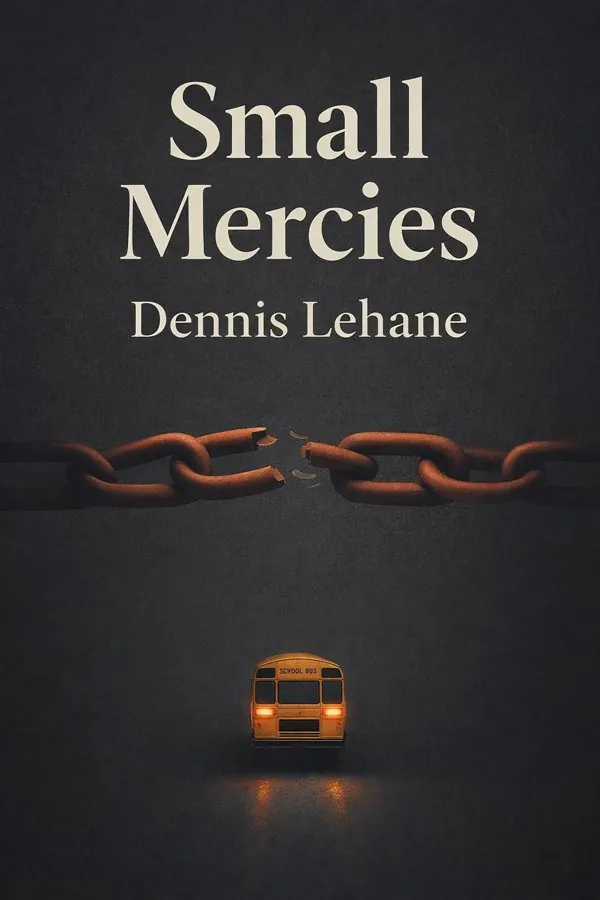
Small Mercies: Summary & Key Insights
 10 min3 chaptersAudio available
What Is Small Mercies About?
Small Mercies by Dennis Lehane is a mystery book spanning 3 pages. Set in Boston during the summer of 1974, 'Small Mercies' follows Mary Pat Fennessy, a tough South Boston mother whose daughter goes missing on the eve of the city's court-ordered school desegregation. As Mary Pat searches for her daughter, she uncovers a web of secrets, racism, and violence that exposes the dark heart of her community. The novel is both a gripping thriller and a searing social commentary on power, prejudice, and the cost of silence.
This FizzRead summary covers all 3 key chapters of Small Mercies in approximately 10 minutes, distilling the most important ideas, arguments, and takeaways from Dennis Lehane's work. Also available as an audio summary and Key Quotes Podcast.
Small Mercies
Set in Boston during the summer of 1974, 'Small Mercies' follows Mary Pat Fennessy, a tough South Boston mother whose daughter goes missing on the eve of the city's court-ordered school desegregation. As Mary Pat searches for her daughter, she uncovers a web of secrets, racism, and violence that exposes the dark heart of her community. The novel is both a gripping thriller and a searing social commentary on power, prejudice, and the cost of silence.
Who Should Read Small Mercies?
This book is perfect for anyone interested in mystery and looking to gain actionable insights in a short read. Whether you're a student, professional, or lifelong learner, the key ideas from Small Mercies by Dennis Lehane will help you think differently.
- ✓Readers who enjoy mystery and want practical takeaways
- ✓Professionals looking to apply new ideas to their work and life
- ✓Anyone who wants the core insights of Small Mercies in just 10 minutes
Want the full summary?
Get instant access to this book summary and 100K+ more with Fizz Moment.
Get Free SummaryAvailable on App Store • Free to download
Key Chapters
The Boston of 1974 was a city boiling under its own divisions. Court-ordered busing to desegregate schools didn’t simply redraw educational lines; it cracked open the façade of neighborhoods that had long lived by their own unwritten codes. In South Boston, or Southie, the street was law, and its guardians were the working-class families who believed their stubbornness was all they had left in a world that kept changing without their consent.
When I wrote about that tension, I wasn’t only interested in the politics or the riots that history books would memorialize. I wanted to show the smaller spaces — kitchens, bar counters, backseat conversations — where those divisions became personal. Southie’s resistance to desegregation was both communal and intimate: mothers feared for their children, men feared for their livelihoods, and underneath it all was the fear of being forgotten or replaced.
It was in this charged environment that Mary Pat Fennessy’s story begins. A widow living in the projects, she’s tough because she has to be — a woman surviving paycheck to paycheck, already scarred by losing her son to an overdose. Her every gesture — from lighting a cigarette to confronting a neighbor — carries the defiance of someone who refuses to pity herself. But when her teenage daughter Jules doesn’t come home one night, that toughness hardens into obsession. What starts as panic becomes a crusade, a refusal to accept silence from anyone who might know where her child has gone.
The setting acts as a character in itself: every alley, every pub, every brick is steeped in loyalty and fear. Busing protests swirl through the streets like a fever, and the city’s divisions no longer seem theoretical — they pulse through the lives of people like Mary Pat, who’ve anchored their identities to a neighborhood that may no longer deserve them.
Mary Pat’s search for Jules drives the narrative like a storm, cutting through the uneasy calm of Southie life. Her questions are blunt, her grief unsoftened by politeness, and with every person she confronts, she exposes not just their secrets but the entire neighborhood’s collective guilt. In the background of her hunt lies another tragedy: the body of a young Black man, Auggie Williamson, found dead on the subway tracks. To outsiders, the two events appear unrelated. But in Southie, where coincidence rarely exists, one disappearance reflects the other.
Mary Pat’s confrontation with her neighbors starts as an act of maternal love, but it soon becomes something larger — a moral excavation. As she digs into Jules’s last night, she stumbles into the shadowy influence of Marty Butler, a crime boss whose hold over the community extends beyond drugs and gambling. Butler represents the mirror image of Southie’s pride: discipline enforced through intimidation, protection that feels indistinguishable from imprisonment. His world thrives on silence — the kind that’s been passed down through generations — and Mary Pat, in her desperation, begins to puncture that silence.
I wanted Mary Pat to feel like a force of nature, a woman propelled by pain but sharpened by truth. Each revelation she uncovers corrodes the myth of Southie’s purity. She learns that Jules had fallen in with people connected to the very violence her neighbors pretend doesn’t exist. Her daughter’s disappearance isn’t the work of a random predator; it’s a byproduct of the racism, loyalty, and criminal enterprise that Southie both denies and depends on. By searching for Jules, Mary Pat is, in effect, pulling apart the moral scaffolding of her community.
This section of the novel is where morality grows murky. Mary Pat faces a bitter recognition: that her own silence — the small compromises she’s made to survive — might have sustained the same system that took her daughter from her. Her pain becomes revelation. What began as a mother’s desperate hunt becomes a reckoning with the ways privilege and prejudice intertwine, how fear feeds obedience, and how justice, if it ever comes, demands more than anger — it requires sacrifice.
+ 1 more chapters — available in the FizzRead app
All Chapters in Small Mercies
About the Author
Dennis Lehane is an American novelist and screenwriter known for his gritty crime fiction set in Boston. His works include 'Mystic River', 'Gone, Baby, Gone', and 'Shutter Island', many of which have been adapted into acclaimed films. Lehane’s writing often explores themes of morality, justice, and the complexities of human nature.
Get This Summary in Your Preferred Format
Read or listen to the Small Mercies summary by Dennis Lehane anytime, anywhere. FizzRead offers multiple formats so you can learn on your terms — all free.
Available formats: App · Audio · PDF · EPUB — All included free with FizzRead
Download Small Mercies PDF and EPUB Summary
Key Quotes from Small Mercies
“The Boston of 1974 was a city boiling under its own divisions.”
“Mary Pat’s search for Jules drives the narrative like a storm, cutting through the uneasy calm of Southie life.”
Frequently Asked Questions about Small Mercies
Small Mercies by Dennis Lehane is a mystery book that explores key ideas across 3 chapters. Set in Boston during the summer of 1974, 'Small Mercies' follows Mary Pat Fennessy, a tough South Boston mother whose daughter goes missing on the eve of the city's court-ordered school desegregation. As Mary Pat searches for her daughter, she uncovers a web of secrets, racism, and violence that exposes the dark heart of her community. The novel is both a gripping thriller and a searing social commentary on power, prejudice, and the cost of silence.
You Might Also Like






Browse by Category
Ready to read Small Mercies?
Get the full summary and 100K+ more books with Fizz Moment.