
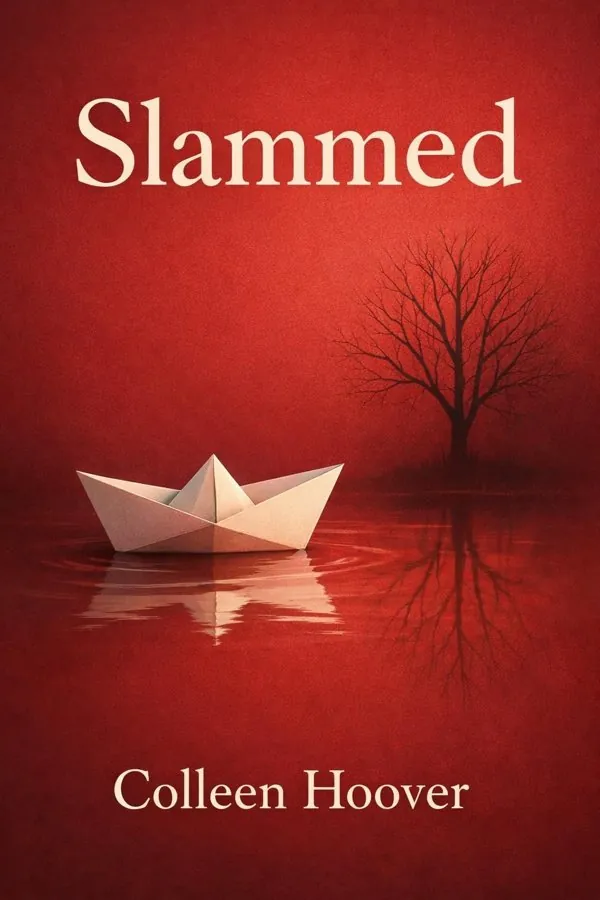
Slammed: Summary & Key Insights
 10 min9 chaptersAudio available
Key Takeaways from Slammed
Starting over rarely feels clean.
Sometimes the people who enter our lives at the right moment feel less like strangers and more like oxygen.
Some of the most painful conflicts are not between right and wrong, but between desire and responsibility.
Growing up is often described as a gradual process, but for Layken and Will, adulthood arrives all at once.
Just when life begins to feel survivable, new grief can reopen every old wound.
What Is Slammed About?
Slammed by Colleen Hoover is a romantic_relationships book spanning 4 pages. Slammed by Colleen Hoover is a contemporary romance that begins with a familiar wound and turns it into something raw, tender, and unexpectedly profound. After the death of her father, eighteen-year-old Layken Cohen moves from Texas to Michigan with her mother and younger brother, carrying grief she barely knows how to name. In her new neighborhood, she meets Will Cooper, a warm, intelligent young man whose easy connection with her feels like a lifeline. Their bond deepens through shared humor, caretaking responsibilities, and the electric honesty of slam poetry—until a shocking revelation turns their growing love into an impossible dilemma. What makes Slammed resonate is that it is not only about romance. It is about what happens when loss forces young people to grow up too quickly, and how art gives shape to emotions that ordinary conversation cannot hold. Hoover, who first broke out with this novel, brings emotional intensity, accessibility, and a strong instinct for intimate character drama. The result is a story about love, grief, family, and resilience that still feels immediate and deeply affecting.
This FizzRead summary covers all 9 key chapters of Slammed in approximately 10 minutes, distilling the most important ideas, arguments, and takeaways from Colleen Hoover's work. Also available as an audio summary and Key Quotes Podcast.
Slammed
Slammed by Colleen Hoover is a contemporary romance that begins with a familiar wound and turns it into something raw, tender, and unexpectedly profound. After the death of her father, eighteen-year-old Layken Cohen moves from Texas to Michigan with her mother and younger brother, carrying grief she barely knows how to name. In her new neighborhood, she meets Will Cooper, a warm, intelligent young man whose easy connection with her feels like a lifeline. Their bond deepens through shared humor, caretaking responsibilities, and the electric honesty of slam poetry—until a shocking revelation turns their growing love into an impossible dilemma. What makes Slammed resonate is that it is not only about romance. It is about what happens when loss forces young people to grow up too quickly, and how art gives shape to emotions that ordinary conversation cannot hold. Hoover, who first broke out with this novel, brings emotional intensity, accessibility, and a strong instinct for intimate character drama. The result is a story about love, grief, family, and resilience that still feels immediate and deeply affecting.
Who Should Read Slammed?
This book is perfect for anyone interested in romantic_relationships and looking to gain actionable insights in a short read. Whether you're a student, professional, or lifelong learner, the key ideas from Slammed by Colleen Hoover will help you think differently.
- ✓Readers who enjoy romantic_relationships and want practical takeaways
- ✓Professionals looking to apply new ideas to their work and life
- ✓Anyone who wants the core insights of Slammed in just 10 minutes
Want the full summary?
Get instant access to this book summary and 100K+ more with Fizz Moment.
Get Free SummaryAvailable on App Store • Free to download
Key Chapters
Starting over rarely feels clean. In Slammed, Layken’s move from Texas to Michigan is supposed to mark a new chapter after her father’s death, but Hoover makes it clear that grief does not stay behind simply because the address changes. Layken arrives in a new town carrying sorrow, anger, fear, and the burden of trying to stay strong for her mother and younger brother. The relocation represents more than geography; it symbolizes the unsettling experience of rebuilding life while still mourning the one that was lost.
This idea matters because many people imagine healing as a straight path: leave the painful place, create a fresh routine, and eventually feel better. But Layken’s experience shows that loss travels with us. A new environment may offer possibility, but it also throws pain into sharper relief. Everything unfamiliar reminds her of what is gone. At the same time, the move opens the door to connection. Her relationship with her new neighbor Will, and the friendship between their younger brothers, becomes evidence that life can contain both grief and joy.
In practical terms, this reflects what many people face after a major disruption such as bereavement, divorce, or relocation. You may function, go to school, work, or care for others, yet still feel emotionally disoriented. Slammed suggests that healing begins not when grief disappears, but when we stop expecting it to vanish on command.
Actionable takeaway: If you are in a season of change, do not judge yourself for carrying old pain into a new chapter. Create one small stabilizing ritual—a walk, a journal entry, or a daily check-in with someone you trust—to help you build a future without denying your grief.
Sometimes the people who enter our lives at the right moment feel less like strangers and more like oxygen. Layken’s first encounters with Will are charged not only by attraction, but by relief. He sees her when she feels invisible inside her own sadness. He makes room for laughter when her life has become defined by responsibility and emotional restraint. Hoover captures a truth about early love: it can feel like rescue, especially when it arrives during a period of loneliness.
Their bond grows quickly because they meet each other in a vulnerable state. Both are young, both are carrying responsibilities beyond their years, and both understand what it means to protect the people they love. Slam poetry becomes part of this connection because it allows them to communicate beyond surface charm. They are not just flirting; they are finding a language for pain, longing, and recognition.
The novel also subtly warns readers about the intensity of connection formed under emotional pressure. When life is hard, affection can become amplified. We may believe the person who understands us is automatically the person we can safely build a life with. Hoover does not dismiss that feeling, but she complicates it. Chemistry is real, but it does not erase circumstance, ethics, or timing.
In everyday life, this idea applies to rebound relationships, friendships formed in crisis, and even mentor-like bonds that emerge during transitions. Strong feelings are meaningful, but they should be examined with patience. Ask what you are responding to: the person themselves, or the relief of being seen?
Actionable takeaway: When a new connection feels powerful, pause long enough to understand why. Attraction matters, but clarity matters too. Try naming three qualities you genuinely value in the person beyond the emotional comfort they provide.
Some of the most painful conflicts are not between right and wrong, but between desire and responsibility. Slammed reaches its emotional turning point when Layken discovers that Will is her teacher. In an instant, what felt hopeful becomes impossible. Hoover uses this revelation to explore a difficult truth: not every sincere relationship can be pursued without causing harm. Sometimes love has to be restrained precisely because it is real.
This is where the novel gains moral complexity. Will and Layken are not dealing with a lack of feeling; they are dealing with the consequences of acting on those feelings in a context shaped by power, rules, and social judgment. Will understands that even if their connection began before either of them knew the truth, continuing it would jeopardize his career, damage Layken’s reputation, and create an unethical dynamic. The heartbreak comes from knowing the emotional bond is genuine while also acknowledging that boundaries exist for a reason.
In practical life, this idea extends beyond teacher-student relationships. It applies whenever affection collides with roles and responsibilities: workplace hierarchies, commitments to family, friendships under strain, or timing that makes a relationship unwise. Mature love is not only about expression. It is also about restraint, accountability, and the willingness to protect another person from avoidable fallout.
Hoover does not romanticize boundary-breaking as proof of passion. Instead, she suggests that self-control can be an expression of care. That is an important lesson for readers who equate intensity with inevitability. The strongest feelings do not always deserve immediate action.
Actionable takeaway: When emotions conflict with responsibility, ask not only “What do I want?” but “What are the consequences for both of us?” If the situation risks harm, create distance and seek perspective before making a decision.
Growing up is often described as a gradual process, but for Layken and Will, adulthood arrives all at once. Both characters shoulder responsibilities that many people do not face until much later in life. Layken is trying to support her grieving family while adjusting to a new home, and Will has become the primary caregiver for his younger brother after the deaths of his parents. In Slammed, love does not unfold in a carefree world. It unfolds in kitchens, school schedules, emotional breakdowns, and the daily labor of keeping a household functioning.
This responsibility shapes their personalities. Layken swings between vulnerability and defiance because she is exhausted from holding herself together. Will often appears composed, but his calm hides sacrifice and pressure. Hoover uses these realities to show how caretaking can accelerate maturity while also creating loneliness. When a young person becomes the stable one for everyone else, they may have little room left to process their own pain.
This is a valuable insight for readers navigating family stress. Taking care of others can foster resilience, empathy, and discipline, but it can also produce guilt, suppression, and burnout. Young adults in particular may feel they have no right to their own emotional needs if someone else depends on them. Slammed pushes against that assumption. Responsibility is honorable, but it should not require emotional erasure.
A practical application is learning to distinguish between support and self-sacrifice. Helping your family may be necessary, but you also need outlets, honest conversations, and support systems of your own. Strength is more sustainable when it is shared.
Actionable takeaway: If you are carrying heavy family responsibilities, identify one place where you can ask for help without shame. Even one honest conversation with a friend, counselor, or relative can reduce the pressure of trying to be everything for everyone.
Just when life begins to feel survivable, new grief can reopen every old wound. Julia’s illness in Slammed deepens the novel from a story of interrupted romance into a meditation on anticipatory grief, maternal love, and the fragility of stability. For Layken, her mother’s diagnosis is not merely another sad event. It is a devastating repetition of trauma. After losing her father, she now faces the possibility of losing the parent who has held the family together.
Hoover handles this plotline by emphasizing the emotional confusion that often accompanies serious illness. Layken is angry, scared, and desperate for control. Julia, however, brings a different energy: grace, preparation, and a fierce commitment to loving her children well even while confronting her own mortality. Through her, the novel argues that family is not defined only by biological ties or shared suffering, but by intentional acts of emotional generosity. Julia’s letters, guidance, and concern for the future become a lasting form of care.
This idea matters because many readers know what it means to live under the shadow of possible loss. Anticipatory grief is uniquely painful: you are mourning someone who is still alive while trying to remain hopeful. Slammed suggests that one response is avoidance, but a better one is presence. Love becomes more meaningful, not less, when time feels uncertain.
In everyday life, this can mean having difficult conversations earlier, preserving memories intentionally, or expressing affection before crisis makes words harder. We often postpone emotional honesty until a “better time,” but the novel reminds us that time is never guaranteed.
Actionable takeaway: If someone you love is facing illness or uncertainty, do not wait for a perfect moment. Say what matters now. Write the letter, ask the question, share the memory, and let your care be known while you still can.
Some emotions are too jagged for ordinary conversation. One of Slammed’s most distinctive contributions is its use of slam poetry as both an artistic device and a healing practice. For Layken, Will, and the people around them, poetry is not ornamental. It is a method of survival. It creates a space where grief, anger, longing, fear, and tenderness can be expressed without being reduced or cleaned up for other people’s comfort.
Hoover shows that spoken-word performance matters because it transforms private pain into shared witness. A poem can reveal what a conversation cannot. It can hold contradiction, vulnerability, and intensity all at once. In the novel, slam poetry also equalizes people. When characters step onto the stage, they are no longer defined only by roles—teacher, student, sibling, parent, caretaker. They become human beings speaking their truth.
This idea has broad practical value. Not everyone writes poetry, but everyone needs a form that allows emotional honesty. For some, that may be journaling, music, painting, voice notes, prayer, therapy, or long walks where thoughts can finally surface. The important lesson is that healing often requires expression. Unspoken pain does not disappear; it hardens.
Slammed also reminds readers that art creates community. When someone articulates something difficult with honesty, others often feel less alone. That is why stories, poems, and performances can be profoundly therapeutic. They do not solve grief, but they make grief speakable.
Actionable takeaway: Choose one creative outlet this week and use it to express something you normally hide. Do not aim for polish. Aim for honesty. The goal is not to impress anyone, but to give your inner life somewhere real to exist.
One of the reasons Slammed feels emotionally believable is that it understands grief is not constant solemnity. Even in the middle of loss, people laugh, tease, misread each other, and cling to absurd moments. Hoover uses humor—especially through dialogue and the younger boys’ interactions—to show that joy does not betray pain. It coexists with it. This is an important emotional truth that many stories about hardship overlook.
Humor in the novel functions as relief, but also as resilience. It gives characters a way to breathe when circumstances become overwhelming. Layken and Will’s banter creates intimacy because it reminds them that they are not only defined by tragedy. Their families’ lighter moments prevent the story from collapsing into despair and instead depict a more realistic emotional landscape, where sorrow and playfulness share space.
In life, many people feel guilty when they laugh after a loss, as if recovery dishonors what happened. Slammed gently rejects that idea. Humor can be one of the mind’s healthiest adaptations. It helps regulate stress, creates connection, and restores perspective. Importantly, healthy humor does not deny suffering. It gives us strength to endure it.
This insight applies in families under pressure, in friendships navigating difficult seasons, and in personal healing. A joke during a hard week, a funny memory about someone who died, or a small ridiculous ritual can become an anchor. Emotional depth is not measured by how long we remain joyless.
Actionable takeaway: In a stressful season, intentionally make space for one light moment each day—a funny text, a shared memory, a comedy clip, or a playful conversation. Let laughter support your healing rather than treating it as something you have to earn.
A powerful relationship is not built on emotion alone; it also depends on timing. One of Slammed’s central tensions is that Layken and Will might be right for each other in many ways, but they meet under circumstances that make their connection complicated and potentially harmful. Hoover uses this conflict to challenge a common romantic fantasy: that if love is strong enough, timing should not matter. In reality, timing often determines whether love can mature or whether it becomes a source of pain.
The novel shows that bad timing does not make feelings fake. It simply means that desire must be measured against reality. Will and Layken’s struggle reveals a more mature model of romance, one that includes patience, frustration, and a willingness to accept delay. Their emotional intensity is not diminished by waiting; if anything, it is tested and clarified by it.
This idea has clear relevance beyond fiction. Many relationships falter not because affection is absent, but because one or both people are in the wrong season—emotionally unavailable, overwhelmed by family obligations, geographically unstable, or professionally constrained. Recognizing timing is not cowardice. It can be wisdom. The refusal to acknowledge context often leads to unnecessary damage.
For readers, this is a useful reminder that longing should not be the sole basis for commitment. The right person at the wrong moment can still lead to heartbreak. Healthy relationships need not only chemistry, but conditions in which trust, safety, and mutual growth are possible.
Actionable takeaway: When evaluating a relationship, consider timing as seriously as emotion. Ask whether both people currently have the practical and emotional capacity to build something healthy. If not, honor the truth instead of forcing a future that the present cannot support.
Grief changes people, but Slammed insists it does not have to permanently close them off from love, creativity, or hope. By the end of the novel, healing is not presented as a neat resolution where pain disappears. Instead, Hoover portrays healing as a series of choices: to remain emotionally open, to keep loving despite loss, to accept support, and to build meaning from experiences that could have turned someone bitter.
Layken’s journey illustrates this beautifully. She begins the story guarded, reactive, and shaped by unprocessed sorrow. Through heartbreak, family crisis, and artistic expression, she slowly learns that survival is not the same as living. To heal is not to forget her father, erase her fear, or pretend everything is fine. It is to integrate loss into a fuller identity rather than letting it define every part of her.
This message is one of the novel’s strongest contributions. It speaks to anyone who has experienced disruption and wondered whether joy is still available to them. Healing rarely looks dramatic. Often it appears in ordinary acts: showing up for school, caring for a sibling, speaking honestly, accepting help, returning to art, or allowing yourself to imagine a future again.
In practical terms, the novel encourages an active approach to recovery. We do not control what wounds us, but we do participate in what rebuilds us. That might involve creative expression, therapy, relationships, rituals of remembrance, or simply refusing isolation.
Actionable takeaway: Identify one concrete action that represents choosing life again—reconnect with a friend, resume a neglected passion, seek support, or make a plan for the future. Healing begins not with certainty, but with one brave act of re-entry into life.
All Chapters in Slammed
About the Author
Colleen Hoover is an American author whose emotionally charged fiction has made her one of the most recognizable voices in contemporary romance. She first rose to prominence with Slammed, her 2012 debut novel, which she initially self-published before it gained major popularity and launched her publishing career. Hoover is known for writing accessible, immersive stories that blend romance with themes of trauma, grief, family conflict, healing, and personal transformation. Over the years, she has written numerous bestselling novels, including Hopeless, Ugly Love, It Ends with Us, and Verity, reaching a broad readership across romance, new adult, and suspense-leaning fiction. Her work often centers on intense emotional relationships and difficult moral choices, and she has earned a devoted global audience for her ability to combine page-turning storytelling with deeply felt human vulnerability.
Get This Summary in Your Preferred Format
Read or listen to the Slammed summary by Colleen Hoover anytime, anywhere. FizzRead offers multiple formats so you can learn on your terms — all free.
Available formats: App · Audio · PDF · EPUB — All included free with FizzRead
Download Slammed PDF and EPUB Summary
Key Quotes from Slammed
“Sometimes the people who enter our lives at the right moment feel less like strangers and more like oxygen.”
“Some of the most painful conflicts are not between right and wrong, but between desire and responsibility.”
“Growing up is often described as a gradual process, but for Layken and Will, adulthood arrives all at once.”
“Just when life begins to feel survivable, new grief can reopen every old wound.”
“Some emotions are too jagged for ordinary conversation.”
Frequently Asked Questions about Slammed
Slammed by Colleen Hoover is a romantic_relationships book that explores key ideas across 9 chapters. Slammed by Colleen Hoover is a contemporary romance that begins with a familiar wound and turns it into something raw, tender, and unexpectedly profound. After the death of her father, eighteen-year-old Layken Cohen moves from Texas to Michigan with her mother and younger brother, carrying grief she barely knows how to name. In her new neighborhood, she meets Will Cooper, a warm, intelligent young man whose easy connection with her feels like a lifeline. Their bond deepens through shared humor, caretaking responsibilities, and the electric honesty of slam poetry—until a shocking revelation turns their growing love into an impossible dilemma. What makes Slammed resonate is that it is not only about romance. It is about what happens when loss forces young people to grow up too quickly, and how art gives shape to emotions that ordinary conversation cannot hold. Hoover, who first broke out with this novel, brings emotional intensity, accessibility, and a strong instinct for intimate character drama. The result is a story about love, grief, family, and resilience that still feels immediate and deeply affecting.
More by Colleen Hoover




You Might Also Like

Rebel
Beverly Jenkins
10 min
The Last Letter
Rebecca Yarros
10 min
A Thousand Boy Kisses
Tillie Cole
10 min
Aflame
Penelope Douglas
10 min
After The Bite
Lynsay Sands
10 min
Alchemised
SenLinYu
10 minBrowse by Category
Ready to read Slammed?
Get the full summary and 100K+ more books with Fizz Moment.