
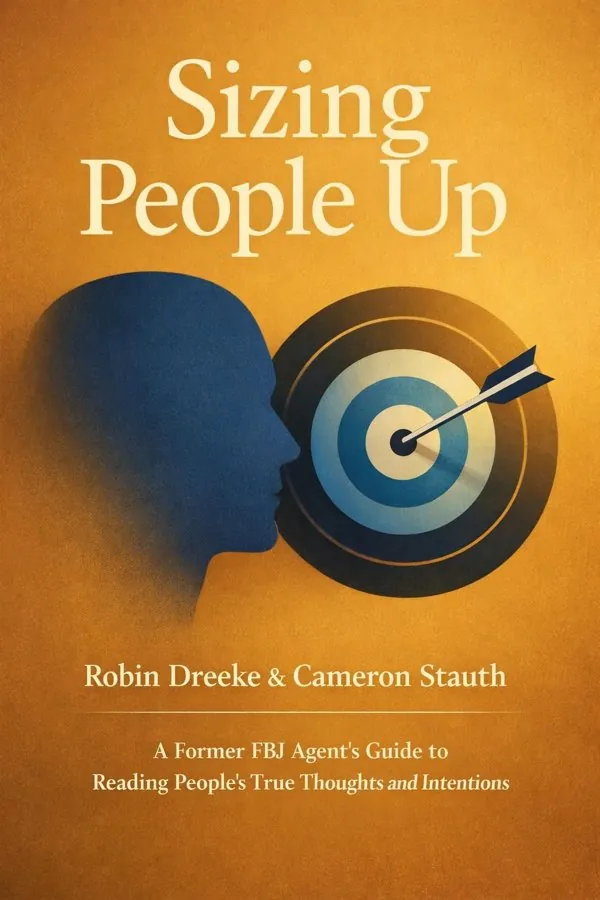
Sizing People Up: A Former FBI Agent’s Guide to Reading People’s True Thoughts and Intentions: Summary & Key Insights
by Robin Dreeke, Cameron Stauth
 10 min11 chaptersAudio available
What Is Sizing People Up: A Former FBI Agent’s Guide to Reading People’s True Thoughts and Intentions About?
Sizing People Up: A Former FBI Agent’s Guide to Reading People’s True Thoughts and Intentions by Robin Dreeke, Cameron Stauth is a psychology book spanning 11 pages. Written by former FBI agent Robin Dreeke with co-author Cameron Stauth, this book provides practical techniques for understanding and predicting human behavior. Drawing on Dreeke’s experience in counterintelligence, it teaches readers how to assess trustworthiness, intentions, and motivations through observation and communication strategies. The work blends psychology and behavioral analysis to help readers navigate personal and professional relationships more effectively.
This FizzRead summary covers all 11 key chapters of Sizing People Up: A Former FBI Agent’s Guide to Reading People’s True Thoughts and Intentions in approximately 10 minutes, distilling the most important ideas, arguments, and takeaways from Robin Dreeke, Cameron Stauth's work. Also available as an audio summary and Key Quotes Podcast.
Sizing People Up: A Former FBI Agent’s Guide to Reading People’s True Thoughts and Intentions
Written by former FBI agent Robin Dreeke with co-author Cameron Stauth, this book provides practical techniques for understanding and predicting human behavior. Drawing on Dreeke’s experience in counterintelligence, it teaches readers how to assess trustworthiness, intentions, and motivations through observation and communication strategies. The work blends psychology and behavioral analysis to help readers navigate personal and professional relationships more effectively.
Who Should Read Sizing People Up: A Former FBI Agent’s Guide to Reading People’s True Thoughts and Intentions?
This book is perfect for anyone interested in psychology and looking to gain actionable insights in a short read. Whether you're a student, professional, or lifelong learner, the key ideas from Sizing People Up: A Former FBI Agent’s Guide to Reading People’s True Thoughts and Intentions by Robin Dreeke, Cameron Stauth will help you think differently.
- ✓Readers who enjoy psychology and want practical takeaways
- ✓Professionals looking to apply new ideas to their work and life
- ✓Anyone who wants the core insights of Sizing People Up: A Former FBI Agent’s Guide to Reading People’s True Thoughts and Intentions in just 10 minutes
Want the full summary?
Get instant access to this book summary and 100K+ more with Fizz Moment.
Get Free SummaryAvailable on App Store • Free to download
Key Chapters
Trust is not magic, nor is it arbitrary—it’s measurable through behavior. Over time, I developed what I call the Trust Equation to guide my own assessments: Predictability plus Integrity plus Benevolence equals Trustworthiness. These three elements give us a roadmap for understanding who will honor their word and who will not.
Predictability comes first because it forms the foundation of reliability. When you can observe consistent patterns over time—how someone reacts under stress, how they treat others when no one is watching—you begin to establish a baseline. Integrity, the second factor, connects behavior to moral alignment. It answers the question: does this person’s word actually mean something to them? Finally, benevolence captures the highest level of trust: does this person consider others’ needs, or do they act purely from self-interest?
In the FBI, I learned that people show us these traits constantly; we simply have to interpret them correctly. Unpredictable behavior warns of instability. A lack of congruence between statements and actions signals compromised integrity. Absence of empathy hints at potential betrayal. But the equation is not about labeling someone as good or bad—it’s about calculating risk. Everyone has moments of weakness or self-interest; trust lies in understanding the degree and frequency of those patterns.
When you apply this model to daily life, it changes how you interpret relationships. A colleague who delivers steady results but deflects responsibility may score high on predictability but low on integrity. A friend who empathizes deeply but frequently fails to follow through might be benevolent but unreliable. By examining these patterns objectively, you stop reacting emotionally and start thinking strategically. The equation helps you see that trust is earned through observable, repeatable behavior—not charming words or grand intentions.
Over years of interviewing, debriefing, and recruiting individuals whose motives I could rarely afford to misjudge, I distilled six signs that consistently indicated whether trust could be extended. They aren’t mystical indicators but behavioral consistencies visible in how people communicate, prioritize, and respond under pressure.
The trustworthy person listens more than they speak, maintaining curiosity without judgment. They make commitments proportionate to their capacity, avoiding exaggerated promises that reveal ego rather than sincerity. They accept feedback without defensiveness, showing they value growth more than image. They demonstrate reliability through small actions—meeting deadlines, following through on minor agreements—which signal larger patterns. They respect boundaries, an overlooked but vital marker of benevolence. And finally, they act naturally; their body language aligns with their words.
Each of these signs operates as a diagnostic tool in real life. The colleague who interrupts frequently often isn’t just impatient; they may need control, hinting at ego-based motivation. A romantic partner whose stories never match observable reality may have integrity challenges. Observing isn’t about accusation—it’s about awareness. These signs allow us to detect emotional congruence and see where intentions diverge from presentation.
Trust grows in direct proportion to the number of these behaviors present over time. When fewer appear, proceed with caution. In FBI fieldwork, our best assets often matched all six, exhibiting emotional control, respect, and predictability even under stress. In business and personal life, the same principles apply: pay attention not to perfection but to consistency.
+ 9 more chapters — available in the FizzRead app
All Chapters in Sizing People Up: A Former FBI Agent’s Guide to Reading People’s True Thoughts and Intentions
About the Authors
Robin Dreeke is a former FBI Special Agent and head of the Counterintelligence Behavioral Analysis Program. He specializes in interpersonal communication and trust-building. Cameron Stauth is an American author known for his works on psychology, medicine, and true stories of human resilience.
Get This Summary in Your Preferred Format
Read or listen to the Sizing People Up: A Former FBI Agent’s Guide to Reading People’s True Thoughts and Intentions summary by Robin Dreeke, Cameron Stauth anytime, anywhere. FizzRead offers multiple formats so you can learn on your terms — all free.
Available formats: App · Audio · PDF · EPUB — All included free with FizzRead
Download Sizing People Up: A Former FBI Agent’s Guide to Reading People’s True Thoughts and Intentions PDF and EPUB Summary
Key Quotes from Sizing People Up: A Former FBI Agent’s Guide to Reading People’s True Thoughts and Intentions
“Trust is not magic, nor is it arbitrary—it’s measurable through behavior.”
“Over years of interviewing, debriefing, and recruiting individuals whose motives I could rarely afford to misjudge, I distilled six signs that consistently indicated whether trust could be extended.”
Frequently Asked Questions about Sizing People Up: A Former FBI Agent’s Guide to Reading People’s True Thoughts and Intentions
Sizing People Up: A Former FBI Agent’s Guide to Reading People’s True Thoughts and Intentions by Robin Dreeke, Cameron Stauth is a psychology book that explores key ideas across 11 chapters. Written by former FBI agent Robin Dreeke with co-author Cameron Stauth, this book provides practical techniques for understanding and predicting human behavior. Drawing on Dreeke’s experience in counterintelligence, it teaches readers how to assess trustworthiness, intentions, and motivations through observation and communication strategies. The work blends psychology and behavioral analysis to help readers navigate personal and professional relationships more effectively.
You Might Also Like

The Body Keeps the Score
Bessel van der Kolk
10 min
Surrounded by Idiots
Thomas Erikson
10 min
Emotional Intelligence
Daniel Goleman
10 min
Attached
Amir Levine
10 min
Why Does He Do That
Lundy Bancroft
10 min
Women Who Run with the Wolves
Clarissa Pinkola Estés
10 minBrowse by Category
Ready to read Sizing People Up: A Former FBI Agent’s Guide to Reading People’s True Thoughts and Intentions?
Get the full summary and 100K+ more books with Fizz Moment.