
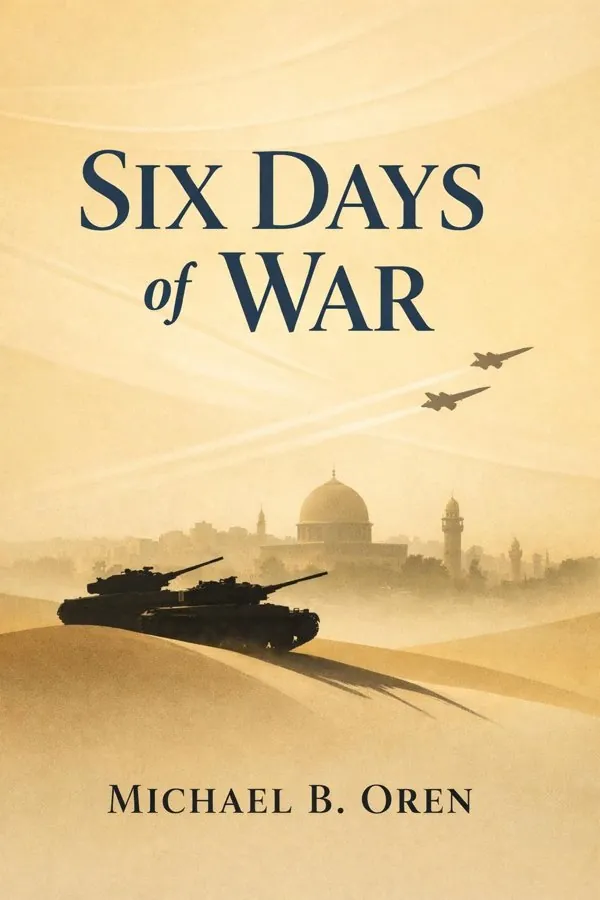
Six Days of War: June 1967 and the Making of the Modern Middle East: Summary & Key Insights
 10 min9 chaptersAudio available
Key Takeaways from Six Days of War: June 1967 and the Making of the Modern Middle East
Wars often begin long before the first shot is fired, in the realm of assumptions, signals, and fears that leaders misread.
Diplomacy does not fail only when negotiators leave the room; it fails when leaders use diplomacy mainly to buy time, protect prestige, or shift blame.
Sometimes history turns in a single morning.
Conflicts rarely stay confined to the front leaders expect.
Some battles matter because of strategy; others matter because they transform identity.
What Is Six Days of War: June 1967 and the Making of the Modern Middle East About?
Six Days of War: June 1967 and the Making of the Modern Middle East by Michael B. Oren is a war_military book spanning 4 pages. Michael B. Oren’s Six Days of War is a gripping history of the June 1967 Arab-Israeli conflict and the vast political aftershocks it unleashed across the Middle East and beyond. In less than a week, Israel defeated the armies of Egypt, Jordan, and Syria, captured territories of immense strategic and symbolic importance, and transformed the map of the region. But Oren’s book is not simply a military chronicle. It is a deeply researched reconstruction of how fear, pride, intelligence failures, superpower rivalry, and political miscalculation combined to make war appear inevitable even when many leaders hoped to avoid it. Drawing on declassified archives, memoirs, interviews, and diplomatic records from multiple countries, Oren shows the war from several sides at once. He explains not only what happened on the battlefield, but also why statesmen made the choices they did and how those choices still shape modern debates about borders, nationalism, occupation, refugees, and peace. The result is an authoritative and highly readable account of a brief conflict whose consequences have lasted for decades.
This FizzRead summary covers all 9 key chapters of Six Days of War: June 1967 and the Making of the Modern Middle East in approximately 10 minutes, distilling the most important ideas, arguments, and takeaways from Michael B. Oren's work. Also available as an audio summary and Key Quotes Podcast.
Six Days of War: June 1967 and the Making of the Modern Middle East
Michael B. Oren’s Six Days of War is a gripping history of the June 1967 Arab-Israeli conflict and the vast political aftershocks it unleashed across the Middle East and beyond. In less than a week, Israel defeated the armies of Egypt, Jordan, and Syria, captured territories of immense strategic and symbolic importance, and transformed the map of the region. But Oren’s book is not simply a military chronicle. It is a deeply researched reconstruction of how fear, pride, intelligence failures, superpower rivalry, and political miscalculation combined to make war appear inevitable even when many leaders hoped to avoid it.
Drawing on declassified archives, memoirs, interviews, and diplomatic records from multiple countries, Oren shows the war from several sides at once. He explains not only what happened on the battlefield, but also why statesmen made the choices they did and how those choices still shape modern debates about borders, nationalism, occupation, refugees, and peace. The result is an authoritative and highly readable account of a brief conflict whose consequences have lasted for decades.
Who Should Read Six Days of War: June 1967 and the Making of the Modern Middle East?
This book is perfect for anyone interested in war_military and looking to gain actionable insights in a short read. Whether you're a student, professional, or lifelong learner, the key ideas from Six Days of War: June 1967 and the Making of the Modern Middle East by Michael B. Oren will help you think differently.
- ✓Readers who enjoy war_military and want practical takeaways
- ✓Professionals looking to apply new ideas to their work and life
- ✓Anyone who wants the core insights of Six Days of War: June 1967 and the Making of the Modern Middle East in just 10 minutes
Want the full summary?
Get instant access to this book summary and 100K+ more with Fizz Moment.
Get Free SummaryAvailable on App Store • Free to download
Key Chapters
Wars often begin long before the first shot is fired, in the realm of assumptions, signals, and fears that leaders misread. Oren shows that the Six-Day War emerged from months of escalating instability rather than from a single dramatic trigger. Along Israel’s borders, Palestinian guerrilla raids increased tensions, especially from Syrian-supported fronts. Israel responded with reprisals designed to deter attacks, but these actions also deepened Arab outrage and reinforced the belief that only military firmness could preserve national honor.
At the center of the regional drama stood Egyptian president Gamal Abdel Nasser, whose prestige as the leading Arab nationalist pulled him into dangerous posturing. False Soviet intelligence suggesting Israeli plans to attack Syria contributed to Egyptian mobilization in Sinai. Nasser then took steps that were meant to strengthen deterrence and political stature: moving troops, expelling UN peacekeepers, and closing the Straits of Tiran to Israeli shipping. Each move narrowed diplomatic room and intensified pressure on Israel to respond.
Oren’s key insight is that all sides believed they were reacting defensively, even as they created an offensive spiral. Israel feared encirclement and annihilation. Arab leaders feared humiliation, division, and loss of credibility. Superpowers added noise rather than clarity. This pattern remains highly relevant: governments frequently mistake symbolic demonstrations of resolve for controllable strategy, only to discover that public commitments create traps.
A practical way to apply this lesson is to examine any modern crisis by separating rhetoric from capability, and capability from intention. Ask which actions are reversible, which are performative, and which create irreversible escalation. In business, politics, or personal conflict, the same principle holds: dramatic signaling can corner everyone involved.
Actionable takeaway: when tensions rise, identify the moves that preserve dignity without eliminating options, because the most dangerous crises are often built from incremental decisions that no one fully intends to turn into war.
Diplomacy does not fail only when negotiators leave the room; it fails when leaders use diplomacy mainly to buy time, protect prestige, or shift blame. One of Oren’s strengths is his demonstration that before June 5, 1967, the region was full of messages, envoys, warnings, and back-channel efforts, yet these rarely produced trust. Egypt sought to project strength without necessarily inviting a full-scale war. Israel sought assurances from allies while debating whether delay would improve or worsen its position. Jordan balanced fear of Israel against pressure from Arab public opinion. Syria remained deeply confrontational. The United States, Soviet Union, and United Nations all played roles, but none could create a stable off-ramp.
Oren shows how diplomacy became entangled with domestic politics. Nasser could not easily retreat after making bold public moves. Israeli leaders faced mounting anxiety from a population watching reserve mobilization disrupt national life and wondering whether waiting meant vulnerability. Jordan’s King Hussein understood the risks of war, yet he also feared political isolation if he stayed outside an Arab coalition. In this atmosphere, even sensible caution looked like weakness.
The broader lesson is that diplomacy depends on more than rational bargaining. It requires political space for compromise. When leaders speak in absolutes, personalize stakes, or let symbolic credibility overshadow practical interests, negotiation becomes theater rather than problem-solving.
Modern readers can apply this insight by paying attention not only to official statements but also to the incentives behind them. In workplaces, institutions, or international affairs, parties often continue unproductive positions because reversal appears more costly than escalation. Good mediation therefore must offer face-saving alternatives, not just logical arguments.
Actionable takeaway: if you want diplomacy to work, create exits that allow all sides to claim some form of legitimacy, because people rarely choose peace if peace looks publicly indistinguishable from surrender.
Sometimes history turns in a single morning. Oren’s account of June 5, 1967, makes clear that Israel’s opening strike was not merely a tactical gamble but a strategic decision rooted in existential fear, operational planning, and political urgency. Israeli leaders concluded that waiting for Arab forces to attack would dangerously reduce their chances of survival. The result was Operation Focus, a meticulously coordinated air assault that destroyed much of Egypt’s air force on the ground and quickly gave Israel control of the skies.
Oren explains why this first day mattered so decisively. Air superiority did not automatically win the war, but it made everything else possible. With Egyptian aircraft crippled, Israeli ground operations in Sinai accelerated. Miscommunication and exaggerated reporting worsened Arab responses. In Amman and Damascus, assumptions about early Arab success helped draw Jordan and Syria more deeply into the fighting, even as the strategic balance had already shifted.
The chapter also raises a difficult moral and analytical question: when, if ever, is preemption justified? Oren does not reduce the issue to slogans. He shows the fear of annihilation in Israel, the diplomatic deadlock, and the closing window for military advantage. At the same time, he invites readers to see how preemption becomes thinkable when states believe delay could be fatal.
This idea has practical relevance beyond war. In competitive environments, organizations often face the temptation to move first before threats fully materialize. But successful preemption requires extraordinary intelligence, preparation, and clarity of purpose. Most actors overestimate their foresight and underestimate second-order consequences.
Actionable takeaway: before endorsing a first strike in any domain, ask three questions—Is the threat truly imminent? Is delay genuinely more dangerous? And is there a realistic plan for what comes after the initial success?
Conflicts rarely stay confined to the front leaders expect. One of Oren’s most revealing contributions is his account of how a war that began largely around Egypt and Sinai quickly widened to Jordan, Jerusalem, the West Bank, and the Golan front with Syria. Once fighting began, alliance pressures, misinformation, emotional symbolism, and battlefield momentum pulled additional actors into decisions they might have avoided under calmer conditions.
Jordan’s entry into the war was especially consequential. Despite Israeli messages urging restraint, King Hussein relied on reports that suggested Arab forces were faring better than they actually were. Jordanian shelling and military engagement triggered Israeli counterattacks that led to the capture of East Jerusalem and the West Bank. Meanwhile, Syria continued to strike from the north, and Israeli leaders had to decide whether to focus on consolidating gains or expanding operations against entrenched Syrian positions on the Golan Heights.
Oren shows how war compresses time. Leaders make choices with imperfect information, under emotional pressure, and amid institutional chaos. The result is often a widening conflict in which original war aims blur and new opportunities or vulnerabilities emerge. What begins as an attempt to neutralize one danger becomes a regional reordering.
This pattern offers a practical framework for understanding escalation in any complex system. A dispute among two parties can pull in others because of obligations, reputation concerns, or mistaken assumptions. In organizations, a conflict between departments can become company-wide if leaders communicate poorly and individuals act on fragments of information.
Actionable takeaway: when managing any fast-moving crisis, track not only your primary opponent but also the secondary actors, alliances, and symbolic flashpoints that could expand the conflict beyond its initial scope.
Some battles matter because of strategy; others matter because they transform identity. Oren demonstrates that the war’s struggle over Jerusalem cannot be understood only in military terms. The city carried immense religious, historical, and national significance, and its capture by Israeli forces became one of the defining images of the war. For Israelis, the reunification of Jerusalem resonated as a moment of deliverance and historical return. For Palestinians and the wider Arab world, it represented a traumatic loss with enduring emotional and political consequences.
Oren is careful to place symbolism alongside geography. Jerusalem was not merely a sacred city; it was embedded in the larger territorial shifts of 1967, which included the Sinai Peninsula, Gaza Strip, West Bank, and Golan Heights. These gains changed Israel’s strategic depth but also created a new reality: military victory had produced control over large populations and contested lands whose future would become the central question of regional politics.
The broader insight is that territory is never only physical space. It is memory, legitimacy, security, and narrative. Leaders often underestimate how powerfully symbolism can harden positions. Once land becomes tied to redemption, justice, or national destiny, compromise becomes much more difficult.
This lesson applies in negotiations of all kinds. People rarely argue only about material resources; they also defend status, identity, and perceived historical rights. Effective problem-solving therefore requires recognizing symbolic stakes instead of treating them as irrational distractions.
Actionable takeaway: in any dispute over land, authority, or inheritance, identify what the contested object means emotionally and historically, because durable solutions must address not just control but also the identities attached to it.
It is tempting to explain Middle Eastern wars as simple byproducts of Cold War competition, but Oren offers a more nuanced picture. The United States and Soviet Union mattered enormously, yet neither fully controlled the regional actors they supported. Moscow supplied intelligence, weapons, and diplomatic backing to Arab states, while Washington maintained close ties with Israel but was also cautious, especially before the war. Still, local leaders made choices based on their own ambitions, fears, and political needs.
Oren’s account helps readers avoid two simplistic interpretations: that the war was merely a puppet conflict orchestrated by superpowers, or that outside powers were irrelevant. The truth lies in the interaction between global rivalry and regional decision-making. Soviet warnings influenced Egyptian behavior, but did not dictate every step. American hesitation affected Israeli calculations, but did not remove Israeli agency. Once the war started, both superpowers scrambled to manage escalation and avoid direct confrontation, especially as the scale of Arab defeat became clear.
This framework is highly useful for analyzing current geopolitics. External powers can amplify local conflicts by providing weapons, guarantees, or disinformation, but they rarely erase the autonomy of local actors. Overemphasizing outside influence can obscure regional responsibility; ignoring it can miss the structural pressures that shape options.
In practical terms, this means policy analysis should ask two parallel questions: what are local actors trying to achieve, and how do larger powers alter their incentives, confidence, or room for error? The answer to either question alone is incomplete.
Actionable takeaway: when assessing any international crisis, resist one-cause explanations and map both the local motives and the external patrons, because durable understanding depends on seeing how internal choices and great-power pressures interact.
Winning a war can solve an immediate danger while creating a far more complex future. Oren makes this paradox central to understanding 1967. Israel’s military success was astonishing: in six days it shattered Arab armies, altered the strategic map, and restored a sense of security and confidence. Yet the victory also introduced questions that military power alone could not answer. What should Israel do with the territories it captured? Could they become bargaining chips for peace, or would they become integral to national identity and security doctrine? How would the presence of large Palestinian populations under Israeli control reshape the conflict?
On the Arab side, defeat was not merely military. It damaged regimes, discredited claims of imminent victory, and intensified the search for explanations, scapegoats, and new strategies. Pan-Arab confidence weakened, but rejection of Israel hardened in many quarters. The Khartoum conference’s famous “three noes” reflected both political shock and the difficulty of acknowledging a new balance of power.
Oren shows that wars do not end when the shooting stops; they transition into argument over meaning. Victors tell stories of necessity and redemption. Defeated societies tell stories of betrayal, conspiracy, or temporary reversal. These narratives then shape the next generation of policy.
This dynamic appears in business mergers, elections, and personal disputes as well. A decisive win can produce overconfidence, moral blindness, or postponed strategic thinking. Immediate triumph often conceals long-term governance problems.
Actionable takeaway: after any major victory, shift quickly from celebration to foresight by asking not only what was won, but what new responsibilities, dilemmas, and unresolved tensions that victory has created.
One of the most enduring consequences of the Six-Day War was that it changed the scale, visibility, and urgency of the Palestinian issue. Oren shows that before 1967, the Arab-Israeli conflict was often framed primarily as a contest between states. After the war, Israel’s control of the West Bank and Gaza placed millions of Palestinians at the center of the conflict in a new way. Territorial conquest had transformed a conventional interstate war into a prolonged struggle over occupation, sovereignty, identity, and self-determination.
This shift had major political effects. Arab states remained central players, but Palestinian nationalism acquired sharper institutional and symbolic force. The Palestine Liberation Organization gained importance as the question of who represented Palestinian aspirations became more urgent. International debate also evolved. The conflict could no longer be understood solely in terms of armistice lines and army movements; it now demanded attention to civilian populations, governance, legal status, and competing claims to nationhood.
Oren’s treatment helps readers see that unresolved political questions can survive, and even intensify, after military outcomes seem decisive. Tactical success may freeze a dispute into a more durable and morally fraught form. That is a lesson with broad application: if a core identity-based grievance remains unaddressed, administrative control will not produce lasting peace.
In practical terms, this idea reminds policymakers and citizens alike to distinguish between managing a problem and resolving it. Order, checkpoints, deterrence, and temporary arrangements may reduce immediate violence, but they cannot substitute for a political horizon accepted as legitimate by those living under it.
Actionable takeaway: when evaluating any conflict, ask whether the current strategy merely contains resistance or genuinely addresses the underlying claims of representation, dignity, and political belonging.
Short wars can cast very long shadows. Oren’s central argument is that June 1967 did not merely redraw boundaries for a moment; it helped make the modern Middle East. The war transformed Israel from a vulnerable state fearing encirclement into a regional military power, while also tying its future to occupied territories and unresolved political questions. It weakened the aura of Arab nationalist unity, altered the prestige of leaders like Nasser, and shifted the strategic calculations of every neighboring government.
The effects spread outward. The war influenced oil politics, superpower diplomacy, subsequent Arab-Israeli wars, the growth of settlement movements, Palestinian mobilization, and the future peace process. It changed the language of international negotiations, especially around land for peace and UN Resolution 242. It also deepened the fusion of military realities with sacred geography, making later compromise more emotionally and politically difficult.
Oren’s wider achievement is to show how a six-day event can become a generational turning point because it changes structures, narratives, and expectations simultaneously. The map changes, but so do the stories people tell about justice, victory, humiliation, and destiny. Those stories can outlast the military facts that produced them.
For readers today, the practical value of this insight lies in historical humility. Present crises often sit atop older moments whose consequences remain active. To understand current headlines, one must identify the formative shocks that still organize fear and hope.
Actionable takeaway: study turning points not as isolated episodes but as origins of long chains, because the best way to understand today’s Middle East is to trace how the outcomes of 1967 still shape what each side believes is possible, necessary, or intolerable.
All Chapters in Six Days of War: June 1967 and the Making of the Modern Middle East
About the Author
Michael B. Oren is an American-born Israeli historian, bestselling author, and former diplomat whose work focuses on Middle Eastern history, U.S.-Israel relations, and the politics of the modern region. Born in the United States and later immigrating to Israel, he built a reputation as a scholar capable of combining deep archival research with clear narrative writing. He served as Israel’s ambassador to the United States, an experience that strengthened his understanding of diplomacy, statecraft, and international decision-making. Oren has written extensively on the Arab-Israeli conflict and the broader strategic history of the Middle East. In Six Days of War, his historical expertise and diplomatic insight come together to produce a detailed, balanced, and influential account of one of the most consequential wars of the twentieth century.
Get This Summary in Your Preferred Format
Read or listen to the Six Days of War: June 1967 and the Making of the Modern Middle East summary by Michael B. Oren anytime, anywhere. FizzRead offers multiple formats so you can learn on your terms — all free.
Available formats: App · Audio · PDF · EPUB — All included free with FizzRead
Download Six Days of War: June 1967 and the Making of the Modern Middle East PDF and EPUB Summary
Key Quotes from Six Days of War: June 1967 and the Making of the Modern Middle East
“Wars often begin long before the first shot is fired, in the realm of assumptions, signals, and fears that leaders misread.”
“Diplomacy does not fail only when negotiators leave the room; it fails when leaders use diplomacy mainly to buy time, protect prestige, or shift blame.”
“Sometimes history turns in a single morning.”
“Conflicts rarely stay confined to the front leaders expect.”
“Some battles matter because of strategy; others matter because they transform identity.”
Frequently Asked Questions about Six Days of War: June 1967 and the Making of the Modern Middle East
Six Days of War: June 1967 and the Making of the Modern Middle East by Michael B. Oren is a war_military book that explores key ideas across 9 chapters. Michael B. Oren’s Six Days of War is a gripping history of the June 1967 Arab-Israeli conflict and the vast political aftershocks it unleashed across the Middle East and beyond. In less than a week, Israel defeated the armies of Egypt, Jordan, and Syria, captured territories of immense strategic and symbolic importance, and transformed the map of the region. But Oren’s book is not simply a military chronicle. It is a deeply researched reconstruction of how fear, pride, intelligence failures, superpower rivalry, and political miscalculation combined to make war appear inevitable even when many leaders hoped to avoid it. Drawing on declassified archives, memoirs, interviews, and diplomatic records from multiple countries, Oren shows the war from several sides at once. He explains not only what happened on the battlefield, but also why statesmen made the choices they did and how those choices still shape modern debates about borders, nationalism, occupation, refugees, and peace. The result is an authoritative and highly readable account of a brief conflict whose consequences have lasted for decades.
You Might Also Like

Patriot
Andrew Britton
10 min
War
John Hersey
10 min
An Army at Dawn: The War in North Africa, 1942–1943
Rick Atkinson
10 min
Brave New War: The Next Stage of Terrorism and the End of Globalization
John Robb
10 min
Catch-22
Joseph Heller
10 min
Command and Control: Nuclear Weapons, the Damascus Accident, and the Illusion of Safety
Eric Schlosser
10 minBrowse by Category
Ready to read Six Days of War: June 1967 and the Making of the Modern Middle East?
Get the full summary and 100K+ more books with Fizz Moment.