
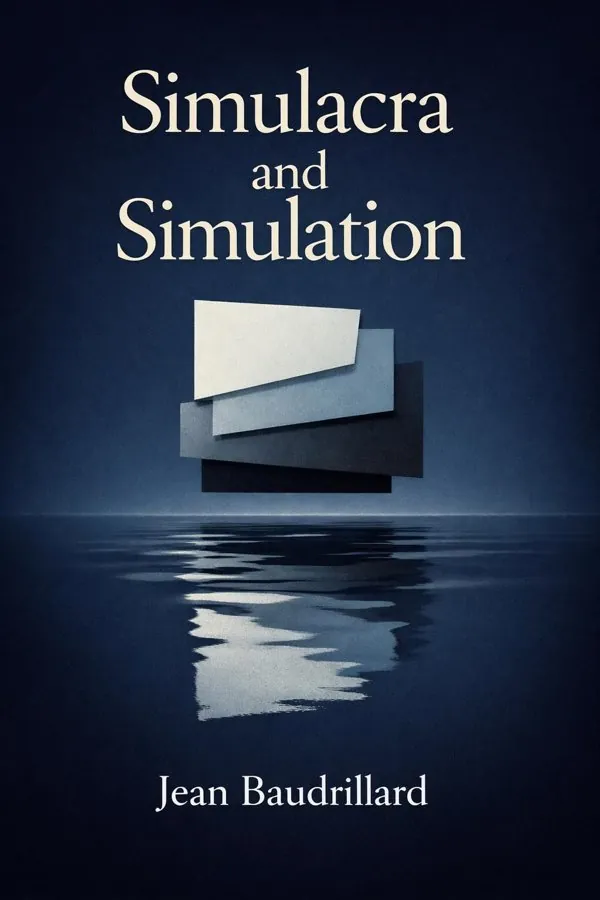
Simulacra and Simulation: Summary & Key Insights
 10 min10 chaptersAudio available
What Is Simulacra and Simulation About?
Simulacra and Simulation by Jean Baudrillard is a western_phil book spanning 10 pages. In this influential philosophical work, Jean Baudrillard examines the concept of the simulacrum and the disappearance of the real in contemporary society. He explores how signs and representations come to replace reality itself, particularly through media, technology, and mass culture. The book has become a cornerstone of postmodern thought and critical theory on simulation and hyperreality.
This FizzRead summary covers all 10 key chapters of Simulacra and Simulation in approximately 10 minutes, distilling the most important ideas, arguments, and takeaways from Jean Baudrillard's work. Also available as an audio summary and Key Quotes Podcast.
Simulacra and Simulation
In this influential philosophical work, Jean Baudrillard examines the concept of the simulacrum and the disappearance of the real in contemporary society. He explores how signs and representations come to replace reality itself, particularly through media, technology, and mass culture. The book has become a cornerstone of postmodern thought and critical theory on simulation and hyperreality.
Who Should Read Simulacra and Simulation?
This book is perfect for anyone interested in western_phil and looking to gain actionable insights in a short read. Whether you're a student, professional, or lifelong learner, the key ideas from Simulacra and Simulation by Jean Baudrillard will help you think differently.
- ✓Readers who enjoy western_phil and want practical takeaways
- ✓Professionals looking to apply new ideas to their work and life
- ✓Anyone who wants the core insights of Simulacra and Simulation in just 10 minutes
Want the full summary?
Get instant access to this book summary and 100K+ more with Fizz Moment.
Get Free SummaryAvailable on App Store • Free to download
Key Chapters
The precession of simulacra marks the historical and conceptual movement in which signs come to replace the real. Once, representation was a mirror held to nature — it sought to imitate, reproduce, or refer to something external. But in our time, representation has broken free from reference, creating a world where signs no longer point toward reality but toward other signs in an endless chain. This precession means that reality is not reflected but simulated; models come first, and reality follows as their shadow.
I describe this as a drift through four phases: the faithful image that reflects a basic reality; the perverted image that masks and distorts reality; the mask that hides the absence of reality; and finally, the pure simulacrum, which bears no relation to reality whatsoever. In the last stage, representation becomes its own universe — autonomous, closed, and radiant in artificial perfection. Disneyland, television news, or consumer advertising serve as paradigmatic examples: they are worlds of simulation whose perfection displaces the messy inconsistency of the real world. The danger is not illusion but indifference — a collective acceptance that the sign has become more real than reality itself.
This precession transforms our very experience of truth. The sign no longer says ‘this is as it is’; it says ‘this is what must be believed.’ In a culture of simulation, belief functions like a software protocol, ensuring the smooth operation of meaning without requiring any external reference. I write not to mourn the real’s loss but to reveal its substitution: to show how in the triumph of simulation, we uncover the logic governing our age.
In tracing the genealogy of simulacra, I distinguish three orders that shape the relationship between signs and reality across history. The first order is that of the counterfeit, characteristic of the Renaissance. Here, representation is imitation — an artistic and moral challenge that depends on the model. The counterfeit mirrors authority and divinity; it seeks resemblance and is haunted by the real presence of what it reproduces.
The second order emerges with the industrial age, the age of production. Mass production detaches the object from any sacred model, replacing imitation with mechanically exact reproduction. The logic of the factory, of commodity exchange, and of equivalence makes every object into a unit of production and consumption. Reality becomes a system of operations governed by economic efficiency, and representation becomes production. Marx could still expose the alienation of labor, but postindustrial simulation transforms alienation itself into the operational functioning of society.
The third order is properly our own: the order of simulation, that of the code. Here, there is no model and no original. Signs become purely operational and programmable, circulating in a closed system that recreates reality from within. Digital culture, genetic engineering, virtual worlds — these are not imitations but reproductions without originals. They simulate the world more precisely than the world itself, obliterating difference. The distinction between true and false, reality and appearance, collapses entirely.
Through these orders, we see the displacement of meaning. What was once grounded in reference gives way to reproduction, then to code. In this final stage, not only reality but also critique itself is absorbed by simulation. The challenge lies in perceiving that there is no outer realm to return to — no primordial real untouched by representation. The simulacrum is not an image of reality; it is reality as it now exists.
+ 8 more chapters — available in the FizzRead app
All Chapters in Simulacra and Simulation
About the Author
Jean Baudrillard (1929–2007) was a French philosopher and sociologist known for his analyses of consumer society, media, and postmodernity. His work investigates the relationship between reality, image, and representation, profoundly influencing critical theory and contemporary philosophy.
Get This Summary in Your Preferred Format
Read or listen to the Simulacra and Simulation summary by Jean Baudrillard anytime, anywhere. FizzRead offers multiple formats so you can learn on your terms — all free.
Available formats: App · Audio · PDF · EPUB — All included free with FizzRead
Download Simulacra and Simulation PDF and EPUB Summary
Key Quotes from Simulacra and Simulation
“The precession of simulacra marks the historical and conceptual movement in which signs come to replace the real.”
“In tracing the genealogy of simulacra, I distinguish three orders that shape the relationship between signs and reality across history.”
Frequently Asked Questions about Simulacra and Simulation
Simulacra and Simulation by Jean Baudrillard is a western_phil book that explores key ideas across 10 chapters. In this influential philosophical work, Jean Baudrillard examines the concept of the simulacrum and the disappearance of the real in contemporary society. He explores how signs and representations come to replace reality itself, particularly through media, technology, and mass culture. The book has become a cornerstone of postmodern thought and critical theory on simulation and hyperreality.
You Might Also Like
A Little History of Philosophy
Nigel Warburton
10 min
Areopagitica
John Milton
10 min
How To Think Like A Philosopher: Essential Principles For Clear Thinking
Peter Cave
10 min
Language, Truth and Logic
A. J. Ayer
10 min
The Age of Reason
Thomas Paine
10 min
The Essays
Michel De Montaigne
10 minBrowse by Category
Ready to read Simulacra and Simulation?
Get the full summary and 100K+ more books with Fizz Moment.