
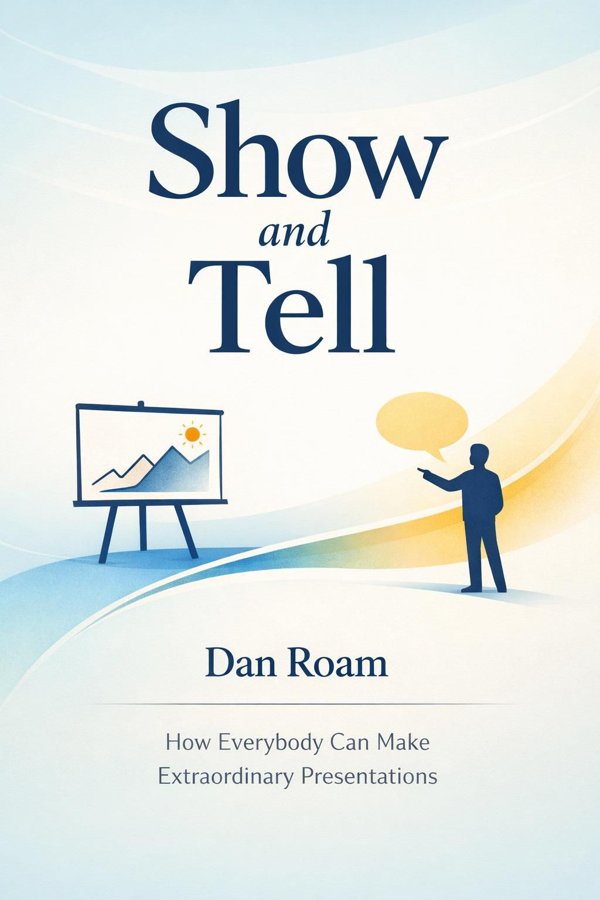
Show and Tell: How Everybody Can Make Extraordinary Presentations: Summary & Key Insights
by Dan Roam
 10 min7 chaptersAudio available
What Is Show and Tell: How Everybody Can Make Extraordinary Presentations About?
Show and Tell: How Everybody Can Make Extraordinary Presentations by Dan Roam is a communication book spanning 7 pages. Show and Tell es un libro de comunicación visual y presentación que enseña cómo estructurar y contar historias efectivas en presentaciones. Dan Roam, conocido por su enfoque de pensamiento visual, ofrece un método claro para combinar palabras e imágenes de manera que cualquier persona pueda comunicar ideas complejas de forma simple y convincente.
This FizzRead summary covers all 7 key chapters of Show and Tell: How Everybody Can Make Extraordinary Presentations in approximately 10 minutes, distilling the most important ideas, arguments, and takeaways from Dan Roam's work. Also available as an audio summary and Key Quotes Podcast.
Show and Tell: How Everybody Can Make Extraordinary Presentations
Show and Tell es un libro de comunicación visual y presentación que enseña cómo estructurar y contar historias efectivas en presentaciones. Dan Roam, conocido por su enfoque de pensamiento visual, ofrece un método claro para combinar palabras e imágenes de manera que cualquier persona pueda comunicar ideas complejas de forma simple y convincente.
Who Should Read Show and Tell: How Everybody Can Make Extraordinary Presentations?
This book is perfect for anyone interested in communication and looking to gain actionable insights in a short read. Whether you're a student, professional, or lifelong learner, the key ideas from Show and Tell: How Everybody Can Make Extraordinary Presentations by Dan Roam will help you think differently.
- ✓Readers who enjoy communication and want practical takeaways
- ✓Professionals looking to apply new ideas to their work and life
- ✓Anyone who wants the core insights of Show and Tell: How Everybody Can Make Extraordinary Presentations in just 10 minutes
Want the full summary?
Get instant access to this book summary and 100K+ more with Fizz Moment.
Get Free SummaryAvailable on App Store • Free to download
Key Chapters
Every presentation, whether it’s a sales pitch, a classroom lecture, or a TED Talk, is fundamentally a story. That’s the message I’ve spent much of my career teaching. When you stand before an audience, you’re not just presenting facts — you’re inviting people into a narrative. A good story has momentum; it gives your listeners something to care about and something to follow. Facts alone vanish almost as soon as they’re absorbed, but when those facts are woven into a story, they take root in memory.
The first step is to understand the kind of story you’re telling. Every presentation is an act of storytelling with purpose: to explain, persuade, or inspire. When we speak with visuals, we have an advantage because the human brain is wired for pictures. Before we read words, we see shapes. Before we analyze data, we sense patterns. So when we shape our story visually — with images, sketches, and diagrams — we’re not just decorating slides; we’re mapping meaning.
Think of it this way: a presentation is not a monologue; it’s an adventure. Your audience is the hero, and your job as presenter is not to impress but to guide. You must show them where the challenge lies, what the stakes are, and what the resolution could look like. The story’s arc mirrors the psychology of engagement: beginning (why this matters), middle (what the problem is and how we confront it), and end (the change we propose). When you tell your story visually, these transitions feel natural. They don’t just describe change; they make people feel it.
Once you see your presentation as a story, everything else falls into place. You stop asking 'what slides do I need?' and start asking 'what journey do I want my audience to take?' That simple shift unlocks creativity, clarity, and confidence — the foundation of extraordinary communication.
One of the earliest insights I share in workshops is that not all presentations are created equal. There are three fundamental species of presentation, each serving a distinct communicative purpose: Report, Explanation, and Inspiration.
A Report is the most straightforward: it’s about conveying facts clearly. When you’re reporting, your goal is precision and transparency. A financial update or a scientific summary should feel concrete, structured, and visualized in a way that simplifies rather than obscures. The best reporters don’t list numbers — they reveal what those numbers mean.
An Explanation goes deeper. It builds understanding. This type of presentation takes the listener from confusion to clarity. You’re not just showing data; you’re teaching how things work. A successful explanation patiently builds bridges between ideas — it transforms complexity into simplicity without dumbing anything down. Here, visual tools shine brightly. Diagrams, sketches, and models can compress volumes of technical detail into one enlightening picture.
The third type, Inspiration, is the most powerful. It’s about emotional transformation. When you inspire, your goal isn’t just to inform or explain but to move hearts and prompt action. Inspiration relies heavily on storytelling and imagery that evokes possibility. An inspiring presentation paints the future vividly; it invites the audience to see themselves in that vision.
Each of these types calls for a different structure, tone, and set of visuals. The Report demands objectivity, the Explanation demands clarity, and the Inspiration demands humanity. Knowing which type you’re delivering is crucial because it determines how your story will live. You can’t inspire people with data alone, nor can you explain with pure emotion. The magic lies in using the right balance for the right purpose — and that awareness is what turns ordinary talks into unforgettable experiences.
+ 5 more chapters — available in the FizzRead app
All Chapters in Show and Tell: How Everybody Can Make Extraordinary Presentations
About the Author
Dan Roam es un consultor y autor estadounidense especializado en pensamiento visual y comunicación empresarial. Es conocido por sus libros sobre cómo usar dibujos simples para resolver problemas y comunicar ideas, incluyendo 'The Back of the Napkin'. Ha trabajado con empresas líderes y organizaciones gubernamentales en todo el mundo.
Get This Summary in Your Preferred Format
Read or listen to the Show and Tell: How Everybody Can Make Extraordinary Presentations summary by Dan Roam anytime, anywhere. FizzRead offers multiple formats so you can learn on your terms — all free.
Available formats: App · Audio · PDF · EPUB — All included free with FizzRead
Download Show and Tell: How Everybody Can Make Extraordinary Presentations PDF and EPUB Summary
Key Quotes from Show and Tell: How Everybody Can Make Extraordinary Presentations
“Every presentation, whether it’s a sales pitch, a classroom lecture, or a TED Talk, is fundamentally a story.”
“One of the earliest insights I share in workshops is that not all presentations are created equal.”
Frequently Asked Questions about Show and Tell: How Everybody Can Make Extraordinary Presentations
Show and Tell: How Everybody Can Make Extraordinary Presentations by Dan Roam is a communication book that explores key ideas across 7 chapters. Show and Tell es un libro de comunicación visual y presentación que enseña cómo estructurar y contar historias efectivas en presentaciones. Dan Roam, conocido por su enfoque de pensamiento visual, ofrece un método claro para combinar palabras e imágenes de manera que cualquier persona pueda comunicar ideas complejas de forma simple y convincente.
More by Dan Roam

You Might Also Like

Magic Words: The Science and Secrets Behind Seven Words That Motivate, Engage, and Influence
Tim David
10 min
Talking Across The Divide: How to Communicate with People You Disagree with and Maybe Even Change the World
Justin Lee
10 min
The Exceptional Presenter: A Proven Formula to Open Up! and Own the Room
Timothy J. Koegel
10 min
4 Essential Keys to Effective Communication in Love, Life, Work--Anywhere!: Including the 12-Day Communication Challenge!
Bento C. Leal III
10 min
Active Listening Techniques: 30 Practical Tools to Hone Your Communication Skills
Nisha Gupta
10 min
Bargaining for Advantage: Negotiation Strategies for Reasonable People
G. Richard Shell
10 minBrowse by Category
Ready to read Show and Tell: How Everybody Can Make Extraordinary Presentations?
Get the full summary and 100K+ more books with Fizz Moment.