
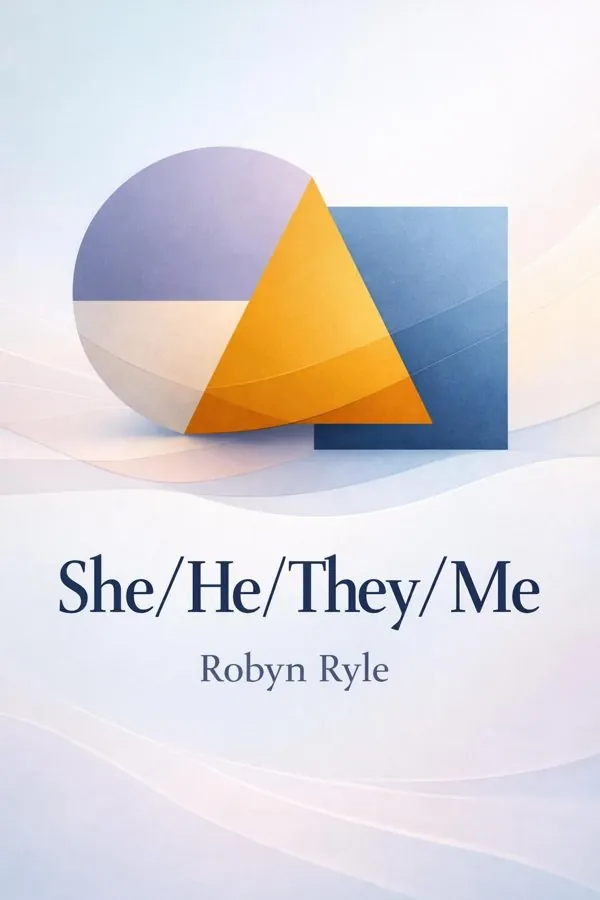
She/He/They/Me: For the Sisters, Misters, and Binary Resisters: Summary & Key Insights
by Robyn Ryle
 10 min11 chaptersAudio available
What Is She/He/They/Me: For the Sisters, Misters, and Binary Resisters About?
She/He/They/Me: For the Sisters, Misters, and Binary Resisters by Robyn Ryle is a sociology book spanning 11 pages. This book explores gender identity and expression through an interactive, choose-your-own-path format. Readers navigate different scenarios that reveal how gender shapes experiences, relationships, and social expectations. It offers an accessible and inclusive look at the complexity of gender beyond traditional binaries.
This FizzRead summary covers all 11 key chapters of She/He/They/Me: For the Sisters, Misters, and Binary Resisters in approximately 10 minutes, distilling the most important ideas, arguments, and takeaways from Robyn Ryle's work. Also available as an audio summary and Key Quotes Podcast.
She/He/They/Me: For the Sisters, Misters, and Binary Resisters
This book explores gender identity and expression through an interactive, choose-your-own-path format. Readers navigate different scenarios that reveal how gender shapes experiences, relationships, and social expectations. It offers an accessible and inclusive look at the complexity of gender beyond traditional binaries.
Who Should Read She/He/They/Me: For the Sisters, Misters, and Binary Resisters?
This book is perfect for anyone interested in sociology and looking to gain actionable insights in a short read. Whether you're a student, professional, or lifelong learner, the key ideas from She/He/They/Me: For the Sisters, Misters, and Binary Resisters by Robyn Ryle will help you think differently.
- ✓Readers who enjoy sociology and want practical takeaways
- ✓Professionals looking to apply new ideas to their work and life
- ✓Anyone who wants the core insights of She/He/They/Me: For the Sisters, Misters, and Binary Resisters in just 10 minutes
Want the full summary?
Get instant access to this book summary and 100K+ more with Fizz Moment.
Get Free SummaryAvailable on App Store • Free to download
Key Chapters
Before we can explore gender’s complexity, we must first dismantle the idea that sex and gender are interchangeable. In my work as a sociologist, I’ve watched how society conflates biology with identity as if chromosomes alone could write the entire story of who we are. But biology tells only part of that tale. Gender extends beyond anatomy—it lives in the social meanings we assign to bodies, behaviors, and roles.
Sex is biological; gender is cultural. This distinction matters because it reveals how what we believe about being 'male' or 'female' isn’t natural law—it’s learned expectation. From the moment a baby is wrapped in a color-coded blanket, their story is already being shaped by collective scripts: boys are strong, girls are sweet. These scripts influence everything—how we interact, who we admire, what we believe we can achieve.
Yet, gender doesn’t exist only as a social label. For many, it’s also an intimate expression of self. It’s how you move, dress, speak, and love. It’s internal as much as external—a mirror and a performance. Realizing this changes everything. It means we stop asking 'Which gender are you?' and start asking 'How do you experience gender?' It’s a question that opens doors rather than closes them.
In defining gender this way, I want readers to hold onto one truth: identities aren’t opposites; they’re continuums. When we embrace that fluidity, we begin to understand that gender diversity isn’t a modern confusion—it’s an ancient fact of human life.
It’s easy to believe that our current understanding of gender is universal, but history proves otherwise. Across centuries and continents, cultures have recognized more than two genders—sometimes three, five, or even dozens. Indigenous communities in North America, for example, have long honored Two-Spirit people, recognizing roles that integrate both masculine and feminine energies into social life. In South Asia, hijras have held cultural significance for centuries, occupying spiritual and social spaces distinct from binary roles.
In contrast, the rise of Western modernity brought a tightening of gender categories. The Enlightenment’s obsession with reason and classification turned the fluidity of identity into rigid science. Victorian norms cemented gender into domestic and public spheres—women belonging to home and morality, men to work and authority. These structures didn’t arise from nature; they were inventions that conveniently served power.
Looking back helps us remember that gender’s boundaries have always been porous. They shift whenever societies need to justify certain hierarchies—patriarchy, colonialism, economic inequality. When we trace this evolution, we see not confusion but creativity. Gender has always adapted, resisted, and reinvented itself, mirroring the societies that contain it.
+ 9 more chapters — available in the FizzRead app
All Chapters in She/He/They/Me: For the Sisters, Misters, and Binary Resisters
About the Author
Robyn Ryle is an American sociologist and writer who teaches gender studies and sociology. Her work focuses on identity, social structures, and how individuals navigate cultural norms related to gender and sexuality.
Get This Summary in Your Preferred Format
Read or listen to the She/He/They/Me: For the Sisters, Misters, and Binary Resisters summary by Robyn Ryle anytime, anywhere. FizzRead offers multiple formats so you can learn on your terms — all free.
Available formats: App · Audio · PDF · EPUB — All included free with FizzRead
Download She/He/They/Me: For the Sisters, Misters, and Binary Resisters PDF and EPUB Summary
Key Quotes from She/He/They/Me: For the Sisters, Misters, and Binary Resisters
“Before we can explore gender’s complexity, we must first dismantle the idea that sex and gender are interchangeable.”
“It’s easy to believe that our current understanding of gender is universal, but history proves otherwise.”
Frequently Asked Questions about She/He/They/Me: For the Sisters, Misters, and Binary Resisters
She/He/They/Me: For the Sisters, Misters, and Binary Resisters by Robyn Ryle is a sociology book that explores key ideas across 11 chapters. This book explores gender identity and expression through an interactive, choose-your-own-path format. Readers navigate different scenarios that reveal how gender shapes experiences, relationships, and social expectations. It offers an accessible and inclusive look at the complexity of gender beyond traditional binaries.
You Might Also Like
Between the World and Me
Ta-Nehisi Coates
10 min
Half the Sky
Nicholas D. Kristof, Sheryl WuDunn
10 min
Men Explain Things To Me
Rebecca Solnit
10 min
Rational Ritual
Michael Suk-Young Chwe
10 min
The New Jim Crow
Michelle Alexander
10 min
Beyond Culture
Edward T. Hall
10 minBrowse by Category
Ready to read She/He/They/Me: For the Sisters, Misters, and Binary Resisters?
Get the full summary and 100K+ more books with Fizz Moment.