
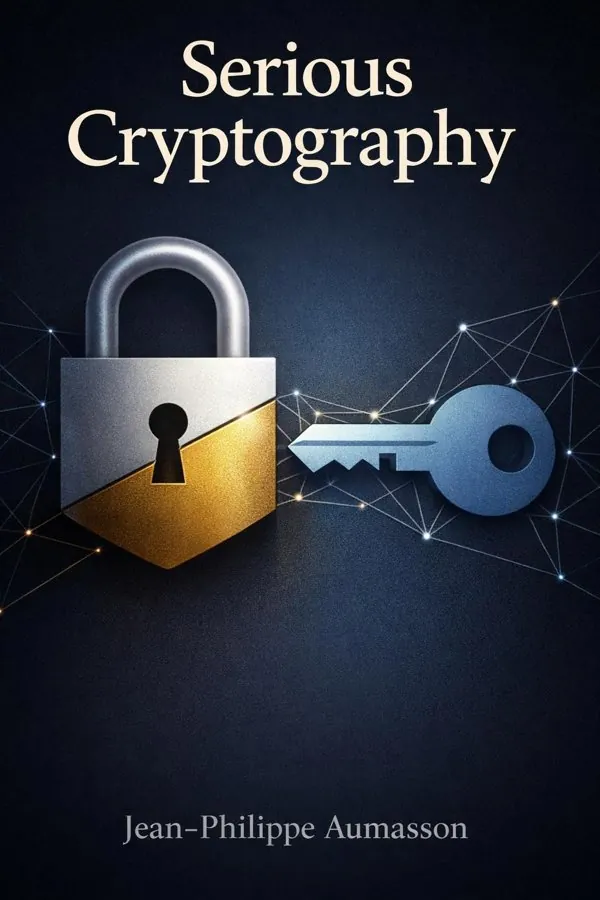
Serious Cryptography: A Practical Introduction to Modern Encryption: Summary & Key Insights
 10 min11 chaptersAudio available
What Is Serious Cryptography: A Practical Introduction to Modern Encryption About?
Serious Cryptography: A Practical Introduction to Modern Encryption by Jean‑Philippe Aumasson is a popular_sci book spanning 11 pages. Serious Cryptography is a comprehensive introduction to modern cryptography, written for practitioners and students who want to understand how encryption works in practice. The book covers symmetric and asymmetric encryption, hash functions, key exchange, digital signatures, and protocols, explaining both the mathematical foundations and the real-world applications. It emphasizes practical security considerations and common implementation pitfalls, making it a valuable resource for developers and security professionals.
This FizzRead summary covers all 11 key chapters of Serious Cryptography: A Practical Introduction to Modern Encryption in approximately 10 minutes, distilling the most important ideas, arguments, and takeaways from Jean‑Philippe Aumasson's work. Also available as an audio summary and Key Quotes Podcast.
Serious Cryptography: A Practical Introduction to Modern Encryption
Serious Cryptography is a comprehensive introduction to modern cryptography, written for practitioners and students who want to understand how encryption works in practice. The book covers symmetric and asymmetric encryption, hash functions, key exchange, digital signatures, and protocols, explaining both the mathematical foundations and the real-world applications. It emphasizes practical security considerations and common implementation pitfalls, making it a valuable resource for developers and security professionals.
Who Should Read Serious Cryptography: A Practical Introduction to Modern Encryption?
This book is perfect for anyone interested in popular_sci and looking to gain actionable insights in a short read. Whether you're a student, professional, or lifelong learner, the key ideas from Serious Cryptography: A Practical Introduction to Modern Encryption by Jean‑Philippe Aumasson will help you think differently.
- ✓Readers who enjoy popular_sci and want practical takeaways
- ✓Professionals looking to apply new ideas to their work and life
- ✓Anyone who wants the core insights of Serious Cryptography: A Practical Introduction to Modern Encryption in just 10 minutes
Want the full summary?
Get instant access to this book summary and 100K+ more with Fizz Moment.
Get Free SummaryAvailable on App Store • Free to download
Key Chapters
To appreciate modern cryptography, you must first distinguish it from the classical art of secret writing. Classical ciphers—think of Caesar’s shifts and Vigenère’s tables—were limited by simplicity. They relied on obscurity rather than unbreakable principles. Once computing power arrived, these simple systems crumbled. Modern cryptography, by contrast, is built on mathematical hardness. It isn’t about hiding a method; it’s about designing systems whose secrets remain protected even if the mechanisms are fully exposed.
This shift marks cryptography’s evolution from art to science. We no longer trust secrecy of design—we trust unfeasibility of attack. You can share your encryption code publicly, and still, no feasible adversary should recover the key or forge authenticated messages. This attitude underpins modern security models, which are grounded in adversarial thinking: we imagine attackers with superpowers and prove, within precise models, that our schemes can withstand them.
Modern cryptography also integrates randomness. Randomness ensures unpredictability—keys must not be guessable, nonces must not repeat, and padding must not reveal structure. Without strong randomness, even mathematically sound schemes collapse, as seen in infamous failures like weak SSL keys or reused initialization vectors in early implementations of WEP.
By understanding this divide—between classical tricks and modern proofs—you grasp why cryptography today demands both robust theory and meticulous engineering. It is no longer merely about concealing information but about guaranteeing security despite exposure.
Symmetric cryptography is the workhorse of secure communication. It’s what encrypts your disk, protects your VPN traffic, and secures messages before public-key handshakes ever begin. It uses the same key to lock and unlock—a principle that appears simple but hides immense complexity.
We start with block ciphers such as AES. Each block cipher transforms a fixed-length input into an equally sized output using a secret key. Though the operation feels mechanical, its design is deeply mathematical. Substitution and permutation layers spread input bits across the output in ways that maximize diffusion. But to encrypt messages longer than a block, we need modes of operation: CBC (Cipher Block Chaining), CTR (Counter Mode), and GCM are the most common.
CBC chains blocks so that each depends on the previous ciphertext—a clever way to prevent pattern repetition. Yet CBC can be dangerous if initialization vectors (IVs) repeat, breaking semantic security. CTR transforms a block cipher into a stream cipher by encrypting successive counters; it’s elegant, parallelizable, and highly efficient. GCM extends CTR by adding authentication, protecting integrity alongside confidentiality.
Symmetric ciphers teach humility. They show that mathematics, if misused, leads to fragility. Reuse a nonce once, and entire sessions can unravel. Implement padding incorrectly, and adversaries can guess plaintexts bit by bit. Through each example—from historical DES to modern AES—the lesson stays constant: don’t invent your own encryption; use standards tested by decades of scrutiny, and always combine encryption with integrity protection.
+ 9 more chapters — available in the FizzRead app
All Chapters in Serious Cryptography: A Practical Introduction to Modern Encryption
About the Author
Jean‑Philippe Aumasson is a Swiss cryptographer and security researcher known for his work on cryptographic algorithms such as BLAKE and SipHash. He has contributed to numerous international cryptographic competitions and has published extensively in the field of applied cryptography.
Get This Summary in Your Preferred Format
Read or listen to the Serious Cryptography: A Practical Introduction to Modern Encryption summary by Jean‑Philippe Aumasson anytime, anywhere. FizzRead offers multiple formats so you can learn on your terms — all free.
Available formats: App · Audio · PDF · EPUB — All included free with FizzRead
Download Serious Cryptography: A Practical Introduction to Modern Encryption PDF and EPUB Summary
Key Quotes from Serious Cryptography: A Practical Introduction to Modern Encryption
“To appreciate modern cryptography, you must first distinguish it from the classical art of secret writing.”
“Symmetric cryptography is the workhorse of secure communication.”
Frequently Asked Questions about Serious Cryptography: A Practical Introduction to Modern Encryption
Serious Cryptography: A Practical Introduction to Modern Encryption by Jean‑Philippe Aumasson is a popular_sci book that explores key ideas across 11 chapters. Serious Cryptography is a comprehensive introduction to modern cryptography, written for practitioners and students who want to understand how encryption works in practice. The book covers symmetric and asymmetric encryption, hash functions, key exchange, digital signatures, and protocols, explaining both the mathematical foundations and the real-world applications. It emphasizes practical security considerations and common implementation pitfalls, making it a valuable resource for developers and security professionals.
You Might Also Like

Structures: Or Why Things Don"t Fall Down
J.E. Gordon
10 min
The Road to Wigan Pier
George Orwell
10 min
Bonk: The Curious Coupling of Science and Sex
Mary Roach
10 min
First Bite: How We Learn to Eat
Bee Wilson
10 min
In Pursuit Of The Unknown: 17 Equations That Changed The World
Ian Stewart
10 min
Napoleon's Buttons: 17 Molecules That Changed History
Penny Le Couteur and Jay Burreson
10 minBrowse by Category
Ready to read Serious Cryptography: A Practical Introduction to Modern Encryption?
Get the full summary and 100K+ more books with Fizz Moment.