
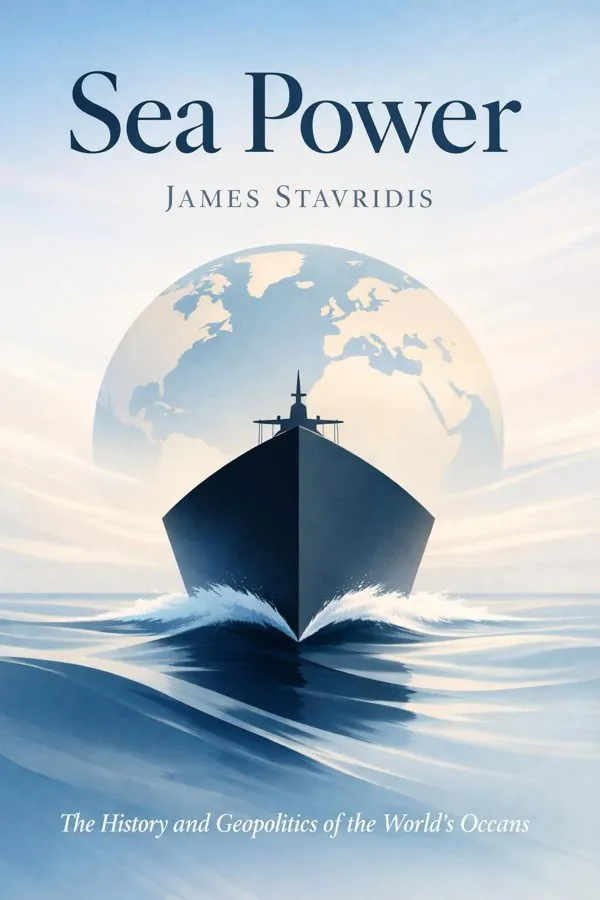
Sea Power: The History and Geopolitics of the World's Oceans: Summary & Key Insights
 10 min9 chaptersAudio available
What Is Sea Power: The History and Geopolitics of the World's Oceans About?
Sea Power: The History and Geopolitics of the World's Oceans by James Stavridis is a war_military book spanning 9 pages. In this sweeping narrative, Admiral James Stavridis explores how the world's oceans have shaped human history, commerce, and conflict. Drawing on his decades of naval experience, he examines the strategic importance of maritime power from ancient times to the modern era, offering insights into how control of the seas continues to influence global politics and security.
This FizzRead summary covers all 9 key chapters of Sea Power: The History and Geopolitics of the World's Oceans in approximately 10 minutes, distilling the most important ideas, arguments, and takeaways from James Stavridis's work. Also available as an audio summary and Key Quotes Podcast.
Sea Power: The History and Geopolitics of the World's Oceans
In this sweeping narrative, Admiral James Stavridis explores how the world's oceans have shaped human history, commerce, and conflict. Drawing on his decades of naval experience, he examines the strategic importance of maritime power from ancient times to the modern era, offering insights into how control of the seas continues to influence global politics and security.
Who Should Read Sea Power: The History and Geopolitics of the World's Oceans?
This book is perfect for anyone interested in war_military and looking to gain actionable insights in a short read. Whether you're a student, professional, or lifelong learner, the key ideas from Sea Power: The History and Geopolitics of the World's Oceans by James Stavridis will help you think differently.
- ✓Readers who enjoy war_military and want practical takeaways
- ✓Professionals looking to apply new ideas to their work and life
- ✓Anyone who wants the core insights of Sea Power: The History and Geopolitics of the World's Oceans in just 10 minutes
Want the full summary?
Get instant access to this book summary and 100K+ more with Fizz Moment.
Get Free SummaryAvailable on App Store • Free to download
Key Chapters
When you look at a map of the Mediterranean, it’s easy to forget how small it seems today compared to the world’s great oceans. And yet this narrow, enclosed sea was once the center of everything. In its time, it was the Internet of the ancient world—a sea of connection, trade, and cultural exchange. Here the Phoenicians learned to ride the waves, building boats that carried goods and ideas from the Levant to Carthage and beyond. The Greeks turned the art of navigation into a science, exploring and colonizing the Aegean and beyond. And the Romans, understanding that true empire required control of the sea lanes, turned Mare Nostrum—‘our sea’—into a secure artery for commerce and conquest.
The lesson that emerges is one of interdependence. Control of the Mediterranean brought stability, prosperity, and dominance. But when that control fractured—when piracy spread, when naval discipline faltered—the sea that had united became the same sea that divided. This dual nature of the ocean, a constant throughout history, still resonates in the struggles of the modern Mediterranean—from migrant crises to disputed energy exploration.
As a sailor, I’ve always felt the Mediterranean’s pulse in the modern navy’s bloodstream. Our ships still patrol the same routes that triremes once sailed. The echoes of Salamis and Actium remind us that the ability to move swiftly across water is more than military advantage—it is civilization’s balancing force.
If the Mediterranean was the nursery of sea power, the Atlantic was its testing ground. The Age of Discovery turned the Atlantic into a highway of unprecedented possibility—and peril. The Portuguese and the Spaniards were the first to throw open its gates, sending their caravels and galleons westward in search of new trade routes. In their wake followed the English, French, and Dutch, carrying not only goods and guns but faiths, languages, and diseases. Through the Atlantic developed the cruel shadow of the slave trade, a grim reminder that maritime power can serve both progress and oppression.
By the eighteenth and nineteenth centuries, the Atlantic had become the beating heart of empire and industry. Britain stood supreme because it mastered logistics, shipbuilding, and naval warfare with an unmatched professionalism. The Battle of the Atlantic during the Second World War was the ultimate confirmation: whoever commanded this ocean commanded the world’s fate. I’ve sailed that ocean in the quiet of peacetime, aware that beneath its gray waves rest countless ships and lives spent defending freedom’s fragile lines of supply.
Even today, the Atlantic remains the strategic link binding North America and Europe—an enduring pillar of the transatlantic alliance. In the flow of energy, trade, and ideas between continents, we can trace the living legacy of those who first ventured across its daunting expanse.
+ 7 more chapters — available in the FizzRead app
All Chapters in Sea Power: The History and Geopolitics of the World's Oceans
About the Author
Admiral James Stavridis is a retired four-star U.S. Navy officer who served as Supreme Allied Commander at NATO and Commander of U.S. Southern Command. He is also an author, educator, and commentator on global affairs, known for his expertise in strategy and international relations.
Get This Summary in Your Preferred Format
Read or listen to the Sea Power: The History and Geopolitics of the World's Oceans summary by James Stavridis anytime, anywhere. FizzRead offers multiple formats so you can learn on your terms — all free.
Available formats: App · Audio · PDF · EPUB — All included free with FizzRead
Download Sea Power: The History and Geopolitics of the World's Oceans PDF and EPUB Summary
Key Quotes from Sea Power: The History and Geopolitics of the World's Oceans
“When you look at a map of the Mediterranean, it’s easy to forget how small it seems today compared to the world’s great oceans.”
“If the Mediterranean was the nursery of sea power, the Atlantic was its testing ground.”
Frequently Asked Questions about Sea Power: The History and Geopolitics of the World's Oceans
Sea Power: The History and Geopolitics of the World's Oceans by James Stavridis is a war_military book that explores key ideas across 9 chapters. In this sweeping narrative, Admiral James Stavridis explores how the world's oceans have shaped human history, commerce, and conflict. Drawing on his decades of naval experience, he examines the strategic importance of maritime power from ancient times to the modern era, offering insights into how control of the seas continues to influence global politics and security.
You Might Also Like

Patriot
Andrew Britton
10 min
War
John Hersey
10 min
An Army at Dawn: The War in North Africa, 1942–1943
Rick Atkinson
10 min
Brave New War: The Next Stage of Terrorism and the End of Globalization
John Robb
10 min
Catch-22
Joseph Heller
10 min
Command and Control: Nuclear Weapons, the Damascus Accident, and the Illusion of Safety
Eric Schlosser
10 minBrowse by Category
Ready to read Sea Power: The History and Geopolitics of the World's Oceans?
Get the full summary and 100K+ more books with Fizz Moment.