
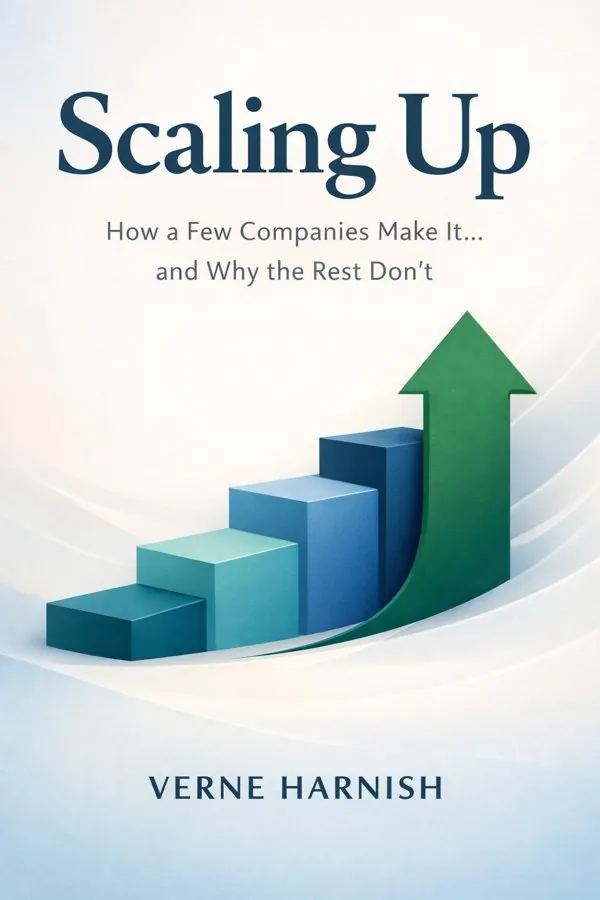
Scaling Up: How a Few Companies Make It...and Why the Rest Don't: Rockefeller Habits 2.0: Summary & Key Insights
 10 min6 chaptersAudio available
What Is Scaling Up: How a Few Companies Make It...and Why the Rest Don't: Rockefeller Habits 2.0 About?
Scaling Up: How a Few Companies Make It...and Why the Rest Don't: Rockefeller Habits 2.0 by Verne Harnish is a leadership book spanning 6 pages. Scaling Up (Rockefeller Habits 2.0) provides a comprehensive framework for growing a business successfully. It focuses on four key decision areas—People, Strategy, Execution, and Cash—offering practical tools and techniques to help leaders manage growth, align teams, and sustain profitability. The book builds on Harnish’s earlier work, Mastering the Rockefeller Habits, and is widely used by entrepreneurs and executives worldwide.
This FizzRead summary covers all 6 key chapters of Scaling Up: How a Few Companies Make It...and Why the Rest Don't: Rockefeller Habits 2.0 in approximately 10 minutes, distilling the most important ideas, arguments, and takeaways from Verne Harnish's work. Also available as an audio summary and Key Quotes Podcast.
Scaling Up: How a Few Companies Make It...and Why the Rest Don't: Rockefeller Habits 2.0
Scaling Up (Rockefeller Habits 2.0) provides a comprehensive framework for growing a business successfully. It focuses on four key decision areas—People, Strategy, Execution, and Cash—offering practical tools and techniques to help leaders manage growth, align teams, and sustain profitability. The book builds on Harnish’s earlier work, Mastering the Rockefeller Habits, and is widely used by entrepreneurs and executives worldwide.
Who Should Read Scaling Up: How a Few Companies Make It...and Why the Rest Don't: Rockefeller Habits 2.0?
This book is perfect for anyone interested in leadership and looking to gain actionable insights in a short read. Whether you're a student, professional, or lifelong learner, the key ideas from Scaling Up: How a Few Companies Make It...and Why the Rest Don't: Rockefeller Habits 2.0 by Verne Harnish will help you think differently.
- ✓Readers who enjoy leadership and want practical takeaways
- ✓Professionals looking to apply new ideas to their work and life
- ✓Anyone who wants the core insights of Scaling Up: How a Few Companies Make It...and Why the Rest Don't: Rockefeller Habits 2.0 in just 10 minutes
Want the full summary?
Get instant access to this book summary and 100K+ more with Fizz Moment.
Get Free SummaryAvailable on App Store • Free to download
Key Chapters
Growth begins and ends with people. No strategy or process can compensate for having the wrong team. When I talk about the People Decision, I’m referring to your conscious design of the human system that powers your business—who you hire, how you lead, and how you align everyone toward the same purpose.
Every company confronting scale eventually faces a tension: the original team that fueled early success may lack the capacity or mindset to take things to the next level. I saw this firsthand in countless organizations; they hit a ceiling not because they lacked opportunity, but because they failed to evolve their people structure. In *Scaling Up*, I emphasize three core priorities—get the right people, in the right roles, doing the right things, all aligned with your core values.
Defining core values is your first act of clarity. Values are not slogans on the wall; they are behavioral commitments that determine who thrives in your environment. When values are clear, recruitment becomes ethical filtering—people who share those values find a home, and those who don’t self-select out. From there, clarity of roles allows every person to understand how their contribution fits into the company’s larger mission.
I often say that alignment is worth more than talent. A highly talented individual who isn’t aligned with your culture will drain energy and dilute momentum; a reasonably talented, aligned person will amplify growth. That’s why the tools in *Scaling Up*—like the Function Accountability Chart and the Process Accountability Chart—exist to make roles visible and measurable. They turn the fuzzy concept of ‘teamwork’ into a structured conversation about ownership.
Leadership development follows naturally. A scaling company must create leaders faster than it creates bureaucracy. So we build coaching rhythms and performance dialogues that make leadership growth a habit. This includes one-on-one check-ins, real-time feedback that’s candid and constructive, and celebrations that reinforce the behaviors you want replicated.
When you consciously decide your people strategy, culture becomes an asset instead of a liability. You’ll feel your team moving in sync, with trust that fuels innovation and speed. That’s the essence of the People Decision: not just building a team, but cultivating an aligned, resilient human engine capable of supporting continuous growth.
A strong team without a clear direction can work hard and still go nowhere. That’s why the second decision—Strategy—is about setting the right direction and defining the differentiation that will carry you forward. Strategy, as I see it, is the art of making intelligent choices about where to play and how to win. It is the difference between reactive growth and deliberate scaling.
I begin with vision—the picture of where you want your company to be ten, twenty, or even a hundred years from now. Then we break that down into actionable horizons, connecting long-term ambition with immediate focus. The One-Page Strategic Plan (OPSP), a cornerstone of *Scaling Up*, exists because clarity should fit on a single piece of paper. Complexity kills execution; simplicity drives alignment.
In building strategy, we define your core values and core purpose, but we also identify your ‘Big Hairy Audacious Goal’ (BHAG)—a term borrowed from Collins and Porras—which represents your inspiring, yet achievable long-term target. This is your compass. Around that, we engineer brand promises—specific commitments that prove your differentiation in the marketplace. They are not marketing slogans but operational truths; each promise must be backed by measurable metrics so they remain credible.
Strategy also means understanding your economic engine. What drives profitability and leverage in your model? What unique advantage enables you to serve customers better or faster than competitors? Through the OPSP and associated tools such as the Seven Strata of Strategy framework, we uncover how value creation happens within your business model and how to strengthen it.
Strategic clarity translates directly into daily action when each team member can articulate not only what the company’s big goal is but how their role advances it. In my experience, companies that maintain this clarity outperform their peers not because their ideas are radically original but because their alignment allows flawless execution. An aligned strategy isn’t just a document—it’s a conversation that reshapes how decisions are made every day.
The Strategy Decision is about transforming ambition into architecture. Once you have a well-built strategy, every choice gains coherence, every effort compounds, and your organization moves as one toward a durable, differentiated future.
+ 4 more chapters — available in the FizzRead app
All Chapters in Scaling Up: How a Few Companies Make It...and Why the Rest Don't: Rockefeller Habits 2.0
About the Author
Verne Harnish is the founder of the Entrepreneurs’ Organization (EO) and the CEO of Scaling Up, a global executive education and coaching company. He is a renowned business growth expert, author, and keynote speaker, known for his work helping companies scale effectively through strategic planning and leadership development.
Get This Summary in Your Preferred Format
Read or listen to the Scaling Up: How a Few Companies Make It...and Why the Rest Don't: Rockefeller Habits 2.0 summary by Verne Harnish anytime, anywhere. FizzRead offers multiple formats so you can learn on your terms — all free.
Available formats: App · Audio · PDF · EPUB — All included free with FizzRead
Download Scaling Up: How a Few Companies Make It...and Why the Rest Don't: Rockefeller Habits 2.0 PDF and EPUB Summary
Key Quotes from Scaling Up: How a Few Companies Make It...and Why the Rest Don't: Rockefeller Habits 2.0
“No strategy or process can compensate for having the wrong team.”
“A strong team without a clear direction can work hard and still go nowhere.”
Frequently Asked Questions about Scaling Up: How a Few Companies Make It...and Why the Rest Don't: Rockefeller Habits 2.0
Scaling Up: How a Few Companies Make It...and Why the Rest Don't: Rockefeller Habits 2.0 by Verne Harnish is a leadership book that explores key ideas across 6 chapters. Scaling Up (Rockefeller Habits 2.0) provides a comprehensive framework for growing a business successfully. It focuses on four key decision areas—People, Strategy, Execution, and Cash—offering practical tools and techniques to help leaders manage growth, align teams, and sustain profitability. The book builds on Harnish’s earlier work, Mastering the Rockefeller Habits, and is widely used by entrepreneurs and executives worldwide.
More by Verne Harnish

You Might Also Like

Extreme Ownership
Jocko Willink
10 min
Dare to Lead
Brene Brown
10 min
Leaders Eat Last
Simon Sinek
10 min
The 21 Irrefutable Laws of Leadership
John Maxwell
10 min
Start With Why
Simon Sinek
10 min
How to Lead When You're Not in Charge
Clay Scroggins
10 minBrowse by Category
Ready to read Scaling Up: How a Few Companies Make It...and Why the Rest Don't: Rockefeller Habits 2.0?
Get the full summary and 100K+ more books with Fizz Moment.