
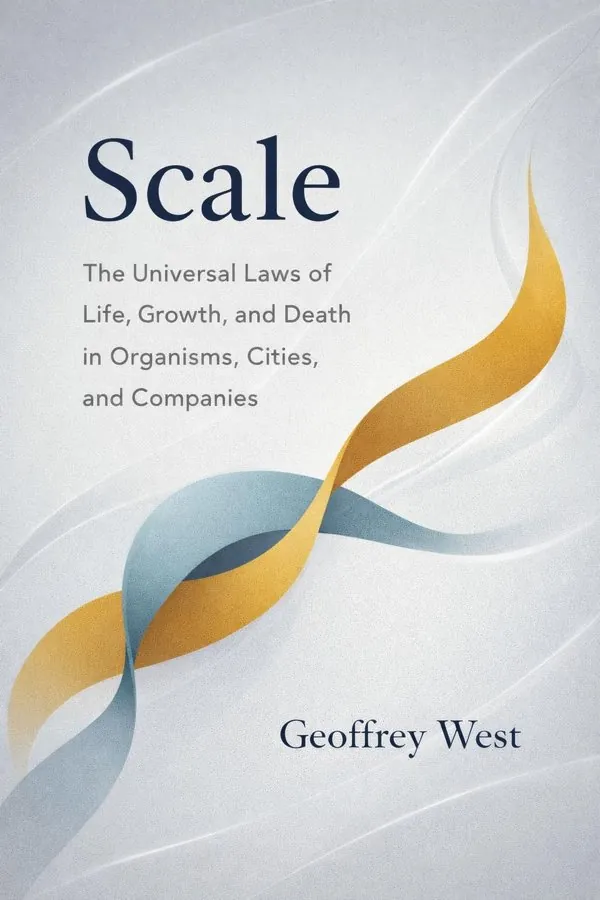
Scale: The Universal Laws of Life, Growth, and Death in Organisms, Cities, and Companies: Summary & Key Insights
 10 min9 chaptersAudio available
What Is Scale: The Universal Laws of Life, Growth, and Death in Organisms, Cities, and Companies About?
Scale: The Universal Laws of Life, Growth, and Death in Organisms, Cities, and Companies by Geoffrey West is a popular_sci book spanning 9 pages. Scale explores the hidden mathematical laws that govern growth and life across biological organisms, cities, and companies. Drawing from physics, biology, and social science, Geoffrey West reveals how universal scaling laws explain why living things and human systems grow, change, and eventually die. The book connects patterns of metabolism, innovation, and sustainability, offering a unified framework for understanding complexity in nature and society.
This FizzRead summary covers all 9 key chapters of Scale: The Universal Laws of Life, Growth, and Death in Organisms, Cities, and Companies in approximately 10 minutes, distilling the most important ideas, arguments, and takeaways from Geoffrey West's work. Also available as an audio summary and Key Quotes Podcast.
Scale: The Universal Laws of Life, Growth, and Death in Organisms, Cities, and Companies
Scale explores the hidden mathematical laws that govern growth and life across biological organisms, cities, and companies. Drawing from physics, biology, and social science, Geoffrey West reveals how universal scaling laws explain why living things and human systems grow, change, and eventually die. The book connects patterns of metabolism, innovation, and sustainability, offering a unified framework for understanding complexity in nature and society.
Who Should Read Scale: The Universal Laws of Life, Growth, and Death in Organisms, Cities, and Companies?
This book is perfect for anyone interested in popular_sci and looking to gain actionable insights in a short read. Whether you're a student, professional, or lifelong learner, the key ideas from Scale: The Universal Laws of Life, Growth, and Death in Organisms, Cities, and Companies by Geoffrey West will help you think differently.
- ✓Readers who enjoy popular_sci and want practical takeaways
- ✓Professionals looking to apply new ideas to their work and life
- ✓Anyone who wants the core insights of Scale: The Universal Laws of Life, Growth, and Death in Organisms, Cities, and Companies in just 10 minutes
Want the full summary?
Get instant access to this book summary and 100K+ more with Fizz Moment.
Get Free SummaryAvailable on App Store • Free to download
Key Chapters
Life, in essence, is an energy management problem. Whether you are a cell, a whale, or a person, survival depends on how efficiently you extract, distribute, and use energy. One of the biggest insights of biological physics is that your size determines nearly everything about your metabolism, lifespan, and even heart rate. The key observation—startling in its simplicity—is that larger organisms consume less energy per cell.
To a physicist, this invites quantification. I wanted to know: Is there a mathematical ratio capturing how metabolism scales with size? Data across mammals, reptiles, and birds show an astonishing regularity: metabolic rate increases with mass raised to the three-quarter power. If an animal is ten thousand times more massive than another, it requires roughly a thousand times more energy per day. Each additional gram costs less energy to maintain. This simple pattern suggested a profound universal law.
But why should nature organize itself this way? To answer that, I had to think beyond biology’s surface diversity and look into its foundations. Every organism, no matter how alien, faces the problem of distributing energy efficiently through a network of vessels or channels. The geometry of that network determines how efficiently resources move. It’s not about biology’s chaos; it’s about physics’ constraints. In essence, the structure of life is a solution to an optimization problem—maximizing delivery while minimizing energy loss.
This insight reframes how we understand aging and growth. Life’s pace slows with size, but its duration expands. Mice live fast and die young; elephants live slowly and long. Yet both accumulate roughly the same number of total heartbeats. The constancy of total energy expenditure over a lifetime hints at a deep conservation principle: life can only extract and process a fixed amount of energy before senescence sets in. Seeing this pattern for the first time was like glimpsing life’s hidden clock—the fundamental rhythm that unites all organisms.
At the core of biological scaling lies the so-called “three-quarter power” law. In simple terms, metabolic rate (B) scales as body mass (M) raised to the power of three-quarters—B ∝ M³⁄⁴. This law has been verified across species and environments, from microbes to mammals, suggesting that it is universal. The elegance of the ¾ exponent is not arbitrary; it emerges from how blood vessels or nutrient pipelines branch through the body in a fractal pattern.
A fundamental principle drives it: efficiency through self-similarity. Nature tends to solve engineering problems in the same way at every scale. Whether you zoom in on capillaries or zoom out to an elephant’s arteries, the branching geometry obeys the same mathematical proportions. Each new level of branching maintains constant ratios for flow and distribution. This geometry ensures that energy reaches every cell with minimal waste, a truly astonishing feat of natural optimization.
Understanding this law allows us to predict numerous biological properties from size alone—lifespan, heart rate, growth rate, time to maturity. The three-quarter exponent becomes a ruler with which to measure life itself. The larger the organism, the slower and more efficient it becomes, leading to a universal curve that unites microbes, trees, and animals in one continuum of metabolic logic.
For me, the deeper revelation was that complexity itself may arise from the pursuit of energetic efficiency. The fact that this same scaling law emerges repeatedly suggests a deep universality. Life’s immense diversity sits on a single mathematical backbone. Once you recognize the prevalence of this exponent, you start seeing it everywhere—in ecosystems’ energy flow, in patterns of tree growth, even in urban designs without realizing it.
+ 7 more chapters — available in the FizzRead app
All Chapters in Scale: The Universal Laws of Life, Growth, and Death in Organisms, Cities, and Companies
About the Author
Geoffrey West is a theoretical physicist and former president of the Santa Fe Institute. His research focuses on complexity science, biological scaling, and the quantitative laws underlying growth and innovation in living and social systems.
Get This Summary in Your Preferred Format
Read or listen to the Scale: The Universal Laws of Life, Growth, and Death in Organisms, Cities, and Companies summary by Geoffrey West anytime, anywhere. FizzRead offers multiple formats so you can learn on your terms — all free.
Available formats: App · Audio · PDF · EPUB — All included free with FizzRead
Download Scale: The Universal Laws of Life, Growth, and Death in Organisms, Cities, and Companies PDF and EPUB Summary
Key Quotes from Scale: The Universal Laws of Life, Growth, and Death in Organisms, Cities, and Companies
“Life, in essence, is an energy management problem.”
“At the core of biological scaling lies the so-called “three-quarter power” law.”
Frequently Asked Questions about Scale: The Universal Laws of Life, Growth, and Death in Organisms, Cities, and Companies
Scale: The Universal Laws of Life, Growth, and Death in Organisms, Cities, and Companies by Geoffrey West is a popular_sci book that explores key ideas across 9 chapters. Scale explores the hidden mathematical laws that govern growth and life across biological organisms, cities, and companies. Drawing from physics, biology, and social science, Geoffrey West reveals how universal scaling laws explain why living things and human systems grow, change, and eventually die. The book connects patterns of metabolism, innovation, and sustainability, offering a unified framework for understanding complexity in nature and society.
You Might Also Like

Structures: Or Why Things Don"t Fall Down
J.E. Gordon
10 min
The Road to Wigan Pier
George Orwell
10 min
Bonk: The Curious Coupling of Science and Sex
Mary Roach
10 min
First Bite: How We Learn to Eat
Bee Wilson
10 min
In Pursuit Of The Unknown: 17 Equations That Changed The World
Ian Stewart
10 min
Napoleon's Buttons: 17 Molecules That Changed History
Penny Le Couteur and Jay Burreson
10 minBrowse by Category
Ready to read Scale: The Universal Laws of Life, Growth, and Death in Organisms, Cities, and Companies?
Get the full summary and 100K+ more books with Fizz Moment.