
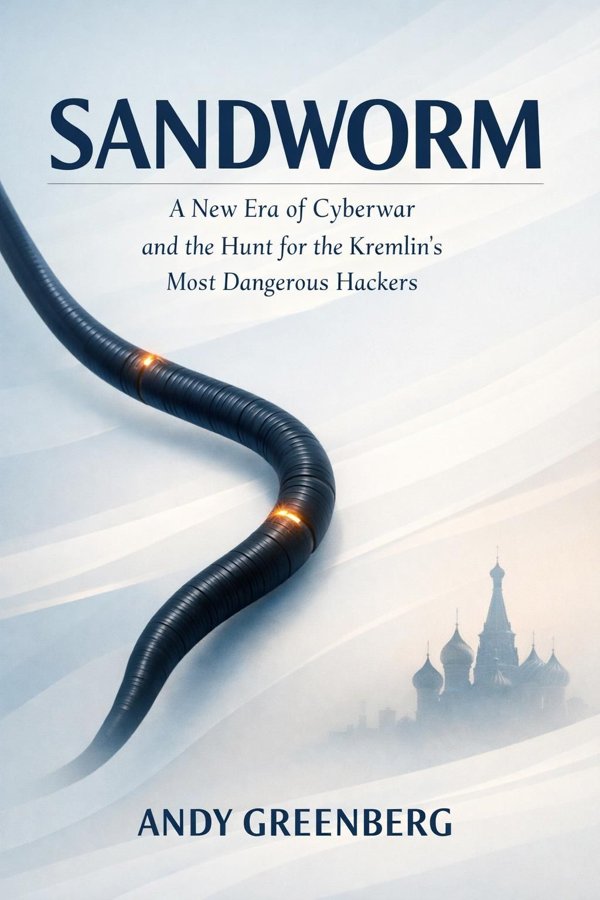
Sandworm: A New Era of Cyberwar and the Hunt for the Kremlin's Most Dangerous Hackers: Summary & Key Insights
 10 min8 chaptersAudio available
What Is Sandworm: A New Era of Cyberwar and the Hunt for the Kremlin's Most Dangerous Hackers About?
Sandworm: A New Era of Cyberwar and the Hunt for the Kremlin's Most Dangerous Hackers by Andy Greenberg is a politics book spanning 8 pages. Sandworm is a nonfiction investigation into the Russian cyberwarfare group known as Sandworm, which has been linked to major cyberattacks including the NotPetya malware. Andy Greenberg traces the origins, operations, and global impact of this group, revealing how state-sponsored hacking has become a new form of geopolitical conflict. The book combines deep technical reporting with geopolitical analysis, showing how cyberweapons are reshaping modern warfare and international relations.
This FizzRead summary covers all 8 key chapters of Sandworm: A New Era of Cyberwar and the Hunt for the Kremlin's Most Dangerous Hackers in approximately 10 minutes, distilling the most important ideas, arguments, and takeaways from Andy Greenberg's work. Also available as an audio summary and Key Quotes Podcast.
Sandworm: A New Era of Cyberwar and the Hunt for the Kremlin's Most Dangerous Hackers
Sandworm is a nonfiction investigation into the Russian cyberwarfare group known as Sandworm, which has been linked to major cyberattacks including the NotPetya malware. Andy Greenberg traces the origins, operations, and global impact of this group, revealing how state-sponsored hacking has become a new form of geopolitical conflict. The book combines deep technical reporting with geopolitical analysis, showing how cyberweapons are reshaping modern warfare and international relations.
Who Should Read Sandworm: A New Era of Cyberwar and the Hunt for the Kremlin's Most Dangerous Hackers?
This book is perfect for anyone interested in politics and looking to gain actionable insights in a short read. Whether you're a student, professional, or lifelong learner, the key ideas from Sandworm: A New Era of Cyberwar and the Hunt for the Kremlin's Most Dangerous Hackers by Andy Greenberg will help you think differently.
- ✓Readers who enjoy politics and want practical takeaways
- ✓Professionals looking to apply new ideas to their work and life
- ✓Anyone who wants the core insights of Sandworm: A New Era of Cyberwar and the Hunt for the Kremlin's Most Dangerous Hackers in just 10 minutes
Want the full summary?
Get instant access to this book summary and 100K+ more with Fizz Moment.
Get Free SummaryAvailable on App Store • Free to download
Key Chapters
Before Sandworm emerged as a name whispered in the corridors of cybersecurity conferences, the signs of Russian state-backed cyber activity had already begun to surface. As I pieced together reports from researchers and intelligence insiders, I found that Moscow’s use of hackers as instruments of policy dated back decades—rooted in the vision of asymmetrical warfare where information itself could destabilize an enemy. Russian intelligence, particularly the GRU, understood that in cyberspace, power could be exercised covertly and cheaply, yielding strategic confusion without overt confrontation.
Ukraine became the testing ground. It was a country locked in political unrest after the annexation of Crimea in 2014 and faced continual economic hardship. For Russia, it also represented a laboratory—a place to rehearse attacks that blended psychological, physical, and digital warfare. The first intrusions targeted government ministries and news outlets, slowly escalating to the manipulation of industrial systems. Researchers began noticing malware families—BlackEnergy, TeleBots—that seemed distinct yet strangely interconnected. When decoded, their clues pointed towards a coordinated team with advanced capabilities and clear state sanctions.
Through interviews with Ukrainian officials and Western analysts, I traced how these cyber-incursions mirrored Moscow’s broader strategic objectives: undermining Ukrainian sovereignty, signaling technological dominance, and testing tools that could later be unleashed worldwide. The sophistication of these attacks suggested not lone hackers seeking notoriety but a disciplined unit, acting within military command structures. The realization that a government could merge hacking with warfare transformed how we perceived global conflict—and that insight became the key to decoding Sandworm’s identity.
The name Sandworm first appeared in scattered reports among online threat analysts, referencing a peculiar obsession with *Dune*, the science fiction saga. Within samples of malicious code, investigators discovered references to the giant worms of Arrakis—a signature hidden in the digital dust. To most, it was a curiosity, but to those examining the attacks’ infrastructure, it revealed something deeper: a cohesive group working from common tools, protocols, and objectives.
As I dove into cybersecurity archives and spoke to experts from firms like FireEye and ESET, the mystery sharpened. Sandworm’s operations were characterized by a striking patience and precision. Their campaigns unfolded in phases—initial reconnaissance, compromised access through spear-phishing, stealthy exfiltration of data, and eventual deployment of destructive malware. Unlike traditional cybercrime, their goal was not financial theft but disruption and confusion. They sought to cripple, not to steal.
I followed the trail through the stories of those who encountered Sandworm face-to-face in their networks. Analysts in Kyiv recount long nights spent tracing malicious scripts that seemed to anticipate every defensive measure. In one eerie instance, power operators watched as their control systems suddenly obeyed phantom commands—switches flipped remotely, displays falsified—and moments later, entire districts went dark. This operation required not just hacking skill but an intimate knowledge of physical engineering and grid architecture. It signaled the birth of a new hybrid actor, capable of merging digital intrusion with kinetic consequences.
By understanding Sandworm’s structure and methods, I came to see them as an archetype of modern cyberwar units: organized yet deniable, sanctioned yet invisible, technically brilliant yet politically ruthless. Their very existence redefined the meaning of a battlefield.
+ 6 more chapters — available in the FizzRead app
All Chapters in Sandworm: A New Era of Cyberwar and the Hunt for the Kremlin's Most Dangerous Hackers
About the Author
Andy Greenberg is an American journalist and senior writer for Wired magazine. He specializes in cybersecurity, privacy, and technology reporting. His work has covered topics ranging from digital espionage to cryptocurrency and hacker culture. Greenberg is also the author of 'This Machine Kills Secrets' and is recognized for his investigative reporting on cyber threats and digital security.
Get This Summary in Your Preferred Format
Read or listen to the Sandworm: A New Era of Cyberwar and the Hunt for the Kremlin's Most Dangerous Hackers summary by Andy Greenberg anytime, anywhere. FizzRead offers multiple formats so you can learn on your terms — all free.
Available formats: App · Audio · PDF · EPUB — All included free with FizzRead
Download Sandworm: A New Era of Cyberwar and the Hunt for the Kremlin's Most Dangerous Hackers PDF and EPUB Summary
Key Quotes from Sandworm: A New Era of Cyberwar and the Hunt for the Kremlin's Most Dangerous Hackers
“Before Sandworm emerged as a name whispered in the corridors of cybersecurity conferences, the signs of Russian state-backed cyber activity had already begun to surface.”
“The name Sandworm first appeared in scattered reports among online threat analysts, referencing a peculiar obsession with *Dune*, the science fiction saga.”
Frequently Asked Questions about Sandworm: A New Era of Cyberwar and the Hunt for the Kremlin's Most Dangerous Hackers
Sandworm: A New Era of Cyberwar and the Hunt for the Kremlin's Most Dangerous Hackers by Andy Greenberg is a politics book that explores key ideas across 8 chapters. Sandworm is a nonfiction investigation into the Russian cyberwarfare group known as Sandworm, which has been linked to major cyberattacks including the NotPetya malware. Andy Greenberg traces the origins, operations, and global impact of this group, revealing how state-sponsored hacking has become a new form of geopolitical conflict. The book combines deep technical reporting with geopolitical analysis, showing how cyberweapons are reshaping modern warfare and international relations.
You Might Also Like

Antifa: The Anti-Fascist Handbook
Mark Bray
10 min
Attack from Within: How Disinformation Is Sabotaging America
Barbara McQuade
10 min
Coercion, Capital, and European States, AD 990–1992
Charles Tilly
10 min
Digital Democracy: Concepts, Methodologies, Tools, and Applications
Various Authors
10 min
Fascism
Stanley G. Payne
10 min
Fire And Fury: Inside The Trump White House
Michael Wolff
10 minBrowse by Category
Ready to read Sandworm: A New Era of Cyberwar and the Hunt for the Kremlin's Most Dangerous Hackers?
Get the full summary and 100K+ more books with Fizz Moment.