
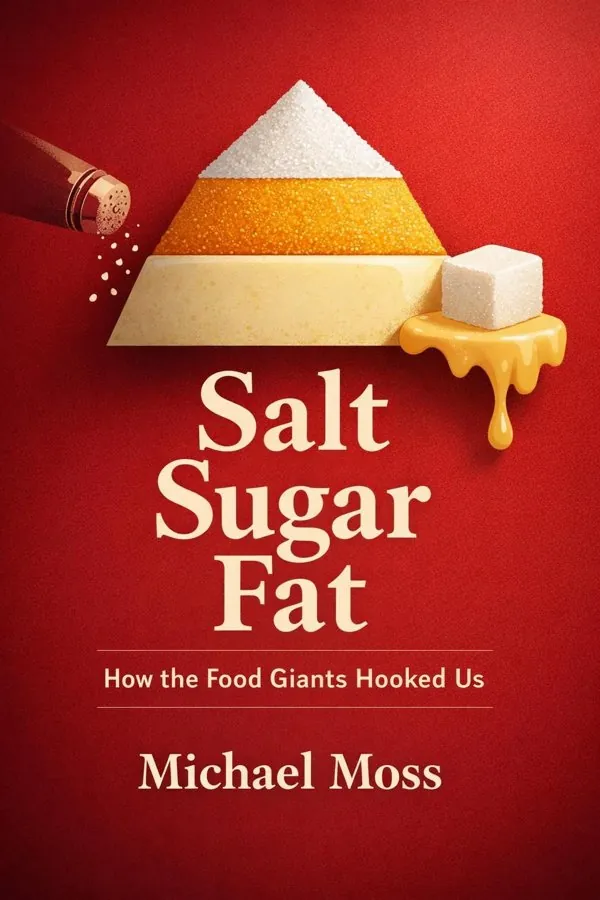
Salt Sugar Fat: How the Food Giants Hooked Us: Summary & Key Insights
by Michael Moss
 10 min12 chaptersAudio available
What Is Salt Sugar Fat: How the Food Giants Hooked Us About?
Salt Sugar Fat: How the Food Giants Hooked Us by Michael Moss is a health_med book spanning 12 pages. Investigative journalist Michael Moss exposes how major food corporations have engineered processed foods to exploit our biological cravings for salt, sugar, and fat. Drawing on internal industry documents and interviews, the book reveals how these ingredients are used to maximize profits at the expense of public health, and how the food industry has shaped consumer habits and government policy.
This FizzRead summary covers all 12 key chapters of Salt Sugar Fat: How the Food Giants Hooked Us in approximately 10 minutes, distilling the most important ideas, arguments, and takeaways from Michael Moss's work. Also available as an audio summary and Key Quotes Podcast.
Salt Sugar Fat: How the Food Giants Hooked Us
Investigative journalist Michael Moss exposes how major food corporations have engineered processed foods to exploit our biological cravings for salt, sugar, and fat. Drawing on internal industry documents and interviews, the book reveals how these ingredients are used to maximize profits at the expense of public health, and how the food industry has shaped consumer habits and government policy.
Who Should Read Salt Sugar Fat: How the Food Giants Hooked Us?
This book is perfect for anyone interested in health_med and looking to gain actionable insights in a short read. Whether you're a student, professional, or lifelong learner, the key ideas from Salt Sugar Fat: How the Food Giants Hooked Us by Michael Moss will help you think differently.
- ✓Readers who enjoy health_med and want practical takeaways
- ✓Professionals looking to apply new ideas to their work and life
- ✓Anyone who wants the core insights of Salt Sugar Fat: How the Food Giants Hooked Us in just 10 minutes
Want the full summary?
Get instant access to this book summary and 100K+ more with Fizz Moment.
Get Free SummaryAvailable on App Store • Free to download
Key Chapters
The postwar boom in America brought more than prosperity; it introduced a complete transformation in how we viewed food. Factories that had churned out rations and preserved goods for soldiers turned their ambitions toward civilian life. The promise was irresistible: meals ready in minutes, products that stayed fresh indefinitely, and an image of modernity defined by convenience. For busy families, especially women entering the workforce, this was emancipation from the drudgery of preparation. Yet those same innovations quietly dismantled our traditional relationship with food.
Companies like General Foods and Heinz reshaped the grocery landscape. Home cooking became less about ingredients and more about assembly — mixing, heating, serving. Behind this new culinary model was a profound scientific push. Food technologists discovered that salt, sugar, and fat didn’t just make food taste good; they could *engineer desire*. Over time, industrial production replaced taste with sensory strategy. People stopped eating because they were hungry — they began eating because the food was designed to make them crave.
In tracing this evolution, I learned that the real revolution wasn’t technological, but psychological. Processed food became a marker of identity — efficient, patriotic, modern. As health problems slowly crept into the national consciousness, the industry adapted not by changing the fundamentals but by adjusting the messaging. The language of “low-calorie,” “lite,” and “heart healthy” became tools to preserve dominance. Thus by the late twentieth century, the average American was consuming products that were less about nourishment and more about manipulation. The rise of processed food is not a coincidence of history; it is a deliberate cultural engineering of appetite.
In my investigation, sugar emerged as the most seductive and treacherous of the trio. The industry’s internal memos revealed decades of research into what scientists called the 'bliss point' — the exact concentration at which sugar gives the maximum pleasure response without overwhelming the senses. Every major food company pursued this metric, testing thousands of formulas to perfect it. The goal was never health; it was consumption. Sugar became both a cheap additive and an irresistible hook.
The science explained why: sugar lights up the reward pathways in our brains, flooding them with dopamine, the same neurotransmitter involved in addiction. When companies like Coca-Cola realized that every sip triggered a miniature pleasure surge, they began designing products to maintain that neurological loop. And it wasn’t only beverages. The cereal aisle turned into a battlefield of sweetness, with products marketed as wholesome while packing the same amount of sugar as cookies.
Parents thought they were giving their children energy and nutrition, yet they were unwittingly feeding an engineered dependency. Industry executives knew this; they had the data. In one confidential meeting described to me, a Kellogg insider admitted that pulling sugar from cereals would be 'like taking heroin from addicts' — prices would collapse, consumption would plummet. Instead of reformulation, they doubled down on marketing. The success of sugar wasn’t an accident of taste — it was the triumph of science weaponized for profit.
+ 10 more chapters — available in the FizzRead app
All Chapters in Salt Sugar Fat: How the Food Giants Hooked Us
About the Author
Michael Moss is an American investigative journalist and author. He won the Pulitzer Prize for Explanatory Reporting in 2010 for his work on food safety. His writing focuses on the intersection of food, health, and corporate influence.
Get This Summary in Your Preferred Format
Read or listen to the Salt Sugar Fat: How the Food Giants Hooked Us summary by Michael Moss anytime, anywhere. FizzRead offers multiple formats so you can learn on your terms — all free.
Available formats: App · Audio · PDF · EPUB — All included free with FizzRead
Download Salt Sugar Fat: How the Food Giants Hooked Us PDF and EPUB Summary
Key Quotes from Salt Sugar Fat: How the Food Giants Hooked Us
“The postwar boom in America brought more than prosperity; it introduced a complete transformation in how we viewed food.”
“In my investigation, sugar emerged as the most seductive and treacherous of the trio.”
Frequently Asked Questions about Salt Sugar Fat: How the Food Giants Hooked Us
Salt Sugar Fat: How the Food Giants Hooked Us by Michael Moss is a health_med book that explores key ideas across 12 chapters. Investigative journalist Michael Moss exposes how major food corporations have engineered processed foods to exploit our biological cravings for salt, sugar, and fat. Drawing on internal industry documents and interviews, the book reveals how these ingredients are used to maximize profits at the expense of public health, and how the food industry has shaped consumer habits and government policy.
You Might Also Like

On Immunity
Eula Biss
10 min
The Three-Body Problem
Liu Cixin
10 min
Community Health Volunteer Toolkit: Training and Practical Activities
World Health Organization
10 min
Healing Back Pain: The Mind-Body Connection
John E. Sarno
10 min
Health Literacy for All: Practical Guides to Communicate Health Information (Compilations)
World Health Organization
10 min
The Complete Guide to Sports Supplements: An Evidence-Based Review
Anita Bean
10 minBrowse by Category
Ready to read Salt Sugar Fat: How the Food Giants Hooked Us?
Get the full summary and 100K+ more books with Fizz Moment.