
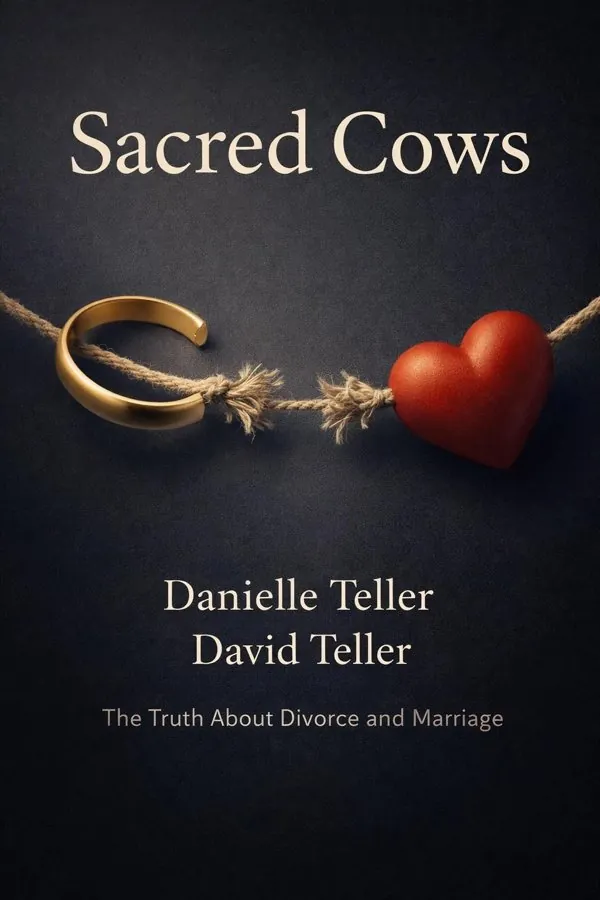
Sacred Cows: The Truth About Divorce and Marriage: Summary & Key Insights
by Danielle Teller, David Teller
 10 min9 chaptersAudio available
Key Takeaways from Sacred Cows: The Truth About Divorce and Marriage
One of the book’s boldest insights is that many people do not choose marriage freely; they inherit a script and mistake it for truth.
Commitment is often praised as an unquestioned virtue, but Sacred Cows argues that commitment is psychologically complex and morally ambiguous.
A surprising number of unhappy relationships continue not because love is strong, but because fear is stronger.
One of the book’s most clarifying ideas is that love and compatibility are not the same thing.
The Tellers bring a physician’s lens to romance by examining the biology behind attachment.
What Is Sacred Cows: The Truth About Divorce and Marriage About?
Sacred Cows: The Truth About Divorce and Marriage by Danielle Teller, David Teller is a relationships book spanning 9 pages. Sacred Cows: The Truth About Divorce and Marriage is a provocative examination of one of modern life’s most protected institutions. Danielle Teller and David Teller argue that many of our strongest beliefs about marriage, lifelong commitment, and divorce are not timeless truths but cultural stories we absorb so deeply that we rarely question them. The book asks uncomfortable but important questions: Why do people remain in unhappy marriages? Why is divorce often treated as moral failure? And what if a relationship’s worth cannot be measured only by whether it lasts forever? What makes this book especially compelling is the authors’ perspective. Both physicians, the Tellers combine scientific thinking, psychological insight, and personal reflection to explore how biology, social pressure, guilt, and fear shape intimate decisions. Rather than promoting divorce or dismissing marriage, they invite readers to think more honestly about what love, compatibility, and commitment actually mean in real life. For anyone who has ever felt trapped by relationship expectations—or wondered whether “success” in love might need a new definition—this book offers a clear-eyed, compassionate, and deeply liberating framework.
This FizzRead summary covers all 9 key chapters of Sacred Cows: The Truth About Divorce and Marriage in approximately 10 minutes, distilling the most important ideas, arguments, and takeaways from Danielle Teller, David Teller's work. Also available as an audio summary and Key Quotes Podcast.
Sacred Cows: The Truth About Divorce and Marriage
Sacred Cows: The Truth About Divorce and Marriage is a provocative examination of one of modern life’s most protected institutions. Danielle Teller and David Teller argue that many of our strongest beliefs about marriage, lifelong commitment, and divorce are not timeless truths but cultural stories we absorb so deeply that we rarely question them. The book asks uncomfortable but important questions: Why do people remain in unhappy marriages? Why is divorce often treated as moral failure? And what if a relationship’s worth cannot be measured only by whether it lasts forever?
What makes this book especially compelling is the authors’ perspective. Both physicians, the Tellers combine scientific thinking, psychological insight, and personal reflection to explore how biology, social pressure, guilt, and fear shape intimate decisions. Rather than promoting divorce or dismissing marriage, they invite readers to think more honestly about what love, compatibility, and commitment actually mean in real life. For anyone who has ever felt trapped by relationship expectations—or wondered whether “success” in love might need a new definition—this book offers a clear-eyed, compassionate, and deeply liberating framework.
Who Should Read Sacred Cows: The Truth About Divorce and Marriage?
This book is perfect for anyone interested in relationships and looking to gain actionable insights in a short read. Whether you're a student, professional, or lifelong learner, the key ideas from Sacred Cows: The Truth About Divorce and Marriage by Danielle Teller, David Teller will help you think differently.
- ✓Readers who enjoy relationships and want practical takeaways
- ✓Professionals looking to apply new ideas to their work and life
- ✓Anyone who wants the core insights of Sacred Cows: The Truth About Divorce and Marriage in just 10 minutes
Want the full summary?
Get instant access to this book summary and 100K+ more with Fizz Moment.
Get Free SummaryAvailable on App Store • Free to download
Key Chapters
One of the book’s boldest insights is that many people do not choose marriage freely; they inherit a script and mistake it for truth. From childhood fairy tales to wedding culture, social media, religion, and family expectations, society trains us to believe that a lasting marriage is the highest form of adult success. In this script, staying married signals virtue, maturity, and emotional achievement, while divorce suggests failure, selfishness, or weakness.
The Tellers challenge this assumption by showing how culture elevates permanence over well-being. A relationship may be emotionally dead, hostile, or damaging, yet if it endures, it is often praised. Meanwhile, a marriage that once brought love, growth, and stability may be judged harshly if it ends. This reveals a contradiction: we often value duration more than quality. The myth is not simply that marriage is good, but that marriage is good by definition and divorce is bad by definition.
This idea has practical consequences. People may ignore abuse, chronic unhappiness, incompatibility, or profound loneliness because they have internalized the belief that ending a marriage is morally wrong. They may also compare their lives to idealized narratives and feel ashamed for normal relationship struggles.
The authors urge readers to separate social prestige from personal truth. A healthy relationship should be judged by honesty, mutual care, growth, and freedom—not by whether it matches a cultural ideal. Actionable takeaway: list the relationship beliefs you were taught by family, religion, and media, and ask which ones actually serve your well-being.
Commitment is often praised as an unquestioned virtue, but Sacred Cows argues that commitment is psychologically complex and morally ambiguous. It can reflect devotion, patience, and integrity—but it can also become stubbornness, fear, identity protection, or a refusal to confront reality. The book asks readers to distinguish between commitment to a person’s well-being and commitment to an institution or self-image.
Many people say, “I made a promise, so I must stay,” as if the promise itself has greater value than the life being lived inside it. Yet circumstances change. People evolve. New information appears. What once felt loving may later become limiting or destructive. The Tellers suggest that mature commitment should include responsiveness to truth, not blind loyalty to a past decision.
This is visible in everyday life. A couple may have entered marriage sincerely, only to discover years later that their values, needs, or visions for life no longer align. Another person may stay because being “the kind of person who never quits” has become central to their identity. In both cases, commitment is operating as a force, but not necessarily a healthy one.
The authors do not dismiss promises; they ask us to interpret them wisely. A meaningful commitment should support honesty, care, and growth, not demand self-erasure. Commitment becomes destructive when it turns into a reason not to think.
Actionable takeaway: when you use the word commitment, define exactly what you are committed to—the relationship’s appearance, your identity as a loyal person, or the actual flourishing of both partners.
A surprising number of unhappy relationships continue not because love is strong, but because fear is stronger. The Tellers identify guilt and fear as two of the most powerful forces keeping people inside marriages that no longer work. Fear of hurting a spouse, disrupting children’s lives, losing financial stability, disappointing family, or facing loneliness can make even a deeply unsatisfying marriage feel safer than change. Guilt intensifies that fear by framing personal needs as selfishness.
This emotional trap is common. Someone may think, “My partner depends on me, so leaving would make me cruel,” even if the marriage has become deadening for both people. Another may believe, “My children need an intact home,” while ignoring the tension, resentment, and emotional withdrawal those children experience every day. Still another may stay because they dread social judgment more than private unhappiness.
The authors encourage readers to examine whether guilt is signaling actual moral responsibility or merely obedience to social conditioning. Sometimes guilt is appropriate; often it is inflated by impossible standards, such as the idea that a good person should sacrifice indefinitely. Fear, too, can disguise itself as wisdom. It may feel responsible to preserve the status quo, but the status quo can be quietly destructive.
The practical lesson is not to make impulsive choices, but to look squarely at the emotional forces shaping your decisions. Naming your fears reduces their power. Honest conversations, therapy, financial planning, and support networks can turn vague dread into manageable reality.
Actionable takeaway: write down the top five reasons you feel unable to change a relationship, then label each one as fear, guilt, practical concern, or genuine desire.
One of the book’s most clarifying ideas is that love and compatibility are not the same thing. Many people assume that if love is real, it should naturally overcome differences in values, temperament, lifestyle, ambition, communication style, sexuality, or emotional needs. The Tellers reject this romantic simplification. Two people can genuinely love each other and still be wrong for each other as long-term partners.
This matters because cultural narratives encourage people to treat love as sufficient proof that a relationship should continue. But a strong emotional bond cannot automatically solve practical and psychological mismatches. A couple may care deeply for one another yet disagree fundamentally about children, money, intimacy, where to live, or how to handle conflict. Over time, unresolved incompatibility can turn love into frustration.
The authors push readers to think beyond chemistry and devotion. Compatibility includes habits, life goals, emotional regulation, conflict patterns, flexibility, and whether each person feels fully themselves in the relationship. For example, if one partner needs closeness and frequent conversation while the other values independence and emotional distance, love may be present, but strain may become chronic. If one person thrives on stability and the other seeks constant reinvention, long-term tension may be inevitable.
This perspective can be liberating. It helps people stop blaming themselves for not being able to “make love enough.” It also encourages more thoughtful partner selection and more honest evaluation of existing relationships.
Actionable takeaway: assess your relationship in separate categories—love, values, daily habits, communication, life goals, and conflict style—to see whether affection is masking deeper incompatibility.
The Tellers bring a physician’s lens to romance by examining the biology behind attachment. Human beings are not purely rational choosers in love. Neurochemistry, sexual attraction, bonding hormones, evolutionary drives, and attachment systems all shape who we connect with and how intensely we experience relationships. This does not make love unreal; it makes it embodied.
The book suggests that pair bonding often feels morally significant because it is biologically powerful. Early-stage attraction can create euphoria, idealization, and a sense of destiny. Bonding can deepen through sex, caregiving, shared routines, and mutual dependence. But biology can also mislead us. Intense longing is not the same as long-term suitability, and the pain of separation does not automatically mean a relationship should be preserved at all costs.
Understanding biology can help readers interpret their feelings with more compassion and less confusion. For instance, someone leaving an unhealthy marriage may mistake withdrawal, panic, or yearning as proof they are making the wrong decision, when some of those feelings may reflect attachment disruption rather than actual compatibility. Likewise, a person entering a passionate romance may overlook incompatibilities because the brain is rewarding novelty and closeness.
The practical value here is balance. Biology explains part of love’s intensity, but it should not be granted total authority. The healthiest relationship choices combine emotional truth with reflection, observation, and time.
Actionable takeaway: when relationship feelings become overwhelming, pause before treating them as final truth; ask what part may come from bonding biology and what part comes from long-term reality.
Few arguments are used more forcefully against divorce than the claim that staying together is always best for children. The Tellers treat this topic with care, arguing that children do need stability, love, and dependable caregivers—but those needs are not always best served by preserving a conflicted or emotionally barren marriage. The real question is not intact family versus divorced family; it is what relational environment children are living in every day.
Children are acutely sensitive to tension, contempt, avoidance, emotional coldness, and chronic conflict. Even when parents believe they are hiding marital problems, children often absorb the atmosphere. A household with constant resentment can teach damaging lessons about love, communication, and self-worth. In contrast, a well-managed divorce with cooperative co-parenting may offer more peace, honesty, and emotional safety than an intact but toxic home.
The book pushes back against simplistic thinking. Divorce can certainly be painful and destabilizing, especially when handled with hostility. But staying together “for the kids” is not automatically noble if the children are witnessing unhappiness, disrespect, or psychological withdrawal. Children benefit most when adults act with emotional maturity, reduce conflict, and prioritize their needs over parental pride.
Practically, this means parents should focus less on preserving the family image and more on building a secure environment. That may involve counseling, better communication, clearer co-parenting agreements, or, in some cases, separation done thoughtfully and respectfully.
Actionable takeaway: if children are part of the decision, evaluate the emotional climate they experience daily—not just the legal status of the marriage.
A major reason people fear divorce is the belief that it marks the end of love, security, and personal coherence. Sacred Cows challenges that assumption by showing that divorce, while painful, can also be a transition into a more truthful life. The authors acknowledge grief, confusion, and disruption, but they also emphasize the human capacity to rebuild identity, routines, family structures, and hope.
After divorce, people often face layered losses: partner, home, daily habits, financial expectations, shared friendships, and imagined future. This can feel like psychological disassembly. Yet rebuilding becomes possible when people stop seeing divorce as permanent damage and start treating it as a demanding life change. Recovery usually involves mourning honestly, resisting simplistic self-blame, and learning from the relationship without reducing it to a mistake.
The authors’ perspective is practical as well as emotional. Rebuilding may include therapy, honest conversations with children, new social support, financial planning, healthier relationship boundaries, and time spent rediscovering preferences that were muted inside the marriage. Some people also need to rebuild trust in their own judgment.
Importantly, the book frames post-divorce life not as a consolation prize but as an opportunity for authenticity. A person can become a better parent, friend, partner, and self when no longer trapped in a role that no longer fits.
Actionable takeaway: if facing or recovering from divorce, create a rebuilding plan with three areas—emotional support, practical stability, and personal rediscovery—so healing becomes intentional rather than passive.
Perhaps the most liberating argument in Sacred Cows is that we need to redefine what counts as a successful relationship. The dominant standard is simple: if a marriage lasts, it succeeded; if it ends, it failed. The Tellers argue that this definition is shallow and often harmful. It rewards endurance regardless of quality and condemns endings regardless of context.
A better definition of success asks different questions. Did the relationship foster honesty? Did both people grow? Were kindness, respect, and care present? Did the partnership help each person live more fully? Did it serve the children involved? And if it ended, did it end in a way that reflected courage and truth rather than deception and denial? Under this framework, some long marriages are failures in everything but duration, while some shorter marriages are meaningful, loving, and successful for the time they existed.
This shift matters because it allows adults to evaluate relationships by lived reality rather than social symbolism. It reduces shame, encourages self-knowledge, and makes room for complexity. Not every valuable relationship is lifelong. Not every ending erases what was good. Sometimes a relationship has fulfilled its purpose and still should not continue.
Applied practically, this new definition can change how people date, marry, parent, and separate. It promotes realism over fantasy and moral seriousness over public performance.
Actionable takeaway: write your own definition of relationship success using measures like honesty, mutual growth, safety, and alignment—not just longevity.
All Chapters in Sacred Cows: The Truth About Divorce and Marriage
About the Authors
Danielle Teller, M.D., and David Teller, M.D., are physician-authors who bring scientific training and human insight to the study of relationships. Their work reflects a distinctive blend of medical reasoning, psychological curiosity, and compassion for the complexity of intimate life. In Sacred Cows: The Truth About Divorce and Marriage, they apply this perspective to one of society’s most emotionally charged topics, examining how biology, social norms, fear, guilt, and personal identity influence decisions about marriage and divorce. Rather than offering rigid formulas, the Tellers encourage readers to question inherited assumptions and think more honestly about what makes relationships healthy, meaningful, and sustainable. Their approach is especially notable for treating love and commitment not as moral slogans, but as realities shaped by both culture and human nature.
Get This Summary in Your Preferred Format
Read or listen to the Sacred Cows: The Truth About Divorce and Marriage summary by Danielle Teller, David Teller anytime, anywhere. FizzRead offers multiple formats so you can learn on your terms — all free.
Available formats: App · Audio · PDF · EPUB — All included free with FizzRead
Download Sacred Cows: The Truth About Divorce and Marriage PDF and EPUB Summary
Key Quotes from Sacred Cows: The Truth About Divorce and Marriage
“One of the book’s boldest insights is that many people do not choose marriage freely; they inherit a script and mistake it for truth.”
“Commitment is often praised as an unquestioned virtue, but Sacred Cows argues that commitment is psychologically complex and morally ambiguous.”
“A surprising number of unhappy relationships continue not because love is strong, but because fear is stronger.”
“One of the book’s most clarifying ideas is that love and compatibility are not the same thing.”
“The Tellers bring a physician’s lens to romance by examining the biology behind attachment.”
Frequently Asked Questions about Sacred Cows: The Truth About Divorce and Marriage
Sacred Cows: The Truth About Divorce and Marriage by Danielle Teller, David Teller is a relationships book that explores key ideas across 9 chapters. Sacred Cows: The Truth About Divorce and Marriage is a provocative examination of one of modern life’s most protected institutions. Danielle Teller and David Teller argue that many of our strongest beliefs about marriage, lifelong commitment, and divorce are not timeless truths but cultural stories we absorb so deeply that we rarely question them. The book asks uncomfortable but important questions: Why do people remain in unhappy marriages? Why is divorce often treated as moral failure? And what if a relationship’s worth cannot be measured only by whether it lasts forever? What makes this book especially compelling is the authors’ perspective. Both physicians, the Tellers combine scientific thinking, psychological insight, and personal reflection to explore how biology, social pressure, guilt, and fear shape intimate decisions. Rather than promoting divorce or dismissing marriage, they invite readers to think more honestly about what love, compatibility, and commitment actually mean in real life. For anyone who has ever felt trapped by relationship expectations—or wondered whether “success” in love might need a new definition—this book offers a clear-eyed, compassionate, and deeply liberating framework.
You Might Also Like
The 5 Love Languages
Gary Chapman
10 min
Men Are from Mars, Women Are from Venus
John Gray
10 min
She Comes First
Ian Kerner
10 min
No More Mr Nice Guy
Robert Glover
10 min
Hold Me Tight
Sue Johnson
10 min
Mating in Captivity
Esther Perel
10 minBrowse by Category
Ready to read Sacred Cows: The Truth About Divorce and Marriage?
Get the full summary and 100K+ more books with Fizz Moment.