
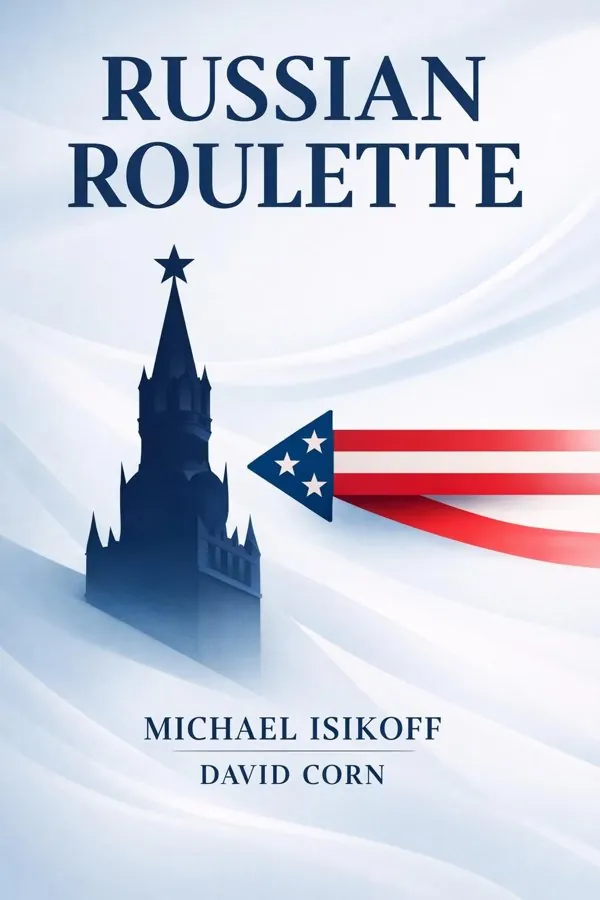
Russian Roulette: The Inside Story of Putin's War on America and the Election of Donald Trump: Summary & Key Insights
by Michael Isikoff, David Corn
 10 min10 chaptersAudio available
What Is Russian Roulette: The Inside Story of Putin's War on America and the Election of Donald Trump About?
Russian Roulette: The Inside Story of Putin's War on America and the Election of Donald Trump by Michael Isikoff, David Corn is a politics book spanning 10 pages. An investigative account detailing Russia's interference in the 2016 U.S. presidential election, exploring the connections between Donald Trump's campaign and Vladimir Putin's government, and the intelligence community's response to the unfolding crisis.
This FizzRead summary covers all 10 key chapters of Russian Roulette: The Inside Story of Putin's War on America and the Election of Donald Trump in approximately 10 minutes, distilling the most important ideas, arguments, and takeaways from Michael Isikoff, David Corn's work. Also available as an audio summary and Key Quotes Podcast.
Russian Roulette: The Inside Story of Putin's War on America and the Election of Donald Trump
An investigative account detailing Russia's interference in the 2016 U.S. presidential election, exploring the connections between Donald Trump's campaign and Vladimir Putin's government, and the intelligence community's response to the unfolding crisis.
Who Should Read Russian Roulette: The Inside Story of Putin's War on America and the Election of Donald Trump?
This book is perfect for anyone interested in politics and looking to gain actionable insights in a short read. Whether you're a student, professional, or lifelong learner, the key ideas from Russian Roulette: The Inside Story of Putin's War on America and the Election of Donald Trump by Michael Isikoff, David Corn will help you think differently.
- ✓Readers who enjoy politics and want practical takeaways
- ✓Professionals looking to apply new ideas to their work and life
- ✓Anyone who wants the core insights of Russian Roulette: The Inside Story of Putin's War on America and the Election of Donald Trump in just 10 minutes
Want the full summary?
Get instant access to this book summary and 100K+ more with Fizz Moment.
Get Free SummaryAvailable on App Store • Free to download
Key Chapters
The story of Russian interference cannot be told without first understanding how U.S.–Russia relations evolved from cautious cooperation after the Cold War to bitter rivalry under Putin. In the 1990s, optimism framed the relationship. There were genuine attempts at partnership—the expansion of trade, nuclear arms reduction agreements, even shared counterterrorism goals following the September 11 attacks. However, beneath these gestures simmered resentment within Russia’s elite. From Moscow’s viewpoint, NATO’s eastward expansion was not a gesture of peace but of encirclement.
Putin’s ascent to power in 1999 marked a turning point. He inherited a Russia bruised by economic turmoil and wounded national pride. His promise was to restore control and dignity, to challenge what he perceived as American arrogance. He believed that the West had exploited Russia’s weakness, and he viewed democracy promotion by the U.S. as a direct threat to his regime’s survival.
By the mid-2000s, Russia’s intelligence apparatus was rejuvenated. The FSB, SVR, and GRU—the heirs to the Soviet KGB—became instruments of hybrid warfare, blending traditional espionage with digital infiltration and psychological operations. The goal was clear: not merely to compete with the United States, but to destabilize it from within.
In meetings with diplomats and intelligence officers we interviewed, a pattern emerged. Russia no longer sought direct confrontation. Instead, it pursued what analysts now call 'active measures'—a Cold War term revived to describe covert actions that used information as ammunition. Propaganda disguised as news, bots amplified on social media, financial entanglements—all were part of a strategy designed to exploit weaknesses in open societies. America, with its polarized politics and divisive media landscape, was fertile ground.
Throughout the 2000s, while Washington focused on the wars in Iraq and Afghanistan, Russia quietly advanced these operations. Cyber units experimented with tactics in Estonia and Georgia. State-backed media, notably RT and Sputnik, honed narratives targeting Western audiences. And when protests erupted in Ukraine, Putin saw not the spread of democracy but evidence of Western meddling. By the time the U.S. entered its 2016 election cycle, Russia had perfected the art of political disruption.
Before 2016, signals of Russian interference were scattered but unmistakable. U.S. intelligence analysts noticed recurring patterns—probing attacks against government servers, phishing attempts targeting political organizations, and unusual information flows from Russian IP addresses. Yet few suspected the scale that was to come.
Our reporting uncovered how Russian cyber operations first tested their capabilities against smaller European states and non-governmental institutions. In the U.S., these actors began targeting think tanks and election-related entities as early as 2014. The Kremlin’s digital operatives operated under layers of anonymity, often masquerading as collective hacker groups such as 'Fancy Bear' and 'Cozy Bear,' names later associated with Russia’s military intelligence and intelligence service.
Equally insidious was the propaganda infrastructure taking root on American social platforms. Thousands of fake accounts posed as activists, journalists, and local citizens, pushing divisive narratives across Facebook and Twitter. One campaign we traced targeted racial tensions; another exploited fears surrounding immigration. Each post was a weaponized data point, designed to polarize public opinion.
When analysts and cyber-security experts flagged these developments, responses were tepid. The concept of a state-sponsored influence operation conducted through memes and posts seemed absurd to traditional policymakers. But gradually, the realization dawned: Russia wasn’t hacking simply for data—it was hacking for hearts and minds.
This chapter reveals how small incidents—a breach here, a viral post there—foreshadowed the storm. Russia had found a new battleground, one where algorithms replaced armies and the truth could be digitally rewritten.
+ 8 more chapters — available in the FizzRead app
All Chapters in Russian Roulette: The Inside Story of Putin's War on America and the Election of Donald Trump
About the Authors
Michael Isikoff is an American investigative journalist known for his work with Newsweek and Yahoo News. David Corn is an American political journalist and Washington bureau chief for Mother Jones magazine. Both authors specialize in political reporting and national security issues.
Get This Summary in Your Preferred Format
Read or listen to the Russian Roulette: The Inside Story of Putin's War on America and the Election of Donald Trump summary by Michael Isikoff, David Corn anytime, anywhere. FizzRead offers multiple formats so you can learn on your terms — all free.
Available formats: App · Audio · PDF · EPUB — All included free with FizzRead
Download Russian Roulette: The Inside Story of Putin's War on America and the Election of Donald Trump PDF and EPUB Summary
Key Quotes from Russian Roulette: The Inside Story of Putin's War on America and the Election of Donald Trump
“The story of Russian interference cannot be told without first understanding how U.”
“Before 2016, signals of Russian interference were scattered but unmistakable.”
Frequently Asked Questions about Russian Roulette: The Inside Story of Putin's War on America and the Election of Donald Trump
Russian Roulette: The Inside Story of Putin's War on America and the Election of Donald Trump by Michael Isikoff, David Corn is a politics book that explores key ideas across 10 chapters. An investigative account detailing Russia's interference in the 2016 U.S. presidential election, exploring the connections between Donald Trump's campaign and Vladimir Putin's government, and the intelligence community's response to the unfolding crisis.
You Might Also Like
Antifa: The Anti-Fascist Handbook
Mark Bray
10 min
Attack from Within: How Disinformation Is Sabotaging America
Barbara McQuade
10 min
Coercion, Capital, and European States, AD 990–1992
Charles Tilly
10 min
Digital Democracy: Concepts, Methodologies, Tools, and Applications
Various Authors
10 min
Fascism
Stanley G. Payne
10 min
Fire And Fury: Inside The Trump White House
Michael Wolff
10 minBrowse by Category
Ready to read Russian Roulette: The Inside Story of Putin's War on America and the Election of Donald Trump?
Get the full summary and 100K+ more books with Fizz Moment.