
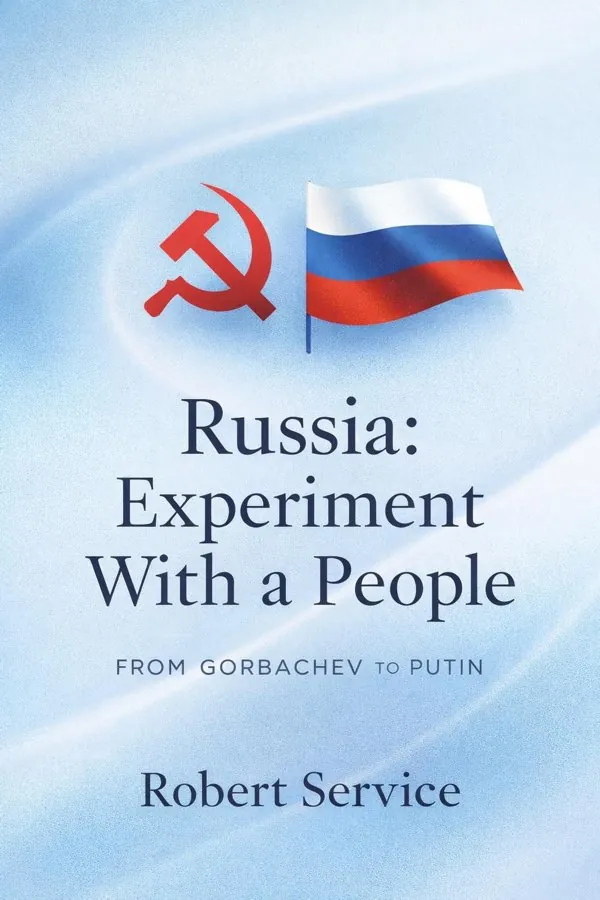
Russia: Experiment With a People: From Gorbachev to Putin: Summary & Key Insights
 10 min12 chaptersAudio available
What Is Russia: Experiment With a People: From Gorbachev to Putin About?
Russia: Experiment With a People: From Gorbachev to Putin by Robert Service is a politics book spanning 12 pages. This book offers a comprehensive analysis of Russia’s transformation from the late Soviet period through the early years of Vladimir Putin’s rule. Historian Robert Service examines the political, economic, and social experiments that shaped post-Soviet Russia, exploring how reform efforts, nationalism, and power struggles defined the nation’s trajectory after the collapse of the USSR.
This FizzRead summary covers all 12 key chapters of Russia: Experiment With a People: From Gorbachev to Putin in approximately 10 minutes, distilling the most important ideas, arguments, and takeaways from Robert Service's work. Also available as an audio summary and Key Quotes Podcast.
Russia: Experiment With a People: From Gorbachev to Putin
This book offers a comprehensive analysis of Russia’s transformation from the late Soviet period through the early years of Vladimir Putin’s rule. Historian Robert Service examines the political, economic, and social experiments that shaped post-Soviet Russia, exploring how reform efforts, nationalism, and power struggles defined the nation’s trajectory after the collapse of the USSR.
Who Should Read Russia: Experiment With a People: From Gorbachev to Putin?
This book is perfect for anyone interested in politics and looking to gain actionable insights in a short read. Whether you're a student, professional, or lifelong learner, the key ideas from Russia: Experiment With a People: From Gorbachev to Putin by Robert Service will help you think differently.
- ✓Readers who enjoy politics and want practical takeaways
- ✓Professionals looking to apply new ideas to their work and life
- ✓Anyone who wants the core insights of Russia: Experiment With a People: From Gorbachev to Putin in just 10 minutes
Want the full summary?
Get instant access to this book summary and 100K+ more with Fizz Moment.
Get Free SummaryAvailable on App Store • Free to download
Key Chapters
When Gorbachev stepped into power in 1985, he confronted a Soviet Union exhausted by stagnation, rigid bureaucracy, and global competition it could no longer sustain. His reform pillars—perestroika (restructuring) and glasnost (openness)—were not conceived as dismantling tools but as mechanisms of revival. I emphasize that Gorbachev’s ambition was to humanize socialism, to reconcile Marxist ideals with efficiency and truth. Yet once glasnost encouraged citizens to speak openly, the floodgates of suppressed grievance burst wide. The revelation of past atrocities under Stalin, the exposure of economic decay, and the rediscovery of political debate triggered a cultural awakening that the Soviet system could not control.
Gorbachev was a moral reformer trapped inside a decaying administrative machine. His faith in dialogue and persuasion met the hard realities of a structure built on fear and conformity. As provincial leaders lost confidence and nationalities asserted autonomy, reform spiraled into rebellion. In revisiting this period, I describe Gorbachev’s dilemma not as mismanagement but as tragedy—he released forces that his moral optimism could not contain. The paradox of perestroika lies here: it revealed the weakness of the Soviet state precisely by attempting to strengthen it.
By the early 1990s, cracks within the federation widened irreversibly. Economic malfunction, the unraveling of party discipline, and centrifugal nationalism converged. The Soviet Union, despite its immense coercive apparatus, could no longer command obedience from its peripheries. I portray the collapse not as a sudden implosion, but as a drawn-out moral and administrative erosion. Gorbachev’s contest with Boris Yeltsin over the future of the union culminated in paralysis. The failed August 1991 coup by hardliners was the final act of desperation—a last attempt to arrest history. When that effort crumbled, popular resistance and elite betrayal combined to extinguish seventy years of Soviet power.
From a historian’s perspective, the disintegration was both political reckoning and cultural liberation. Yet for ordinary Russians, it felt more like abandonment. The empire dissolved, leaving millions stranded across new borders, economies without safeguards, and identities without a center. In this phase, the Soviet ideal of collective solidarity gave way to individual survival.
+ 10 more chapters — available in the FizzRead app
All Chapters in Russia: Experiment With a People: From Gorbachev to Putin
About the Author
Robert Service is a British historian and political commentator specializing in Russian history. He is a professor of Russian history at the University of Oxford and a senior fellow at St Antony’s College. Service is known for his authoritative biographies of Lenin, Stalin, and Trotsky, as well as his works on Soviet and post-Soviet politics.
Get This Summary in Your Preferred Format
Read or listen to the Russia: Experiment With a People: From Gorbachev to Putin summary by Robert Service anytime, anywhere. FizzRead offers multiple formats so you can learn on your terms — all free.
Available formats: App · Audio · PDF · EPUB — All included free with FizzRead
Download Russia: Experiment With a People: From Gorbachev to Putin PDF and EPUB Summary
Key Quotes from Russia: Experiment With a People: From Gorbachev to Putin
“When Gorbachev stepped into power in 1985, he confronted a Soviet Union exhausted by stagnation, rigid bureaucracy, and global competition it could no longer sustain.”
“By the early 1990s, cracks within the federation widened irreversibly.”
Frequently Asked Questions about Russia: Experiment With a People: From Gorbachev to Putin
Russia: Experiment With a People: From Gorbachev to Putin by Robert Service is a politics book that explores key ideas across 12 chapters. This book offers a comprehensive analysis of Russia’s transformation from the late Soviet period through the early years of Vladimir Putin’s rule. Historian Robert Service examines the political, economic, and social experiments that shaped post-Soviet Russia, exploring how reform efforts, nationalism, and power struggles defined the nation’s trajectory after the collapse of the USSR.
You Might Also Like

Antifa: The Anti-Fascist Handbook
Mark Bray
10 min
Attack from Within: How Disinformation Is Sabotaging America
Barbara McQuade
10 min
Coercion, Capital, and European States, AD 990–1992
Charles Tilly
10 min
Digital Democracy: Concepts, Methodologies, Tools, and Applications
Various Authors
10 min
Fascism
Stanley G. Payne
10 min
Fire And Fury: Inside The Trump White House
Michael Wolff
10 minBrowse by Category
Ready to read Russia: Experiment With a People: From Gorbachev to Putin?
Get the full summary and 100K+ more books with Fizz Moment.