
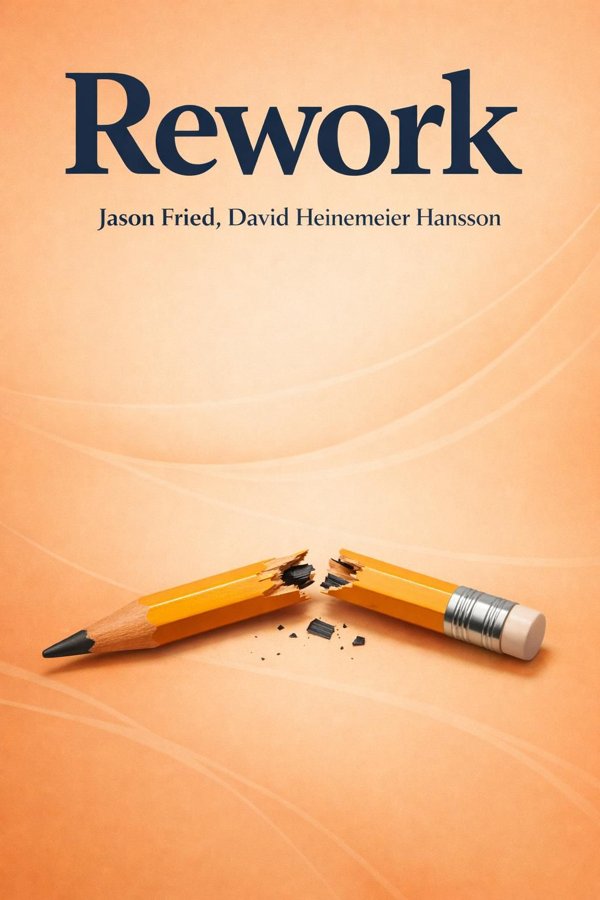
Rework: Summary & Key Insights
by Jason Fried
 10 min9 chaptersAudio available
Key Takeaways from Rework
One of the most dangerous myths in business is that you need a complete map before taking the first step.
Most people are not stuck because they lack ideas; they are stuck because they keep waiting for ideal conditions.
Busyness is easy to confuse with usefulness.
Businesses often become obsessed with the wrong audience: competitors instead of customers.
Many companies fail because they try to become their future version too early.
What Is Rework About?
Rework by Jason Fried is a business book published in 2010 spanning 9 pages. What if most of what you’ve been taught about business is not just outdated, but actively unhelpful? In Rework, Jason Fried and David Heinemeier Hansson argue that many of the so-called rules of entrepreneurship—writing elaborate business plans, raising outside capital, obsessing over competitors, hiring early, and working around the clock—create more friction than progress. Instead, they offer a radically simpler approach: start now, build something useful, keep costs low, communicate clearly, and grow only as much as necessary. The book matters because it replaces abstract business theory with sharp, experience-tested lessons from the founders of Basecamp, a company that built a profitable software business by ignoring much conventional wisdom. Fried writes with unusual clarity and conviction, cutting through the noise of startup culture and reminding readers that a business is not a performance—it is a product, a process, and a promise to customers. For entrepreneurs, freelancers, managers, and anyone tired of business clichés, Rework is a practical manifesto for doing less, better. It does not romanticize complexity. It shows that simplicity, focus, and action can be a real competitive advantage.
This FizzRead summary covers all 9 key chapters of Rework in approximately 10 minutes, distilling the most important ideas, arguments, and takeaways from Jason Fried's work. Also available as an audio summary and Key Quotes Podcast.
Rework
What if most of what you’ve been taught about business is not just outdated, but actively unhelpful? In Rework, Jason Fried and David Heinemeier Hansson argue that many of the so-called rules of entrepreneurship—writing elaborate business plans, raising outside capital, obsessing over competitors, hiring early, and working around the clock—create more friction than progress. Instead, they offer a radically simpler approach: start now, build something useful, keep costs low, communicate clearly, and grow only as much as necessary.
The book matters because it replaces abstract business theory with sharp, experience-tested lessons from the founders of Basecamp, a company that built a profitable software business by ignoring much conventional wisdom. Fried writes with unusual clarity and conviction, cutting through the noise of startup culture and reminding readers that a business is not a performance—it is a product, a process, and a promise to customers.
For entrepreneurs, freelancers, managers, and anyone tired of business clichés, Rework is a practical manifesto for doing less, better. It does not romanticize complexity. It shows that simplicity, focus, and action can be a real competitive advantage.
Who Should Read Rework?
This book is perfect for anyone interested in business and looking to gain actionable insights in a short read. Whether you're a student, professional, or lifelong learner, the key ideas from Rework by Jason Fried will help you think differently.
- ✓Readers who enjoy business and want practical takeaways
- ✓Professionals looking to apply new ideas to their work and life
- ✓Anyone who wants the core insights of Rework in just 10 minutes
Want the full summary?
Get instant access to this book summary and 100K+ more with Fizz Moment.
Get Free SummaryAvailable on App Store • Free to download
Key Chapters
One of the most dangerous myths in business is that you need a complete map before taking the first step. Rework challenges this belief head-on by arguing that traditional business plans often create a false sense of certainty. Markets change, customer behavior shifts, technology evolves, and competitors appear unexpectedly. A detailed five-year plan may look impressive, but it is usually speculation dressed up as strategy.
Fried’s point is not that thinking ahead is useless. It is that overplanning becomes a substitute for learning. Real understanding comes from doing, shipping, observing, and adjusting. Entrepreneurs often spend months creating projections, pitch decks, and market analyses for a product that has never been tested in the real world. Meanwhile, someone with a simpler idea and faster execution can launch, gather feedback, and improve before the planner even begins.
This idea is especially relevant for small businesses and solo creators. A freelance designer does not need a 40-page plan to start offering a niche service. A software founder does not need to predict every revenue stream before building a useful first version. A consultant can start with one clear service, one audience, and one paying client.
The practical alternative is to replace static planning with directional clarity. Know the problem you want to solve, the people you want to help, and the smallest version of your offer that creates value. Then let reality inform the next move.
Actionable takeaway: trade the perfect plan for a simple starting blueprint—define your customer, your offer, and your next concrete step, then begin.
Most people are not stuck because they lack ideas; they are stuck because they keep waiting for ideal conditions. Rework insists that momentum matters more than readiness. The “right time” to start a business, launch a product, or test a concept rarely arrives in a neat and obvious way. Waiting often feels responsible, but in practice it becomes procrastination disguised as preparation.
Fried argues that progress is built through action, not intention. Every small move reveals information that thinking alone cannot produce. When you launch a basic website, you learn whether people understand your offer. When you release a simple product, you discover what customers actually value. When you begin selling, you see where objections arise. Starting small is not a weakness; it is the fastest path to truth.
This principle can be applied almost anywhere. If you want to start an online store, open with a limited catalog instead of 100 products. If you want to build an app, release one strong feature instead of an all-in-one platform. If you want to write a newsletter, publish ten issues before worrying about branding, automation, or monetization. Movement creates clarity.
The book also rejects the idea that big launches are necessary. Quiet beginnings are often better. They allow room for mistakes, improvement, and refinement without the pressure of hype. Starting small lowers risk while increasing learning.
Actionable takeaway: pick the smallest version of your business or project that can be used, sold, or tested this week, and launch that instead of waiting for a polished final version.
Busyness is easy to confuse with usefulness. Rework argues that modern workplaces reward activity—meetings, emails, urgent messages, constant coordination—even when none of it produces meaningful results. Fried reframes productivity as the ability to make progress on important work without unnecessary interruption.
The book is especially sharp on what destroys output: long meetings, fragmented attention, and a culture of immediate responsiveness. When people are interrupted every few minutes, they cannot enter the focused state required for solving problems, writing, designing, or building. A day filled with motion can still be a day with no accomplishment.
Instead of optimizing for visible effort, Fried recommends designing work around uninterrupted time. This may mean fewer meetings, shorter check-ins, written updates instead of calls, and realistic expectations about response time. It also means prioritizing essentials. Teams often overcommit because they treat every idea, request, and feature as urgent. But when everything matters, nothing truly does.
A practical example is product development. A team that works on three core improvements over two weeks will often outperform a team trying to juggle twelve initiatives at once. The same applies to individuals. A founder who spends a morning improving the checkout flow may create more value than one who spends the day answering low-priority messages.
Productivity is not about squeezing more tasks into the day. It is about protecting the time and energy needed to do work that counts.
Actionable takeaway: identify the top one or two high-value tasks each day and protect uninterrupted blocks of time to complete them before reacting to everyone else’s priorities.
Businesses often become obsessed with the wrong audience: competitors instead of customers. Rework warns that constant competitor watching drains focus, fuels imitation, and pushes companies into reactive decision-making. When you are always looking sideways, you stop looking forward.
Fried’s argument is not that competitors are irrelevant. It is that they should not define your identity. If your strategy is based on copying another company’s features, pricing, messaging, or tactics, you become a weaker version of someone else. Real differentiation comes from clarity about your own values, strengths, and customer needs.
This idea is liberating for entrepreneurs who feel crowded by established players. You do not need to outspend a larger company to win. You may win by being simpler, more personal, more transparent, faster to respond, easier to use, or better tailored to a specific niche. A large software platform may offer fifty features, while a small competitor succeeds by solving one painful problem elegantly. A big agency may serve everyone, while an independent consultant grows by specializing in one industry.
Customers rarely choose based only on feature comparison charts. They choose based on trust, fit, ease, experience, and relevance. Businesses that spend less time stalking rivals and more time improving the customer experience often build stronger loyalty.
The healthiest approach is to know the landscape without being consumed by it. Learn enough to understand positioning, then return your attention to creating value.
Actionable takeaway: stop measuring your business primarily against competitors and instead ask what one customer frustration you can solve better, faster, or more simply this month.
Many companies fail because they try to become their future version too early. Rework argues that growth should be earned through real demand, not forced through ambition, investor expectations, or vanity. Evolution works best when a business expands in response to what customers actually use and want.
Fried favors an incremental approach. Instead of launching with a giant vision, create a smaller product that solves one concrete problem. Then observe what happens. What features do customers rely on? What are they asking for? Where are they getting stuck? These signals should shape the next stage of development more than internal fantasies about scale.
This mindset reduces waste. Businesses often overbuild because they imagine what customers might need years from now. Restaurants add bloated menus. apps cram in features. service firms create complicated packages. In trying to appear “complete,” they become confusing and harder to manage. Evolution means resisting that pressure and allowing the business to become more sophisticated only where reality justifies it.
Basecamp itself is an example of this philosophy: a focused product that grew by refining utility rather than chasing trend after trend. The lesson extends beyond software. A coaching business might begin with one core program, then add workshops only after demand appears. A retail brand might start online, then open a physical location only when the numbers support it.
Healthy growth is not about becoming bigger at any cost. It is about becoming more useful over time.
Actionable takeaway: review your business for features, offers, or expansions driven by assumption rather than evidence, and cut back until growth reflects proven customer demand.
Promotion does not have to feel like hype. Rework presents a more sustainable view of marketing: earn attention by sharing what you know, showing your process, and teaching people something useful. Instead of shouting for visibility, become worth discovering.
Fried argues that businesses should market through generosity and clarity. When you publish helpful insights, answer common questions, explain your methods, or share useful tools, you build trust long before a sale. This type of promotion is especially effective for smaller companies because it does not require huge budgets. It requires expertise, consistency, and a willingness to be open.
Examples are everywhere. A financial advisor can write short guides that explain basic investing mistakes. A fitness coach can post practical training tips for beginners. A software company can publish tutorials, templates, and behind-the-scenes product decisions. Each piece of useful content does two things: it helps the audience and signals competence.
Rework also emphasizes honesty in communication. Strong promotion does not rely on inflated claims or polished spin. It works when the company’s voice is clear, human, and specific. People are more likely to trust a business that sounds real than one that sounds manufactured.
In a crowded market, teaching is a powerful differentiator. It transforms marketing from interruption into service. It creates a relationship before a transaction and positions the business as a credible guide rather than just another seller.
Actionable takeaway: choose one recurring customer question and create a simple piece of educational content around it each week to build trust and attract the right audience.
One of the easiest ways to create unnecessary complexity is to hire too early. Rework pushes against the assumption that growth always requires more people. Fried argues that adding employees should be a last resort, not a milestone to celebrate automatically. More staff often means more coordination, more meetings, more management, and more communication overhead.
The real test is whether there is a sustained, painful problem that cannot be solved by simplifying, prioritizing, automating, or saying no. Many companies hire because they are disorganized, not because they truly need help. They add people to compensate for unclear processes, bloated offerings, or weak focus. The result is often a larger but less efficient business.
When hiring is necessary, Fried recommends hiring for demonstrated ability rather than polished résumés or abstract credentials. Great candidates show clear thinking, strong communication, and evidence that they can produce useful work. A portfolio, writing sample, trial project, or real-world track record often reveals more than an interview performance.
This principle matters for founders managing cash carefully. A new hire is not just a salary; it is a long-term commitment. If the role is not essential, the cost can burden the business unnecessarily. Before hiring a marketer, for example, a founder might first simplify the product, sharpen the offer, and improve customer referrals.
Hiring should remove friction, not add it.
Actionable takeaway: before opening a new role, ask whether the problem can be solved by better focus, clearer systems, or a smaller scope—and hire only if the pain remains real and persistent.
Culture is often treated as a branding exercise, but Rework reminds us that culture is not what a company says about itself—it is how people experience work every day. Perks, slogans, and mission posters do not create a healthy workplace. Habits do. Expectations do. The way leaders communicate, make decisions, handle mistakes, and respect people’s time does.
Fried advocates for a calmer, more intentional work culture. That means fewer emergencies manufactured by poor planning, less ego-driven management, and more trust in individuals to do meaningful work. A strong culture is not loud. It is consistent. People know what matters, what good work looks like, and how to collaborate without chaos.
This is especially important in small teams, where behavior spreads quickly. If leadership celebrates late-night heroics, the culture becomes reactive and exhausting. If managers interrupt constantly, people stop thinking deeply. If honesty is punished, problems stay hidden. On the other hand, if the company values clarity, respect, focus, and autonomy, those norms compound.
Culture also shows up in what is tolerated. Do meetings start and end on time? Are decisions documented? Can people disagree without politics? Is rest respected, or is burnout quietly rewarded? These questions matter more than office perks.
The lesson is that culture is built operationally, not cosmetically. The daily rhythm of the company becomes the real environment employees live in.
Actionable takeaway: identify one recurring work habit in your team—such as unnecessary meetings, after-hours messaging, or unclear ownership—and improve it, because culture changes when behavior changes.
No business avoids problems. Products break, shipments are delayed, customers get frustrated, and internal mistakes happen. Rework’s advice on damage control is refreshingly simple: when something goes wrong, respond quickly, tell the truth, and fix what you can without defensiveness. Most reputational damage comes less from the original mistake than from denial, delay, or spin.
Fried encourages companies to treat customers like adults. If a service outage happens, explain what occurred, what is being done, and what customers should expect next. If an order is late, communicate before the customer has to chase you. If your team made a poor decision, admit it plainly. People are often surprisingly forgiving when they sense honesty and effort.
This approach also strengthens internal culture. Teams that can acknowledge errors without panic learn faster. Instead of hiding failure, they examine it and improve systems. A restaurant that openly addresses a service breakdown can retrain staff and prevent recurrence. A software company that writes a clear postmortem after an outage can improve infrastructure and earn more trust than if it had said nothing.
Damage control is not just reactive. It includes preparing simple response principles in advance: communicate early, stay factual, apologize when necessary, and focus on resolution. Calm, direct responses preserve credibility.
In a world where bad experiences spread fast, transparency is not weakness. It is professional maturity.
Actionable takeaway: create a simple response protocol for business mistakes—acknowledge the issue, communicate clearly, outline the fix, and follow up—so problems are handled with speed and honesty.
All Chapters in Rework
About the Author
Jason Fried is an American entrepreneur, author, and the cofounder of Basecamp, the software company behind the popular project management platform of the same name. He is known for advocating a minimalist, practical approach to business, product design, and workplace culture. Rather than promoting hustle, hypergrowth, or bureaucracy, Fried argues for calm companies, focused work, smaller teams, and simple products that solve real problems well. His ideas have influenced entrepreneurs, managers, and creatives looking for a more sustainable way to build and lead. In addition to Rework, he has coauthored other influential books on work and management. Fried is widely respected for turning unconventional business principles into a profitable, enduring company.
Get This Summary in Your Preferred Format
Read or listen to the Rework summary by Jason Fried anytime, anywhere. FizzRead offers multiple formats so you can learn on your terms — all free.
Available formats: App · Audio · PDF · EPUB — All included free with FizzRead
Download Rework PDF and EPUB Summary
Key Quotes from Rework
“One of the most dangerous myths in business is that you need a complete map before taking the first step.”
“Most people are not stuck because they lack ideas; they are stuck because they keep waiting for ideal conditions.”
“Busyness is easy to confuse with usefulness.”
“Businesses often become obsessed with the wrong audience: competitors instead of customers.”
“Many companies fail because they try to become their future version too early.”
Frequently Asked Questions about Rework
Rework by Jason Fried is a business book that explores key ideas across 9 chapters. What if most of what you’ve been taught about business is not just outdated, but actively unhelpful? In Rework, Jason Fried and David Heinemeier Hansson argue that many of the so-called rules of entrepreneurship—writing elaborate business plans, raising outside capital, obsessing over competitors, hiring early, and working around the clock—create more friction than progress. Instead, they offer a radically simpler approach: start now, build something useful, keep costs low, communicate clearly, and grow only as much as necessary. The book matters because it replaces abstract business theory with sharp, experience-tested lessons from the founders of Basecamp, a company that built a profitable software business by ignoring much conventional wisdom. Fried writes with unusual clarity and conviction, cutting through the noise of startup culture and reminding readers that a business is not a performance—it is a product, a process, and a promise to customers. For entrepreneurs, freelancers, managers, and anyone tired of business clichés, Rework is a practical manifesto for doing less, better. It does not romanticize complexity. It shows that simplicity, focus, and action can be a real competitive advantage.
Compare Rework

More by Jason Fried


You Might Also Like






Featured In
Browse by Category
Ready to read Rework?
Get the full summary and 100K+ more books with Fizz Moment.