
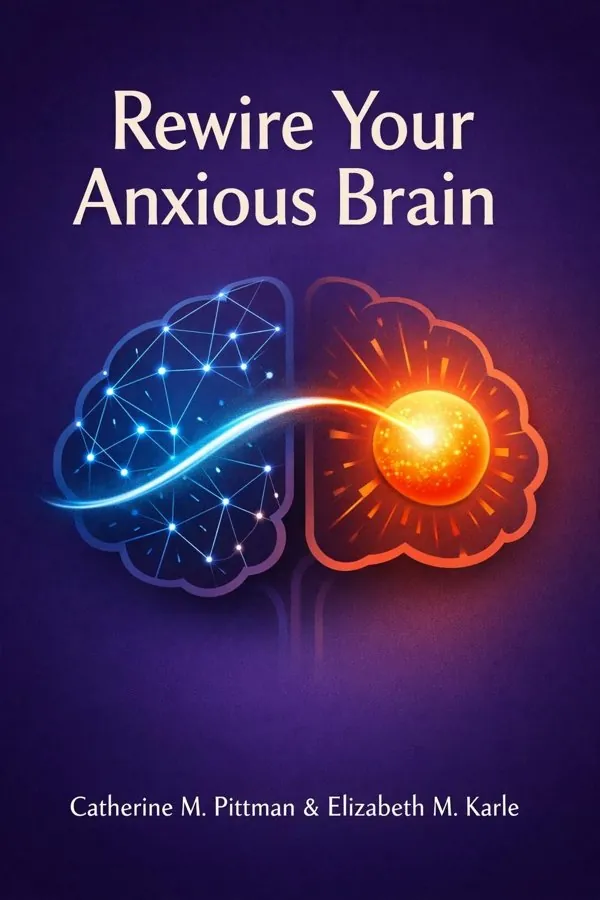
Rewire Your Anxious Brain: How to Use the Neuroscience of Fear to End Anxiety, Panic, and Worry: Summary & Key Insights
by Catherine M. Pittman, Elizabeth M. Karle
 10 min5 chaptersAudio available
What Is Rewire Your Anxious Brain: How to Use the Neuroscience of Fear to End Anxiety, Panic, and Worry About?
Rewire Your Anxious Brain: How to Use the Neuroscience of Fear to End Anxiety, Panic, and Worry by Catherine M. Pittman, Elizabeth M. Karle is a neuroscience book spanning 5 pages. This book explains how the brain’s two main anxiety pathways—the cortex and the amygdala—create fear and worry, and offers practical, neuroscience-based strategies to retrain these systems. By understanding how the brain processes anxiety, readers can learn to manage panic, fear, and chronic worry more effectively through evidence-based exercises and cognitive-behavioral techniques.
This FizzRead summary covers all 5 key chapters of Rewire Your Anxious Brain: How to Use the Neuroscience of Fear to End Anxiety, Panic, and Worry in approximately 10 minutes, distilling the most important ideas, arguments, and takeaways from Catherine M. Pittman, Elizabeth M. Karle's work. Also available as an audio summary and Key Quotes Podcast.
Rewire Your Anxious Brain: How to Use the Neuroscience of Fear to End Anxiety, Panic, and Worry
This book explains how the brain’s two main anxiety pathways—the cortex and the amygdala—create fear and worry, and offers practical, neuroscience-based strategies to retrain these systems. By understanding how the brain processes anxiety, readers can learn to manage panic, fear, and chronic worry more effectively through evidence-based exercises and cognitive-behavioral techniques.
Who Should Read Rewire Your Anxious Brain: How to Use the Neuroscience of Fear to End Anxiety, Panic, and Worry?
This book is perfect for anyone interested in neuroscience and looking to gain actionable insights in a short read. Whether you're a student, professional, or lifelong learner, the key ideas from Rewire Your Anxious Brain: How to Use the Neuroscience of Fear to End Anxiety, Panic, and Worry by Catherine M. Pittman, Elizabeth M. Karle will help you think differently.
- ✓Readers who enjoy neuroscience and want practical takeaways
- ✓Professionals looking to apply new ideas to their work and life
- ✓Anyone who wants the core insights of Rewire Your Anxious Brain: How to Use the Neuroscience of Fear to End Anxiety, Panic, and Worry in just 10 minutes
Want the full summary?
Get instant access to this book summary and 100K+ more with Fizz Moment.
Get Free SummaryAvailable on App Store • Free to download
Key Chapters
In every anxious experience, two regions of your brain are involved, but they play remarkably different roles. The cortex, your thinking brain, is analytical and deliberate. It’s where language, reasoning, and imagination reside. The amygdala, in contrast, is automatic, ancient, and emotional. It acts long before conscious thought—triggering the physiological fear response that tightens your chest or makes your heart race. Understanding how these two systems work together and separately is the foundation for reducing anxiety effectively.
The amygdala’s purpose is survival. It evolved to keep us alive by detecting danger quickly and mobilizing the body. The moment it senses a threat, it activates the hypothalamus, the adrenal glands, and floods the system with adrenaline and cortisol. This cascade happens in milliseconds, far faster than the cortex can process. That’s why sometimes you feel fear before you know what you’re afraid of. The sensation of panic is not irrational—it’s just that your amygdala has learned to see danger where there may be none.
The cortex works differently. Its mode is thinking, projecting, and interpreting. When you worry, your cortex isn’t responding to an immediate threat but to a mental simulation of one. You imagine losing your job, getting sick, saying the wrong thing, and so the cortex sends distress signals that in turn feed the amygdala. In this loop, thoughts can generate physiological fear even in the absence of real peril. Thus, the two systems reinforce each other: your thoughts make you anxious, and your bodily sensations feed more thoughts of alarm.
To transform anxiety, you must first understand how the amygdala learns. It does not learn through reasoning or words; it learns through experience and association. It records sensory patterns—sights, sounds, smells—linked with danger. Once those associations are in place, the amygdala will react automatically to anything resembling that pattern, even if you consciously know there is no threat.
Consider a person who once had a panic attack in a crowded subway. The amygdala learned to associate the environment—the noise, the closeness, the motion—with fear. Later, even thinking about the subway might trigger racing heart or breathlessness. Insight alone cannot overwrite this memory; the amygdala must relearn safety through new experiences. This is where exposure-based strategies come in. Gradual, repeated exposure to feared situations in safe contexts teaches the amygdala that the old connection no longer predicts danger. Over time, its fear response diminishes. Neuroscience shows that when the amygdala’s fear circuits are reactivated under safe conditions, new inhibitory pathways form. This is what we call ‘rewiring’ fear—creating a neural map of calm that overrides the old alarm pattern.
This process takes patience. You are not suppressing fear but reshaping how your brain interprets stimuli. Each time you stay with the discomfort instead of fleeing, your brain learns that safety is possible. This is how you reclaim confidence—not by convincing yourself logically, but by teaching your brain through lived experience.
+ 3 more chapters — available in the FizzRead app
All Chapters in Rewire Your Anxious Brain: How to Use the Neuroscience of Fear to End Anxiety, Panic, and Worry
About the Authors
Catherine M. Pittman, PhD, is a clinical psychologist and professor of psychology at Saint Mary’s College in Notre Dame, Indiana, specializing in anxiety disorders and brain-based therapy. Elizabeth M. Karle, MLIS, is a librarian and writer with a focus on psychology and self-help topics.
Get This Summary in Your Preferred Format
Read or listen to the Rewire Your Anxious Brain: How to Use the Neuroscience of Fear to End Anxiety, Panic, and Worry summary by Catherine M. Pittman, Elizabeth M. Karle anytime, anywhere. FizzRead offers multiple formats so you can learn on your terms — all free.
Available formats: App · Audio · PDF · EPUB — All included free with FizzRead
Download Rewire Your Anxious Brain: How to Use the Neuroscience of Fear to End Anxiety, Panic, and Worry PDF and EPUB Summary
Key Quotes from Rewire Your Anxious Brain: How to Use the Neuroscience of Fear to End Anxiety, Panic, and Worry
“In every anxious experience, two regions of your brain are involved, but they play remarkably different roles.”
“To transform anxiety, you must first understand how the amygdala learns.”
Frequently Asked Questions about Rewire Your Anxious Brain: How to Use the Neuroscience of Fear to End Anxiety, Panic, and Worry
Rewire Your Anxious Brain: How to Use the Neuroscience of Fear to End Anxiety, Panic, and Worry by Catherine M. Pittman, Elizabeth M. Karle is a neuroscience book that explores key ideas across 5 chapters. This book explains how the brain’s two main anxiety pathways—the cortex and the amygdala—create fear and worry, and offers practical, neuroscience-based strategies to retrain these systems. By understanding how the brain processes anxiety, readers can learn to manage panic, fear, and chronic worry more effectively through evidence-based exercises and cognitive-behavioral techniques.
You Might Also Like
Anxious
Joseph LeDoux
10 min
Hallucinations
Oliver Sacks
10 min
The Biological Mind: How Brain, Body, and Environment Collaborate to Make Us Who We Are
Alan Jasanoff
10 min
The Feeling of Life Itself: Why Consciousness Is Widespread but Can't Be Computed
Christof Koch
10 min
The No-Nonsense Meditation Book
Steven Laureys
10 min
A General Theory of Love
Thomas Lewis, Fari Amini, Richard Lannon
10 minBrowse by Category
Ready to read Rewire Your Anxious Brain: How to Use the Neuroscience of Fear to End Anxiety, Panic, and Worry?
Get the full summary and 100K+ more books with Fizz Moment.