
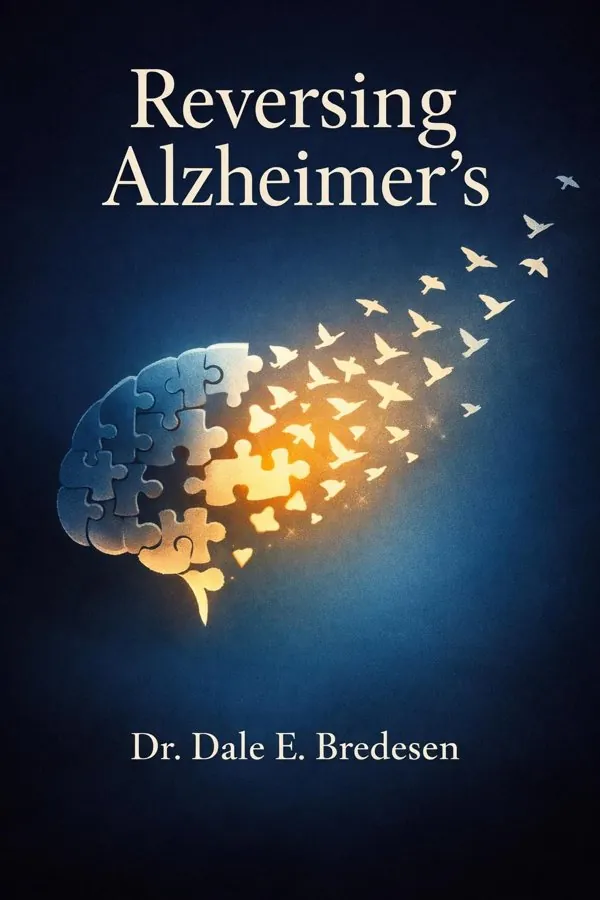
Reversing Alzheimer's: The New Breakthroughs That Will Change Your Life: Summary & Key Insights
 10 min5 chaptersAudio available
What Is Reversing Alzheimer's: The New Breakthroughs That Will Change Your Life About?
Reversing Alzheimer's: The New Breakthroughs That Will Change Your Life by Dr. Dale E. Bredesen is a health_med book spanning 5 pages. This book presents a comprehensive approach to preventing and reversing cognitive decline associated with Alzheimer's disease. Dr. Dale Bredesen outlines the science behind his protocol, which integrates nutrition, lifestyle, and medical interventions to restore brain health. The work challenges conventional views of Alzheimer's as an irreversible condition and offers hope through evidence-based strategies.
This FizzRead summary covers all 5 key chapters of Reversing Alzheimer's: The New Breakthroughs That Will Change Your Life in approximately 10 minutes, distilling the most important ideas, arguments, and takeaways from Dr. Dale E. Bredesen's work. Also available as an audio summary and Key Quotes Podcast.
Reversing Alzheimer's: The New Breakthroughs That Will Change Your Life
This book presents a comprehensive approach to preventing and reversing cognitive decline associated with Alzheimer's disease. Dr. Dale Bredesen outlines the science behind his protocol, which integrates nutrition, lifestyle, and medical interventions to restore brain health. The work challenges conventional views of Alzheimer's as an irreversible condition and offers hope through evidence-based strategies.
Who Should Read Reversing Alzheimer's: The New Breakthroughs That Will Change Your Life?
This book is perfect for anyone interested in health_med and looking to gain actionable insights in a short read. Whether you're a student, professional, or lifelong learner, the key ideas from Reversing Alzheimer's: The New Breakthroughs That Will Change Your Life by Dr. Dale E. Bredesen will help you think differently.
- ✓Readers who enjoy health_med and want practical takeaways
- ✓Professionals looking to apply new ideas to their work and life
- ✓Anyone who wants the core insights of Reversing Alzheimer's: The New Breakthroughs That Will Change Your Life in just 10 minutes
Want the full summary?
Get instant access to this book summary and 100K+ more with Fizz Moment.
Get Free SummaryAvailable on App Store • Free to download
Key Chapters
Alzheimer’s disease has been described as the defining plague of the 21st century, and yet for all our medical sophistication, conventional treatment has remained stunningly ineffective. For years, clinical trials repeated the same strategy: search for a single molecule thought to be responsible—amyloid beta—and design drugs to remove it. Billions were invested, and the outcome was heartbreakingly consistent: minimal improvement, sometimes even worsening cognitive function. What went wrong?
From my perspective as a neurologist and researcher, the error lay in reductionism. Alzheimer’s is not caused by one agent but by an intricate matrix of disturbances across metabolism, inflammation, hormones, and exposure to toxins. The plaques are not the root cause—they are a symptom, a reaction, the brain’s desperate attempt to protect itself. To reverse Alzheimer’s, we must look deeper, to the biochemical balance that determines whether our neurons flourish or wither.
That’s why many therapies fail: they target the smoke but ignore the fire. We must see Alzheimer’s for what it is—a system-wide disorder of resilience. My clinical work at UCLA and the Buck Institute confirmed that every patient presents a unique fingerprint of contributors: some suffer from insulin resistance in the brain, others from chronic inflammation driven by infection or autoimmune processes, and still others from exposure to metals or biotoxins. Yet medicine has treated them identically.
The limitations of conventional treatment lie not only in its narrow focus but also in its misunderstanding of what “irreversible” means. Neuroplasticity shows that the adult brain can learn, adapt, and build new connections throughout life. The common assumption that degeneration cannot be halted ignores this immense regenerative potential. By shifting from a drug-centric model to a systems biology perspective, we can harness that ability.
So when I say *reversing* Alzheimer’s, I’m not promising miracles. I’m describing the scientific reality uncovered through rigorous study and clinical application: when the underlying imbalances are corrected, cognitive improvement follows. This chapter opens the door to understanding why our old model failed—and what a new model must look like.
To grasp how cognitive decline unfolds, we must first appreciate the beautiful complexity of the brain. Your brain is not a static organ—it’s an adaptive network, rewiring itself moment by moment based on experience, learning, and biochemistry. Memory formation occurs through synaptic plasticity, where connections strengthen or weaken as neurons encode patterns. Neurotransmitters facilitate communication, while metabolic processes supply the energy to sustain this electrical symphony.
But under stress—metabolic, inflammatory, or toxic—the balance shifts. The pathways that support plasticity begin to fail, and those that prune or simplify connections dominate. In scientific terms, this is a switch from synaptoblastic to synaptoclastic activity: the brain ceases building and begins tearing down. This process doesn’t happen overnight; it evolves silently, often years before symptoms emerge. By the time memory lapses become noticeable, the neural architecture has been under siege for a long time.
Here lies the heart of the challenge. The conventional medical system detects decline only when it’s far advanced, whereas the biological alterations start decades earlier. That’s why prevention and early intervention are key pillars of the approach I describe in this book. By identifying early imbalances in glucose metabolism, inflammation, nutrient deficiencies, or toxin exposure, we can reverse the destructive processes before severe damage occurs.
When I developed the ReCODE protocol, I drew on decades of cellular research showing how neurons respond to environmental cues. The brain acts like a metabolic sensor—it knows when it has sufficient growth factors, hormones, and antioxidants to build. If those signals vanish and oxidative stress rises, the brain shifts into protective retraction. Understanding this mechanism reframes Alzheimer’s not as an inexorable decay but as an adaptive response gone awry. Repairing your cognition demands reversing the signals—providing the cues of abundance and resilience so that synaptogenesis resumes.
Once you understand that, you no longer see Alzheimer’s as mysterious or untouchable. You recognize it as an imbalance the brain can correct given the right biological support. This realization is the cornerstone of the journey toward recovery.
+ 3 more chapters — available in the FizzRead app
All Chapters in Reversing Alzheimer's: The New Breakthroughs That Will Change Your Life
About the Author
Dr. Dale E. Bredesen is an American neurologist and researcher specializing in neurodegenerative diseases. He served as a professor at UCLA and the Buck Institute for Research on Aging. His research focuses on the mechanisms of Alzheimer's disease and the development of therapeutic protocols to reverse cognitive decline.
Get This Summary in Your Preferred Format
Read or listen to the Reversing Alzheimer's: The New Breakthroughs That Will Change Your Life summary by Dr. Dale E. Bredesen anytime, anywhere. FizzRead offers multiple formats so you can learn on your terms — all free.
Available formats: App · Audio · PDF · EPUB — All included free with FizzRead
Download Reversing Alzheimer's: The New Breakthroughs That Will Change Your Life PDF and EPUB Summary
Key Quotes from Reversing Alzheimer's: The New Breakthroughs That Will Change Your Life
“Alzheimer’s disease has been described as the defining plague of the 21st century, and yet for all our medical sophistication, conventional treatment has remained stunningly ineffective.”
“To grasp how cognitive decline unfolds, we must first appreciate the beautiful complexity of the brain.”
Frequently Asked Questions about Reversing Alzheimer's: The New Breakthroughs That Will Change Your Life
Reversing Alzheimer's: The New Breakthroughs That Will Change Your Life by Dr. Dale E. Bredesen is a health_med book that explores key ideas across 5 chapters. This book presents a comprehensive approach to preventing and reversing cognitive decline associated with Alzheimer's disease. Dr. Dale Bredesen outlines the science behind his protocol, which integrates nutrition, lifestyle, and medical interventions to restore brain health. The work challenges conventional views of Alzheimer's as an irreversible condition and offers hope through evidence-based strategies.
You Might Also Like

On Immunity
Eula Biss
10 min
The Three-Body Problem
Liu Cixin
10 min
Community Health Volunteer Toolkit: Training and Practical Activities
World Health Organization
10 min
Healing Back Pain: The Mind-Body Connection
John E. Sarno
10 min
Health Literacy for All: Practical Guides to Communicate Health Information (Compilations)
World Health Organization
10 min
The Complete Guide to Sports Supplements: An Evidence-Based Review
Anita Bean
10 minBrowse by Category
Ready to read Reversing Alzheimer's: The New Breakthroughs That Will Change Your Life?
Get the full summary and 100K+ more books with Fizz Moment.