
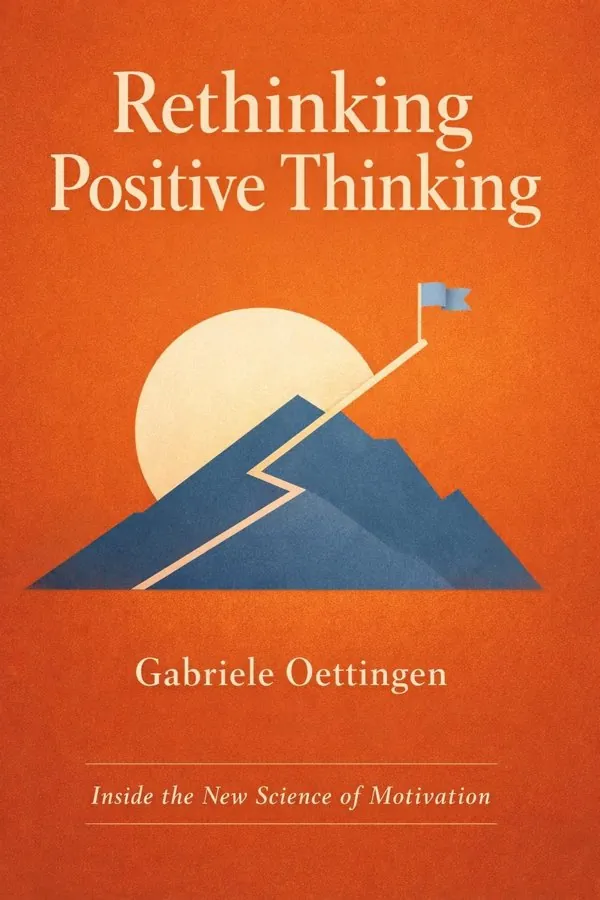
Rethinking Positive Thinking: Inside the New Science of Motivation: Summary & Key Insights
 10 min11 chaptersAudio available
What Is Rethinking Positive Thinking: Inside the New Science of Motivation About?
Rethinking Positive Thinking: Inside the New Science of Motivation by Gabriele Oettingen is a positive_psych book spanning 11 pages. In this groundbreaking work, psychologist Gabriele Oettingen challenges the conventional wisdom of positive thinking. Drawing on over two decades of research in motivation and self-regulation, she introduces the concept of 'mental contrasting'—a method that combines positive visualization with realistic assessment of obstacles. Through the WOOP (Wish, Outcome, Obstacle, Plan) framework, Oettingen provides a practical approach to achieving goals by balancing optimism with strategic realism.
This FizzRead summary covers all 11 key chapters of Rethinking Positive Thinking: Inside the New Science of Motivation in approximately 10 minutes, distilling the most important ideas, arguments, and takeaways from Gabriele Oettingen's work. Also available as an audio summary and Key Quotes Podcast.
Rethinking Positive Thinking: Inside the New Science of Motivation
In this groundbreaking work, psychologist Gabriele Oettingen challenges the conventional wisdom of positive thinking. Drawing on over two decades of research in motivation and self-regulation, she introduces the concept of 'mental contrasting'—a method that combines positive visualization with realistic assessment of obstacles. Through the WOOP (Wish, Outcome, Obstacle, Plan) framework, Oettingen provides a practical approach to achieving goals by balancing optimism with strategic realism.
Who Should Read Rethinking Positive Thinking: Inside the New Science of Motivation?
This book is perfect for anyone interested in positive_psych and looking to gain actionable insights in a short read. Whether you're a student, professional, or lifelong learner, the key ideas from Rethinking Positive Thinking: Inside the New Science of Motivation by Gabriele Oettingen will help you think differently.
- ✓Readers who enjoy positive_psych and want practical takeaways
- ✓Professionals looking to apply new ideas to their work and life
- ✓Anyone who wants the core insights of Rethinking Positive Thinking: Inside the New Science of Motivation in just 10 minutes
Want the full summary?
Get instant access to this book summary and 100K+ more with Fizz Moment.
Get Free SummaryAvailable on App Store • Free to download
Key Chapters
When I first set out to examine positive thinking, it was not because I distrusted hope—I was fascinated by it. But in studying how people pursue their wishes, I began noticing an unsettling pattern. When individuals indulged deeply in fantasies of success—imagining perfect careers, effortless weight loss, harmonious relationships—they felt good in the moment but were less likely to act later. Physiologically, their bodies showed reduced blood pressure and lower energization, patterns that mirror relaxation, not readiness.
In my early experiments at the University of Hamburg, I asked students to imagine achieving top grades or romantic success. Those who dwelled on these fantasies with vivid positivity were less likely to study or take constructive action than those who paired their dreams with reflections on what might stand in their way. It was as if their minds had tricked them into a false sense of accomplishment. The cultural narrative of positive thinking—so prevalent in self-help circles—had quietly detached desire from action.
This finding challenged decades of motivational dogma, and I knew it required careful exploration. Across subsequent studies, my colleagues and I replicated the effect in multiple areas: weight loss, job hunting, smoking cessation. The result was robust and consistent—pure optimism leads to complacency. Not because optimism is wrong, but because it disconnects us from reality. The mind loves to revel in success; it hates to confront struggle. Yet it is exactly through that confrontation that motivation is born.
Mental contrasting begins with the same spark of positive thinking: a wish, something you truly desire. But unlike traditional visualization, it doesn’t stop at fantasizing the perfect outcome. Instead, once you imagine the outcome, you deliberately contrast it with the obstacles that currently stand between you and that dream. In this act of mental juxtaposition—the wish vs. the obstacle—the brain integrates optimism with realism.
This contrast triggers an emotional and physiological shift: if the wish feels attainable in light of the obstacle, you feel energized to act; if not, your motivation gently releases, freeing you to focus your efforts elsewhere. In essence, mental contrasting teaches the mind to calibrate hope—to sift achievable goals from fantasy and then to commit wholeheartedly where success is possible.
What makes this method powerful is its paradoxical simplicity. You don’t need to suppress dreams or dwell negativity—you need both halves. Visualizing the future sets direction, recognizing obstacles activates effort. Together, they form a closed motivational circuit that propels us not toward imagined success, but toward concrete action.
+ 9 more chapters — available in the FizzRead app
All Chapters in Rethinking Positive Thinking: Inside the New Science of Motivation
About the Author
Gabriele Oettingen is a professor of psychology at New York University and the University of Hamburg. Her research focuses on motivation, self-regulation, and behavior change. She is best known for developing the concept of mental contrasting and the WOOP method, which have been widely applied in education, health, and organizational settings.
Get This Summary in Your Preferred Format
Read or listen to the Rethinking Positive Thinking: Inside the New Science of Motivation summary by Gabriele Oettingen anytime, anywhere. FizzRead offers multiple formats so you can learn on your terms — all free.
Available formats: App · Audio · PDF · EPUB — All included free with FizzRead
Download Rethinking Positive Thinking: Inside the New Science of Motivation PDF and EPUB Summary
Key Quotes from Rethinking Positive Thinking: Inside the New Science of Motivation
“When I first set out to examine positive thinking, it was not because I distrusted hope—I was fascinated by it.”
“Mental contrasting begins with the same spark of positive thinking: a wish, something you truly desire.”
Frequently Asked Questions about Rethinking Positive Thinking: Inside the New Science of Motivation
Rethinking Positive Thinking: Inside the New Science of Motivation by Gabriele Oettingen is a positive_psych book that explores key ideas across 11 chapters. In this groundbreaking work, psychologist Gabriele Oettingen challenges the conventional wisdom of positive thinking. Drawing on over two decades of research in motivation and self-regulation, she introduces the concept of 'mental contrasting'—a method that combines positive visualization with realistic assessment of obstacles. Through the WOOP (Wish, Outcome, Obstacle, Plan) framework, Oettingen provides a practical approach to achieving goals by balancing optimism with strategic realism.
You Might Also Like

Don't Sweat the Small Stuff... and It's All Small Stuff
Richard Carlson
10 min
Option B
Sheryl Sandberg & Adam Grant
10 min
Hallelujah Anyway: Rediscovering Mercy
Anne Lamott
10 min
I Can Do It: How to Use Affirmations to Change Your Life
Louise Hay
10 min
The Coffee Bean: A Simple Lesson to Create Positive Change
Jon Gordon, Damon West
10 min
The Happiness Hypothesis: Finding Modern Truth in Ancient Wisdom
Jonathan Haidt
10 minBrowse by Category
Ready to read Rethinking Positive Thinking: Inside the New Science of Motivation?
Get the full summary and 100K+ more books with Fizz Moment.