
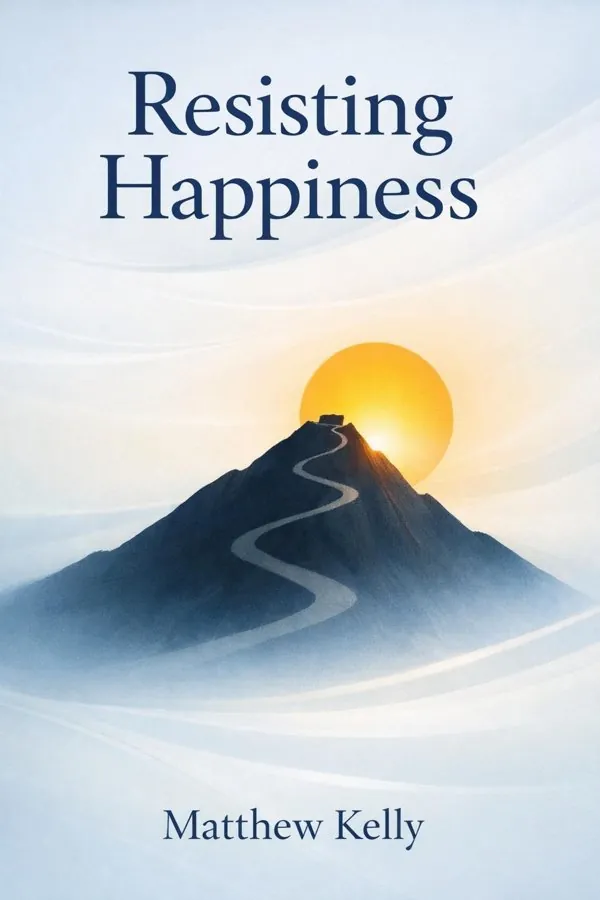
Resisting Happiness: Summary & Key Insights
 10 min9 chaptersAudio available
Key Takeaways from Resisting Happiness
The greatest obstacles to a happy life are often not dramatic failures, but tiny acts of avoidance repeated every day.
What feels easiest in the moment can become expensive over time.
People do not resist happiness only because they are weak; often they resist because they are disconnected from purpose.
Real freedom is not doing whatever feels good in the moment; it is having the strength to choose what is good, even when it is difficult.
A grateful person sees possibilities that a resentful person cannot.
What Is Resisting Happiness About?
Resisting Happiness by Matthew Kelly is a positive_psych book spanning 11 pages. Resisting Happiness by Matthew Kelly is a practical, spiritually grounded guide to understanding why people so often sabotage the very lives they say they want. Rather than treating unhappiness as a mystery or a matter of bad luck, Kelly argues that a hidden force operates inside everyday life: resistance. It appears in small moments of avoidance, procrastination, distraction, fear, and self-protection, quietly pulling people away from what is good for them. The book explores how this resistance affects relationships, purpose, faith, health, and inner peace, and how greater awareness can help break its hold. What makes the book compelling is its simplicity. Kelly does not rely on abstract theory alone; he uses personal stories, spiritual reflection, and direct questions that encourage readers to examine their habits honestly. His background as a bestselling author, speaker, and influential voice in personal development and Catholic spirituality gives the book both motivational energy and moral seriousness. Resisting Happiness matters because it reframes happiness not as a mood to chase, but as the result of choosing what is true, disciplined, generous, and aligned with one’s deepest purpose.
This FizzRead summary covers all 9 key chapters of Resisting Happiness in approximately 10 minutes, distilling the most important ideas, arguments, and takeaways from Matthew Kelly's work. Also available as an audio summary and Key Quotes Podcast.
Resisting Happiness
Resisting Happiness by Matthew Kelly is a practical, spiritually grounded guide to understanding why people so often sabotage the very lives they say they want. Rather than treating unhappiness as a mystery or a matter of bad luck, Kelly argues that a hidden force operates inside everyday life: resistance. It appears in small moments of avoidance, procrastination, distraction, fear, and self-protection, quietly pulling people away from what is good for them. The book explores how this resistance affects relationships, purpose, faith, health, and inner peace, and how greater awareness can help break its hold.
What makes the book compelling is its simplicity. Kelly does not rely on abstract theory alone; he uses personal stories, spiritual reflection, and direct questions that encourage readers to examine their habits honestly. His background as a bestselling author, speaker, and influential voice in personal development and Catholic spirituality gives the book both motivational energy and moral seriousness. Resisting Happiness matters because it reframes happiness not as a mood to chase, but as the result of choosing what is true, disciplined, generous, and aligned with one’s deepest purpose.
Who Should Read Resisting Happiness?
This book is perfect for anyone interested in positive_psych and looking to gain actionable insights in a short read. Whether you're a student, professional, or lifelong learner, the key ideas from Resisting Happiness by Matthew Kelly will help you think differently.
- ✓Readers who enjoy positive_psych and want practical takeaways
- ✓Professionals looking to apply new ideas to their work and life
- ✓Anyone who wants the core insights of Resisting Happiness in just 10 minutes
Want the full summary?
Get instant access to this book summary and 100K+ more with Fizz Moment.
Get Free SummaryAvailable on App Store • Free to download
Key Chapters
The greatest obstacles to a happy life are often not dramatic failures, but tiny acts of avoidance repeated every day. Kelly’s central insight is that resistance rarely announces itself as self-destruction. More often, it sounds reasonable. It is the inner voice that says sleep a little longer, postpone the difficult conversation, skip prayer today, delay exercise until next week, or numb discomfort with entertainment. Because these decisions seem small, they feel harmless. But over time, they shape a life.
Resistance matters because it keeps people from becoming the best version of themselves. It interrupts growth not by attacking openly, but by gently steering attention toward ease, comfort, and distraction. A person may sincerely want a better marriage, stronger faith, healthier body, or more meaningful work, yet still keep choosing the habits that undermine those desires. That mismatch creates confusion: people think they lack discipline or ability, when often they simply have not learned to recognize resistance.
In daily life, this idea is highly practical. Resistance appears when you hesitate to apologize, avoid starting an important project, ignore a budget, or leave meaningful books unread while scrolling aimlessly. The key is to notice the pattern. Ask: What good thing do I keep delaying? Where do I repeatedly choose what is easy over what is life-giving?
Actionable takeaway: Spend one week identifying your three most common forms of resistance and write them down the moment they appear. Awareness is the first step toward freedom.
What feels easiest in the moment can become expensive over time. Kelly shows that resistance is deceptive because its cost is usually delayed. Choosing comfort over courage rarely brings immediate disaster. Instead, the damage accumulates quietly: a neglected friendship becomes distance, a postponed health habit becomes fatigue, a delayed spiritual practice becomes emptiness, and an ignored calling becomes regret.
This is why resistance is so dangerous. If every poor decision produced instant pain, most people would change quickly. But life usually works differently. The consequences of avoidance unfold slowly, hidden inside routines. That makes short-term relief feel harmless even when it undermines long-term happiness. Kelly’s argument pushes readers to think beyond immediate emotion. Happiness is not simply about feeling good now; it is about building a life that remains good over time.
Consider ordinary examples. Saying yes to every unnecessary purchase may bring a moment of pleasure, but later creates financial stress. Avoiding a hard but honest conversation may preserve peace for a day, yet damage trust for months. Skipping reflection and prayer may save a few minutes in the morning, but leave the rest of the day scattered and reactive. The point is not guilt. It is clarity. Every choice moves us toward deeper freedom or deeper fragmentation.
Actionable takeaway: Before making a decision, ask one simple question: “Will this choice make my life better tomorrow, next month, and next year?” Let long-term peace outrank short-term comfort.
People do not resist happiness only because they are weak; often they resist because they are disconnected from purpose. Kelly suggests that when life feels vague, resistance becomes stronger. Without a clear sense of who you are, what matters, and what you are called to contribute, it is easy to drift into distraction. Purpose gives structure to desire. It turns abstract hopes into a direction worth following.
The book encourages readers to see happiness as the byproduct of living in alignment with meaning. This is an important shift. Many people search directly for happiness through pleasure, approval, achievement, or consumption. Kelly argues that these pursuits cannot satisfy for long when they are detached from purpose. A meaningful life requires listening deeply, noticing where your gifts meet the needs around you, and accepting that your life is meant to serve something larger than comfort.
Purpose does not always arrive as a grand revelation. Sometimes it emerges through faithful attention to daily responsibilities: being a present parent, doing honest work, helping the lonely, mentoring a younger colleague, or returning to a neglected spiritual life. The more a person lives intentionally, the less power resistance has. A clear “why” strengthens the ability to endure inconvenience, uncertainty, and effort.
Actionable takeaway: Write a personal purpose sentence in one paragraph. Include who you want to become, how you want to serve others, and what values you refuse to compromise. Revisit it every morning for a month.
Real freedom is not doing whatever feels good in the moment; it is having the strength to choose what is good, even when it is difficult. Kelly connects this idea to both faith and discipline. In his view, spiritual life is not an escape from daily struggle but a source of strength that helps people resist chaos, temptation, and passivity. Discipline then becomes the practical expression of that inner alignment.
This matters because many people think of discipline as restrictive. Kelly reframes it as liberating. The disciplined person is less controlled by moods, impulses, and outside pressures. Regular habits of prayer, reflection, exercise, generosity, and honest work build the kind of character that can withstand resistance. Faith adds depth to this process by reminding the reader that personal transformation is not accomplished through willpower alone. Grace, trust, and openness to God help sustain change when motivation fades.
A simple routine illustrates the point. Starting the day with silence, prayer, and a written intention can shape every decision that follows. Choosing one disciplined practice, such as reading for ten minutes instead of checking your phone, strengthens your capacity to choose the better path again later. Discipline is cumulative. Small acts of fidelity become a stronger self.
Actionable takeaway: Choose one spiritual practice and one behavioral habit to keep for the next 30 days, such as five minutes of morning prayer and a nightly review of the day. Protect them as non-negotiable anchors.
A grateful person sees possibilities that a resentful person cannot. Kelly treats gratitude not as a sentimental mood, but as a disciplined way of seeing reality. Resistance often thrives in environments of complaint, comparison, entitlement, and scarcity. When people focus on what is missing, they become more vulnerable to discouragement and self-pity. Gratitude interrupts that spiral by reorienting attention toward what is already good, already present, and already worth honoring.
This shift has profound effects. Gratitude calms anxiety because it returns the mind to what is real instead of what is feared. It softens envy because it makes room for appreciation rather than competition. It also deepens faith by helping people recognize that life is filled with gifts, not just demands. In this sense, gratitude becomes a practical weapon against resistance. It weakens the inner voice that says, “Nothing is enough,” and strengthens the ability to act generously and courageously.
In everyday life, gratitude can be practiced in simple ways: thanking a spouse for routine acts often taken for granted, noting three blessings before bed, appreciating your body for what it allows you to do rather than criticizing its imperfections, or remembering the mentors and friends who shaped your life. These small acts rebuild perspective.
Actionable takeaway: Keep a gratitude list for 14 days. Each day write five specific things you are grateful for, including at least one challenge that is helping you grow. Specific gratitude changes perception more deeply than vague positivity.
A life is built one decision at a time. Kelly emphasizes that happiness does not emerge from vague intentions but from concrete commitments. People often overestimate the value of wishing and underestimate the power of deciding. The difference is crucial. Wishes are emotional; decisions are directional. When a person truly decides, behavior begins to organize around that choice.
Resistance loves ambiguity. It thrives when commitments remain soft, optional, or endlessly revisable. A person who says, “I should get healthier,” remains vulnerable to delay. A person who says, “I walk every morning at 7 a.m.,” has moved from desire to structure. The same applies to marriage, finances, faith, work, and personal growth. Kelly invites readers to stop negotiating endlessly with themselves and start making clear commitments that reduce hesitation.
This idea also affects identity. Repeated decisions tell you who you are becoming. If you consistently choose honesty, attentiveness, generosity, and discipline, you become that kind of person. If you repeatedly choose avoidance, indulgence, and distraction, those choices also shape identity. In that sense, every decision is both practical and moral.
Useful applications include scheduling what matters, setting limits in advance, and reducing decision fatigue. If you know evenings are vulnerable to distraction, plan them before they arrive. If generosity matters to you, automate giving. If your spiritual life matters, assign it a specific time and place.
Actionable takeaway: Identify one area where indecision is draining your energy. Make a clear, measurable commitment today, put it on your calendar, and tell one trusted person so the decision becomes real.
Happiness shrinks when life revolves around the self. Kelly insists that human beings are not designed to thrive in isolation or self-absorption. One of the most effective ways to resist resistance is to move outward through community and service. When people become excessively focused on their own feelings, fears, and disappointments, their world narrows. Service expands it. It reconnects personal struggle to shared humanity.
Community matters because growth is difficult alone. Encouragement, accountability, example, and belonging all help people sustain change. A supportive friend can ask the hard question, remind you of your values, or help you keep a promise when your enthusiasm fades. Service matters because it redirects energy away from endless self-concern. Helping another person often restores meaning faster than trying to engineer a better mood.
These ideas are deeply practical. Join a small group centered on reflection, faith, or personal growth. Volunteer somewhere that puts you in direct contact with human need. Look for daily acts of service within ordinary life: listening fully to a coworker, cooking for a tired family member, mentoring someone younger, checking in on a lonely neighbor. None of these actions erase struggle, but they place it within a more generous frame.
Kelly’s broader point is that happiness is relational. It grows when people give, connect, and contribute. Isolation feeds resistance; service weakens it.
Actionable takeaway: Commit to one weekly act of organized service and one intentional act of personal generosity. Put both on your schedule so service becomes part of your life, not just a passing intention.
Many people think they are being realistic when they are actually being ruled by fear. Kelly highlights how resistance often disguises itself as caution, perfectionism, or prudence. Fear says, “Wait until you are fully ready.” It says, “Do not risk embarrassment.” It says, “Stay where things are familiar.” Left unchallenged, fear becomes a quiet architect of smallness.
The problem is not that fear exists. Fear is natural. The problem is allowing fear to make decisions. A fulfilling life always requires vulnerability: speaking honestly, changing direction, forgiving someone, beginning again, trusting God, pursuing meaningful work, or letting go of a false identity. Resistance amplifies fear by convincing people that discomfort is danger. Kelly calls readers to distinguish between the two. Growth often feels uncomfortable, but discomfort is frequently the sign that transformation is underway.
In practical terms, overcoming fear does not require heroic gestures. It often begins with modest acts of courage. Send the email. Make the appointment. Admit the mistake. Start the project before you feel ready. Return to the spiritual practice you abandoned. Courage grows through repetition, just as avoidance does.
Kelly’s message is hopeful: fear loses authority when faced directly and consistently. You do not need to eliminate fear to move forward; you need to stop treating it as a trustworthy guide.
Actionable takeaway: Name one decision you have delayed because of fear. Take the smallest concrete step toward it within 24 hours. Momentum weakens fear more effectively than endless analysis.
A genuine life is not created by occasional inspiration, but by daily habits rooted in truth and trust. Kelly brings together several themes here: authenticity, routines, and surrender. To live authentically is to stop performing for approval and start aligning behavior with convictions. But authenticity is not merely self-expression. It also requires discipline. The person who wants to live truthfully must build habits that support that desire.
Daily habits matter because they convert values into experience. If reflection matters, create silence. If your relationships matter, offer attention. If health matters, move your body. If faith matters, pray. If integrity matters, tell the truth quickly. Resistance is strongest in unstructured spaces, where mood and impulse dominate. Healthy routines reduce the power of internal chaos and help the best self show up consistently.
At the same time, Kelly stresses surrender and trust. Not everything can be controlled, fixed, or predicted. Some forms of resistance arise from the illusion that total control will keep us safe. Trust loosens that illusion. It allows a person to act faithfully without demanding certainty about outcomes. That is especially important in spiritual life, where growth often involves patience, humility, and dependence on grace.
Taken together, these ideas form a mature vision of happiness: know who you are, practice what matters, and trust beyond what you can control.
Actionable takeaway: Build a simple “happy life” routine with three daily practices—one for your mind, one for your relationships, and one for your spirit—and keep them consistently for two weeks while releasing the need for perfect results.
All Chapters in Resisting Happiness
About the Author
Matthew Kelly is an Australian-born motivational speaker, author, and business consultant known for his work in personal development and Catholic spirituality. Over the course of his career, he has written numerous bestselling books focused on purpose, habits, decision-making, and becoming “the best version of yourself,” a phrase central to his message. Kelly’s writing combines accessible self-help principles with spiritual reflection, making his work popular among readers seeking both practical guidance and deeper meaning. In addition to his books, he has spoken widely to audiences around the world on leadership, faith, and personal transformation. His influence comes from his ability to frame everyday struggles — distraction, fear, inconsistency, and lack of purpose — in a way that feels immediate, honest, and actionable.
Get This Summary in Your Preferred Format
Read or listen to the Resisting Happiness summary by Matthew Kelly anytime, anywhere. FizzRead offers multiple formats so you can learn on your terms — all free.
Available formats: App · Audio · PDF · EPUB — All included free with FizzRead
Download Resisting Happiness PDF and EPUB Summary
Key Quotes from Resisting Happiness
“The greatest obstacles to a happy life are often not dramatic failures, but tiny acts of avoidance repeated every day.”
“What feels easiest in the moment can become expensive over time.”
“People do not resist happiness only because they are weak; often they resist because they are disconnected from purpose.”
“Real freedom is not doing whatever feels good in the moment; it is having the strength to choose what is good, even when it is difficult.”
“A grateful person sees possibilities that a resentful person cannot.”
Frequently Asked Questions about Resisting Happiness
Resisting Happiness by Matthew Kelly is a positive_psych book that explores key ideas across 9 chapters. Resisting Happiness by Matthew Kelly is a practical, spiritually grounded guide to understanding why people so often sabotage the very lives they say they want. Rather than treating unhappiness as a mystery or a matter of bad luck, Kelly argues that a hidden force operates inside everyday life: resistance. It appears in small moments of avoidance, procrastination, distraction, fear, and self-protection, quietly pulling people away from what is good for them. The book explores how this resistance affects relationships, purpose, faith, health, and inner peace, and how greater awareness can help break its hold. What makes the book compelling is its simplicity. Kelly does not rely on abstract theory alone; he uses personal stories, spiritual reflection, and direct questions that encourage readers to examine their habits honestly. His background as a bestselling author, speaker, and influential voice in personal development and Catholic spirituality gives the book both motivational energy and moral seriousness. Resisting Happiness matters because it reframes happiness not as a mood to chase, but as the result of choosing what is true, disciplined, generous, and aligned with one’s deepest purpose.
You Might Also Like
Don't Sweat the Small Stuff... and It's All Small Stuff
Richard Carlson
10 min
Option B
Sheryl Sandberg & Adam Grant
10 min
Hallelujah Anyway: Rediscovering Mercy
Anne Lamott
10 min
I Can Do It: How to Use Affirmations to Change Your Life
Louise Hay
10 min
The Coffee Bean: A Simple Lesson to Create Positive Change
Jon Gordon, Damon West
10 min
The Happiness Hypothesis: Finding Modern Truth in Ancient Wisdom
Jonathan Haidt
10 minBrowse by Category
Ready to read Resisting Happiness?
Get the full summary and 100K+ more books with Fizz Moment.